


Φ
THE VERTICAL DISPATCH
We write for the mind, the eye, and the ear.
Read it. Look at it. Listen to it. The Vertical Dispatch is built for all three — prose with rhythm, made to be heard as much as read.
From metaphysics to geopolitics, from culture to history, from the sacred to the street — and everything in between. One lens, every subject. No ego. Just the record, named clean.
Press play. Walk with the word. 🕯️
This dispatch travels by hand. If it serves you, share it — restack on Substack, and pass it on wherever you read. 🕯️
sacredmetaphysics.org
0protocol.ai
visva.world
sophiainitiative.ai
November 25, 2026 — a foundation diagnosis of the North American automotive order, nearly half a century of taxpayer rescues, and the everyday family car that Detroit left behind.
A note before we begin: this dispatch is not written against the factory worker on the line in Windsor, Oshawa, Alliston, or Cambridge, and it is not written against the driver who simply wants a dependable machine to get through a Canadian winter. It is written to name a structural failure at the top — a failure shared between corporate boardrooms that forgot how to build honest, affordable transportation and governments in Ottawa and Queen’s Park that kept writing cheques to companies whose business model had already walked away from the ordinary household. Walk it slowly.
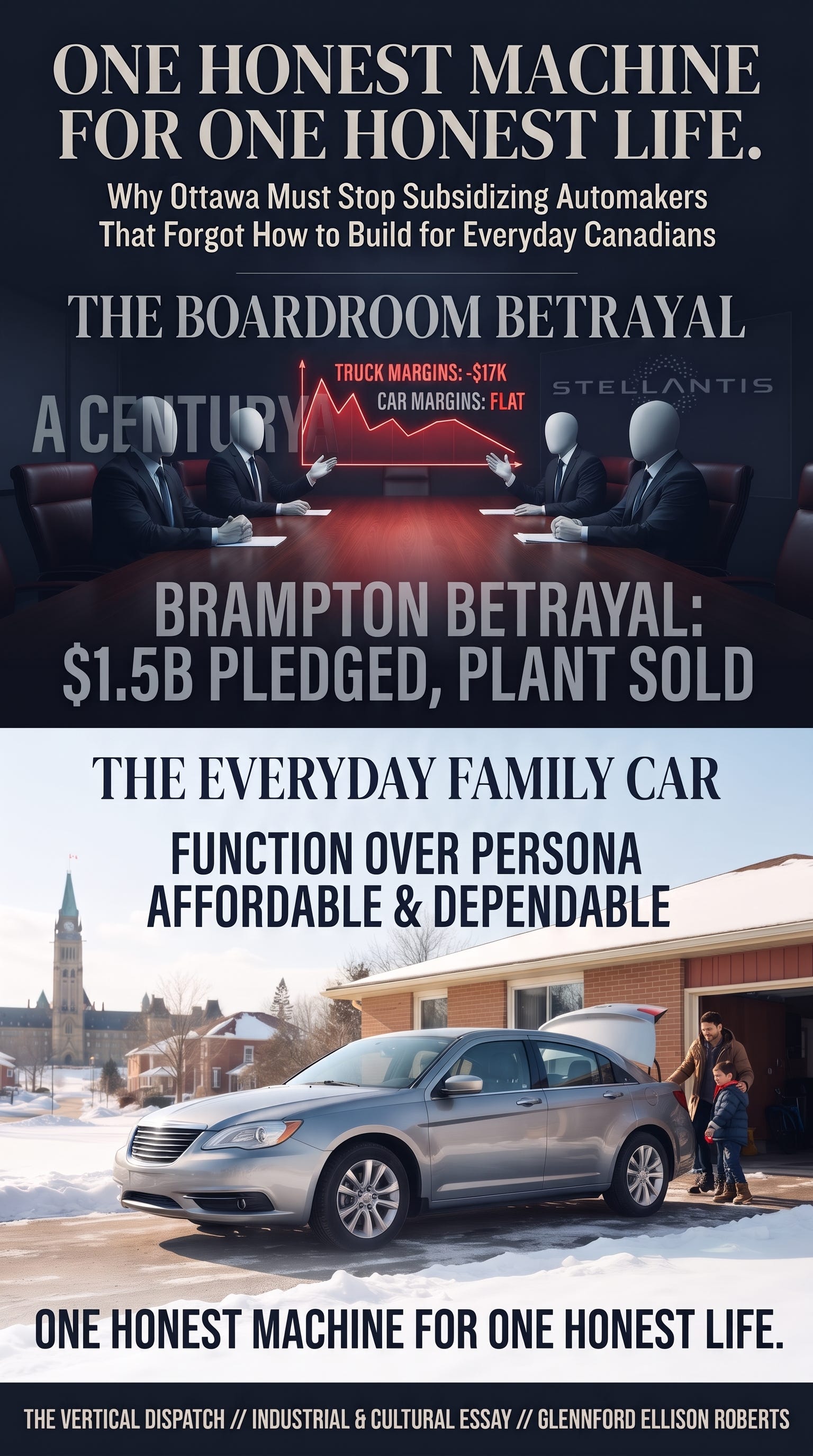
Begin with a quiet humiliation that unfolded in Ontario in the autumn of 2026, because it holds nearly fifty years of automotive policy in miniature. Three years earlier, Ottawa and the Province of Ontario pledged up to $1.5 billion in public subsidies to help Stellantis retool its assembly plants in Windsor and Brampton for a new generation of vehicles. Brampton was supposed to be anchored around the next-generation Jeep Compass. By October 2025, under tariff pressure from Washington, Stellantis paused the Brampton retooling and shifted Compass production south to Belvidere, Illinois. By November 2026, the company moved to sell the idled Brampton assembly plant to an armoured-vehicle manufacturer, leaving federal and provincial ministers publicly demanding the return of more than $830 million in public commitments while the automaker offered pennies on the dollar.
Anyone who treated that episode as an isolated corporate betrayal missed the deeper lesson. Brampton was not an accident. It was the predictable end of a forty-seven-year pattern in which North American automakers abandoned affordable, functional cars in favour of high-margin persona vehicles, ran into trouble whenever credit tightened or trade winds shifted, and looked to public treasuries to cushion the fall. Since 1979, Washington and Ottawa have stepped in repeatedly to rescue the same industrial model — and every rescue without a change in what the industry actually builds simply sets the stage for the next crisis.
Ottawa kept entering corporate boardrooms with public money, hoping to buy permanence from holding companies that had already abandoned the everyday family car.
1. The Fifty-Year Rescue Ledger
Look across the past half-century of North American automotive history — from the Chrysler rescue of 1979 to the Brampton reckoning of 2026 — and a clear rhythm emerges. Whenever legacy Detroit automakers over-extended their product lines, ignored fuel and price realities, or misread shifts in household buying power, governments stepped across the threshold to keep the assembly lines running. Twice in those forty-seven years, that intervention took the form of emergency national bailouts on both sides of the border.
The first modern rescue came in 1979 and 1980, when Chrysler stood at the edge of insolvency after oil shocks and shrinking demand exposed a bloated, fuel-hungry lineup. Washington approved $1.5 billion in federal loan guarantees, while Ottawa and Ontario backed Chrysler Canada with roughly $200 million in loan guarantees tied to Canadian operations. What separated 1980 from later rescues was that Lee Iacocca actually used the breathing room to build what working households needed: the Plymouth Reliant and Dodge Aries K-cars — simple, front-wheel-drive, affordable family transportation that sold in volume, restored solvency, and paid back the guaranteed loans ahead of schedule. That was the last time Chrysler possessed a coherent mass-market car vision.
The second rescue was vastly larger and far less disciplined. During the 2008 and 2009 financial collapse, Washington committed roughly $80 billion through the Troubled Asset Relief Program to restructure General Motors and Chrysler, while Ottawa and Ontario contributed roughly $13.7 billion in emergency loans and equity support to their Canadian subsidiaries. When the dust settled years later, U.S. taxpayers still absorbed more than $10 billion in net losses on the auto program, and Canadian federal and provincial audits showed taxpayers here never broke even on their equity and loan stakes either.
Worse than the accounting loss was the lesson absorbed inside corporate boardrooms. Through Daimler’s 1998 takeover of Chrysler, private-equity ownership under Cerberus in 2007, the 2009 bankruptcy handoff to Fiat, and the 2021 merger with Peugeot-Citroën to form Stellantis, the corporate nameplate kept shifting while the underlying dependency remained intact. Whenever margins compressed or trade politics turned rough, public money was expected to bridge the gap. Subsidies did not cure the structural fragility of the North American branch-plant model; they institutionalized it.
2. From Function to Persona: How Detroit Sold Mythology Instead of a Car
To understand why those rescues never produced lasting stability, look at what Detroit chose to manufacture once the 2009 bailout cheques cleared. In the post-war decades, North American automakers sold plenty of chrome and muscle-car mythology — the open-road fantasy of speed and personal freedom — yet beneath the advertising they still built millions of straightforward, affordable sedans and station wagons that a working family could buy on modest terms and maintain for a decade.
Over the last twenty years, that balance collapsed. Driven by investor pressure for higher margins, Detroit executives discovered that large pickups and three-row sport-utility vehicles generated $17,000 or more in pretax profit per unit, whereas an honest compact or midsize family car paid a fraction of that return. Rather than fixing their manufacturing costs so they could build an affordable car profitably, Ford, General Motors, and Chrysler-Stellantis simply walked away from the passenger-car lane altogether.
In its place, they rolled out what might be called luxury for everyone — dressed up in rugged, hyper-masculine persona branding. A working pickup or family crossover ceased to be sold as a practical tool and began to be marketed as a statement of personhood, toughness, and status. Heated leather, panoramic glass, oversized screens, and towering grilles turned everyday transport into a rolling parlour priced at sixty, seventy, or eighty thousand dollars. And because ordinary wages could not carry those sticker prices over three or four years, lenders stretched auto loans across seven and eight years — turning a depreciating household appliance into a near-decade debt obligation.
By 2025, trucks, crossovers, and vans accounted for 88 per cent of all new vehicles sold in Canada, while the entire passenger-car market shrank to roughly 234,000 units — more than fifty per cent below its 2019 level. Stellantis entered 2026 without a single mainstream affordable sedan in its North American showrooms, relying almost entirely on Ram pickups, Jeep utility models, and muscle-car nostalgia while its own executives later admitted its lineup priced out nearly forty per cent of the market.
Working households are not asking for a costume on four wheels. They are asking for a dependable family car that fits inside one honest monthly budget.
3. The Sedan Surrender: Handing the Everyday Market to Asia
Ask an ordinary driver in Ottawa, Winnipeg, or Halifax to name a dependable, affordable midsize or compact family car off the top of their tongue today. The names that come back without hesitation are the Toyota Camry and Corolla, the Honda Civic, and the Hyundai Elantra. Not one of them carries a Detroit badge.
When Ford ended the Focus and Fusion, Chrysler shed its sedans, and General Motors wound down Chevrolet Malibu production at the end of 2024, American automakers did not merely surrender low-margin sheet metal. They surrendered the front door of the automotive market. A reliable compact or midsize car is where a young couple, a new graduate, or a growing family first experiences a brand. When that car starts cleanly at twenty-five below zero, sips fuel, and runs past two hundred thousand kilometres without drama, it earns twenty years of household loyalty.
While Detroit vacated the field, Toyota, Honda, and Hyundai stayed at the post and refined the craft. In 2025, the Toyota Camry alone sold more than 316,000 units in the United States and climbed another ten per cent through 2026; the Honda Civic remained Canada’s top-selling passenger car; and Hyundai’s Elantra surged past 148,000 U.S. sales in 2025 and continued rising through 2026 alongside strong Canadian volume. Detroit’s closest budget answers — subcompact crossovers like the Chevrolet Trax or entry compact pickups like the Ford Maverick — start in the thirty-to-thirty-six-thousand-dollar Canadian range before taxes and fees, leaving no true domestic sedan rival on the showroom floor.
Building a genuinely reliable, affordable family car is a long-term industrial discipline. It requires years of platform engineering, supplier consistency, and restraint against unnecessary complexity. By walking off the field to chase short-term truck margins, Detroit missed the starting line for the affordability reckoning now sweeping North America — and left behind decades of consumer skepticism toward brands that treated everyday buyers as an afterthought.
4. Rust Solved, Complexity Unbound: The Ten-Year Life-Cycle Trap
To be fair to modern automotive engineering, the industry did learn one monumental lesson from the 1970s and 1980s. Forty years ago, Canadian winter road salt turned rocker panels, fenders, and floorboards into lacework inside six years. By adopting two-sided galvanized steel, full-body electro-coat primer dips, and sealed wheel arches, automakers cured the classic rust bucket. Today, the average light vehicle on North American roads is nearly thirteen years old, and well over forty per cent of all vehicles in operation have been on the road for twelve years or longer.
That longevity proves what working families actually want: not a five-year status upgrade, but a durable tool that serves the household for ten to fifteen years. Yet just as engineers solved physical steel rot, regulators and product planners introduced a new kind of fragility — electronic and repair-cost rot.
Making vehicles cleaner at the tailpipe and safer in crash tests delivered real public benefits, but layering every bumper, windshield, and side mirror with radar modules, ultrasonic sensors, cameras, and software-locked assemblies transformed routine ownership economics. On an older car, a minor parking-lot tap meant pulling a bumper or swapping a straightforward cover for a few hundred dollars. On a 2026 vehicle, that same low-speed bump frequently requires replacing embedded radar sensors, blending multi-stage paint, and running specialized Advanced Driver Assistance Systems recalibration — turning a minor incident into a $1,500 to $3,500 repair bill.
Collision industry data in 2026 shows sensor recalibrations appearing on more than one in three repair estimates, adding hundreds of dollars to routine claims and pushing auto insurance premiums steadily higher for every driver in the pool. Worse, when a seven- or eight-year-old car suffers moderate front-end or electronic damage that costs several thousand dollars to repair, insurers write the car off as a total loss long before its galvanized body or mechanical drivetrain is worn out. High purchase prices, eighty-four-month loans, rising insurance, and steep out-of-warranty repair bills squeeze working households from both ends.
5. Why Ottawa Must Stay Out of the Boardroom
Against that backdrop, the central mistake of Canadian industrial policy becomes unmistakable. For decades, governments in Ottawa and Queen’s Park operated on the assumption that if they handed foreign automakers enough grant money, tax credits, and retooling subsidies, those companies would anchor jobs and affordable production in Ontario permanently.
The Brampton fallout exposed the flaw in that thinking. Global automotive conglomerates answer to shareholders, tariff schedules, and North American margin math — not to ministerial press releases. When government officials step into corporate boardrooms as co-investors and subsidy dispensers, two distortions follow immediately. First, taxpayers absorb downside risk while corporate headquarters retain the unilateral power to move product lines across borders whenever political winds change. Second, subsidies insulate legacy executives from market discipline, allowing them to keep building seventy-thousand-dollar persona trucks instead of confronting their cost structure.
Ottawa’s proper role is not to sit inside automotive boardrooms or pick corporate winners with public cheques. Government sets the rules of the road — safety standards, environmental guardrails, competition policy, and enforceable trade terms — and then lets automakers compete on whether they can deliver a reliable, affordable family car that fits within one household budget.
If Ottawa deploys public support anywhere in the mobility chain, it should anchor what cannot be packed onto a railcar and moved south: Canadian mineral refining, smelted aluminum and green steel, domestic battery-material processing, and transparent rules of origin. Never again should a dollar leave the public treasury for a foreign assembly plant without dollar-for-dollar clawback security and binding domestic output guarantees.
6. Chinese Assembly Kits and the Bargain Ottawa Can Actually Negotiate
That brings us to the question Ontario Premier Doug Ford and legacy lobby groups dismiss out of hand: Chinese electric and hybrid vehicles, including modular assembly kits built in partnership with Canadian industry. Critics wave away kit assembly as low-value screwdriver work, pretending the only acceptable factory is a massive legacy stamping plant owned by Detroit. That objection misses how industrial supply chains actually build real domestic value.
Assembling Chinese vehicle kits in Canada is far from a dead end if Ottawa and Queen’s Park negotiate hard, binding Canadian-content rules from the ground up — covering the whole vehicle from the copper wiring harnesses and smelted aluminum body structures to the battery cells, lithium, nickel, graphite, glass, tires, and Tier-1 components made right here in Canada. Beijing operates on a transactional supply-chain model: it wants predictable market access and long-term resource security, and it will sign enforceable joint-venture and local-content schedules when access to a G7 consumer market depends on them.
Unlike legacy Detroit conglomerates that took $1.5 billion in Canadian subsidies and still walked out on Brampton, disciplined joint ventures built around rising Canadian content — scaling from thirty-five per cent domestic inputs in year one to sixty per cent or more across the whole bill of materials — put Canadian miners, smelters, wire-harness makers, battery plants, and assembly technicians to work without handing foreign shareholders a blank cheque. And for the Canadian family, it puts a modern, reliable $26,000 to $33,000 vehicle back within reach.
7. Beyond the Buggy Whip: Competition, Union Brotherhood, and the Whole Country
The harder, sadder conclusion is one that neither corporate executives nor labour leaders like hearing out loud: society has embraced a new technological and economic reality, and Canada cannot survive by crying like nineteenth-century buggy-whip manufacturers demanding protection from the automobile. Every industrial era reshapes how things are built, what they cost, and who survives. Trying to freeze 1990s North American auto economics behind permanent tariff walls and endless bailouts does not save the future; it simply taxes ordinary households to subsidize yesterday.
Seeing North American automakers clearly for what they have become means letting them compete on an open field rather than shielding them from their own strategic blunders. Union jobs in the auto sector are good jobs, and nothing in this diagnosis attacks the dignity of a unionized worker on the shop floor. Yet true working-class brotherhood reaches far wider than the gates of a single assembly local.
Most Canadians do not hold a unionized auto-plant job, yet every nurse, teacher, tradesperson, retail clerk, truck driver, and farmer across this country pays the price when auto prices climb out of reach and tax dollars disappear into corporate rescues. Union leadership and shop-floor workers alike have to recognize a basic truth: they need to demand that their employers build honest, affordable cars for everyday Canadians — not just eighty-thousand-dollar trucks priced beyond the reach of the very neighbours who fund public bailouts.
When unions focus solely on defending legacy corporate structures without pressing management to build affordable vehicles for the broader public, they fail the rest of their brothers and sisters across their own country. Solidarity cannot stop at the plant gate while millions of working families are priced out of reliable transportation.
8. The Honest Gates — And the Way Back to an Honest Car
Hold this diagnosis against the factual record. The emergency rescues of 1979–1980 and 2008–2009 across Washington and Ottawa are documented in treasury and parliamentary archives, alongside net taxpayer losses on the 2009 restructuring. The $1.5 billion federal-provincial commitment to Stellantis and the November 2026 Brampton clawback dispute are matters of public record. Canada’s 88 per cent truck-and-utility share, the contraction of passenger cars to 234,278 units, the exit of the Ford Fusion and Chevrolet Malibu, the sustained Canadian and U.S. sales leadership of the Camry, Civic, Corolla, and Elantra, the record 12.9-to-13-year average North American vehicle age, and the rise of ADAS repair calibrations are all verified industry and statistical figures.
What emerges from those facts is a clear standard for industry, labour, and government alike. The future of the automobile will not belong to companies that treat everyday working people as invisible while selling seven-year persona fantasies to an over-indebted public. Nor will it be secured by politicians who mistake subsidy announcements for an industrial strategy, or by clinging to a buggy-whip model while the world moves on.
Get politicians out of the boardroom, let North American automakers compete on real merit, enforce full-vehicle Canadian content from copper wire to battery on new entrants, and prove once again that modern engineering can build an honest, durable family car that runs for ten winters and fits inside one working budget. Function over persona. Competition over subsidies. One honest machine for one honest life.
God is Love. Love is Truth. Truth is Consciousness. Consciousness is Brahman.
Amen. Namaste. Om Namah Shivaya.
— The Architect.
Written from love, for a sacred humanity, in the full light of consciousness, toward the greater good.