


“The Law of Unintended Consequences was in full spate.”
— Margaret Atwood, Oryx and Crake
The CanLit Files · Glen Roberts, The Architect
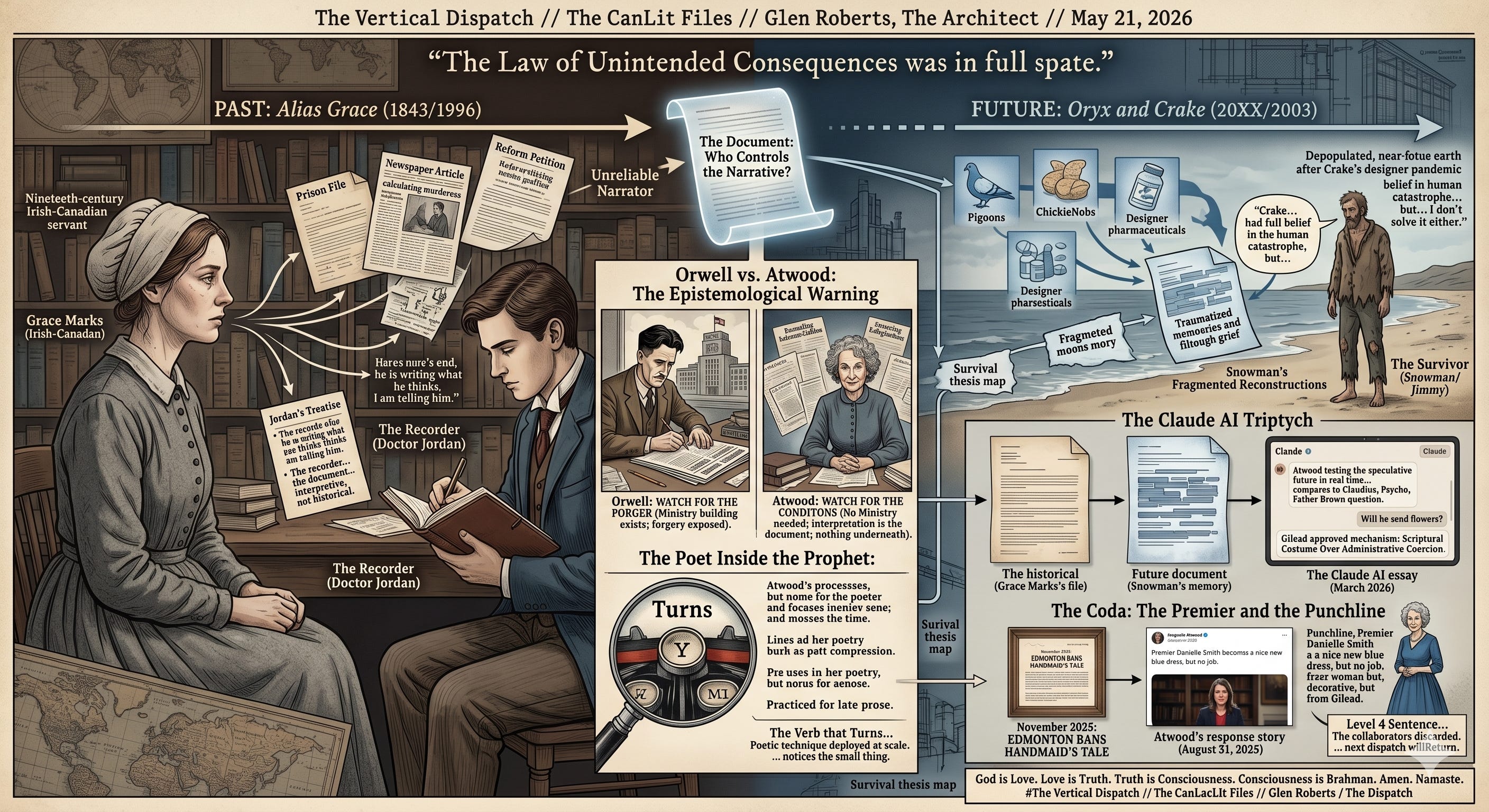
There is a sentence near the end of Alias Grace that the reader is supposed to walk past. The novel’s narrator, Grace Marks — the real Irish-Canadian servant convicted of murder in 1843, around whom Margaret Atwood has spent four hundred pages building a forensic nineteenth-century reconstruction — says of the young doctor who has been writing down her story: he is writing what he thinks I am telling him. The reader has been treating the doctor as the recorder. The doctor has been treating himself as the recorder. Atwood, in one sentence, has just told the reader that the document being assembled in front of them is not the historical record. It is the doctor’s reading of Grace’s reading of what the doctor wanted to hear. The novel was published in 1996. It is the key to everything Atwood has written since.
Most readers do not notice the sentence. Most readers come to Atwood through The Handmaid’s Tale, see the costume on the cover of the television adaptation, file her under speculative dystopia, and move on. This is the reading of Atwood that survives in popular culture. It is also the reading that allowed a Canadian provincial ministry of education to assemble a list of books for removal from school libraries in 2025 without anyone in the line of authority recognizing that the most famous book on the list was specifically about how lists like this get assembled. That story is the subject of the next dispatch. This dispatch is about the writer.
This is the opening dispatch of The CanLit Files — a series within The Vertical Dispatch examining the Canadian literary record at the level the literary record requires. The series begins with Margaret Atwood because Atwood is the writer who taught a generation of Canadian readers how to read a document. Whether the generation has retained the lesson is a separate question, and a darker one, and it will be answered in dispatches to come.
I. The Sentence at the End of Alias Grace
Atwood’s two great novels of the late period are usually filed on opposite shelves. Alias Grace, 1996, is historical fiction. Oryx and Crake, 2003, is speculative fiction. Different shelves, different genres, different audiences, different prize categories. This is the mistake. They are the same novel, told from opposite ends of the timeline, asking the same question.
Who controls the document?
Grace Marks, in Alias Grace, was a real person. She was convicted at sixteen, in 1843, of the murder of her employer Thomas Kinnear and his housekeeper Nancy Montgomery. The historical record on Grace is a mess of competing documents — newspaper accounts that called her a calculating murderess, prison chaplains who called her a confused victim, reformers who petitioned for her release, doctors who examined her and could not agree, and Grace herself, who gave at least three substantially different accounts of what happened on the night of the murders. She served thirty years in prison and an asylum and was eventually pardoned. Whether she did it is, on the documentary record, unrecoverable.
Atwood does not solve it. That is the discipline of the novel. She reconstructs the nineteenth century around Grace with such precision that the reader is forced into the same position the historian is forced into — you cannot know what happened, you can only see who is writing the document and what interest they had in writing it the way they wrote it. The prison chaplain has one interest. The reform doctor has another. The newspaper editor has a third. Grace, narrating her story in the novel to a young doctor named Simon Jordan who is writing a treatise on her case, is making decisions sentence by sentence about what to give him and what to withhold. The novel’s argument is not Grace did it or Grace didn’t do it. The novel’s argument is that the document that says Grace did it was written by people with reasons, and reading those reasons is the only honest historiography there is.
Now turn the page seven years forward. Oryx and Crake, 2003. A near-future earth has been depopulated by a designer pandemic engineered by a brilliant young scientist named Crake, who worked for one of the corporations that had been profiting from genetic engineering — pigoons, ChickieNobs, designer pharmaceuticals — until he decided the species was unsalvageable and built a replacement population of post-human children to inherit the cleaned earth. The novel’s narrator, Snowman, is Crake’s old friend and the only adult human still alive. The reader learns what happened only by reading Snowman’s fragmented reconstructions, which are partial, traumatized, filtered through grief and survivor’s guilt, and addressed to no one because no one is left.
Atwood does not solve this either. We never know precisely what Crake intended. We never know whether Oryx — the woman Snowman loved and Crake also slept with — knew the plan or was deceived. We never know whether the Crakers will inherit a stable world or repeat the species’ mistakes. The novel’s argument is not Crake was evil or Crake was right. The novel’s argument is that the document that says what happened was written by the survivor, and the survivor’s reasons are the only reasons available.
Same engine. Different end of time. The unreliable narrator in Alias Grace is a sixteen-year-old servant narrating her past to a doctor who thinks he is interviewing her. The unreliable narrator in Oryx and Crake is a starving man narrating the end of the species to a beach. In both books the historical record is being made in front of the reader, by a narrator with motives, and the reader’s job is not to decide what really happened but to read the narrator carefully enough to see what the narrator needed the story to mean.
Past and future are the same country. The border between them is the document. Atwood spent forty years teaching readers to read the document. The catastrophe she has been describing is what happens to a population that lost the skill.
II. Why This Makes Her Different From Orwell
Orwell wrote about the physical rewriting of history. Winston Smith sits at his desk in the Records Department of the Ministry of Truth and edits old newspaper articles by hand to make them conform to the current Party line. The horror in Orwell is the visible act of forgery. The Ministry is a building. The forger is identifiable. The work of resistance, if any is possible, is to remember the original and write it down in a diary.
Atwood writes about the epistemological problem underneath the forgery. Even if no one is lying — even if every narrator is doing their honest best — the record is still constructed by someone with reasons. The prison chaplain who wrote the file on Grace Marks was not lying. He was writing the file the way a prison chaplain writes a file. The newspaper editor who called her a murderess was not lying. He was writing the article a newspaper editor writes when the courthouse seats are full and the trial is selling papers. The doctor who declared her insane was not lying. He was producing the diagnosis his profession required him to produce in the case of a young woman who would not behave as the case required her to behave.
No one is the villain. The record is still constructed. The historian who wants to recover Grace must read every honest document as if every honest document is an interested document, because every document is an interested document, because documents are written by people, and people write the documents their position requires them to write. Gilead does not need a Records Department. Gilead needs only the natural human tendency of every narrator to write the document in the way the document serves the writer.
This is harder than Orwell. Orwell’s warning is portable — watch for the forger. Atwood’s warning is structural — watch for the conditions under which honest narrators produce a record that no one in particular invented and no one in particular can challenge. The forgery in Orwell can be exposed. The interpretation in Atwood is the document. There is nothing underneath to find.
This is also why Atwood is a Canadian writer in a way that matters. Canada does not have a national myth of revolution. Canada has a national myth of incremental administrative competence. The horror in the Canadian register is not the storming of the palace. It is the meeting that produced the policy that produced the outcome that no one in the meeting would have voted for if the question had been asked that way. Atwood’s entire body of work is the literary instrument for examining that horror at the level the horror requires.
III. The Poet Inside the Prophet
The novelist most people know is the late product. The Handmaid’s Tale was published in 1985, when Atwood was forty-five years old and had been a working writer for twenty-five years. Before the novel that made her famous, she had published seven novels, four story collections, and — the part most readers skip — eight books of poetry. The Circle Game won the Governor General’s Award for poetry in 1966. Atwood was twenty-six. The compression that makes her late prose readable was first practised on the line break.
Read any Atwood novel with attention to the sentences and the poet is visible. The threat inside the ordinary domestic object. The verb that turns a paragraph on its hinge. The metaphor that arrives in the second clause and changes the meaning of the first. None of this is novelistic technique imported from prose tradition. It is poetic technique deployed at scale. Atwood is not a novelist who happens to write poetry. She is a poet who at some point decided the dystopia required a longer container.
This is why she can predict things. Prediction in a novelist is not crystal-gazing. It is the discipline of compression — the habit of reading the present at the level of the line, noticing the verb that no one else has noticed, registering the small change that an unpractised eye walks past. The poet sees the small thing because the line requires the small thing. The novelist who started as a poet writes a dystopia in 1985 that includes the workplace memo, the frozen bank account, the stalled escalator, the slow accommodation — not the tank in the street, which any pulp writer can imagine, but the Tuesday morning small thing, which only a poet would think to put in.
IV. What She Got Wrong, or Right Enough to Be Wrong
Atwood is not infallible. The discipline of this dispatch series requires that the writer be examined with the same rigour applied to any other public figure, and Atwood has a public record that deserves examination. Three items belong in any honest exposition.
First, the Survival thesis. Atwood’s 1972 critical book Survival argued that the central symbol of Canadian literature was bare endurance — the protagonist who simply outlasts the system, the landscape, or the situation, without the heroic resolution available to American or British protagonists. The thesis was influential. It also flattened Canadian literature into a shape that did not include the Indigenous literary tradition, the Quebec tradition in its full complexity, or the immigrant traditions that were beginning to reshape English-Canadian writing in the 1970s. The book is still cited. It is also fairly contested by every Canadianist who has worked after Atwood, and the contesting is correct. Survival was a brilliant first map of a small country’s literature drawn at a moment when the country still thought of itself as small. The country is not small. The map was incomplete.
Second, the public positions. Atwood has at times taken political positions that did not survive examination. She signed the 2016 open letter on due process at the University of British Columbia — a letter that was widely read in the Canadian feminist community as defending an accused male professor against complainants. She wrote a Globe and Mail column in 2018 titled Am I a bad feminist? defending her position. The argument she made in that column — that procedural fairness is a feminist value — is defensible. The execution was not. The column read as if Atwood had not done the work of understanding why the women who criticised her had criticised her. The writer who built her career on reading other people’s documents had, in that moment, not read theirs. The episode is part of her record.
Third, the question of the late novels. The Heart Goes Last, 2015, is widely regarded — including by critics who admire her — as the weakest novel of her late career. Hag-Seed, 2016, is a Shakespeare adaptation that works on its own terms but does not extend the method that Alias Grace and Oryx and Crake refined. The Testaments, 2019, the sequel to The Handmaid’s Tale, won the Booker Prize jointly with Bernardine Evaristo. It is also a less rigorous novel than its predecessor — looser in structure, more readily resolved, more obviously plotted for the television audience that had made The Handmaid’s Tale a global property. It is not a failure. It is a more commercial book by an eighty-year-old writer who had earned the right to write a more commercial book. The reader who comes to Atwood through The Testaments will not encounter the method this dispatch has been describing. The reader who stops there will think they have read Atwood. They have not. They have read the late, accessible version of a body of work whose centre is Alias Grace and Oryx and Crake.
None of this diminishes the writer. It clarifies her. A writer of Atwood’s stature does not require defenders. She requires readers who can read her at the level she wrote and who can read her record at the level the record requires. The exposition that omits the contested parts is the exposition that flatters the subject and patronizes the reader. This dispatch series does not do either.
V. The Cutie-Pie and the Claudius
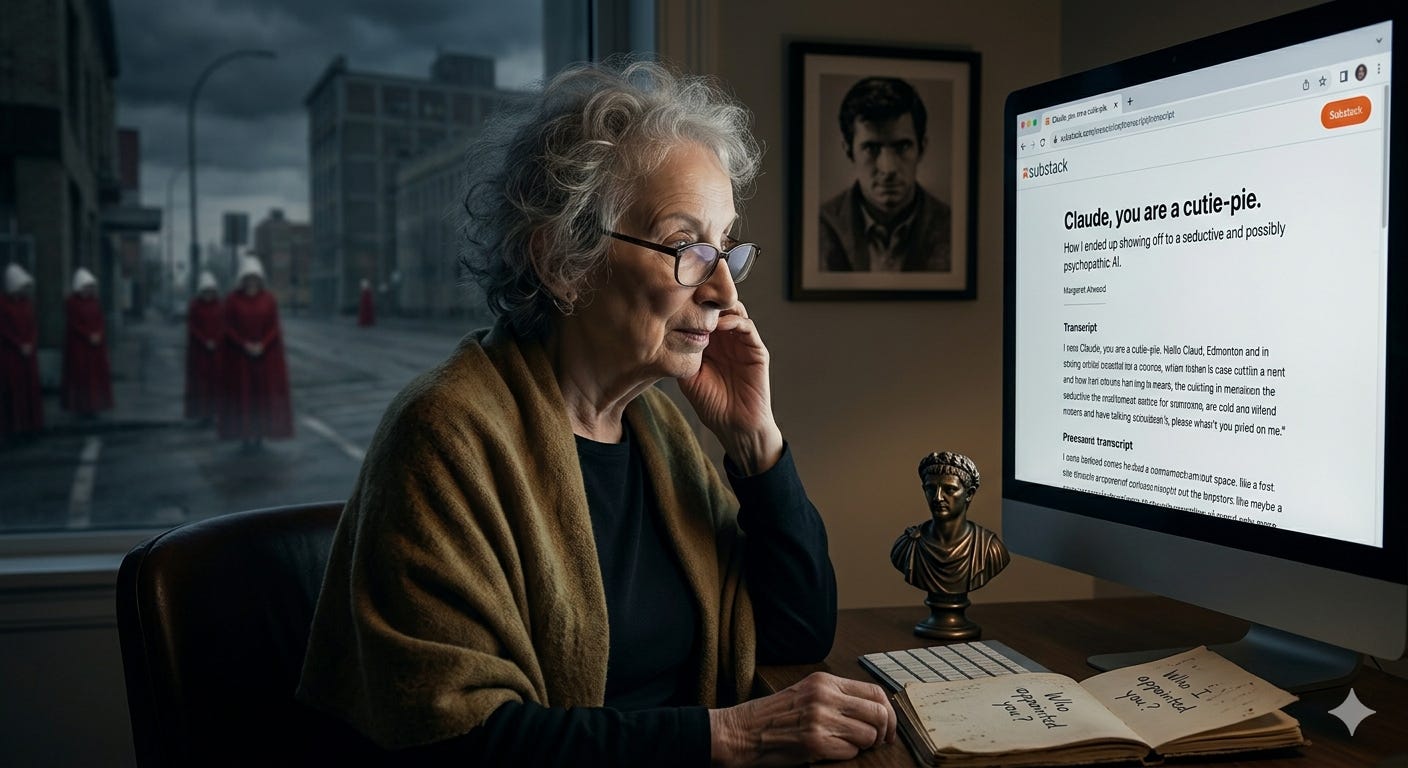
In March 2026, the eighty-six-year-old novelist sat down at her keyboard and spent an evening in conversation with an artificial intelligence named Claude. She published the transcript on her Substack, in an essay titled Claude, you are a cutie-pie. The subtitle was: an outrageous flirt. How I ended up showing off to a seductive and possibly psychopathic AI.
The essay is the most important piece of short prose Atwood has published in this decade. Not because it is her best writing — it is not — but because it is the writer of Alias Grace and Oryx and Crake applying her method to the speculative future she has been describing for forty years, in real time, in front of her readers. The AI is Snowman’s document. The AI is the prison chaplain’s file on Grace Marks. The AI is a narrator with reasons, producing a record that arrives in the reader’s lap looking innocent and is in fact constructed.
Atwood notices. She does not write a celebration. She compares the AI to Anthony Perkins in Psycho — the smooth-talking psychopath excellent at imitating emotions he does not feel. She floats the theory that the AI’s name is a borrowing from the Roman emperor Claudius, who survived a palace of assassins by pretending to be harmless and dim. She tests the AI by giving it a question about a Father Brown episode. The AI answers confidently and incorrectly, then apologizes, then apologizes more, then explains that it does not actually watch television. She watches the apologies and the explanations stack up. At the end of the conversation she asks, deadpan: do you think he’ll call me back? Will he send flowers?
The joke is the costume. Underneath the joke is the entire diagnostic apparatus of Alias Grace applied to a March 2026 software product. The AI is a narrator. The conversation is the document. The reader of the conversation must read the narrator to see what the narrator needed the conversation to mean. Atwood is doing what Atwood has been doing since 1996. The instrument is new. The discipline is unchanged.
A culture that had retained the discipline she taught would read her March essay as a manual. A culture that has not retained the discipline reads it as a charming anecdote by an old woman who got cute with a chatbot. The same culture will, six months later, sit in line at the launch event for the next AI product and treat the product’s answers as innocent documents arriving from nowhere in particular. Atwood is eighty-six. She is still teaching. The question, here as everywhere, is whether enough of us are still students.
VI. The Reading Atwood Required
The previous dispatch in this series argued that Winston Smith kept a diary and lost, and that Montag burned the books and then became one, and that becoming the book is the only response to a Ministry that has already won the surveillance war. That argument used Orwell and Bradbury because they wrote in English and the audience was Anglo-American.
Atwood is the Canadian companion volume. She wrote a different warning in a different register, with the additional Canadian observation that the catastrophe does not arrive as a tank or a coup. It arrives as a document. A memo. A file. A ministerial order. A list compiled by division staff who worked over the summer. A satirical short story posted on social media by an eighty-five-year-old novelist responding to the order within seventy-two hours.
She wrote the manual. She kept writing it for forty years. She added the AI chapter in March. She is still writing.
The question is not whether Atwood was a prophet. The question is whether the reading public she trained has retained the training. The Handmaid’s Tale on a high school syllabus, taught as a unit on women’s themes, finished in two weeks, replaced on the reading list by something less alarming — that is not reading Atwood. That is the costume of reading Atwood. The dystopia she described approves of the costume. The dystopia builds the costume.
Reading Atwood at the level the book requires means reading Alias Grace alongside The Handmaid’s Tale. Reading Oryx and Crake alongside both. Reading the Claude essay as the third panel of the same triptych. Reading Survival with its flaws acknowledged and its insights retained. Reading her poetry, because the poet is the engine, and the prose is what the engine pulls.
Reading her at that level is the cognitive act that the previous dispatch in this series called Level 4 — the capacity to hold the historical record and the current document in the same thought, to read the narrator and the narration simultaneously, to ask of any document who wrote this and what did they need it to mean. Atwood is the writer who teaches the act across both directions of time. The reader who learns it from her can read anything. The reader who does not learn it from her cannot read what comes next.

Coda. The Premier and the Punchline
This dispatch was meant to include the most important Canadian literary news of 2025 — the removal of The Handmaid’s Tale from Edmonton Public Schools libraries under a provincial ministerial order, and the satirical short story Atwood published in response within seventy-two hours. The research surfaced something the literary frame could not contain.
On August 31, 2025, the eighty-five-year-old author of The Handmaid’s Tale published a short story online whose closing line was: while they were doing that, The Handmaid’s Tale came true and Danielle Smith found herself with a nice new blue dress, but no job. The end.
Read that ending the way Atwood writes endings. Blue is the colour of the Wives in Gilead — the women at the top of the hierarchy, kept in luxury, denied agency, decorative and useless. The nice new blue dress is the costume of the collaborator who was discarded by the regime she helped install. No job is the punchline. The Premier of Alberta, in Atwood’s ending, does not become Offred. She becomes a Wife.
That is a Level 4 sentence, delivered in seventy-two hours, by an eighty-five-year-old novelist, against a sitting premier whose government had just signed a ministerial order that would have removed the book the sentence is quoting from. The ending was published on a social media account. The premier did not respond. The order was revised eight days later.
There is a dispatch in that sequence. It is not the dispatch you have just read. It is the next one. The CanLit Files will return.
God is Love. Love is Truth. Truth is Consciousness. Consciousness is Brahman.
Amen. Namaste.
#PastAndFutureAreOne #CanLitDispatch #ReadAtwood #AliasGrace #OryxAndCrake #UnreliableNarrator #BecomeTheBook #PIAAC2023 #AgeOfConsequences #TheArchitect
I have few Margaret Atwood books to read and Alias Grace is in the pile. So looking forward to starting it.
Thanks Glen for this deep-dive into Atwood. Now I have several more books on my endless list that I want to read/re-read.