


Sovereignty · Governance · Consequence
In the spring of 2020, at the height of the first COVID lockdown, New York Times columnist David Brooks identified two types of politicians that the pandemic had thrown into sharp relief. Weavers were the ones trying to repair, to build consensus, to manage complexity with the full weight of institutional responsibility on their shoulders. Rippers were something else entirely. Rippers see politics as war. They do not care what they destroy in achieving their specific aims. The conflict is not a means to an end. For the ripper, the conflict is the point. It gives their life meaning. It is who they are.
Brooks expected the pandemic to sideline the rippers. He was wrong within a week. By the time the column was six months old, the rippers had figured out how to weaponise the pandemic itself — the lockdowns, the mandates, the vaccines, the restrictions — as fuel for the war. And in Canada, one ripper had been watching from the backbenches of the House of Commons, taking notes, waiting for the convoy that would give him the overpass moment that launched his leadership campaign and carried him to within one election of the prime ministership.
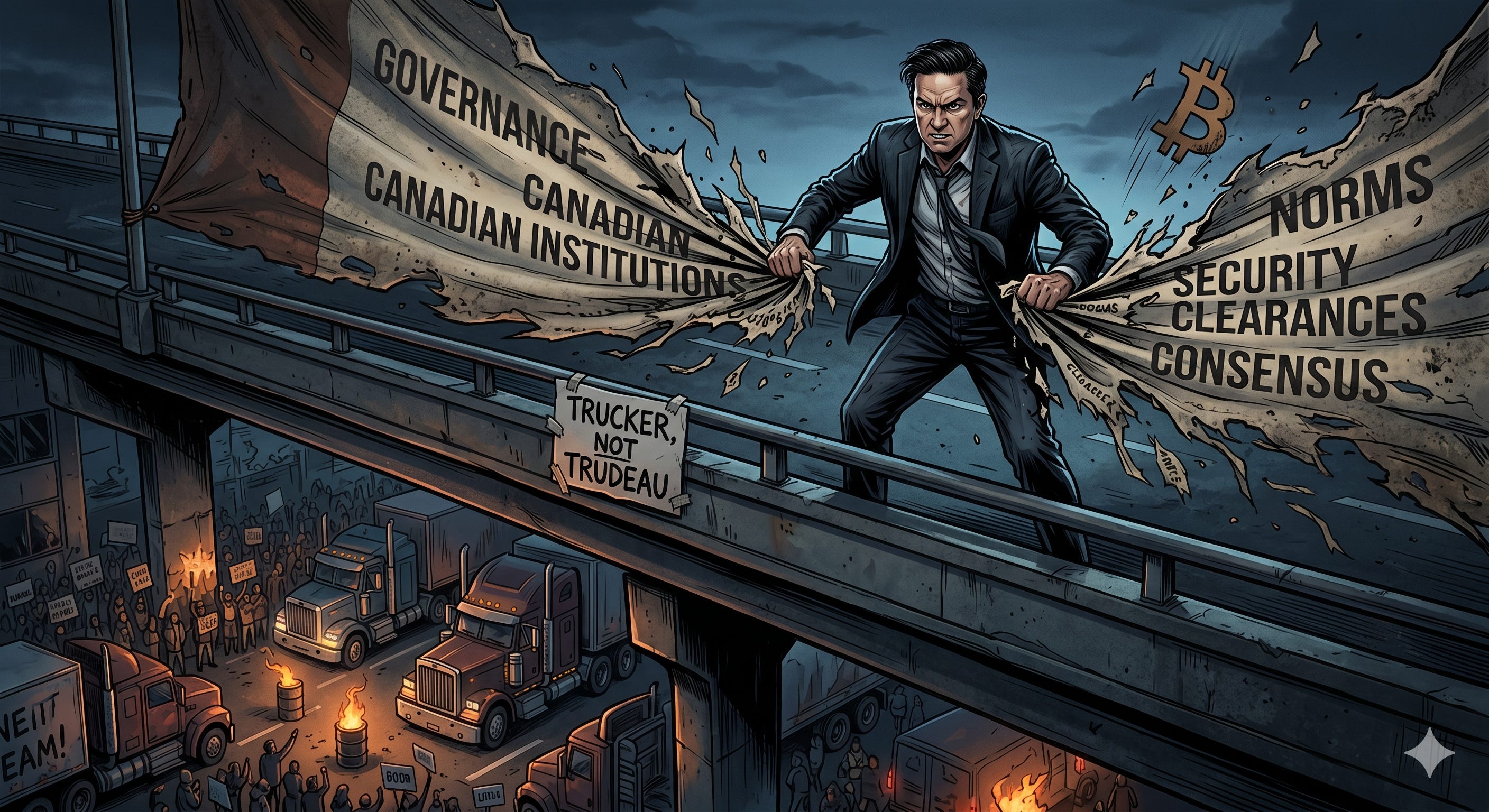
That man is Pierre Poilievre. He is currently the Leader of the Official Opposition in the Canadian House of Commons, the head of the Conservative Party of Canada, a Member of Parliament since 2004, a career politician who has never held a private‑sector job of significant duration or responsibility, a man whose entire adult working life has been financed by the Canadian taxpayer while he runs against the government that employs him. In the most precise application of Brooks’ taxonomy, he is a ripper. And the rules — the conventions, the norms, the institutional guardrails that distinguish a functional democracy from a permanent campaign — do not apply to him in the way he has arranged his political life. Not because he is above them. Because he has decided, consistently and deliberately, that he does not need them.
This dispatch applies the AIG standard to that decision and to the record it has produced. The elenchus applied to Pierre Poilievre: define what you claim to know, show your work, account for the documented contradictions in your position. No quarter. The record is what it is.
I. THE FORMATION — AN ANGRY TEENAGER WHO NEVER CHANGED
Pierre Poilievre was born on June 3, 1979, in Calgary, Alberta. He was adopted as an infant by Marlene and Don Poilievre, both schoolteachers. He grew up in a household that was politically engaged — conservative, Catholic, and ideologically serious in the way that the Reform Party movement in late‑1980s Alberta was ideologically serious. His mother began taking him to Conservative riding association meetings and anti‑abortion rallies when he was fourteen years old. He attended seminars at the Fraser Institute. He volunteered, unpaid, for Preston Manning’s Reform Party. He was, in the backrooms of Calgary’s nascent populist conservative movement in the early 1990s, what Mark Bourrie’s biography Ripper: The Making of Pierre Poilievre describes as the political equivalent of a hockey goon.
The hockey goon description is precise. A hockey goon is not the most skilled player on the ice. He is the most willing to do the dirty work — the hits, the scrums, the intimidation — that the more talented players either cannot or will not do. He has a specific function: to change the emotional temperature of the game, to unsettle the opposition, to make the arena feel dangerous for anyone who crosses into his territory. He is valuable to the team not for what he builds but for what he disrupts. Bourrie’s argument — the central thesis of his biography — is that Poilievre has never been anything other than the goon. He entered politics as the goon at fourteen. He is the goon at forty‑five. The body has grown. The role has not changed.
The intellectual formation locked in during those teenage years and has not been revised since. Poilievre absorbed the economic views of Milton Friedman and Ayn Rand — the libertarian canon of individual freedom, minimal government, free markets, and the moral legitimacy of the profit motive — and has carried them forward without substantial modification through three decades of political life. Ayn Rand’s objectivism is a philosophy that offers the intoxicating simplicity of a world in which the productive individuals are heroes, the state is the enemy, and the complexity of social interdependence is a problem invented by people who want to steal from the strong. It is intellectually coherent at seventeen. It is an arrested operating system at forty‑five.
Bourrie’s verdict on this formation is the harshest and most precise in the biography: Poilievre is an angry teenager in the body of a grown man. That makes him a stellar opposition politician. It is a bad combination in a prime minister. The AIG assessment agrees. Level 3 processing — competent, fluent, capable of sustained argument within a familiar framework — can sustain the ripper operation indefinitely. It cannot hold the structural complexity of a G7 economy navigating a trade war, a housing crisis, an energy transition, and an AI transformation simultaneously. The operating system was locked in as a teenager. The country requires something more.
II. THE CAREER — TWENTY YEARS OF OTHER PEOPLE’S MONEY
Pierre Poilievre has never held a private‑sector job of significant duration or responsibility — a point documented in his public biography and emphasized by analysts who have examined his career. This is the foundational fact that his anti‑establishment populism often seeks to obscure. Whatever his rhetoric, he has been part of the political establishment since he was twenty‑four years old.
He was first elected to Parliament in 2004 at the age of twenty‑five, representing Nepean–Carleton, and he has remained in Ottawa ever since. Over two decades, he has been re‑elected multiple times, building a political career financed entirely by the public purse. Before entering elected office, he worked as a parliamentary staffer — also taxpayer‑funded. His entire adult working life has unfolded inside the federal political system.
He has never built a business, never met a payroll, never navigated the regulatory, financial, or operational realities he claims to understand better than the experts he frequently challenges. These are observations drawn from the public record, not moral judgments. They form part of the contrast between the identity he presents and the career he has actually lived.
In 2025, he lost his federal bid — a political setback that reshaped the Conservative landscape. Some political commentators argued that his subsequent rapid re‑entry into Alberta politics resembled an insider‑driven political arrangement; others rejected that characterization entirely. What is uncontested is that he remained a central figure in conservative politics and continued to position himself as the tribune of the ordinary Canadian against what he calls the Ottawa elite.
His parliamentary salary — $203,100 in 2025 for the Leader of the Official Opposition — deposited on schedule throughout these years, even as he criticized the very government that employs him. His disclosed investments include units in the Vanguard FTSE Canada Index ETF and a Purpose Bitcoin ETF. The Bitcoin holding is notable because he spent 2022 promoting cryptocurrency as a hedge against inflation, a position that drew scrutiny from economists and central‑bank officials. Bitcoin fell by roughly 65 percent between its 2021 peak and the end of 2022, a decline that affected Canadians who followed his advice.
The Vanguard ETF he holds contains shares in Brookfield Corporation — the same company he criticized Mark Carney over during the 2025 campaign. His team stated that he does not control the contents of his ETFs. Analysts noted the asymmetry: he does not extend the same interpretive generosity to his opponents. This is not hypocrisy in the conventional sense; it is part of the operating model that Brooks and Bourrie describe when they classify him as a ripper — a political actor for whom conflict is not a means but an end.
The Ottawa insider who runs against Ottawa. The career politician who campaigns against career politicians. The man who advised Canadians to buy Bitcoin and then watched it crash while his salary remained stable. These contradictions are not incidental. They are structural. They are the architecture of the ripper’s political identity.
III. THE SECURITY CLEARANCE — THE RULES THAT APPLY TO EVERYONE ELSE
In June 2024, the National Security and Intelligence Committee of Parliamentarians published a report alleging that Beijing and New Delhi had interfered in Conservative Party leadership races. The details were largely redacted. The full unredacted report was available only to MPs with top‑secret security clearance. Every other federal party leader — Liberal, NDP, Bloc Québécois, Green — obtained or already held security clearance. Poilievre refused.
His stated reason: obtaining a security clearance would gag him. The information he received in classified briefings would restrict what he could say publicly, limiting his ability to hold the government to account. He would rather remain uninformed about classified material than be constrained in what he could say about it. This is his position, stated clearly and maintained consistently.
In March 2025, The Globe and Mail reported, citing a source with top‑secret clearance, that CSIS had learned Indian agents and their proxies were involved in raising money and organising within the South Asian community for Poilievre during the 2022 Conservative leadership race. CSIS did not share this information with Poilievre. The reason: he does not have the necessary security clearance. He is the only federal party leader who has declined an offer to obtain one. He cannot be briefed on which members of his own caucus may be compromised by foreign powers. He cannot receive the classified information about the foreign interference in his own leadership campaign.
Former national security adviser Richard Fadden pointed out the precise contradiction in Poilievre’s stated position: through the threat‑reduction‑measure pathway — a mechanism that allows CSIS to brief individuals regardless of clearance status when there are reasonable grounds to believe a threat exists — Poilievre could receive sensitive information and speak about it freely. He would not be gagged. The gag‑order rationale is not supported by the available mechanism.
CSIS offered him exactly this briefing in December 2024. He initially agreed, then rejected the terms when told the briefing would come with restrictions on what he could say about it. The restriction he rejected is the same restriction he cited as the reason for refusing the full clearance in the first place.
The logic is circular: he refuses the clearance because it would gag him, then refuses the alternative briefing because it would gag him, while remaining ungagged and uninformed about the foreign interference in his own leadership campaign. His Conservative foreign‑affairs critic Michael Chong later suggested that the personal and family information gathered in the clearance process could be used by the government for political purposes. The stated reason is freedom to speak. The underlying concern, by his own colleague’s account, is mistrust of the process.
His privacy is protected. Canada’s security is not his problem.
IV. THE BITCOIN CONTRADICTION — THE EXPERT WHO IS NOT ONE
In March 2022, Pierre Poilievre stood outside a London, Ontario shawarma restaurant and bought lunch with Bitcoin. He had arranged the event specifically to promote his campaign promise to make Canada the blockchain capital of the world. He told Canadians that cryptocurrency could help them opt out of inflation. He told them the Canadian dollar was being ruined by the government and that Bitcoin was the alternative. He was running for the Conservative Party leadership at the time. He won that leadership race in September 2022 with 68.15 percent of available points on the first ballot — the most decisive Conservative leadership victory in modern Canadian history.
Bitcoin peaked at approximately USD $68,000 in November 2021. By November 2022 — two months after Poilievre became Conservative leader — it had fallen to approximately USD $16,000. Canadians who followed his advice and converted savings into Bitcoin lost approximately 76 percent of those savings in twelve months. The Privy Council Office, the non‑partisan body that advises the prime minister, was sufficiently concerned about Poilievre’s cryptocurrency claims that it prepared a briefing note for the head of the public service on the viability of digital currencies as protection against inflation. The note’s findings were not publicly released, but its existence confirms that the government’s own experts took the cryptocurrency‑inflation claim seriously enough to examine it formally.
The Bank of Canada — which Poilievre called financially illiterate and whose governor he threatened to fire if elected prime minister — is one of the most respected central‑banking institutions in the world. Its independence from political interference is a structural feature of the Canadian financial system that protects Canadians from exactly the kind of political pressure on monetary policy that has contributed to inflation crises in other countries. Poilievre’s position on the Bank of Canada is not economic analysis. It is the Ayn Rand position: the state institution is the enemy, the market is the solution, and the expert is the obstacle. The Bitcoin crash of 2022 tested that position against reality. Reality won.
Poilievre’s Vanguard ETF holdings, disclosed during the 2025 election, include shares in Brookfield Corporation — the same company he had been attacking Mark Carney over, arguing that Carney’s Brookfield connections represented an unacceptable conflict of interest. His campaign said he does not control the contents of his ETFs. He does not apply the same charity to his political opponents. He never does. That is the ripper operating system: the standard applied to others is not the standard applied to oneself. The rules are for everyone else. For the ripper, the rules are a weapon to be used against opponents, not a framework to be followed.
V. THE CONVOY — THE DAY HE CHOSE THE OVERPASS
On January 28, 2022, the Freedom Convoy — a protest against federal COVID vaccination mandates that grew into a weeks‑long occupation of downtown Ottawa — began rolling into the capital city. Truckers and their supporters drove from across the country, parked on the streets surrounding Parliament Hill, honked their horns continuously through the night, harassed and frightened local residents, and established what amounted to a lawless encampment in Canada’s capital.
Pierre Poilievre drove to an overpass on the convoy’s route and made a video. He held a Trucker, Not Trudeau sign. He cheered the convoy. He supplied the protesters with Subway sandwiches. He told them they were heroes. He positioned himself as their champion against a government he described as tyrannical. He did not express concern about the occupied streets, the harassed residents, the businesses forced to close, the workers at the nearby Shepherds of Good Hope shelter who described being harassed by convoy participants. He did not acknowledge that some convoy organizers had expressed interest in replacing the elected government with a committee that would include convoy leaders. He did not engage with the concerns of Ottawa residents who were living through what their mayor called an occupation. He stood on the overpass and made the video.
The convoy ended the leadership of Erin O’Toole — the Conservative leader who had tried to occupy the pragmatic centre of Canadian politics and who was removed by his own caucus in part because of his handling of the convoy file. Poilievre had positioned himself perfectly. The convoy came for Trudeau but finished O’Toole, and Poilievre stepped through the opening. He won the subsequent leadership race with 68 percent of the vote. The overpass video was the moment his leadership campaign began in earnest.
Mark Bourrie’s analysis of this sequence is the most damning passage in his biography: Poilievre was not surprised by the convoy. He had been cultivating exactly this constituency — the angry, the alienated, the convinced that the system was irredeemably broken — for years. He had developed a data‑driven approach to identifying and reaching voters who were susceptible to the grievance politics of division. He had built a media operation that bypassed traditional journalism and spoke directly to his base through social media, podcasts, and rallies. He had been preparing for the convoy before anyone knew it was coming. And when it arrived, he was on the overpass.
The ripper does not ask whether what he is doing is good for Canada. The ripper asks whether what he is doing advances the war. The convoy advanced the war. The overpass video is the clearest single image of the Poilievre operating system in action: a moment of national crisis treated as a campaign opportunity, a group of Canadians who included genuine grievances and genuine extremists treated as undifferentiated allies in the war against the government, the norms of what a responsible opposition leader does in a crisis subordinated entirely to the calculation of what a leadership candidate does to win.
VI. THE PIAAC SCORE — WHAT THE PUBLIC RECORD MEASURES
AIG governance applies the Socratic question to Pierre Poilievre’s public record with the same rigour it applies to every other subject the Vertical Dispatch examines: define what you claim to know, show your work, demonstrate that the operating system is adequate to the problem it claims to solve.
The PIAAC assessment of Poilievre’s public record places him at Level 3 — the same level as the majority of the educated political class he operates within. Level 3 can sustain complex argument within a familiar framework. It can deploy statistics selectively and effectively. It can construct a coherent political narrative and maintain it across multiple media environments simultaneously. It can identify and exploit the emotional vulnerabilities of an audience with precision. These are real capacities. They produce electoral success. They are the skills of the extremely gifted opposition politician that Bourrie acknowledges him to be.
What Level 3 cannot do is hold the structural complexity of governing a G7 economy across multiple simultaneous crises without simplifying it into the binary of the campaign. Axe the Tax. Build the Homes. Fix the Budget. Stop the Crime. Four slogans. Four binaries. Each one a genuine problem reduced to a phrase that implies a solution without specifying one. The carbon tax was axed — by Carney, after Poilievre spent two years campaigning on it — and the affordability crisis it was supposed to have been causing has not resolved. The homes are not being built at the required pace under any government. The budget has not been fixed by any political party. The crime rate is a complex function of social, economic, and demographic variables that no slogan addresses. The Level 3 mind produces the slogan. The Level 4 mind asks what happens after the slogan.
The distinction matters at the level of prime‑ministerial governance, where the strategist and the analyst must be integrated in the same mind operating at full capacity. Poilievre has spent twenty years developing one of those capacities. He has spent very little time developing the other. The security‑clearance episode is the most precise diagnostic of this gap: a leader who refuses to know what he needs to know because knowing it would constrain what he can say is a leader who has prioritised the campaign over the country. The ripper’s operating system cannot accommodate the security clearance because the clearance imposes exactly the kind of institutional obligation — the duty to hold classified information responsibly, to respect the constraints that responsible governance requires — that the ripper’s operating system is designed to reject. The rules do not apply to him. Including the rules that protect Canadians from foreign interference in their democracy.
The ripper tears. He does not build. He does not weave. He does not hold complexity long enough to govern it. He finds the wound in the body politic and makes it wider, because a wider wound produces more anger, and more anger produces more followers, and more followers produce more power, and power is what the war is for. Canada did not make him prime minister on April 28, 2025. The operating system that would have governed from that power is documented in this dispatch, in Bourrie’s biography, and in twenty years of public record in the House of Commons. The rules do not apply to him — not the security clearance rules, not the rules of evidence when he makes economic claims, not the rules of responsibility that the overpass moment required, not the rules of consistency when his ETF holds shares in the company he attacks. Canada saw the record. Canada chose differently. The ripper is still in the building. The Vertical Dispatch will be watching.
God is Love. Love is Truth. Love is Consciousness. Consciousness is Brahman.
Amen. Namaste.
Dispatch Hashtags
#TheRipper #PierrePoilievre #AIG #VerticalDispatch #TheArchitect #AgeOfConsequences #MarkBourrie #RipperBiography #DavidBrooks #RippersAndWeavers #HockeyGoon #SecurityClearance #CSIS #ForeignInterference #India #ConservativeLeadership2022 #Bitcoin #CryptoCapital #BlockchainCapital #BitcoinCrash #AxeTheTax #FreedomConvoy #Ottawa #Overpass #TruckerNotTrudeau #LeadershipCampaign #CareerPolitician #OttawaInsider #PIAACLevel #Stratum4 #AynRand #MiltonFriedman #NoPrivateSectorExperience #ParliamentarySalary #VanguardETF #BrookfieldContradiction #CanadaElection2025 #OfficialOpposition #SubstackCanada #TheVerticalDispatch #NoFear
We had a close call at the Carney/Poilièvre first round and I hope Poilièvre never gets this close to power again. Letting him stay as opposition leader with a Carney majority is the surest way we will have a functioning government. I’m glad you wrote this article. I had read “The Poilièvre Project” by Martin Lukacs so I knew what he was like. Framing it differently still confirms why he can’t change….simply cannot…..
Poilieripper. Yeah, it makes exquisite sense. Perfect dive into the Stornoway squatter.