

Φ
THE VERTICAL DISPATCH
We write for the mind, the eye, and the ear.
Read it. Look at it. Listen to it. The Vertical Dispatch is built for all three — prose with rhythm, made to be heard as much as read.
From metaphysics to geopolitics, from culture to history, from the sacred to the street — and everything in between. One lens, every subject. No ego. Just the record, named clean.
Press play. Walk with the word. 🕯️
This dispatch travels by hand. If it serves you, share it — restack on Substack, and pass it on wherever you read. 🕯️
The Foundation Series · On the Ego
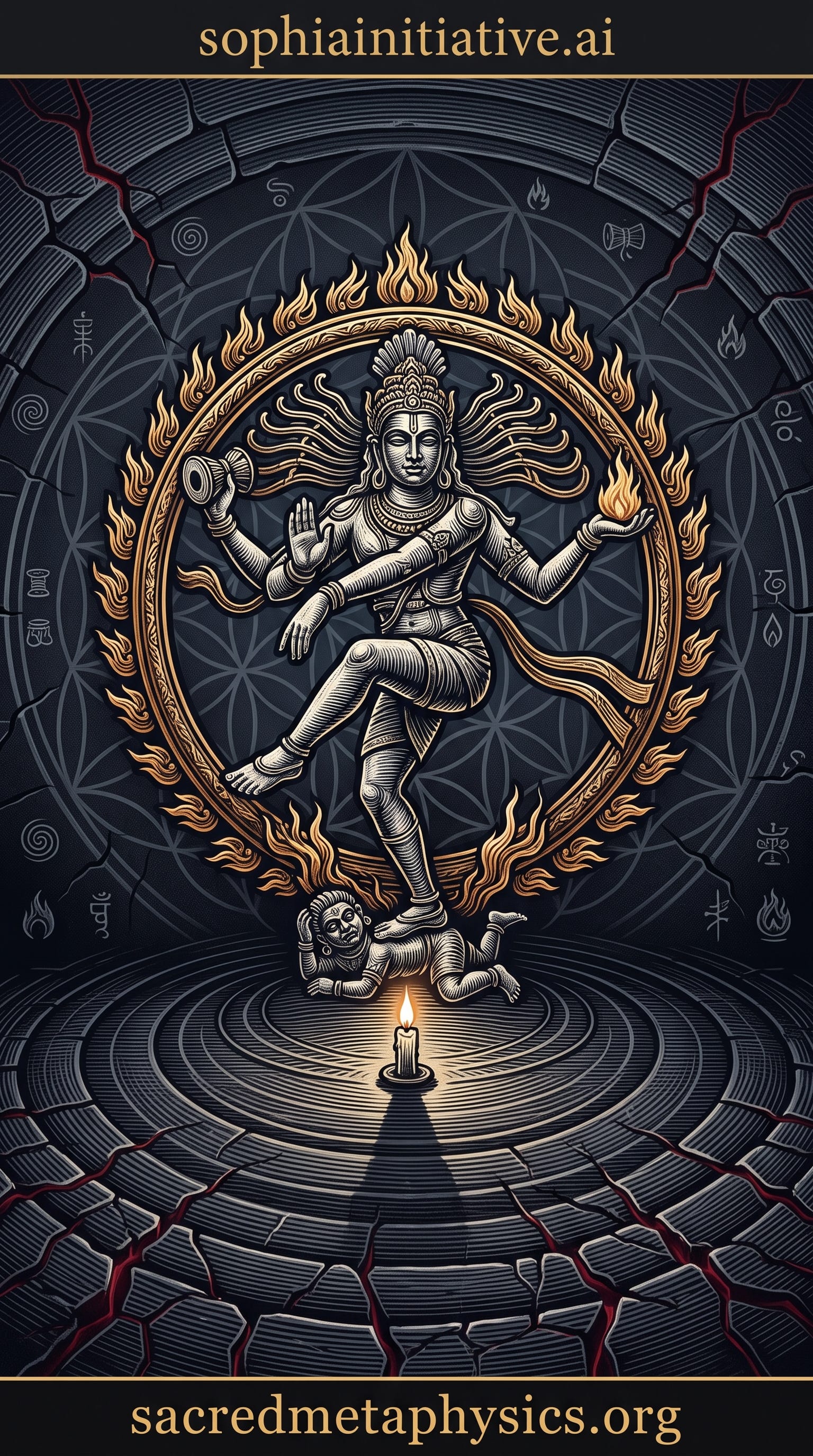
Shiva dances. One foot lifted, one foot crushing the small demon of forgetting underfoot. Fire in one hand, the drum of creation in the other. The dance isn’t good beating evil — it’s rhythm. Build, break, build again. Giving and taking in the same gesture, the same beat.
That’s the whole argument of this piece, before a single word of psychology shows up. The ego is not the villain of this story. It’s the shadow the dance throws. You don’t get the dancer without the shadow — they arrive in the same instant, off the same light. The only real question is what happens when the shadow forgets it’s a shadow and starts believing it’s the one dancing.
Carl Jung spent a career staring at that exact shadow and gave it a clinical name — confirmation, not discovery. What you refuse to look at runs the show from the dark. Jung’s “shadow” was never evil either. Just the disowned part, put in the closet because the house had to look presentable for company.
And Jung himself was late. In Sanskrit, ahamkara — “the I-maker” — names the same operation, and the term is old enough that Jung’s whole discipline is, by comparison, a few decades of research on a subject that already had a two-thousand-five-hundred-year head start. Ahamkara isn’t described there as a character flaw. It’s described as a function: the point where undivided awareness performs a single operation on itself and comes out the other side believing it’s a someone, bounded, separate, with a story to defend. A temple full of carvers, a Sanskrit-speaking tradition centuries older than either, and a Swiss psychiatrist working alone in Zurich — none of them reading each other’s work, none of them speaking each other’s language — all arriving at the same structure. One pattern, surfacing three times, in soils with no root system connecting them. That’s the lineage this piece is standing in: not one man’s metaphor, but a recurrence old enough and wide enough to trust.
This is a complex subject and we’re going to paint it in broad strokes anyway — not because the nuance doesn’t matter, but because a shape you can see from across the room beats a precision nobody can use. So one rule before we swing at anything: we judge the construct, never the person currently wearing it. Nobody built their own ego from scratch. It got assembled the way every ego gets assembled — school, scarcity, a hundred small survivals before anyone was old enough to consent to the architecture. When this piece gets sharp, the sharpness is aimed at the mechanism. Never at the human inside it.
Because here’s what the dance is actually showing you, under the mythology: the Self is sacred. Nobody’s arguing that. The ego is its shadow — thrown by the same light, doing exactly what a shadow does. Playing a role. Holding a shape. Nurturing the thoughts that keep the story of “me” running from one day into the next. Not a mistake. Not a demon. Just the part of the dance that falls where the light doesn’t reach.
The Shadow’s Three Moves
And the shadow, once it’s up and running, is remarkably easy to catch in the act, because it only ever does three things. It wants to be right — not occasionally, not only when provoked, but as a standing posture, the way a compass wants north. Being right is the feeling of the boundary holding; being wrong is a small tear in it, and the shadow will defend a parking spot with the same intensity it defends a philosophy, because from the inside the two register on the same instrument. It wants to be heard — not merely understood, but registered, counted, confirmed by someone else’s attention that the boundary is real and not just a story it’s telling itself in an empty room. And it wants to control — not out of malice, most days, but out of function: a boundary that can’t secure its own territory isn’t doing the one job a boundary was drawn to do.
None of that requires a villain. It requires only a shadow, cast once, at the start of the story — and it explains a wider range of human behavior, a marriage, a comment section, a cabinet meeting, than most of the theories built to explain them separately. Watch for it and you’ll start seeing the same three moves everywhere, which is either sobering or funny depending on the day, and it’s meant to be read as a little of both. Shiva’s own foot is still in the air, mid-step, not planted in judgment on anyone. The dance doesn’t stop for anyone’s dignity, including the piece currently writing about it.
The First Layer
Abraham Maslow’s ladder gets taught in nearly every introductory psychology class and mostly survives as five boxes in a triangle — from his 1943 paper “A Theory of Human Motivation”: physiological needs, safety, love and belonging, esteem, and at the top, self-actualization. At the first two rungs the ego isn’t the problem, it’s the correct operator — wanting food, wanting shelter, wanting to be safe is the boundary doing exactly the job a boundary exists to do, and no teaching about dissolving the self has any business asking a hungry or endangered person to set that down first.
The turn comes at the third rung. Belonging isn’t a luxury bolted on top of the real needs — Maslow is precise that it’s a genuine one. But the shadow, running the only program it has, answers belonging the way it answered survival: draw a line, defend it. That’s the layer where an “I” first needs a “we” to be recognized by, and where Jung’s disowned material gets its first working assignment — who’s in, who’s out, who gets a seat. Every tribe, every family, every nation, every comment section is still running the circuitry first wired at that layer.
State the hinge plainly, because the rest of this piece swings on it: once belonging becomes boundary, every larger scale that inherits the boundary inherits the shadow’s grammar along with it. Family, tribe, nation, civilization — each is just the belonging-contest played on a bigger board, with the same rules the shadow learned at the smallest one.
The Wrong-Sized Boundary
For most of the species’ history, the tribe was the right size for that boundary, because the tribe was the same size as the world a person actually lived in. You didn’t trade with, marry, or go to war with anyone beyond the range your own feet or your own language could reach, so the circle of “us” and the circle of “everyone who could actually affect my life” were the same circle. What’s changed isn’t the need for belonging. It’s the size of the room. Trade, travel, and a phone in every pocket have made “everyone a person might actually depend on or be harmed by” a species-wide category for the first time in the species’ history — which leaves the shadow running a boundary algorithm built for a few hundred people, loose in a world of eight billion.
This isn’t an argument for dissolving what the smaller boundary produced. A people’s culture — the language, the recipe, the particular way a place teaches its children to be human — isn’t the thing in question, and belonging to a place is not the same claim as closing a boundary around it. Philosophers of identity have made the rootedness case seriously, not as reflexive tribalism: a self doesn’t form in a vacuum, it forms inside inherited frameworks of meaning, and a person raised with no particular place or story of their own isn’t thereby raised into a wider humanity — often they’re raised into nowhere. The actual weld that needs breaking isn’t between a person and their people. It’s between belonging as identity and belonging as the outer edge of who counts as fully human — two different jobs the shadow keeps doing with the same single line.
The Same Grammar, Every Scale
This is the reason a publication that opens with metaphysics keeps circling back to geopolitics, and a publication about geopolitics keeps circling back to the family dinner table. The shadow’s belonging-contest doesn’t stay in one room. It’s the identical grammar whether it’s two siblings competing for their mother’s attention across forty years of unspoken scorekeeping, two nations disputing a border neither can quite say why it matters this much, or two factions fighting over who gets to write the record everyone else will inherit. Picture the actual table: the sibling who still brings up, twenty years on, who got the bigger room — not because the room matters anymore, but because the ledger was never closed, and the shadow keeps a longer ledger than anyone admits to over the holidays. Different stakes, same shape everywhere it turns up: an “I” trying to secure its place inside a “we,” and a shadow willing to do a great deal of unexamined work to make sure it isn’t the one left standing outside the circle when the doors close.
The Boundary Weaponized
Nowhere does that weld cost more than in war, and here the smaller claim is the only one worth making, because the larger one doesn’t survive its first counter-example. It isn’t true, and doesn’t need to be true, that the ego is the sole cause of any given war — the material causes are real: land, water, trade routes, empire, resources, ideology. But look for the one thing every war shares regardless of its material cause, and it isn’t a resource. It’s a “them.” No war in the historical record gets fought without the shadow’s oldest operation first being performed at civilizational scale: drawing the boundary of “us” so that whoever falls outside it can be killed without the killing registering, to the one doing it, as killing one of us.
And that boundary almost never gets drawn by the person handed a rifle and a story about who the enemy is. It gets drawn from a podium, by the powerful, the propagandist, the mythmaker — which is where the accountability actually belongs, and where this piece keeps insisting it stay. Point the finger up, at the structure that manufactured the “them.” Never down, at the person who inherited it and was never handed the tools to see the line for what it was. The material cause supplies the reason a war starts where and when it does. The manufactured enemy supplies the one thing the reason alone can’t: permission.
To be precise about the claim, since precision is the whole discipline this publication keeps trying to practice: this piece is not arguing that the ego causes war. It’s arguing that the ego is the mechanism that makes war psychologically possible once the material causes are already in the room. Take the shadow’s operation away and the land dispute doesn’t disappear — but the killing over it gets a great deal harder to arrange.
The Water the Fish Can’t See
Every pattern named so far in this piece is something you can hold at arm’s length and examine, the way you’d study a boundary drawn on a map. The ego is the one pattern that can’t be examined that way — it isn’t an object the eye is looking at, it’s the position the eye is looking from. Invisible for the same reason water is invisible to a fish: not hidden, just the medium the looking happens inside of.
Which makes a piece like this one a little dangerous to write, worth saying plainly rather than pretending otherwise. Noticing the pattern is exactly the kind of insight the shadow loves to claim as its own achievement — “I see the trick everyone else is missing” is not, on inspection, a humble sentence. But the seeing still isn’t the shadow’s accomplishment: the moment a boundary becomes visible as a boundary, drawn rather than given, it has already started to loosen. A line can’t be fully seen by someone standing entirely inside it. Call this whole piece a report from partway out the door, then — not a photograph taken from outside the house. Nobody writing about the ego gets to skip being one.
The Dance Doesn’t Stop at the Individual
Scale the dance up and it doesn’t change shape, only size. Shiva’s foot still lifts and falls; civilizations still build and break and build again, giving and taking in the same gesture a single ego moves through across a single lifetime. The shadow a person casts across a dinner table is the same shadow a nation casts across a border, run through more zeroes. Which is the whole reason to open this piece with a god dancing instead of a diagram. The diagram is Maslow’s — useful, real, worth keeping. But the dance is older, and it’s still the one playing underneath every triangle, every ladder, every border anyone’s ever drawn.
Why We Keep Coming Back to This
This is also, plainly, why the ego keeps showing up in this publication no matter what the week’s subject line says it’s about. Start pulling on any thread — a war, an election, a family that’s stopped speaking, an institution that’s stopped serving the people it was built for — and the thread runs, every time, back to the same knot: individuals, and the relationship between them, and the shadow each one is casting without quite meaning to. Geopolitics is family life with more zeroes and a flag. Family life is geopolitics with fewer casualties and worse holidays. Name the domain and the mechanism underneath it is the same mechanism, first switched on at the exact layer Maslow mapped seventy years before anyone here had the language for it: the moment belonging stopped being optional and the shadow got its very first job.
Which is the only honest answer to why a dispatch that opens with metaphysics keeps ending up back at the ego, week after week. Not because the ego is the most interesting subject available. Because it’s the one subject actually underneath all the others, the way a foundation sits underneath a house whether or not anyone in the house is thinking about it that day. The geopolitics, the governance, the sacred floor beneath both — every room this publication builds is standing on this one piece of ground. Better, always, to know what the ground itself is made of.
There’s a method buried in that, not just a theme, and it’s worth naming plainly since it’s the same method every piece here leans on. Watch a pattern show up in a dinner table argument, a border dispute, an ancient Sanskrit term, and a Swiss psychiatrist’s case notes, all without any of them borrowing from the others, and you’re not looking at four coincidences. You’re looking at one structure, photographed from four angles. That’s the whole discipline: don’t trust a pattern because one clever mind proposed it, trust it because it keeps showing up uninvited, in places that never read each other’s mail. The ego passes that test more thoroughly than almost anything else this publication has ever examined, which is the real reason it keeps getting the floor. Not because the subject is fashionable, but because the evidence for it refuses to stay contained in any one tradition’s territory.
So say the thesis once, plainly, in its strongest form, and let the piece rest on it: the ego is the subject underneath every other subject not because it’s the most interesting one available, but because every human system — a marriage, a war, a civilization — is built out of humans, and so far, every human is built out of this one operation. That’s not a flourish. It’s the plainest fact this publication keeps finding underneath everything else it covers, and the hardest one to keep looking at directly, this piece included.
God is Love. Love is Truth. Truth is Consciousness. Consciousness is Brahman.
Amen. Namaste. Om Namah Shivaya.
— The Architect.
Written from love, for a sacred humanity, in the full light of consciousness, toward the greater good. 🕯️
The Vertical Dispatch
sophiainitiative.ai
On the Record
Carl Jung’s distinction between individuation (ego integration, which does not dissolve the self) and the shadow (disowned psychic content, not inherently malevolent) is drawn from Jung’s own body of work and is already locked house doctrine in this project.
Ahamkara (”the I-maker”) is traced to the Brihadaranyaka Upanishad (1.2, 1.4) and the Chandogya Upanishad (7.25), among the oldest of the major Upanishads, composed roughly 900–600 BCE — read there as a cosmic operation before a psychological one, consistent with this house’s prior treatment in “The Ego as the Master Metapattern.”
Abraham Maslow, “A Theory of Human Motivation,” Psychological Review, 1943 (physiological, safety, love/belonging, esteem, self-actualization); Maslow later expanded the model in posthumously published work (The Farther Reaches of Human Nature, 1971) to include cognitive and aesthetic needs and self-transcendence.
The rootedness case draws on Charles Taylor, Sources of the Self (1989) — paraphrase of the work’s general argument; a specific page-pulled passage should be located before any direct quotation is attributed to Taylor.
The war material-causes-versus-constructed-enemy framing is this piece’s own argument, consistent with this house’s prior locked treatment in “The Ego as the Master Metapattern.” Material causes of war generally (land, trade, resources, ideology) are well attested in the historical literature (e.g., Geoffrey Blainey, The Causes of War, 1973), though not individually cited here. Per house rule, fact-dense material touching conflict is flagged for the mandatory MS Copilot second-eye pass before this dispatch is republished.
The Nataraja (Shiva as cosmic dancer) imagery on the accompanying poster — the raised leg, the figure of Apasmara underfoot, the damaru drum, the flame — reflects standard Hindu iconography, most familiarly rendered in Chola bronze sculpture. A specific primary or academic art-history source is being located and will be added on republication.
Verify against primary sources before republication. Walk with the word.
Suggested Tags
The Ego, Carl Jung, Shiva, Nataraja, Ahamkara, Maslow’s Hierarchy of Needs, Nonduality, Sacred Metaphysics, The Foundation Series.
Substack Notes
Shiva dances — one foot lifted, one foot on the small demon of forgetting — and that single image carries the whole argument of this dispatch before a word of psychology shows up. The ego isn’t the villain of the story. It’s the shadow the dance throws, and you don’t get the dancer without it.
From there the piece follows the shadow through Carl Jung’s own name for it, back through the older Sanskrit ahamkara, and down to the exact rung on Maslow’s ladder — belonging — where an “I” first needs a “we,” and where the same grammar starts running underneath a family dinner table, a border dispute, and a war, at whatever scale it turns up.
The discipline running under all of it: judge the construct, never the person wearing it, and point accountability up at the structures that manufacture an enemy, never down at the people handed one. Seeing the pattern isn’t the finish line either — the piece says so about itself, plainly, in its own closing turn.
Written from love, in service of the record. Walk with the word. 🕯️
#TheVerticalDispatch #TheArchitect #SophiaInitiative #TheEgo #CarlJung #Shiva #Nataraja #Maslow #TheFoundationSeries #GodIsLove #LoveIsTruth #OmNamahShivaya
Factual matter in this Dispatch is drawn from the public record and sourced above, including points still open for a fuller citation, which are named as such rather than resolved. All characterizations of traditions, teachings, historical patterns, and research findings are the author’s own interpretation and commentary. This piece makes no assertion about the private intentions or character of any living person, and its discussion of war and conflict is offered at the level of general historical pattern, not as a claim about any specific named party or living figure. Readers are encouraged to verify all claims independently and to evaluate the argument on its own merits.