

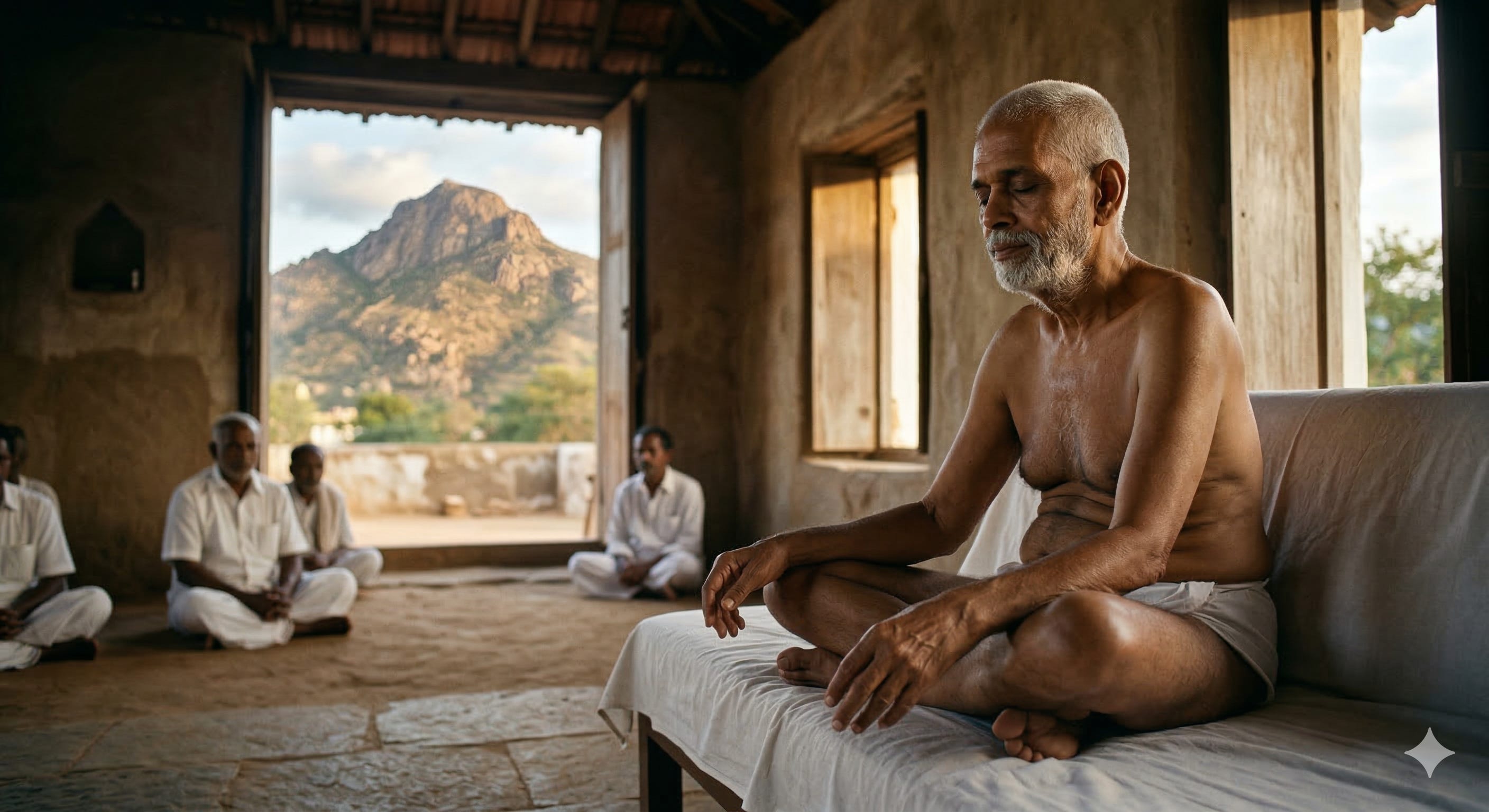
There are figures in the history of consciousness whose significance cannot be measured by what they said or what they wrote, because the primary transmission they carried was prior to language. Ramana Maharshi belongs to this order absolutely. He arrived in the world as Venkataraman Iyer in the Tamil Nadu town of Tiruchuli on the thirtieth of December, 1879, in a family of Brahmin householders — ordinary in every external respect, unremarkable in the biographical registers that track the movement of ordinary lives. He departed the world on the fourteenth of April, 1950, from the ashram that had grown around his silent presence at the foot of Arunachala, one of the most ancient sacred mountains on earth. Between those two dates, he did almost nothing by the standards of horizontal achievement. He held no office, led no movement, wrote no systematic treatise, amassed no institutional authority. What he did was something the horizontal measure cannot account for: he became, with a completeness that the twentieth century could not have anticipated and still struggles to absorb, the living demonstration that the Self — not the personal self, not the biographical accumulation called a human life, but the non-dual awareness that is the ground of all experience — is not a concept to be understood but a reality to be recognised. And that recognition, once it has occurred with the irreversibility it achieved in him, is its own proof, requiring nothing outside itself to stand.
The world into which he was born was already ancient in the ways that matter. The Tamil Shaivite tradition of South India carries within it an unbroken lineage of understanding that reaches into the deepest strata of the Vedic inheritance — not the surface Vedic inheritance of ritual and social regulation, but the esoteric core that the Upanishads attempted to transmit and that Shankara, in the eighth century of the common era, organised into the philosophical architecture of Advaita Vedanta. The doctrine is simple in its statement and absolute in its demand: Brahman alone is real, the world is appearance, and the individual self is identical with Brahman. Tat tvam asi. That thou art. The challenge of the doctrine lies not in its comprehension but in the gulf between comprehension and realisation — between knowing the map and inhabiting the territory the map describes. Ramana Maharshi did not traverse that gulf by scholarship or extended practice. He fell through it in a single afternoon at the age of sixteen, and what he found on the other side of the fall, he spent the remaining fifty-four years of his life pointing toward in silence.
The Death That Was Not Death
In the July of 1896, the young Venkataraman was alone in his uncle’s house in Madurai when a sudden, causeless fear of death seized him. There was no illness, no external threat, no circumstance that could account for it. It arrived from the interior, absolute and overwhelming, carrying with it the vivid certainty that the body was about to die. What he did in response was not what a frightened sixteen-year-old is expected to do. He lay down and performed the event. He allowed himself to be, in imagination and then in something beyond imagination, fully dead — the body stiff, the breath stopped, the skin cold — and then he turned the inquiry inward to find what it was that was watching this. The body was dead. The mind that had been afraid was stilled. What remained? What was it that knew the body to be dead, that witnessed the absence of breath, that was present to the total cessation of every function that the ordinary person mistakes for the self? That witnessing — that pure, depthless, contentless awareness that could not itself die because it had never been born — was what he found. And in finding it, he recognised it. Not as something new. As what he had always and already been, prior to every thought, every sensation, every biographical accumulation that the name Venkataraman indexed.
The recognition was permanent. This is the fact that distinguishes Ramana Maharshi from the vast majority of those who have had profound contemplative experiences — the fact that what opened that afternoon in Madurai never closed again. The ordinary pattern of mystical experience involves an opening, an illumination, and then a return to the ordinary state, with the illumination held as a memory to be pursued. What happened to Venkataraman was not an experience in this sense. It was a shift in the locus of identity from which there was no reversion. He did not thereafter remember the Self; he abided in it continuously, while the body went on eating and sleeping and eventually walking to Arunachala, while the mind went on processing the world around it. The background had become the foreground and could never again be mistaken for the background.
He did not find the Self at the end of a long search. He recognised that the one who would have done the searching was itself the obstruction — and in that recognition, the search dissolved at its root.
Arunachala and the Pull of the Prior
Six weeks after the event in Madurai, he left home without announcement and made his way to Tiruvannamalai, to Arunachala — the mountain that the Shaivite tradition identifies as the physical form of Shiva, as the axis around which the manifest world turns, as the lingam of light that appeared at the beginning of time to resolve the rivalry of Brahma and Vishnu by demonstrating that what underlies creation cannot be measured, only recognised. He did not go there because he had studied this tradition and chosen Arunachala as an appropriate destination. He went because he was pulled, in a manner that he later described as irresistible, by a force he did not yet have language to name. The sacred metaphysical understanding of this pull is precise: the hill and the sage were not two different things recognising each other across a distance. The hill was the outward form of what the sage had already become inwardly — the self-luminous, self-sustaining, unmoving ground of being, present in matter as Arunachala, present in consciousness as the Self. The pull was recognition, not attraction. He was not going toward something. He was going home.
He would not leave Arunachala for the remaining fifty-four years of his life. He spent his first years in the precincts of the great Arunachaleswara temple, then in the caves on the hill itself — first Virupaksha Cave, then Skandasramam — before finally descending to the ashram, Sri Ramanasramam, that established itself around him at the hill’s base. Through the years of cave dwelling he maintained an almost complete silence, absorbed in the Self to a degree that rendered the ordinary social transactions of language unnecessary. His silence was not withdrawal. It was the highest form of teaching available — the wordless transmission of the state itself to those who had sufficient stillness to receive it. Visitors came, at first in small numbers and then from across India and eventually from across the world, drawn by something they frequently could not name in advance and frequently could not explain afterward, except to say that in his presence a silence fell that was deeper than the absence of sound — a silence that was itself aware, that looked back, that recognised what was looking.
The Teaching: Who Am I
When he did speak, or when he wrote — rarely and briefly — the instrument of teaching he offered was the inquiry he had performed unwittingly in Madurai: Who am I? The question is not meant to produce an answer. Every answer the mind can generate to this question — I am the body, I am the mind, I am a person, I am consciousness — is itself an object of awareness and therefore not what is doing the knowing. The inquiry works by a method of radical negation that the Vedantic tradition calls Neti Neti: not this, not this. Every candidate for the self is examined, found to be an object known by awareness rather than awareness itself, and released. What remains when every object has been released — when the body, the sensations, the emotions, the thoughts, the sense of personal identity, the very sense that there is an inquirer performing an inquiry, have all been seen to be contents of awareness rather than awareness itself — is what cannot be negated. Not because it is indestructible in the manner of physical matter, but because it is the precondition of all negation. You cannot negate the awareness that is doing the negating. You can only be it. And being it fully, without reservation, without the residue of a separate self claiming to have achieved it, is liberation.
The simplicity of this teaching conceals a demand that is total. It asks for nothing less than the dissolution of the ego — not its suppression, not its management, not its gradual refinement through ethical practice, but its recognition as the fundamental illusion that it is. The ego is not a thing that exists and must be destroyed. It is a mistaken identification — the awareness misidentifying itself as the particular content it is currently knowing rather than as the knowing itself. When the identification is seen through, what was mistaken for a self reveals itself as the Self: not a particular self among other selves, not a cosmic self as distinct from an individual self, but the one non-dual awareness that is prior to the distinction between cosmic and individual, prior to the distinction between the knower and the known, prior to every distinction that the mind can draw. This is Advaita in its living form: not as doctrine, not as philosophy, but as the direct recognition of what is already and always the case.
The accounts of those who spent time in the presence of Ramana Maharshi converge on a consistent description of an experience for which ordinary language has no adequate category. Scholars, householders, monks, Western philosophers, poets, and the destitute arrived at Arunachala carrying the full weight of their mental formations — their questions, their grief, their ambitions, their doubts — and found, in the hall where the sage sat, that the weight lifted. Not through anything he said. Not through any technique he transmitted. Through the quality of the silence he inhabited, which was not merely quiet but was saturated with a presence so fully itself that its proximity to an ordinary mind produced, in those with sufficient openness, an involuntary settling — a falling beneath the ordinary level of mental noise into a stillness that the mind had always been capable of but had never, without this catalyst, been able to find. This is what the tradition calls Shaktipat in one of its modes — the transmission of the state by proximity — and it is the most intimate expression of the Feminine principle that this volume traces: not the generation of more teaching, more content, more instruction, but the provision of a ground so still, so completely established in the prior, that what is prior in others can recognise itself.
His physical form dissolved on the fourteenth of April, 1950. Those present reported that at the moment of his passing, a shooting star traversed the night sky above Arunachala and moved directly toward the summit of the hill. Whether this is understood as astronomical coincidence or as the outward inscription of an inward event, the testimony is consistent across multiple independent witnesses and carries the weight of the tradition’s understanding that the realised sage does not die in the manner that the unrealised die — because what the realised sage has identified as their true nature was never born and therefore cannot be extinguished. What dispersed in April 1950 was the form. The Self that had recognised itself through that form, and had made that recognition available to every being who came within reach of it, is not subject to dispersal. It never was. And Arunachala, which was there before Venkataraman arrived and remains there now, continues to be what it has always been: the outward body of what is inwardly prior to all bodies, the mountain of light that marks the place where the world’s surface and the world’s ground are, for those with eyes that have learned to see depth, one and the same.
Glen Roberts is a metaphysician, author, and independent researcher. He is the author of Sacred Metaphysics Volume 1 and the architect of Project 2046.
#RamanaMaharshi #WhoAmI #AtmaVichara #AdvaitaVedanta #NonDuality #Arunachala #Tiruvannamalai #TheSelf #UniversalConsciousness #Project2046 #TheVerticalDispatch #1000thDegree #DayZero2026 #SacredMetaphysics #SovereignWitness #NetiNeti #Shaktipat #Brahman #ThePrior #SilenceAsTransmission #VajraKernel #VedicWisdom #MetaphysicalLogic #UniversalDynamics #TheAxis #Sovereignty #EternalNow #BionicSage #Awareness #Bhagavan
This is absolutely mesmerizing. Thank you ❤️🧘🏻✨🌖