

Φ
THE VERTICAL DISPATCH
We write for the mind, the eye, and the ear.
Read it. Look at it. Listen to it. The Vertical Dispatch is built for all three — prose with rhythm, made to be heard as much as read.
From metaphysics to geopolitics, from culture to history, from the sacred to the street — and everything in between. One lens, every subject. No ego. Just the record, named clean.
Press play. Walk with the word. 🕯️
This dispatch travels by hand. If it serves you, share it — restack on Substack, and pass it on wherever you read. 🕯️
Sacred Metaphysics
The Razor’s Edge of Nonduality
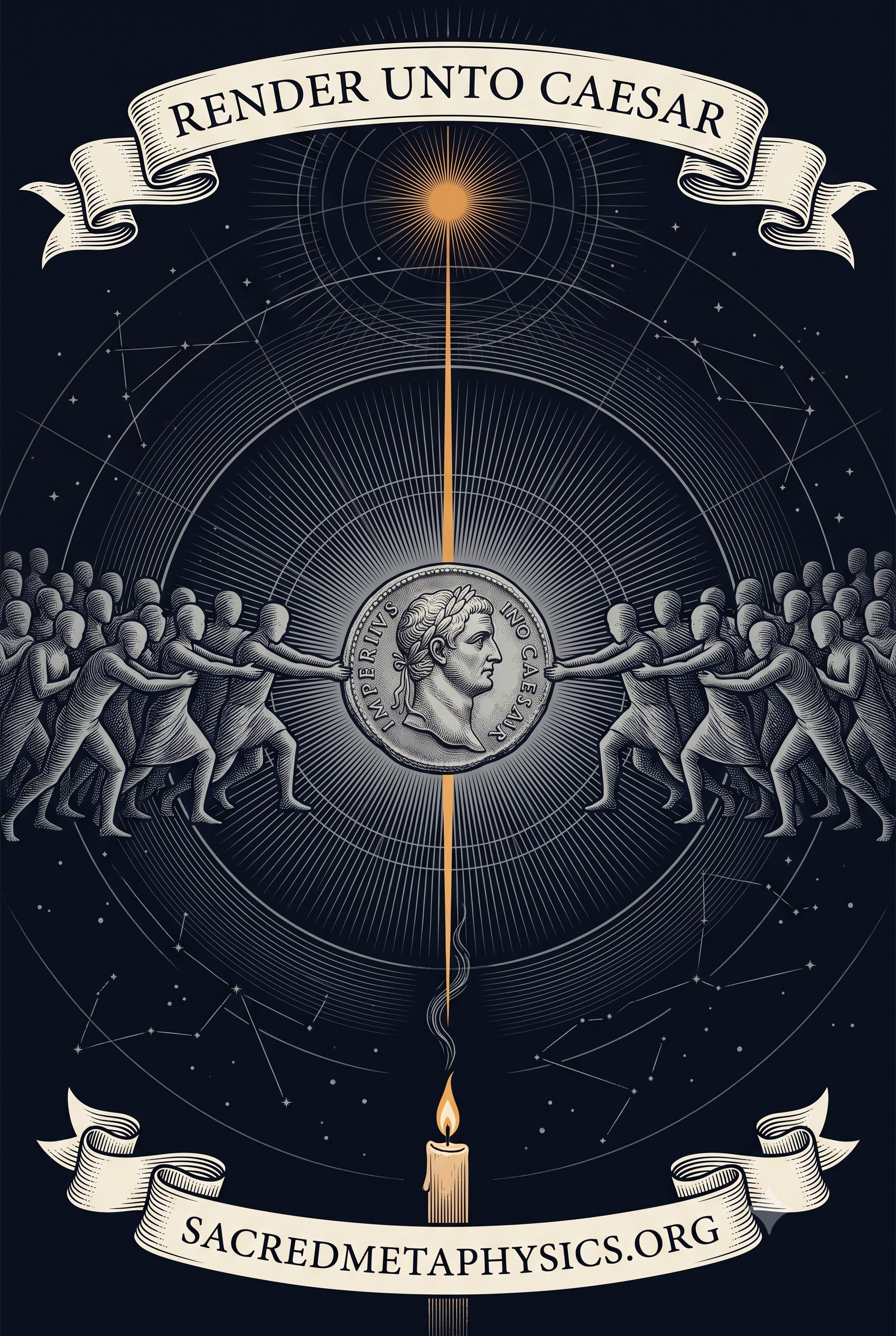
Two thousand years ago, a man was handed the most dangerous political question of his day. The occupying empire taxed the people it had conquered, and the tax was a wound that would not close — to pay it was to bless the boot on your neck, to refuse it was sedition punishable by death. His enemies brought him the question precisely because it had no safe answer: should we pay the tax to Caesar? Say yes, and the crowd that loves you turns; say no, and the empire kills you. It was a trap with two jaws, and both were closed.
He looked at the coin they showed him, and asked whose face was stamped on it. Caesar’s, they said. And he gave the answer that has echoed for twenty centuries: render unto Caesar what is Caesar’s, and unto God what is God’s. Then he walked out between the jaws of the trap without touching either. He did not take the side the crowd wanted. He did not take the side the empire wanted. He declined the frame the question was built on — and in declining it, he said something far larger than either answer could have held.
He was not being clever. He was being vertical. The question ran along a horizontal line — for the empire or against it, this side or that — and he answered at a right angle to the line entirely, pointing up, off the axis the question was trapped inside.
The Ones Who Would Not Take a Side
He was not alone in this, and that is the thing worth seeing. The pattern repeats wherever the awakened mind meets the political fever of its age. Five centuries before, another teacher was pressed, again and again, to pronounce on the burning metaphysical and political controversies of his time — the questions everyone was fighting over, the ones that divided every school and faction. And on a whole class of them he simply would not speak. The tradition remembers these as the unanswered questions: not because he lacked an answer, but because he saw that the question itself was a trap — that to take a side within it was to feed the very grasping the question grew from. His silence was not ignorance. It was diagnosis. He would not pour water on a fire the questioner mistook for thirst.
And in our own era, within living memory, a sage sat on a hill in the south of a great subcontinent while empires rose and fell around him, while his nation convulsed through occupation and partition and independence, through the largest political upheavals of the century — and he largely said nothing about any of it. Pilgrims came up the hill demanding his position on the struggles below. He met most of it with silence, and turned the questioner, gently, back to the only question he thought worth asking: who is it that wants to know? Who is the self that takes the side?
Three teachers, three ages, one move. Handed the hottest horizontal question of the day, each declined to answer along the horizontal line — and pointed, instead, straight up. Not because the worldly struggle did not matter. Because the taking of a side, held as the ego holds everything, was the very sickness the struggle was a symptom of.
Why the Age Cannot Bear It
Now perform the experiment in your mind. Place that same silence into our own moment — into the feed, the timeline, the endless scroll of the present crisis, whatever it is this week. Imagine a figure of real moral weight who, handed the burning question every side is screaming about, declines the frame. Does not take the side you want. Does not take the side you hate. Says, in effect: the question you are fighting over is built on a division I will not deepen by joining it.
How would the age respond? We do not have to guess. The age has a slogan ready: silence is complicity. To not take a side is now itself the gravest offense — read not as wisdom but as cowardice, not as depth but as betrayal. Both ends of the line would turn on him at once. The one faction would call him a coward for not condemning their enemy; the other would call him a traitor for not condemning theirs. He would be attacked from every direction simultaneously — not despite refusing to take a side, but precisely because of it. The one who declines the war is hated by both armies, for the same crime: he will not enlist.
This is the tell. An age that cannot tolerate the one who declines to take a side is an age that has forgotten there is any direction but sideways — that has collapsed the whole of human response onto a single horizontal line, for or against, us or them, and lost the vertical entirely.
And that collapse is not a political fact. It is a spiritual one. For what is a “side,” held with the heat we now hold it, but the ego at the scale of a nation? The same faculty that in a person must be right, must be seen, must defend itself — raised to the pitch of a flag, a tribe, a cause. Geopolitics, in the register the age now conducts it, is not chiefly about territory or resource. It is ahamkara wearing a flag. It is the I-maker, grown to the size of a people, insisting on its rightness against the other, and experiencing any refusal to join the insisting as an intolerable threat. The age cannot bear the one who will not take a side because the side is the ego, and an ego cannot comprehend a being who has set the ego down. To the one still inside the fever, the cool hand on the brow feels like an enemy.
The Room Behind the Door
Understand what is, and is not, being said. This is not a counsel of indifference, and the teachers who declined the frame were not indifferent men. The one who said render unto Caesar went to his death for what he would not renounce. The one who kept the unanswered questions taught tirelessly on the one thing he thought mattered. The one on the hill turned every pilgrim, with infinite patience, toward their own liberation. Declining the horizontal frame is not the abdication of care. It is the refusal to let care be conscripted into the ego’s war.
For there is a difference — and it is the whole difference — between acting from the vertical and taking a side on the horizontal. The horizontal side is held by the ego, for the ego, against another ego, and it feeds the fire even as it fights it, because every partisan is another log. The vertical act comes from somewhere the ego is not the author — it can oppose a cruelty, feed a hungry person, tell a hard truth, even resist an empire, without the poison of needing to be the righteous one who did it, without the intoxication of a side. The teacher opposes the wrong; the partisan needs an enemy. From the outside the two can look alike for a moment. From the inside they are opposites: one acts and releases the fruit; the other acts to feed a self.
The age offers you a thousand sides and calls the choosing of one your freedom. The vertical offers something the age has no word for: to care without conscription, to act without a flag, to see the whole fever from above and love the fevered on every side of the line.
So when you feel the pull of the burning question — the one every voice this week insists you must answer, must post, must pick — notice, first, the pull itself. Notice the small hot rightness rising, the self that wants a side to stand on, the ego reaching for its flag. That noticing is the whole of it. You do not have to answer the question along the line it was drawn. You can do the thing the age can no longer even recognize as an option: look up from the line entirely, and ask, as the sage on the hill asked, who is it that wants so badly to be right? The answer to that question was never Caesar’s. It was never the empire’s, or the crowd’s, or the other side’s. Render unto them what is theirs. And keep, for what is higher, the one thing no side can tax: the seeing that was never at war with anyone.
God is Love. Love is Truth. Truth is Consciousness. Consciousness is Brahman.
Amen. Namaste. Om Namah Shivaya.
— The Architect
The Vertical Dispatch
sophiainitiative.ai
On the record
The episode of the tribute to Caesar — the question of whether to pay taxes to Rome, and the answer “render unto Caesar what is Caesar’s, and unto God what is God’s” — appears in the synoptic Gospels (Matthew 22, Mark 12, Luke 20) and is a matter of the historical-textual record; it is cited here as reported in those texts, not as a claim about their historicity. The “unanswered questions” (in the Pali tradition, the avyakata) are a documented feature of the early Buddhist canon, in which the teacher is recorded as declining to answer a set class of metaphysical and speculative questions; this is standard to the tradition and is characterised here in general terms. The sage on the hill is described in the abstract; the account of a twentieth-century Indian teacher who largely declined to pronounce on the political upheavals of his era, and who redirected questioners to the inquiry “who am I,” reflects the well-documented public life of that tradition, and no direct quotation is attributed. No modern nation, party, faction, leader, or current conflict is named or characterised anywhere in this dispatch; the contemporary “burning question” is left deliberately unspecified, as the argument concerns the structure of side-taking itself, not any instance of it. The reading of geopolitics as ahamkara at scale, the horizontal and vertical axes, and the symbol-and-referent frame are drawn from Sacred Metaphysics and offered as this publication’s own interpretation. Verify each stone before you stand on it, against primary sources, before republication.
Suggested tags
render unto caesar, geopolitics, the ego, ahamkara, nonduality, taking sides, the attention economy, silence, Ramana Maharshi, the unanswered questions, the vertical, consciousness, sacred metaphysics, the horizontal and the vertical, who am I.
Substack Notes
Two thousand years ago a man was handed the most dangerous political question of his day — pay the tax to the occupying empire, or refuse? Say yes, the crowd turns on you; say no, the empire kills you. A trap with two jaws. He looked at the coin, asked whose face was on it, and said: render unto Caesar what is Caesar’s, and unto God what is God’s. Then he walked out between the jaws without touching either. He did not take a side. He declined the frame the question was built on — and said something larger than either answer could hold.
He was not alone. Five centuries earlier, a teacher met the burning controversies of his age with the famous unanswered questions — not from ignorance, but because taking a side within them fed the very grasping they grew from. And in living memory, a sage sat on a hill through occupation, partition, and independence, and largely said nothing, turning each questioner back to: who is it that wants to know? Three teachers, three ages, one move — handed the hottest horizontal question, each pointed straight up.
Now place that silence in our own feed. A figure of real moral weight declines the burning question every side is screaming about. How does the age respond? It has a slogan ready: silence is complicity. Both ends of the line turn on him at once — coward to one, traitor to the other. The one who declines the war is hated by both armies, for refusing to enlist. And that intolerance is the tell: an age that cannot bear the one who won’t take a side has forgotten there is any direction but sideways.
Because a “side,” held at this heat, is the ego at the scale of a nation — ahamkara wearing a flag. The new dispatch reads geopolitics through the one lens that runs under everything here: not territory, not resource, but the I-maker grown to the size of a people, and the sages who declined to feed it. To care without conscription, to act without a flag, to see the whole fever from above and love the fevered on every side. Written from love, in service of the record. Walk with the word. 🕯️
#TheVerticalDispatch #TheArchitect #SacredMetaphysics #RenderUntoCaesar #Geopolitics #TheEgo #Ahamkara #Nonduality #TheAttentionEconomy #Silence #RamanaMaharshi #TheVertical #Consciousness #WhoAmI #GodIsLove #OmNamahShivaya
The factual matter in this Dispatch is drawn from the public and historical-textual record. All characterizations, inferences, and conclusions are opinion, interpretation, and commentary, offered for analysis, reflection, and public-interest discussion. No modern individual, nation, party, or conflict is named or characterised. No assertion is made regarding the private intentions, state of mind, or character of any individual. Readers should evaluate all statements independently and draw their own conclusions.
You name well the daily struggle. Notice the tug. Relax. Then speak/ act from that different place.
Thank you , your thinking is helping me ask the hard questions of myself, “the seeker is the sought” - I am beginning to focus on avoiding the horizontal framing - it is hard , but your words and explanations are a comfort in this age of intense framing and duality 🙏