

Let us begin with the most honest wager available to a thinking person.
Either God exists, or God does not. At first glance, call it fifty-fifty. A coin flip for the intellectually scrupulous. We will grant that much to anyone who comes to this conversation in good faith, and we ask only one thing in return: follow the logic wherever it goes, without flinching.
Because by the time we are finished, the coin will not look so balanced.
The evidence is not hidden in scripture or locked behind initiation. It is written into the structure of every argument anyone has ever made. But before we trace that structure, sacred metaphysics requires us to make one discrimination first — the discrimination that changes everything, including the one making it.
The First Question Sacred Metaphysics Asks
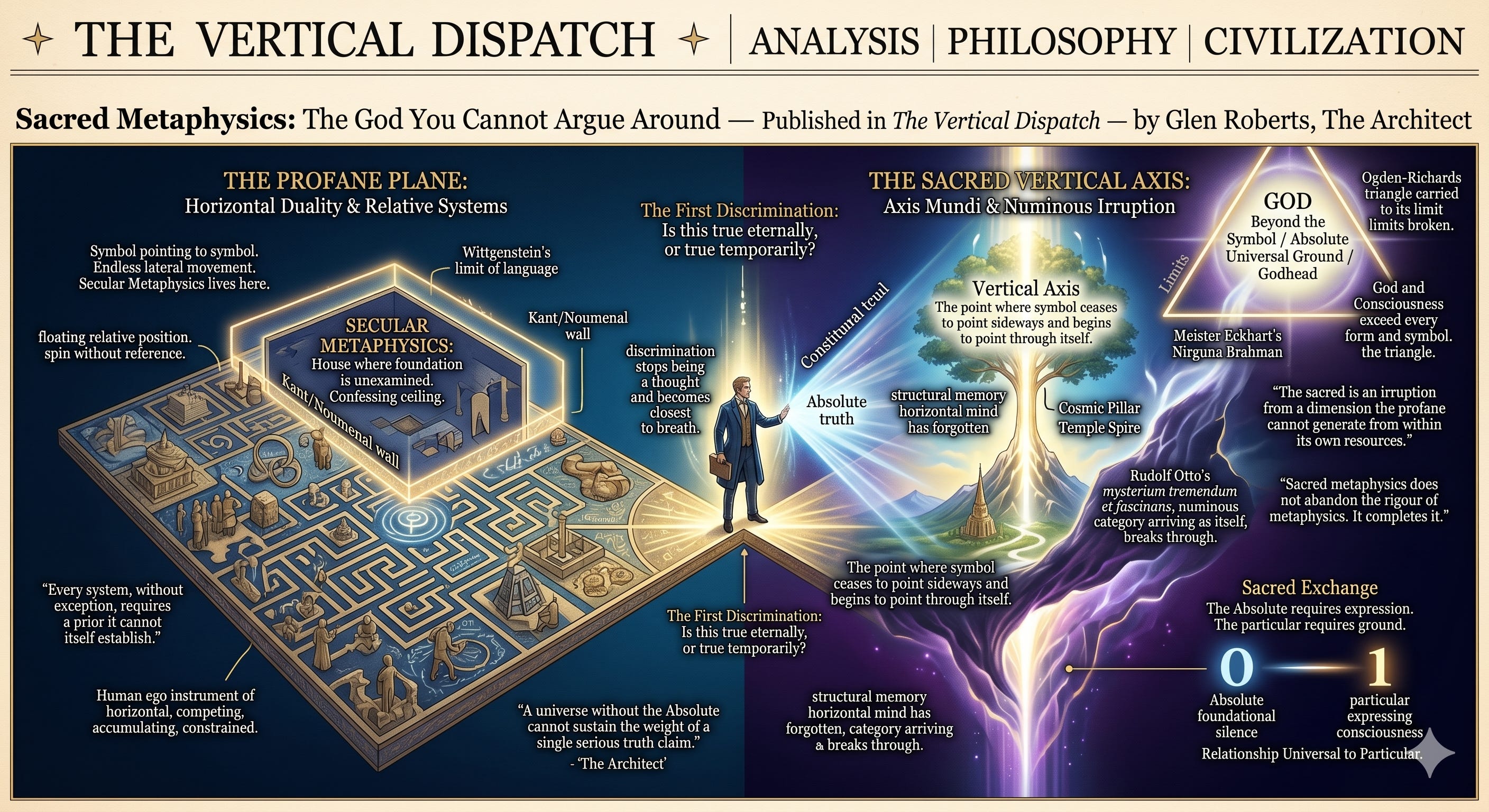
Before any other analysis begins, sacred metaphysics makes a discrimination that secular philosophy has rarely attempted with full seriousness.
Is this true eternally, or true temporarily?
These are not the same category, and collapsing them is the foundational error of secular metaphysics. Something may be true within a frame — within a culture, a historical moment, a physical regime, a state of consciousness — without being true as such. Conditional truth is real. But it is not the same as truth.
For truth to be truth — not useful, not coherent, not internally consistent, but genuinely true — it must hold across every frame. It must be eternal. And for something to be eternal, there must be something that is — permanently, unconditionally, prior to every frame that could contain or dissolve it.
That something is what sacred metaphysics calls the Absolute. What most of the world, across every tradition and every century, has called God.
Aristotle gave Western thought its first rigorous map of reality in the Categories — ten fundamental kinds of predication: substance, quality, quantity, relation, place, time, and so on. It remains one of the most disciplined acts of philosophical analysis ever undertaken. But Aristotle did not ask the one question that sacred metaphysics places first: which of these categories hold eternally, and which hold only conditionally? He mapped the furniture of reality without discriminating between what is permanent and what is frame-dependent. Sacred metaphysics does not discard Aristotle’s categories. It applies to them the one filter he did not: the eternal and the temporal.
Isaiah Berlin, in a different register entirely, approached the same fault line from the political direction. His distinction between negative liberty — freedom from constraint — and positive liberty — freedom toward something — maps with surprising precision onto the temporal and eternal. Negative liberty is horizontal: it operates within a given frame, removing obstacles, expanding conditional room. Positive liberty immediately raises the vertical question: toward what? Berlin was suspicious of positive liberty because he saw how easily a claimed Absolute becomes an ideology imposing itself as universal truth. He was right to be suspicious. But his caution points precisely to the sacred metaphysician’s task: without a genuine Absolute — eternal, not merely asserted — every claim to positive freedom is a masked relative pretending to be universal. The discrimination between eternal and temporal is exactly the safeguard Berlin needed and could not locate on secular terms.
But here is what no academic treatment of this discrimination will tell you: lived consistently, it does not remain an analytical tool. It becomes who you are.
When you train the awareness to ask, in every moment and every encounter — is this eternal or temporal, sacred or profane, vertical or horizontal? — the question stops being a thought and becomes something closer to breath. Automatic. Constitutional. The sacred metaphysician does not perform this discrimination. They inhabit it. And the world, viewed from inside that inhabitation, is a fundamentally different world than the one secular metaphysics describes.
Everything that follows in this piece flows from that single discrimination. Hold it as you read.
What Metaphysics Actually Is
Metaphysics is not mysticism. It is not religion in academic clothing. It is the attempt to ask the most fundamental questions available to a rational mind — What is real? What is the structure of existence? What makes knowledge possible at all?
Every philosopher who has ever lived has done metaphysics, including the ones who claimed to be dismantling it. You cannot think seriously about reality without standing somewhere. And the question sacred metaphysics forces into the open is precisely this: where are you standing, and what is holding the ground beneath your feet?
Secular metaphysics — the kind taught in most universities, published in most journals — proceeds as though this question has been satisfactorily deferred. It maps relations between concepts, constructs elegant formal systems, traces the logic of causation, consciousness, time, and identity. It does this with extraordinary sophistication.
And then it quietly runs out of ground.
Because every system, without exception, requires a prior it cannot itself establish. Kant saw this with devastating clarity. Pure reason reaches for the Absolute and finds only the architecture of its own categories looking back. The noumenal — the thing as it actually is — remains permanently beyond the reach of the very instrument we are using to look for it. Metaphysics, pursued honestly on its own terms, confesses its own ceiling.
Wittgenstein drew the boundary from the other side: whereof one cannot speak, thereof one must be silent. The limit of language is not the limit of reality. It is the outline of something that exceeds every symbol we have ever made.
This is not a failure of philosophy. It is philosophy’s most important discovery. The wall is real. And the wall has a shape.
The 50/50 That Is Not Really 50/50
We said we would grant the even odds. Let us examine them honestly.
If God does not exist — if there is no Absolute, no universal ground, no objective eternal truth of goodness, beauty, and being — then what you have is a universe of relatives. Process without ground. Relations without anchor. Every metaphysical claim becomes, at bottom, a preference held by a particular nervous system in a particular historical moment. Sophisticated perhaps. Internally consistent perhaps. But floating.
And here is the structural problem that no secular system has ever solved: a relative position without an absolute reference point has no weight. You cannot measure anything without a fixed point against which to measure it. You cannot have more or less without a scale. You cannot have true or false without a standard that is not itself merely another opinion.
Zero requires one. One requires zero. This is not mysticism — this is the architecture of knowledge itself. Duality is not a bug in the system. It is the system. And duality requires
both terms to be real. If the Absolute does not exist, neither does the relative — it simply dissolves into undifferentiated noise, with no axis against which to locate itself, measure itself, or mean anything at all.
The moment you claim that something is more true than something else, you have borrowed from the Absolute you may not believe in. The moment you call anything better or worse, you are standing on ground you have not yet named. The moment you make any argument whatsoever, you are presupposing that truth is not merely local — that it holds, or fails to hold, independent of your preference.
We are simply asking you to name what you are already standing on.
This is why we say, with humility but without apology: it is not really fifty-fifty. The asymmetry is not theological. It is structural. A universe without the Absolute cannot sustain the weight of a single serious truth claim. A universe with the Absolute can sustain everything — including the arguments of those who deny it.
The Sacred and the Profane
Mircea Eliade, one of the twentieth century’s most rigorous scholars of religious experience, made a distinction that secular thought has never adequately answered. The sacred and the profane are not two opinions about the same space. They are two fundamentally different modes of being in the world.
The profane is the horizontal plane. Symbol pointing to symbol. Concept referencing concept. An endless lateral movement across the surface of reality, mapping relations between things without ever asking what the things are grounded in. Secular metaphysics lives here. It is not without value. But it is without orientation.
The sacred is the vertical axis. The point where the symbol ceases to point sideways and begins to point through itself — toward what cannot be symbolized. Eliade called this the axis mundi, the world-axis present in every authentic tradition: the tree, the mountain, the pillar, the temple spire. Not decoration. Structural memory of a truth the horizontal mind has forgotten.
Rudolf Otto named what is encountered when the vertical axis opens. He called it the numinous — the mysterium tremendum et fascinans. The tremendous and fascinating mystery. Not an idea. Not a concept derived from ethics or reason or aesthetic feeling. A category of experience that arrives as itself, prior to every framework brought to contain it. The sacred is not an interpretation of the profane. It is an irruption from a dimension the profane cannot generate from within its own resources.
Wolfgang Smith, physicist and metaphysician, gave this the formal architecture it deserves. Reality is not flat. It is tripartite — the corporeal, the intermediary, the spiritual — and the catastrophic error of modernity is collapsing all three tiers into the first. Secular metaphysics operates within the corporeal and intermediary dimensions and mistakes the ceiling of that domain for the ceiling of reality itself. Sacred metaphysics knows that the vertical dimension is not optional. It is what makes the map coherent. Without the vertical, the horizontal is not merely incomplete — it is unanchored, spinning without reference.
God Beyond the Symbol
Here we must be precise, because the word God has been handled carelessly for a very long time, and we are not ashamed of it but we are insisting on its actual meaning.
We are not speaking of God as tribal guarantor, political authority, or cosmic reward mechanism. We are not defending any institution. We are speaking of God as what Meister Eckhart called the Godhead — the ground beneath every name and form, the reality that precedes every predicate, including the predicate of existence as we ordinarily conceive it.
Eckhart was uncompromising: even the name God is already a reduction. The moment we say it, we have made something of what exceeds every making. And yet — and this is the sacred paradox that no purely secular philosophy can resolve — the reduction is necessary, because we are particular beings embedded in language, moving through time. We require symbols. What sacred metaphysics insists is that we never mistake the symbol for what it is pointing toward.
This is the Ogden-Richards triangle carried to its absolute limit. Symbol, reference, referent. In ordinary language the referent is another thing in the world. In sacred metaphysics, the ultimate referent is what no symbol can contain. God and consciousness share this property: they are the two categories in all of human knowledge that exceed every form and every symbol used to describe them. You cannot put consciousness in a box. You cannot put God in a proposition. Both exceed the triangle. And both, for that reason, are the proper domain of sacred metaphysics rather than secular analysis.
Shankara, the eighth-century Advaita master who debated this question in every corner of the subcontinent, stated it with surgical precision. Nirguna Brahman — the Absolute without attributes — is not a theological position. It is what reason arrives at when it follows itself all the way to the end without blinking. The Absolute has no form because form is always particular. And the Absolute, by definition, is prior to every particular, including the particular of form itself.
Including you.
And here the argument becomes irreducibly personal. If the Absolute exists, you are a particular held in genuine relationship to the Universal. Not metaphorically. Not sentimentally. Structurally. Your particularity has weight because it is anchored against something that does not move. The relative has meaning because the Absolute is real. The one means something because the zero is real.
Without that — without the Universal — your particularity is simply one configuration among infinite others, with no more claim to significance than any other transient arrangement. The temporal truth of your existence would be precisely that: temporal. True for now. Gone without remainder.
We know which of these accounts reflects what serious human experience actually reports. We are asking the logic to follow the experience, rather than overriding it.
The Wall Every Metaphysician Eventually Reaches
Thousands of years of philosophy have produced extraordinary maps. The Greeks gave us the architecture of being. The medievals gave us the integration of reason and revelation. The moderns gave us critical precision. The postmoderns gave us the honest confession that every map has a mapmaker with a perspective.
And every one of these traditions, pursued with full seriousness to its terminus, arrives at the same wall.
Plato’s Forms require a Form of the Good that is beyond being itself. Aristotle’s causal chain requires an Unmoved Mover that is not itself moved. Kant’s critical reason requires a regulative Absolute it can gesture toward but never constitute. Hegel’s dialectic requires a total Spirit that contains and exceeds every partial moment. Even Thomas Nagel — a committed secular philosopher with no theological agenda — conceded in Mind and Cosmos that materialism cannot account for consciousness or value, and that something has been systematically excluded from the modern picture that no accumulation of sophistication can paper over.
The wall is not a failure of intelligence. It is intelligence reaching its own honest boundary — and finding that the boundary has a shape. And the shape, in every tradition that has examined it without flinching, points in the same direction.
Alvin Plantinga, from within the analytic tradition, made the epistemic point with precision: belief in God is properly basic. It does not require proof any more than belief in other minds requires proof, or belief in the reliability of memory, or belief in the external world. These are foundational commitments that make all other inquiry possible. The demand that theism justify itself entirely on the terms of a framework that has already excluded the divine is not
a neutral demand. It is a question that has been begged before the conversation begins. And it has been running Western intellectual culture for three centuries without acknowledgment.
Sacred metaphysics does not ask you to abandon rigour. It asks you to apply rigour to the framework itself — to notice what your system of inquiry has presupposed before it made its first move, and to ask whether that presupposition can bear the weight you have placed on it.
Sacred Metaphysics Is Not a Retreat — It Is the Completion Let us be clear about what is not being argued here.
We are not saying reason is insufficient. We are saying that reason, followed with full honesty, arrives somewhere that reason alone cannot inhabit — and that the appropriate response to that arrival is not retreat into irrationalism, but the expansion of the frame to include what reason has pointed toward.
We are not asking for the suspension of critical thought. We are asking for critical thought disciplined enough to notice when it has reached its own limit — and humble enough not to call that limit the limit of reality.
Sacred metaphysics does not abandon the rigour of metaphysics. It completes it. It takes the horizontal work of mapping relations, concepts, and formal structures — the indispensable work of Aristotle, Kant, Hegel, Wittgenstein, and everyone who has thought carefully about the structure of being — and it restores the vertical axis without which the map has no orientation, no ground, and ultimately no claim to truth rather than mere coherence.
The eternal and the temporal. The sacred and the profane. The Absolute and the relative. Zero and one.
These are not theological impositions on a neutral philosophical enterprise. They are the structural requirements of any system that intends to speak truthfully about reality rather than merely elegantly about its own categories.
Every serious metaphysician in history has been secretly borrowing from the God they refused to name. The Forms required the Good. The causal chain required the Mover. The categorical framework required the noumenal. The linguistic limit required what lay beyond it. The structure of knowledge itself required the Absolute against which relative claims could be measured.
You do not have to believe in God to do metaphysics. But if you refuse the Absolute as ground, your position floats free of any anchor. And a position without anchor has no weight — not because we have judged it, but because the architecture of knowledge itself will not support it.
Without the Absolute, metaphysics is a conversation about furniture arrangement in a house whose foundation has never been examined.
Without the relative — without you, without particularity, without the singular configuration of consciousness that you are — the Absolute remains unwitnessed. God without creation is a mirror with nothing to reflect. Zero without one is not silence. It is the precondition of all speech, waiting.
This is the sacred exchange at the heart of existence. The Absolute requires expression. The particular requires ground. And the relationship between them — irreducible, intimate, structural — is where meaning lives.
The sacred is not an addition to metaphysics.
It is what metaphysics has always been looking for.
And the God it has been circling, under every name and in every tradition, is not the God of any particular religion or any particular century. It is the Absolute universal, objective, eternal truth of goodness, beauty, and being itself.
That God has always been here. Closer than any argument. Prior to every system. Waiting, not to be proven.
To be recognized.
Glen Roberts writes The Vertical Dispatch on Substack under the byline The Architect. His book Sacred Metaphysics and Consciousness: The History of the Absolute and Eternal is forthcoming.
#SacredMetaphysics #Philosophy #Theology #Metaphysics #TheAbsolute #ExistenceOfGod #EternalTruth #SecularPhilosophy #VerticalAxis #AxisMundi #TheNuminous #MirceaEliade #RudolfOtto #ImmanuelKant #Wittgenstein #Aristotle #AdvaitaVedanta #Shankara #MeisterEckhart #NirgunaBrahman #Godhead #PhilosophyOfReligion #Epistemology #Ontology #AlvinPlantinga #ThomasNagel #TheVerticalDispatch #Substack Writers #LongformPhilosophy #ContemplativeThought #RationalFaith #TheSovereignSelf
From experience. There is an awareness state where thoughts feelings come and go. And the awareness remains. Alive. Awake. Seemingly timeless and boundless. Yet Dynamic and Alice’s. Prior to and surrounding the contents of ordinary mind. The source womb from which pulsations emanate. The holding of all. Our particular lives can turn back and reflect on and witness this everyday mystery.
I do appreciate your articulation that without the absolute all relatives are meaningless. The ennui of contemporary life.
Didn’t get past the first couple paragraphs. Eternal is an assertion.