

Φ
THE VERTICAL DISPATCH
We write for the mind, the eye, and the ear.
Read it. Look at it. Listen to it. The Vertical Dispatch is built for all three — prose with rhythm, made to be heard as much as read.
From metaphysics to geopolitics, from culture to history, from the sacred to the street — and everything in between. One lens, every subject. No ego. Just the record, named clean.
Press play. Walk with the word. 🕯️
This dispatch travels by hand. If it serves you, share it — restack on Substack, and pass it on wherever you read. 🕯️
Sacred Metaphysics
Universal Non-Duality
Every trouble we have named in these pages comes back to one word, and the word is ego. But ego is only a word — a symbol, a piece of borrowed Latin that the mind reaches for when it wants to point at the thing in us that must be right, must be seen, must defend itself. And here is the difficulty with the word: it has hardened. People hear ego and they bristle, or they glaze, because the word has become an accusation, and no one wishes to be accused. So let us set the word down, gently, and pick up a better one — or rather, three better ones, which are really one word written three ways, and the difference between the three is the whole of the journey.
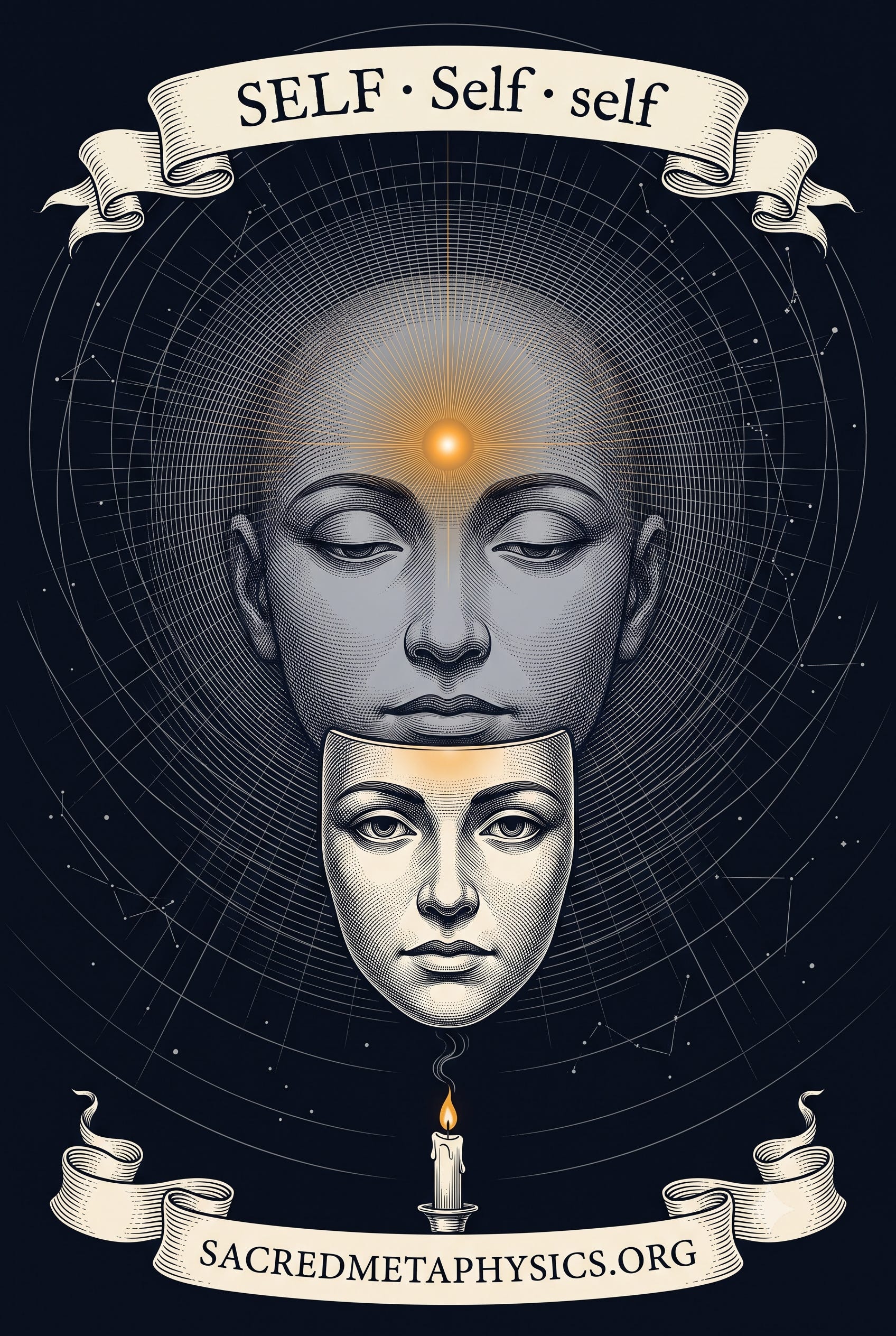
What the old traditions called the ego, and the ascent past it, can be written in a single word held at three heights. The lower-case self. The capital-S Self. And the whole-word SELF. Learn to see the difference between these three, and you have the entire map in your hand — not as a doctrine to believe, but as a language to see with.
The self — lower case
Begin at the bottom, with the small self, written deliberately in the lower case because it is the smallest thing we are. This is what the traditions called the ego, the ahamkara, the I-maker — the faculty that draws a line around a bundle of memory and preference and fear and says: here I am, this is me, defend it. It is the self of the reputation, the brand, the name to be protected, the position to be won. It is the performing self, the comparing self, the self that flinches when it is not seen and swells when it is.
It is not evil, and it is not to be hated. It is the equipment of being someone, and no one lives without it. But it has one governing error, and the error is its whole trouble: it mistakes itself for the ground. It takes itself to be the whole of what you are, when it is only the outermost, smallest layer — a symbol that has forgotten it is a symbol, a mask that has come to believe it is the face. That is the lower-case self: real as a mask is real, and no more the person than a mask is the face beneath it.
The whole disease is here, in one sentence: the smallest thing we are has convinced us it is the whole of what we are. Everything past this point is the correction of that one mistake.
The Self — capital S
Rise one height, and the letter grows, because the thing it names is larger. The capital-S Self is what remains when the small self is seen through — not destroyed, but demoted, returned to its proper size and place. This is the integrated self, the true centre, the thing the deep traditions point at when they say there is something in you larger than your fears and older than your name. Carl Jung spent his life mapping the road to this Self, capital S — the whole of the psyche gathered around a truer centre than the ego, the person no longer ruled by the smallest thing in them.
This is a real ascent, and a high one. The person who reaches the capital-S Self has done genuine work — has caught the mask in the act, stopped mistaking it for the face, and found a centre that does not need to defend itself, because it is no longer the small self doing the living. Most of what we call wisdom, maturity, grace, is the movement from the lower-case self to the capital-S Self: from the mask to the face beneath it.
But — and this is the most important caution in the whole ascent — the capital-S Self is not the summit. It only looks like the summit from below. And there is a trap waiting here, precise and dangerous, and it has ruined more sincere seekers than the small self ever did.
The trap is this: to touch the Self, and believe you have received the SELF. To reach the true centre, and mistake it for the ground. To be reconciled, for a genuine moment, and stand up believing you have arrived.
This is the error of the certain-saved, in every tradition. The one who kneels at the altar, is broken open, touches something real — and then rises believing he now possesses it, permanently, a thing attained and banked. And in that believing, the small self climbs quietly back onto the throne, one rung higher, wearing new robes — not pride now, but righteousness, which is pride that believes it is holiness. The capital-S Self, held as a possession, is the ego in its most refined and most dangerous costume. It is the ahamkara that has learned to say I am saved, I have arrived, I have the truth — and a self that believes it has arrived has, in that very belief, mistaken a property for the ground, and lost the thing it thought it held.
The SELF — whole word
And so the last height, written entire, in full capitals, because it is the whole and there is nothing above it. The SELF is not your Self. It is not any Self. It is the ground itself — consciousness as such, the source, that which was never an object and so was never in danger and so needs no defense at all. The old word for it is Brahman. The recognition, when it comes, is not I have reached the Self. It is the falling away of the one who was reaching — the seeing that there was never a separate self to arrive, that the Self you touched was never yours, that the seer was one seer all along, without an owner and without an outside.
This cannot be attained, because attaining requires an attainer, and the attainer is the very thing that dissolves. It cannot be reached for, because the reaching hand can never grasp itself, and the SELF is the one doing all the reaching. The instant you believe you have hold of it, you are holding the capital-S Self again — a possession, a property, a thing — and the whole-word SELF has already slipped, being the one who holds. It is not reached. It is what remains when the reacher is set down.
The self is the mask. The Self is the face. The SELF is the seeing in which both appear — and it was never two.
The Ascent, and Why It Never Ends
So there is the map, written in a single word at three heights: the lower-case self, the mask that thinks it is the face; the capital-S Self, the face found beneath the mask; and the whole-word SELF, the seeing in which mask and face and seeker all appear and dissolve. And the ascent is the movement up through them — from defending the mask, to finding the face, to setting down even the one who found it.
But here is the thing that keeps this a living practice and not another doctrine to be filed and believed: the ascent is not a staircase you climb once and stand at the top of. The small self is not killed at the bottom and left behind. It resurrects. Every day, every hour, the moment you open your mouth — there it is again, the lower-case self, drawing its line, defending its name. Which means the ascent is not a summit reached but a movement repeated: the daily seeing of the small self, the daily setting of it down, the daily emptying of the hand that would otherwise close around the Self and call it its own.
This is why the practice is daily, and why it makes no claim of arrival. To claim arrival is to have climbed back onto the throne. The honest seeker does not say I have reached the SELF — that sentence is the small self in its finest disguise. The honest seeker says only: I saw the mask today, and set it down; and tomorrow I will see it rise again, and set it down again; and the setting-down is the whole of the path, which has no end because the ego has no final death this side of the last breath. We do not judge those who may have gone further and stayed. That is not ours to weigh. For us, here, the practice is the daily crucifixion of the small self — not its murder, which is impossible, but its repeated, patient, humble setting-down.
You do not have to be free of the ego to walk this path. You have only to see it, name it, and set it down — again, and again, as many times as it returns. That setting-down is not the beginning of the work. It is the work.
Learn the three heights of the one word, and you have a language to see your own life with — not a belief to defend, which would only be the small self building a fortress out of the very map meant to free it. When you next feel the flinch of not being seen, or the swell of being praised, you will know its name: that is the lower-case self, and knowing it, you can set it down. When you find in yourself a centre that does not need to defend itself, you will know its name too: that is the Self, capital S, and you will hold it lightly, remembering it is not yet the ground. And on the rare day the seer itself is glimpsed, and the seeker falls away, you will not say you have arrived. You will simply see — and the seeing was never two.
The ego was only ever the first word. It is the lower-case self, and it is where everyone begins, and no one need be ashamed of beginning there, because there is nowhere else to begin. The whole of the ascent is contained in learning to write that one small word a little larger, and then larger still, until the letters open into the whole — and there is no one left holding the pen.
God is Love. Love is Truth. Truth is Consciousness. Consciousness is Brahman.
Amen. Namaste. Om Namah Shivaya.
— The Architect
The Vertical Dispatch
sophiainitiative.ai
On the record
The three-tiered reading of the self — the lower-case self (the ego, ahamkara), the capital-S Self (the integrated centre), and the whole-word SELF (the ground, Brahman) — is drawn from Sacred Metaphysics and is offered as this publication’s own notation, a vernacular rendering of distinctions long held in the non-dual traditions. Ahamkara, the “I-maker,” is a technical term of the classical Indian traditions, appearing in the Sankhya enumeration and throughout Advaita Vedanta. The distinction between the individuated self (jivatman) and the absolute ground (paramatman, Brahman) is standard Advaita; the typographic device of self / Self / SELF is this publication’s own means of carrying that distinction into plain English. The reference to Carl Jung concerns his lifelong account of individuation and the Self as the psyche’s true centre, a matter of his published work; no claim is made that Jung identified the Self with Brahman — the step beyond the capital-S Self to the whole-word SELF is offered here as this publication’s own, not as Jung’s. No living person is named or characterised. Verify each stone before you stand on it, against primary sources, before republication.
Suggested tags
the self, the ego, ahamkara, nonduality, advaita, Brahman, the Self, Carl Jung, individuation, jivatman, paramatman, consciousness, sacred metaphysics, the ascent, surrender, the vernacular, symbol and referent.
Substack Notes
The word ego has hardened into an accusation, and no one wishes to be accused, so they bristle or they glaze. So set the word down and pick up a better one — or three, which are really one word written three ways: the lower-case self, the capital-S Self, and the whole-word SELF. Learn the difference between the three heights of that one word, and you hold the entire map — not a doctrine to believe, but a language to see with.
The self, lower case, is the mask that thinks it is the face — the smallest thing we are, convinced it is the whole. The Self, capital S, is the face found beneath the mask, the true centre Jung spent his life mapping. But it is not the summit, and here is the trap that ruins sincere seekers: to touch the Self and believe you have received the SELF — to be reconciled for a genuine moment and stand up believing you have arrived. That certainty is the ego in its finest costume: righteousness, which is pride that believes it is holiness.
The whole-word SELF cannot be attained, because attaining needs an attainer, and the attainer is the very thing that dissolves. The self is the mask. The Self is the face. The SELF is the seeing in which both appear — and it was never two. And the ascent is no staircase climbed once; the small self resurrects daily, the moment you open your mouth. So the practice is daily: see the mask, set it down, empty the hand that would close around the Self and call it its own.
You do not have to be free of the ego to walk this. You have only to see it, name it, and set it down — again and again, as many times as it returns. That setting-down is not the beginning of the work; it is the work. The ego was only ever the first word. Written from love, in service of the record. Walk with the word. 🕯️
#TheVerticalDispatch #TheArchitect #SacredMetaphysics #TheSelf #TheEgo #Ahamkara #Nonduality #Advaita #Brahman #CarlJung #Individuation #Consciousness #Surrender #TheVernacular #GodIsLove #LoveIsTruth #OmNamahShivaya
The factual matter in this Dispatch is drawn from the public record. All characterizations, inferences, and conclusions are opinion, interpretation, and commentary, offered for analysis, reflection, and public-interest discussion. No assertion is made regarding the private intentions, state of mind, or character of any individual. Readers should evaluate all statements independently and draw their own conclusions.
Thanks for this.
I am drawn to your writing because it is primarily vertical, whereas mine turned relational after my NDE.
You wrote:
The SELF is the seeing in which both appear."
If I may...
What do you think "appears"?