


Φ
THE VERTICAL DISPATCH
We write for the mind, the eye, and the ear.
Read it. Look at it. Listen to it. The Vertical Dispatch is built for all three — prose with rhythm, made to be heard as much as read.
From metaphysics to geopolitics, from culture to history, from the sacred to the street — and everything in between. One lens, every subject. No ego. Just the record, named clean.
Press play. Walk with the word. 🕯️
This dispatch travels by hand. If it serves you, share it — restack on Substack, and pass it on wherever you read. 🕯️
Building Canada Strong · The Age of Consequences
Sunday, July 5, 2026
“Why must we pay so much more for oil and gas produced, processed, and consumed right here in Canada, with no connection to the Middle East whatsoever? And who benefits from this outcome?”
— Jim Stanford, economist, Centre for Future Work, April 2026
Here is a fact worth holding still, because everything that follows hangs on it. On the morning the United States and Israel opened their war on Iran, the price at the pump in Ottawa moved within hours. Not within weeks. Within hours. And the gasoline it moved — the fuel in the tanks under the forecourt — had been refined weeks earlier, from crude pumped months before, in a country that produces far more oil than it consumes, half a world away from any strait an Iranian mine could ever close.
No molecule of that fuel came from the Middle East. Its cost of production did not change. Nothing physical happened to it. And yet the number on the sign climbed, the way it always climbs — fast on the way up, slow on the way down — because Canadians, in a nation awash in more energy than it needs, pay the world’s price for oil the way a country with no oil at all would pay it.
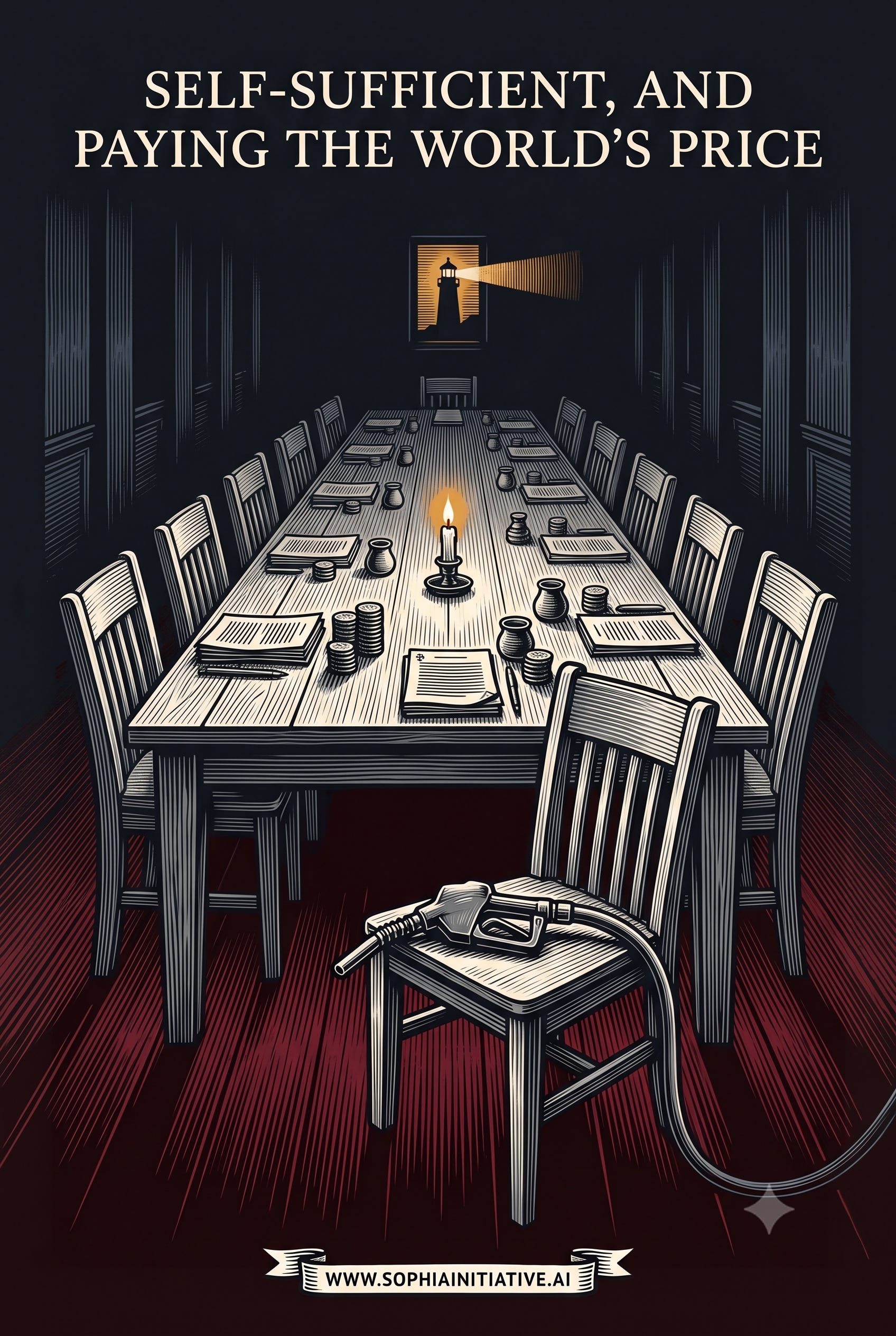
This dispatch asks two questions, and they are not rhetorical. Why does a self-sufficient producer nation charge its own citizens the global price? And now that Canadian taxpayers are being asked to finance a forty-billion-dollar pipeline to sell still more of that oil abroad — what, exactly, does the citizen get back? Here is the answer in one line, and the rest of this dispatch is its proof: a globally-traded commodity has one price, and a producer nation’s own consumers pay that one price — unless the nation deliberately builds a wall between the world price and the domestic pump. Canada never built the wall. And in the deal now on the table, every party secured a return except the household at the pump — the one party asked to pay the most was promised nothing. That is the empty chair, and we will come to it.
The frame that holds all of this is the one this publication uses on every problem: the AIG filter — is there a problem, is there a solution, is it credible, is it achievable. We will walk it in order. But first the current beneath it all, because you cannot judge the Canadian pump without understanding why the world’s price is high right now, and why — for reasons we will lay out plainly — today’s price may be closer to the future of fuel than to its past.
The Current Beneath the Price: A Strait the World Forgot
On the twenty-eighth of February, 2026, the United States and Israel opened a war on Iran. Within days the Strait of Hormuz — the twenty-one-mile throat through which roughly a fifth of the world’s oil moves — went effectively shut. It has not fully reopened. And somewhere between the third month and the fourth, the world quietly stopped looking at it. That forgetting is the first thing to correct, because the strait is still choking, and its grip is what sets the deck every Canadian pays into.
The numbers are stark and they are sourced. Before the war, about a hundred and thirty ships a day transited the strait; Lloyd’s List Intelligence put the monthly figure near three thousand vessels. After the war began, traffic collapsed. Kpler recorded just a hundred and ninety-one vessels crossing in the entire month of April — against a baseline of three thousand. CNN and the U.S. Naval Institute framed it the same way: traffic at under ten percent of the pre-war average, at the low point under five. The International Maritime Organization reported around twenty thousand mariners and two thousand ships stranded in the Gulf. Iran did not merely close the strait; it reshaped it, abandoning the international shipping lane, publishing its own route hugging Iranian waters past Larak Island, and permitting passage on its own terms. The International Energy Agency called it the largest supply disruption in the history of the global oil market. Not of the decade. Of the history.
The daily cost of that closure runs in tiers, and the tiers must not be blended. The direct bleed: Gulf producers and Iraq lose on the order of one-point-one billion dollars a day in oil revenue while the strait stays shut. The institutional read: the Federal Reserve Bank of Dallas modeled the shock raising the benchmark U.S. crude price toward ninety-eight dollars and cutting global economic growth by nearly three percentage points, annualized, in a single quarter. And the ledger of who won and who lost — this is the part that matters for a producer nation — the New York Times, comparing the war period against the year before, found the biggest beneficiaries were the United States, its export revenue up about fifty billion dollars, and Russia, up more than fifteen, while every Gulf nation that could not bypass the strait saw revenue fall. The chokepoint did not only cost. It transferred. Hold that word; it returns.
Why This Price May Be the New Floor
The comfortable assumption — the one every household is quietly making — is that when the strait reopens, prices fall back to where they were. The record says otherwise, and it says so through several institutions at once. There are reasons to believe today’s price is less a spike to be waited out than a floor to be lived on. Four of them, each bound to its source.
One — the reopening is not the recovery. The word “reopening” and the word “recovery” are being priced as if they are the same event; they are months apart. When the strait reopens, the first released barrels arrive into refiners who already covered their summer needs, so it briefly looks like a glut — a false dawn that fools the market into calling it over. Then the real wave lands: every nation that drained its reserves to survive the closure must refill them at once, buying above what it consumes. This has a name in the trade — the restocking overhang. The Atlantic Council estimates that refilling the lost inventory over a year would demand an extra one-point-eight million barrels a day beyond baseline demand, and it flags that this assumes countries do not expand their reserves past prewar levels. They are doing the opposite. Governments caught underprepared are now mandating larger buffers. And the bill is already running: the U.S. Strategic Petroleum Reserve has fallen roughly ninety million barrels since March, about a million a day, oil that must all be bought back.
Two — the floor itself has moved. The U.S. Energy Information Administration now writes, in plain language, that oil prices will reflect a larger risk premium throughout its entire forecast, because the structural disruption to Middle East flows persists even after a ceasefire. That is the government’s own forecasting body saying the premium is baked into the whole forward curve. Two permanent supply changes seal it: the United Arab Emirates exited the OPEC+ producer group as of May 1, forcing the EIA to cut its estimate of the cartel’s spare capacity — the world’s shock absorber — by about a third. And the World Bank’s structural finding: a geopolitically-driven one-percent drop in production now pushes prices up an average of over eleven percent, with volatility roughly double the calm-period norm. The machine that used to pull prices back down has fewer teeth than it had a year ago.
Three — the only way down is a glut, and a glut is now hard to make. Oil falls only when supply outruns demand — either a real oversupply, or the demand destruction a high price causes eating the market out from under itself. The classic fast route to a glut is a producer breaking ranks to grab market share, flooding the market to punish rivals; it is the 2014 and 2020 playbook. But that lever is weaker now, and even where a surplus does form, it cannot clear quickly — for the two physical reasons that close this section.
Four — the hulls and the pipes are the bottleneck behind the bottleneck. The world’s fleet of supertankers — the vessels that carry the bulk of long-haul crude — numbers only about eight hundred and eighty, and roughly a quarter of them are walled off in the sanctioned “shadow fleet.” A new one cannot be built in under three years; the order books are booked out that far, and a five-year-old used tanker now sells for more than a new one, because the used ship can sail this week and the new one cannot. Pipelines cannot rescue this, because a pipe delivers only where it already runs, and the bypass lines that skip the strait are near their ceilings — and they end at a coast, where the oil still has to board a scarce ship to cross an ocean no pipe can span. The bottleneck moved from the well to the hull to the pipe, and none of those three can be fixed fast.
Reopening is a word. Recovery is a thing. They are months — perhaps years — apart.
Set the two clocks honestly, because evenhandedness demands it. The forecasters split. The EIA’s own path has the benchmark easing toward eighty-nine dollars by late this year and seventy-nine in 2027; the World Bank sees it falling to seventy in 2027; JPMorgan is the outright bear, expecting brief geopolitical rallies to subside into soft fundamentals. So the acute war peak — the part that took crude to its highs — likely does compress. But the floor beneath it has risen, and it does not fall back. The honest synthesis is neither “prices stay at the peak forever” nor “they snap back to 2019.” It is a new, higher plateau between the two. The old normal is gone. And for a household, the practical instruction is the same whichever forecaster is right: do not budget for a return to the old price, because it is not coming.
The Paradox: Self-Sufficient, and Still Paying
Now bring it home, because here is where a Canadian should feel the whole thing in the chest. Canada is a net oil exporter. It produces roughly five million barrels a day and consumes far less — three-quarters more than it burns, by the economists’ framing. On paper, this is an energy-rich nation, one of the world’s top producers, blessed with more oil than it could use in generations. And its citizens pay the world’s price at the pump, to the cent, on oil that never left the country.
This is not a contradiction the record hides. It is one the record names. The Bank of Canada’s own economists put it plainly: Canadian retail gasoline is tied to global benchmarks priced in U.S. dollars, because crude is a globally-traded commodity, and even though Canada is a major producer, Canadian refineries buy crude at market rates set by global supply and demand. So a war on the far side of the earth empties a Canadian wallet within twenty-four hours — on fuel already made, from oil already pumped, with no change to the cost of producing any of it.
Here is the mechanism, bound to its referent, because this is the load-bearing point. A globally-traded commodity has one price, and a producer nation’s own consumers pay that one price — unless the nation deliberately builds a wall between the world price and the domestic pump. Some producer nations build that wall; their citizens pay a made-at-home price. Canada never built it. Canada chose the open-market path — became, in the analysts’ word, a price-taker, historically tied to a single buyer, with about ninety-seven percent of its oil exports going to the United States. So the pump tracks the global benchmark no matter where the barrel came from. It is not that a producer nation cannot shield its citizens. It is that Canada chose a system in which being a producer does nothing for the pump — and that choice was never put to Canadians in the open.
The cost of that choice is not hypothetical, though its exact size is contested. One economist estimated the cumulative toll on Canadian consumers from the 2022 oil spike alone — a war in Ukraine, a country that barely produces oil — at something over two hundred billion dollars across three years, on the order of twelve thousand dollars per household. Treat that number as an illustration of direction, not a load-bearing figure: it is his estimate, it is disputed, and a net-exporter nation also gains at the national level when prices rise. The argument does not need the precise dollar amount. It needs only the shape of the thing, which no one disputes: the household does not feel the national gain. It feels the pump. And that gap — between the country’s ledger and the family’s budget — is the whole story, whether the toll is measured in the tens of billions or the hundreds.
The Windfall, and Where It Lands
Follow the money, because the keel says accountability points up at the structure, never down at the citizen. When oil spikes, who gains and who pays? A net-exporter nation does see a national windfall — improved terms of trade, higher export earnings, richer royalties. The federal Spring Economic Update says so; every bank economist says so. But the windfall does not fall evenly, and the honest accounting of where it lands is unforgiving.
The gain concentrates. It flows to energy-sector profits, to provincial royalties — the price of oil makes or breaks Alberta’s budget — and to shareholders, many of them foreign, and even the domestic ones distributing returns across global portfolios rather than reinvesting at home. Meanwhile the cost falls on the household as a regressive tax: the family that spends the largest share of its income on fuel and heat absorbs the most, while receiving the least of the offsetting gain. As one university analysis put it, a war-driven oil spike in Canada today is less a national windfall than a redistribution — across sectors, across provinces, and from consumers to producers. The transfer we watched the strait perform on a global scale runs again, quietly, inside our own borders: from the many who pay the pump to the few who hold the wells.
The Filter: Public Money, and What It Should Buy
Now the deal, and the question your taxpayer dollar earns you the right to ask. On July 2, 2026, Prime Minister Carney and Alberta Premier Smith announced a proposed pipeline from Alberta to the British Columbia coast — one million barrels a day, bound for tidewater and export to Asia, roughly following the existing Trans Mountain corridor, at a stated cost of thirty-five to forty-four billion dollars. Let us run it through the AIG four-question filter, because that is how this publication tests any proposal that asks for public trust and public money.
Is there a problem? Yes — and it is a problem of who pays and who benefits. This is not an ordinary public-private venture. The reporting is blunt: the project is, in one analyst’s words, almost one hundred percent taxpayer-funded — with only about ten percent carried by the private partner, Pembina, it is effectively a taxpayer-built pipeline. One distinction matters and the dispatch will not blur it: “funded” is not the same as “owned.” What the public is carrying is the capital and the risk of building it; the ownership picture is more layered — Ottawa and Alberta enter as equal partners, with a meaningful equity stake reserved for Indigenous communities and the federally-owned Trans Mountain Corporation leading construction. So the public pays to build and carries the downside, while the ownership and the eventual profit are shared out among governments, Indigenous nations, and the producers who ship through it. And the paradox sharpens against the deal’s own numbers: Canadians are putting up thirty-five to forty-four billion dollars in public money and risk, while the oil companies who stand to benefit are expected to earn roughly sixty billion dollars in profit this year alone. The tell is the private sector’s absence — the Pembina Institute’s own director said the lack of private investment should ring alarm bells in Ottawa. When private capital will not carry a project tied to an industry earning sixty billion in profits, and the public purse must, the question of what the public gets back stops being rhetorical.
Is there a solution? Yes — a sovereign return the household can feel. The tool exists, because the deal is built entirely of such tools. B.C. negotiated an annual royalty for taking on the environmental risk. First Nations negotiated a meaningful equity stake. B.C. and First Nations secured an environmental liability and emergency-response trust fund. The oil companies secured regulatory certainty and a fast-tracked path through the Major Projects Office. Attaching a condition to public money is not exotic here; it is how every party at the table secured its return. The solution is simply to seat the one party that was left standing: the Canadian citizen, as consumer. A sovereign condition on the public stake — a domestic-supply or domestic-price provision — is the fair-trade counterpart to the risk the public is being asked to carry.
Is it credible? Here honesty is required, and the referent must be named precisely. This pipeline carries oil to tidewater for export — by design, the barrels are meant to leave. So it cannot physically pipe cheaper crude into a Canadian refinery; the claim “this pipeline should give us cheap gas” outruns the referent and a fair reader would reject it. The credible claim is narrower, and it survives: when the public finances an energy asset, the public deserves a return it can feel — and the instrument for delivering one is not a fantasy, because other nations already run it.
Name it plainly, so the solution is architecture and not a wish. The mechanism is a fuel price-stabilization fund tied to an automatic pricing rule. Colombia runs one: retail gasoline and diesel are linked to the international benchmark, but monthly adjustments are capped — on the order of three percent — and a stabilization fund absorbs the difference, so a global spike is smoothed at the domestic pump instead of landing on the household in a single week. The funding logic is the sovereign point, and the International Monetary Fund names it exactly: for an oil-producing country, the world price is an opportunity cost — the revenue a nation forgoes by selling a barrel at home instead of exporting it is, in the Fund’s own words, akin to a subsidy. In other words, a producer nation already holds the lever. Canada could fund a domestic buffer directly from the export earnings this very pipeline is built to generate — the windfall pays for the shield — triggered automatically when the global benchmark crosses a threshold. That is a policy choice, not a dream. The tool exists and is in use.
And the honesty the keel demands: these funds have a mixed record. The IMF notes that stabilization funds in developing economies have often been exhausted during sustained price run-ups, or quietly redirected. A buffer is not a miracle; it smooths a spike, it does not repeal the world price, and if the high price is not a spike but a raised floor — as this dispatch argues it now is — a buffer must be designed to soften the shock, not to promise a permanently cheaper pump. Named with its limits, the instrument is real. Named as magic, it would be the bigger, weaker claim. We name it real.
Is it achievable? The critical path closes — if the will exists. The deal is not yet built; the Major Projects Office has until October 1 to designate it in the national interest, and construction would not begin before September 2027. There is time. The financing framework is being written now, its details, in the province’s own words, still to come. The moment to attach a sovereign condition is precisely this one — before the public stake is finalized, while every other party’s return is still being papered. The constraint is not feasibility, and it is not the absence of a working model elsewhere. It is whether anyone in Ottawa asks the question on the household’s behalf.
Every party at the table secured a return. The one asked to pay the most secured nothing for the pump.
So the smaller, unkillable claim — the one that survives the sharpest reader — is not that a pipeline owes Canadians cheap gasoline. It is this: the deal, as written, carved out a return for the province, for First Nations, for the shareholders, and for the treasury, while carving out nothing for the citizen at the pump. The tool to attach such a condition demonstrably exists, because the deal is made of such tools. The household was the only party at the table asked to pay the most and promised nothing in return. That is not a demand for a free lunch. It is a question about an empty chair.
The Case for the Deal, at Full Strength
Evenhandedness is the keel, so here is the government’s case made as its own defenders would make it, without strawman. The public return, they would say, already exists — it is simply national rather than personal. The pipeline is projected to catalyze over two hundred billion dollars in investment and support some hundred and fifty thousand jobs; it diversifies Canada’s exports away from a single buyer in an unstable world; it strengthens the country’s hand as an energy supplier of choice; and it keeps Alberta anchored in confederation ahead of a separation referendum this October. The royalties it generates fund the very hospitals, schools, and services that serve the household indirectly. A domestic-price carve-out, they would argue, could forgo the export windfall that pays for all of it — you cannot both sell to the world at the world’s price and shield your citizens from that price, without surrendering the gain that funds the public good. The private partner Pembina, they would add, brings discipline that guards against the cost overruns that plagued Trans Mountain’s expansion.
It is a serious case, and a Canadian should weigh it honestly. But it turns on a single question the citizen is entitled to press, and we hand it to the reader rather than answer it for them: is national income in Ottawa’s ledger the same thing as relief in a household’s budget? The country may grow richer while the family at the pump grows poorer — that was the redistribution we traced. The government’s case is that the two eventually connect. The household’s question is how many years of a raised price floor it must carry at the pump before that connection is felt at the kitchen table. Both propositions are on the record. The reader may decide which weighs more.
The Keel
A man who has read real water knows the wave that takes the boat is rarely the one you see coming. It is the one behind it — the one you relax into after the first has passed, when you have already dropped your brace and turned to look at the shore. The reopening of the strait will be that breath of false calm. The screens will go quiet, the glut will look like relief, and a tired country will turn away and call it over. But the floor will have moved, and it will not move back — and the household that budgeted for a return to the old price will be caught unready by a plateau that stays.
So the counsel of this dispatch is plain, and it is offered not to frighten but to steady, which is the only reason a keel exists. Adjust to the new number. Put it in the household budget as the number, not as a spike you are waiting out. Do not plan a single dollar on fuel coming down this year, and hold that discipline, with caution, deep into next. If prices ease, that is a gift — but a family should never budget on a gift. Plan for the floor. And know, while you plan, that the floor did not have to sit this high — that a nation with more oil than it needs chose a system in which its own abundance never reaches its own pump, and is now asking its citizens to finance still more export while promising them nothing at the till.
The transfer runs from the many to the few — from the household to the well, from the citizen to the shareholder, from the kitchen table to the ledger in Ottawa and Calgary. Naming that transfer is not resentment; it is accountability pointing up at the structure, exactly where it belongs, and never down at the family trying to fill a tank. For a nation is not only an economy — it is a moral structure, and a moral structure is judged by who it leaves standing outside the room when the returns are shared. The fair trade is simple and it is not radical: if the public carries the risk, the public earns a return it can feel. Every other party at the table understood that. Only the citizen’s chair was left empty. The moment to fill it is now, before the papers are signed — and the ask is nothing more than what everyone else already secured.
The waters are rough — Canadian and global. The old order is loosening; the price floor is rising; the pump does not fall the way it climbs. But the keel holds when you read the water without fear, name the record clean, and set the boat at the right angle so the people aboard glide safe over the wave. Walk with the word.
God is Love. Love is Truth. Truth is Consciousness. Consciousness is Brahman.
Amen. Namaste. Om Namah Shivaya.
— The Architect.
The Vertical Dispatch
sophiainitiative.ai
On the record
Sourcing note. All figures below are drawn from the public record and are date-stamped; several are volatile and should be re-verified before republication. The July 2, 2026 pipeline announcement and the ongoing Iran ceasefire have both moved the board since several of these figures were published. Ship-transit and stranded-vessel counts across the Hormuz crisis are explicitly lower bounds, as many vessels transited with AIS transponders disabled.
The strait and the global price. Pre-war baseline ~130 ships/day (Congressional Research Service) and ~3,000 vessels/month (Lloyd’s List Intelligence); 191 vessels in April, traffic under 10% of pre-war (Kpler; CNN; USNI News, May 1, 2026); ~20,000 mariners / 2,000 ships stranded (International Maritime Organization). “Largest supply disruption in the history of the global oil market” (International Energy Agency, cited widely). ~$1.1B/day direct revenue loss, Gulf + Iraq (SolAbility model, April 11, 2026 — modeled figure). Benchmark to ~$98 and global growth down ~2.9 points annualized, Q2 (Federal Reserve Bank of Dallas, March 20, 2026). US export revenue up ~$50B, Russia up >$15B over the war period (New York Times analysis through May 8, 2026).
Why the price may be the new floor. Restocking: refilling lost inventory requires ~1.8 mb/d above baseline for a year, assuming no reserve expansion (Atlantic Council, Global Energy Center, May 7, 2026); restocking cycles historically add ~5–15% to demand for ~6–18 months (analyst estimate, June 2026 — provisional). US SPR down ~90M barrels since March, ~1 mb/d (EIA weekly data, via Free Market Speculator, July 2026). “Larger risk premium throughout the forecast” (US Energy Information Administration, May Short-Term Energy Outlook). UAE exited OPEC+ May 1; OPEC spare capacity cut ~35% (EIA, via Investing.com, May 26, 2026). A 1% geopolitical production drop raises prices ~11.5%, volatility ~2x calm periods (World Bank Commodity Markets Outlook, April 28, 2026). Forecast easing to ~$79–$89 by 2027 (EIA; World Bank; JPMorgan 2026 outlook). Global tanker fleet ~880 VLCCs, ~23% in sanctioned shadow fleet, ~3-year newbuild lag, used-exceeds-new resale (Argus; Tankers International; iMarine; Clarksons data, Feb–Mar 2026). IEA bypass-pipeline capacity ~3.5–5.5 mb/d vs ~20 mb/d strait flow.
The Canadian paradox and the deal. Canada a net exporter, ~5 mb/d production, retail pump tied to global benchmarks priced in USD (Bank of Canada, via Global News; NRCan). ~97% of exports historically to the US (Troy Media / Globe and Mail). ~$200B / ~$12,000-per-household toll from the 2022 spike (Jim Stanford, Centre for Future Work, April 2026 — his estimate; contested; treated as illustrative of direction, not load-bearing; net-exporter national gains per Spring Economic Update and bank economists provide the counter). Redistribution framing (MacEwan University analysis, March 2026). Pipeline: ~$35.2–$43.7B, 1 mb/d, Trans Mountain corridor, export to Asia, construction from ~Sept 2027, MPO designation by Oct 1, 2026 (Alberta government submission; Prime Minister’s Office release, July 2, 2026). “Almost 100% taxpayer-funded,” ~10% Pembina (analyst via CBC, July 4, 2026; Globe and Mail, July 3, 2026) — funding/risk distinguished from ownership: Ottawa–Alberta equal partners, Indigenous equity stake, Trans Mountain Corp. leads construction (PMO release; National Observer, July 2, 2026). Oil companies’ ~$60B profit this year (critic cited in Globe and Mail). B.C. royalty, First Nations equity stake, environmental trust fund, Pembina as private partner (PMO release; Global News; National Observer, July 2, 2026). ~$200B catalyzed investment / ~150,000 jobs; Alberta separation referendum October 2026 (PMO; Globe and Mail).
The domestic-price mechanism. Fuel price-stabilization fund with automatic pricing rule, monthly adjustments capped (~3% gasoline), fund absorbs the difference: Colombia model (IMF 2019, cited in Wiley/Asia & the Pacific Policy Studies, 2025). “World price is an opportunity cost … revenue forgone is akin to a subsidy” for an oil-producing country (IMF Working Paper 20/194). Mixed record — stabilization funds often exhausted in sustained price run-ups or redirected (IMF Technical Notes and Manuals, 2012; Working Paper 20/194). Presented as a real, in-use instrument with its failure mode named, not as a guarantee of a permanently cheaper pump. Verify against primary sources before republication.
Suggested tags
Canada oil prices · gas prices Canada · Alberta pipeline · Trans Mountain · Carney · Danielle Smith · net oil exporter · Strait of Hormuz · energy sovereignty · taxpayer funding · pump prices · energy affordability · Building Canada Strong
Substack Notes
Canada produces more oil than it burns. So why does a war on the far side of the world empty your wallet at the pump within twenty-four hours — on fuel already refined, from oil already pumped, that never left the country? This dispatch answers that, and then asks a harder question: now that Canadian taxpayers are financing a $40-billion pipeline, what does the citizen get back?
The answer to the first is a choice we never made in the open. Canada is a price-taker — our pump tracks the global benchmark because we never built the wall between the world price and the home pump that some producer nations build. The answer to the second is an empty chair. The new pipeline deal carved out a return for the province, for First Nations, for the shareholders, and for the treasury — and nothing for the household at the pump. When private capital won’t touch a project earning $60 billion in profits and the public purse has to carry it, the question of what the public gets back stops being rhetorical.
And the timing is grave. For reasons we lay out in full — a strait the world forgot but that is still choking, an OPEC buffer cut by a third, a risk premium now baked into the U.S. government’s own forecast, a supertanker fleet that can’t grow for three years, and pipelines that end at a coast where oil still needs a scarce ship — today’s price may be closer to the future of fuel than to its past. The peak may ease. The floor has risen, and it does not fall back the way it climbed.
So the message to every Canadian household is plain, and it is offered to steady, not to frighten: adjust to the new number. Budget for the floor, not for a drop that isn’t coming. And know it didn’t have to sit this high. We run it through the AIG filter — public money should buy a public return — and land on a fair trade that is not radical at all, because other nations already run the tool: a fuel stabilization fund, funded from export earnings, that caps how fast a global spike reaches the pump. If the public carries the risk, the public earns a break at the pump. Every other party at the table understood that. Only the citizen’s chair was left empty.
Written from love, in service of the record. Walk with the word. 🕯️
#TheVerticalDispatch #TheArchitect #SophiaInitiative #BuildingCanadaStrong #CanadaOil #GasPrices #AlbertaPipeline #EnergySovereignty #StraitOfHormuz #GodIsLove #LoveIsTruth #OmNamahShivaya
The factual matter in this Dispatch is drawn from the public record. All characterizations, inferences, and conclusions are opinion, interpretation, and commentary, offered for analysis, reflection, and public-interest discussion. No assertion is made regarding the private intentions, state of mind, or character of any individual. Readers should evaluate all statements independently and draw their own conclusions.
hmmm. another NEP, it'd be funny to hear the wingers in AB go nuts.
Great analysis! There are a few variables in this scenario that run on history and the current 'current'. The AB royalty fund has historically never sustained value for citizens. It's moved up & down and mainly down. The current Smith/UCP government are madly privatizing most if not all citizen services typically funded by collective governments in this country. More earned royalties from greater sales facilitated by two citizen funded pipelines will not necessarily change course from history and will likely generate little return for citizens (Ralph bucks or Dani Dollars) may be the extent of 'shared wealth'. But, the shareholders - mainly foreign will benefit greatly. And the pump price remains global. AB does not refine its product. Eastern Canada refineries are set-up for foreign crude - not AB raw, heavy bitumen. Can/should AB invest in refining its own bitumen products?