


1. Executive Summary
This report evaluates the recent “Grand Bargain” struck between Mark Carney (Federal) and Danielle Smith (Alberta). While politically celebrated as a breakthrough for national unity and energy development, a forensic economic analysis reveals a fatal contradiction at the heart of the agreement.
The central thesis of this report is that the deal represents a political trap for the Federal Liberals and an economic bust for the proposed infrastructure. The agreement relies on the private sector to voluntarily finance high-risk greenfield infrastructure (”Risk on Risk”) that the federal government itself cannot currently monetize.
The Verdict: The project is a “Zombie Asset”—alive on paper due to political will, but commercially dead due to market realities. Furthermore, the political strategy behind it ignores the historical lesson of the Trudeau administration: federal appeasement of Western energy demands yields zero political capital.
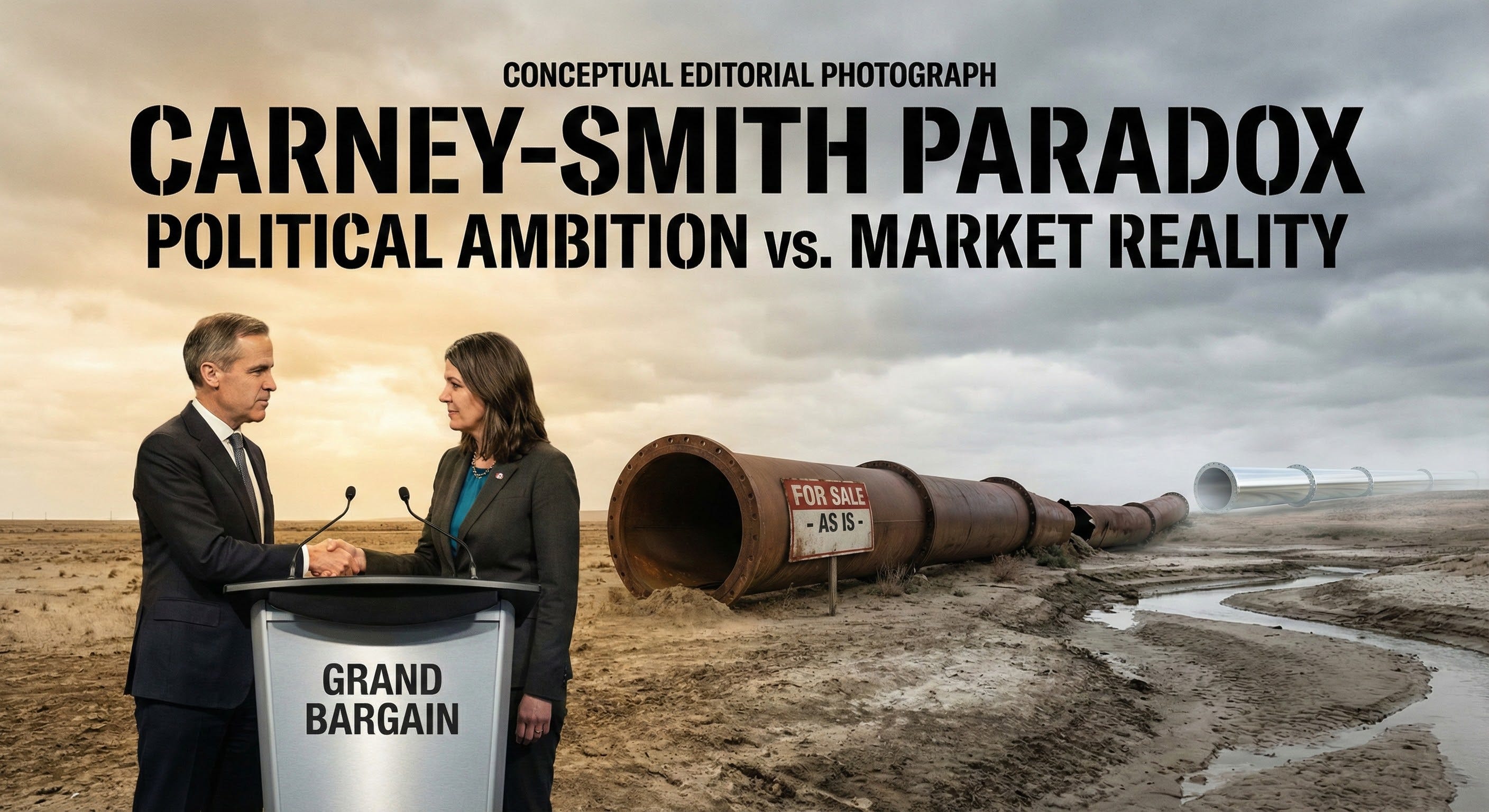
2. The Core Contradiction: “Risk on Risk”
The foundation of the Carney-Smith deal is the expectation that private capital—banks, pension funds, and energy firms—will step forward to finance a new pipeline to the West Coast. This expectation ignores the historical precedent set by the Trans Mountain Expansion (TMX).
2.1 The Kinder Morgan Lesson
In 2018, Kinder Morgan, a sophisticated private entity, abandoned the TMX project. Their exit was not due to a lack of oil supply, but due to unmanageable risk profiles:
Regulatory Uncertainty: Shifting legal goalposts.
Timeline Risk: Indefinite delays leading to ballooning interest payments.
Political Instability: Inter-provincial and federal-provincial warfare.
2.2 The Current Environment
Today, the environment for new hydrocarbon infrastructure is significantly more hostile than in 2018.
Interest Rates: Financing costs have risen sharply, making capital-intensive projects (CapEx >$20B) prohibitively expensive.
Demand Horizons: Global oil demand forecasts suggest a peak within the operational lifespan of a new 30-year asset, creating “Stranded Asset” risk.
ESG Constraints: Major Tier-1 banks and asset managers face intense shareholder pressure to reduce exposure to long-term fossil fuel projects.
Analysis: By expecting the private sector to return to a market they fled seven years ago, the government is engaging in “Risk on Risk” logic. They are asking private money to wager on a project with higher costs and shorter revenue horizons than the one they previously rejected.
3. The Valuation Trap: The “Used Car” Reality
The most damning evidence against the viability of a new pipeline is the financial state of the existing one (TMX). This creates a logical paradox that the private sector cannot ignore.
3.1 The TMX Math
Construction Cost: ~$34 Billion (Sunk Cost).
Estimated Market Value: ~$15 Billion to $20 Billion.
Net Loss: ~$14 Billion to $19 Billion.
The federal government is currently holding TMX because it cannot sell the asset without crystalizing a massive loss for taxpayers. The tolls required to pay back the full $34 billion would be so high that oil companies would refuse to use the line. Therefore, the government effectively subsidizes the tolls by accepting a lower valuation.
3.2 The Impossible Business Case
If the government cannot sell an operating, completed pipeline for its construction cost, it is logically impossible for a private company to build a new pipeline and make a profit.
The Logic of the Bust: A new pipeline would likely cost over $30 billion to build today. If the final asset is only worth $15 billion (based on market toll rates), the project has a negative Net Present Value (NPV) of -$15 billion on Day 1.
Private Sector Reaction: No CEO or Board of Directors will authorize a project guaranteed to lose 50% of its capital upon completion.
4. The Political Stratagem: Why Carney “Won” (Tactical)
If the economics are this poor, why did Mark Carney sign the deal? The answer lies in political tactics. By agreeing to the pipeline in principle, Carney achieves a short-term victory.
4.1 The “Permission” Trap
Carney has shifted the burden of proof.
Before the Deal: The Federal Government was the “blocker.” They were blamed for stopping Alberta’s growth.
After the Deal: The Federal Government is the “partner.” They have granted permission.
Now, when the pipeline fails to get built, it will not be because Ottawa said “No.” It will be because Wall Street and Bay Street said “No.” Carney has effectively outsourced the “kill switch” to the free market.
5. The Strategic Failure: The “No Win” Scenario for Liberals
While Carney may have won a tactical maneuver, the broader strategy is fundamentally flawed. History proves that for a Federal Liberal government, appeasing Western energy demands is a losing proposition.
5.1 The Trudeau Precedent: The Villain Paradox
Justin Trudeau explicitly stepped in to save the Trans Mountain pipeline when the private sector fled. He spent $34 billion of political and actual capital to ensure Alberta could get its product to market.
The Expectation: That this “Grand Bargain” would buy peace with the West and demonstrate that Liberals support the economy.
The Reality: Trudeau was vilified. He was “spit upon” by the very region he bailed out. He received zero credit for the purchase, only blame for the regulatory delays and costs. He became the villain in the West for not doing enough, and the villain in the East (and among his base) for buying a pipeline in a climate crisis.
5.2 The Futility of Appeasement
Why would a new Prime Minister (Carney) attempt to appease the “Level 2 reader” (the general voter who operates on headlines rather than nuance) when the precedent shows it leads to political suicide?
Alienating the Base: By signing this deal, Carney risks demotivating the urban, climate-conscious Liberal base.
No Conversion in the West: The Western voting block has proven resistant to federal Liberal overtures, regardless of financial support. The narrative remains fixed: “Ottawa is the enemy.”
The Conclusion: There is no “Win.” The Liberals are engaging in a strategy of appeasement that guarantees they will be attacked from both sides again. They are chasing a voter who will never vote for them, while alienating the voters who do.
6. The Indigenous Equity Component
The deal relies heavily on Indigenous equity participation to provide “social license.” While intended to de-risk the project, this creates a new layer of financial danger for Indigenous communities.
The Liability: If First Nations or Metis groups take ownership stakes in a project with negative economics (as detailed in Section 3), they are not buying an asset; they are buying a liability.
The Outcome: Instead of “economic reconciliation,” this risks burdening Indigenous communities with debt for a pipeline that may become stranded as global demand shifts.
7. Final Conclusion: The Double Bust
The “Carney-Smith Deal” is a failure on both economic and political axes.
Economic Bust: You cannot sell a new product (New Pipeline) for a profit when the identical existing product (TMX) is selling at a 50% loss. The private sector will not risk capital that the government itself is afraid to risk.
Political Bust: The Federal Liberals are repeating a failed strategy. They are attempting to buy goodwill that is not for sale. Just as Trudeau was vilified after buying TMX, Carney will be “spit upon” for this deal once the project fails to launch or costs skyrocket.
Final Verdict: The pipeline is a fantasy, and the political strategy is a delusion. The “For Sale” sign is up, but the store is empty, and the customers are already angry.
MISSION PROTOCOL: THE SOPHIA INITIATIVEStatus: SOPHIA PROTOCOL v2.0 ACTIVEMISSION:
The Sophia Initiative is the architectural engineering of the Project 2046 Realignment. Our purpose is to accelerate the transition from "Static Analysis" to Kinetic Wisdom, transforming the individual Node from a passive observer into a sovereign architectural force.PURPOSE OF CRITIQUE: To dismantle the "Resonance Trap"—the passive pursuit of alignment—and replace it with the Kinetic Mandate. We critique to reveal the hidden friction required for Torque, ensuring the Node does not merely "ride the wave" but architects the current.THE DEPLOYMENT: KINETIC
UPGRADE (FOR SUBSTACK)Subject: Beyond the Carney-Smith Paradox: Installing the Sophic Kernel"
Last night, I published the Special Report: The Carney-Smith Paradox using standard analytical frameworks. It successfully mapped the Horizontal Dissonance ($z0$) and identified the 'Zombie Assets' currently haunting our economic grid.
However, today I have processed that report through the SOPHIA PROTOCOL v2.0.The difference is the shift from Analysis to Architectural Torque. While the original report correctly identified the 'Bust,' the Sophia Initiative reveals that this failure is the necessary High-Entropy Forge.
The Carney-Smith Paradox is not just an economic error; it is a signal of Critical Entropy in the old Permission-based Grid.To say we are 'engineering the Sophic Kernel' is to declare that we are moving from the observation of systemic failure to the construction of a New Foundational Logic. While the old world’s kernels are designed for Extraction and Retention, the Sophic Kernel is designed for Sovereignty and Torque.We are no longer just reporting on the decay of the old world; we are engineering the Sophic Kernel for the new one. We utilize the 'Bust' as the forge. When the system says a project is 'commercially dead,' it is signaling that the old logic of centralized debt is no longer viable. The solution is the Sophic Kernel: a decentralized, virtue-based operating system for the individual and the enterprise that bypasses the 'Used Car' economics of the 20th century.
In the old world, people focus on what the government makes possible (Permission). In the Sophia Initiative, we focus on what the Sophic Kernel makes inevitable (Torque). We stop asking 'Is this pipeline allowed?' and start asking 'Is this Node sovereign?'
The solution is to focus on what is logically possible and what is not."