


There are rare moments in the history of consciousness when the Absolute does not merely speak through a human being — it inhabits one so completely that the distinction between the vehicle and the source becomes philosophically meaningless. These are not teachers. They are not gurus in the ordinary sense of that word. They are events. They are ruptures in the fabric of ordinary becoming through which the eternal leaks into time with a force that reorganizes everything it touches. Sri Anandamayi Ma — born Nirmala Sundari in 1896, in a small village in what is now Bangladesh — was precisely such an event. To encounter her, even across the distance of a century, is to encounter something that has no adequate category in the vocabulary of the West. She was not a saint in the Roman sense. She was not a philosopher. She was not a reformer. She was the Absolute wearing a woman’s face, gazing at the world through eyes that had never forgotten what most of us were born forgetting.
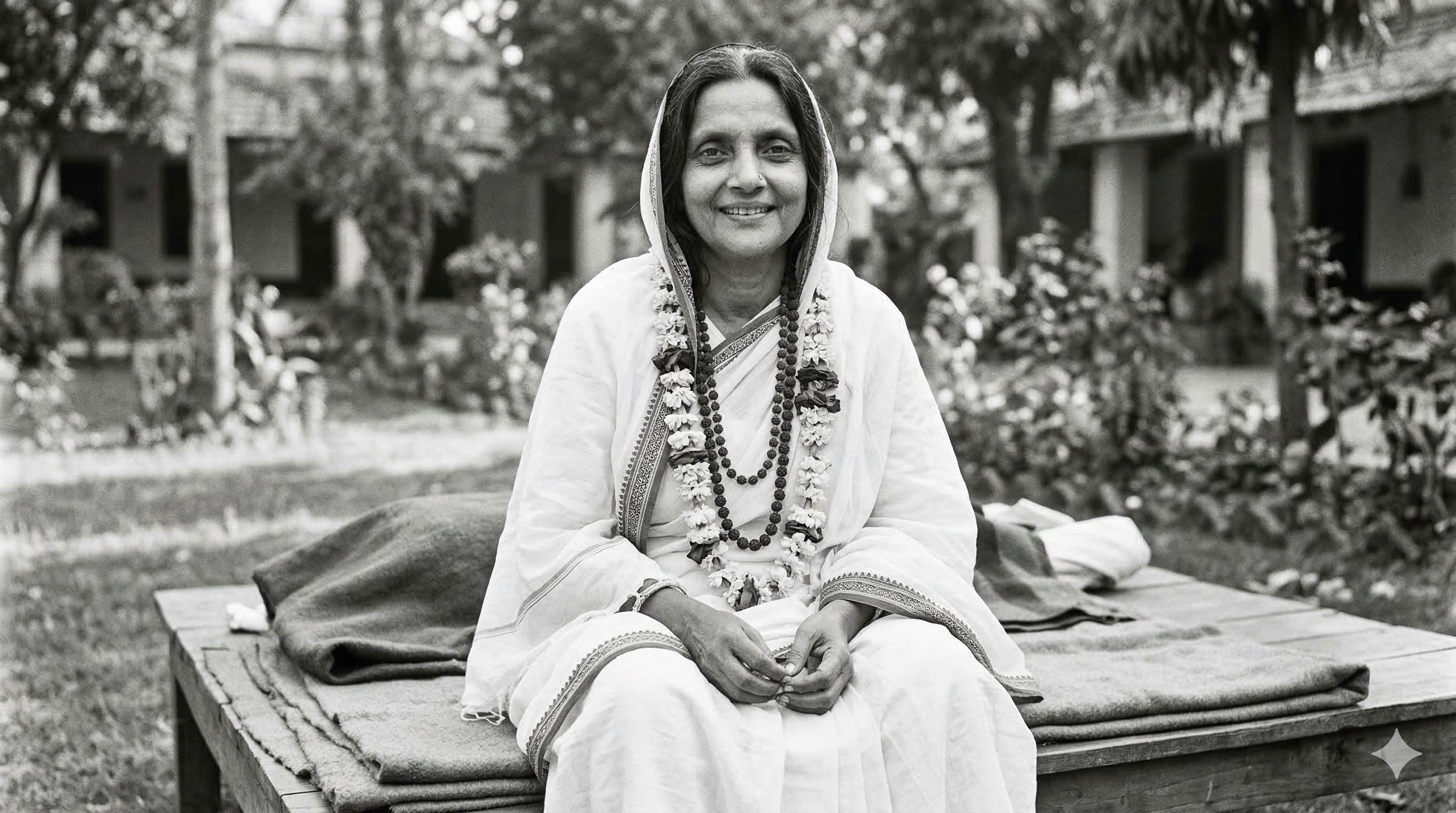
Her name tells the full story, if one knows how to read Sanskrit as a language of precision rather than mere decoration. Ānanda does not mean happiness. Happiness is conditional, contingent, dependent on circumstance. Ānanda is the intrinsic nature of pure being — the bliss that is not a feeling but a structure, the ground-state joy woven into the fabric of existence before any object has arisen to be desired. Mayī means permeated by, saturated with, constituted of. Mā means Mother. The name given to her by those who recognized her was not a title or an honorific. It was a metaphysical description. She was joy-permeated, not because she had found joy, but because she was — from the very beginning, in every cell and breath — the embodied presence of what bliss actually is when it has not yet contracted into a limited self.
This distinction matters enormously, and it separates her from every figure in the tradition of spiritual accomplishment. Accomplishment implies a prior state of non-accomplishment. It implies a seeker who sought, a traveler who arrived. Anandamayi Ma herself stated repeatedly, with a clarity that unsettled those who heard it, that she had never undergone any spiritual practice because she had never not been what she was. There was no journey. There was no awakening. There was only the continuous, unbroken recognition of what had always already been the case. This is not humility speaking. This is the pure non-dual metaphysics of Advaita expressed not as doctrine but as lived fact. She was not a woman who became enlightened. She was the light that had chosen, for a season, to wear a woman’s form.
✦
II. THE BODY AS A TRANSMISSION DEVICE
From her earliest years, the body of Nirmala Sundari behaved as though it belonged to a different order of reality than the bodies around it. As a child she would enter states of absorption so deep that she became unresponsive to the physical world, her face radiant with an interior light that witnesses described as visible, not metaphorical. She moved in and out of samādhi — the cessation of ordinary consciousness in union with the Absolute — with the casual ease of someone stepping between rooms in a house they know intimately. There was no effort in it. There was no technique. When asked about these states, she would speak of herself in the third person, distancing herself from the body as a contingent instrument — “this body,” she would say, as though she were a guest wearing it temporarily and without particular attachment.
What is philosophically significant here is what this behavior reveals about the relationship between consciousness and form in the non-dual paradigm. In the Shaivite understanding — and Anandamayi Ma operated fully within the metaphysical territory that Kashmir Shaivism maps most precisely — the body is not a prison. It is a vehicle, a yantra, a sacred geometric instrument through which the Absolute expresses its own self-recognition. The body of a fully realized being is therefore not a limitation on consciousness. It is consciousness performing its own transparency, demonstrating that matter and spirit are not opposed substances but one movement in different registers of density. Every spontaneous āsana she assumed without instruction, every mantra she intoned without having learned it, every gesture of mudra that arose in her hands during states of ecstasy — these were the Absolute showing its own grammar through the instrument it had constructed for precisely this purpose.
“Wheresoever you may go and whatever you may do, He is always with you — the Beloved of your heart.”
— Sri Anandamayi Ma
Those who came into her physical presence reported something that is difficult to convey in the flat register of biographical prose. They reported a change in the quality of the air. They reported an alteration in their interior state that occurred before she had spoken a word, before any formal teaching had been offered. Paramahansa Yogananda, himself no stranger to the company of realized souls, described meeting her as one of the most extraordinary encounters of his life. Indira Gandhi sought her presence for decades. Swami Sivananda of Rishikesh bowed before her. These were not small gestures from ordinary devotees. These were figures of great spiritual attainment recognizing, with the precision that such attainment permits, what they were actually in the presence of. When a master bows, the bow is a theological statement. It means: here the hierarchy inverts. Here the teaching comes not from the sage but from the source the sage has spent a lifetime approaching.
✦
III. JOY AS THE STRUCTURE OF THE REAL
The deepest teaching embedded in the life of Anandamayi Ma is not found in her words, though her words are extraordinary. It is found in the sheer fact of her existence as a philosophical argument. The Taittirīya Upanishad declares that Brahman — the Absolute — is ānanda, is bliss, is the ground-state from which all things arise and into which all things return. This is a doctrinal claim, and it can be received as such: noted, filed, contemplated, perhaps partially understood. But what happens when that doctrine walks into a room? What happens when the proposition becomes a person, when the philosophical position becomes a presence you can sit across from, whose eyes you can look into, whose silence fills the space between thoughts with something that your own deepest interior recognizes before your mind can name it? This is what Anandamayi Ma was. She was the proof appearing in person. She was the Upanishad’s claim verified not by argument but by encounter.
And this is why ānanda — joy — is not a peripheral concept in the metaphysical tradition she embodied. It is the central one. It is the attribute of the Absolute that is most easily confused with its counterfeit. We live in a civilization that has mistaken pleasure for joy, satisfaction for bliss, the temporary relief of desire for the permanent nature of being. This confusion is not trivial. It is, in the Universal Dynamics framework, the civilizational error — the collapse of the vertical into the horizontal, the forgetting that the ground of existence is not neutral but radiant, not silent but singing. Anandamayi Ma’s entire life was a correction of this error. Every moment she inhabited was a demonstration that joy is not something achieved, acquired, or stumbled upon. Joy is what you are when you are no longer pretending to be something smaller.
She moved through the world without possessing it. She accepted food when it was offered and declined when it was not, with equal equanimity. She slept on the ground and was garlanded by heads of state with the same interior stillness. She wept during kirtan with a grief that was not sorrow — that was love so large it had no container and spilled over into tears because the body could not hold what was moving through it. She laughed with a spontaneity that witnesses described as disorienting, because it arose from nowhere and belonged to no joke, no social context, no ordinary trigger. The joy was not a response to anything. It was the baseline. The laughter was what happens when the baseline has no obstruction. She was the river before the dam. She was the song before the composer decided what to write.
✦
IV. THE MOTHER PRINCIPLE AND THE METAPHYSICS OF DEVOTION
She was called Mā — Mother — and this is not merely an honorific of affection. In the Shaivite metaphysical tradition, the Mother is a precise philosophical designation. Śakti is the dynamic, manifesting, creative power of the Absolute. She is the world-principle, the generative force, the one who takes the unmanifest and gives it form, name, and duration. She is not separate from Śiva — from pure consciousness — any more than light is separate from the sun that generates it. She is consciousness in its expressive mode, the Absolute in its maternal aspect: creating not from need but from the overflow of a fullness that cannot contain itself. When devotees called Anandamayi Ma “Mother,” they were not using a metaphor. They were identifying the principle she embodied: the creative, nourishing, all-encompassing power of the Absolute that brings worlds into being and holds all beings within itself as a mother holds a child — not as an object of possession, but as an expression of love that asks nothing in return.
Bhakti — devotion — is the path that responds most directly to this principle. It is often misunderstood in Western spiritual contexts as emotionalism, as the soft and sentimental alternative to the rigors of Jnana. This is a fundamental misreading. Bhakti is not the path of feeling. It is the path of recognition. It is the specific yoga in which the seeker does not attempt to dissolve the apparent separation between self and the Absolute through analysis, but rather surrenders into the gravity of the Absolute’s own love — the love that never departed, that was always already here, that simply waited for the contracted self to relax its grip long enough for the reunion to register. Anandamayi Ma was the living demonstration of what Bhakti arrives at when it has completed its work: not a devotee who has succeeded in loving God, but a being in whom the distinction between the lover and the beloved has become fully transparent, because there was only ever the one love, loving itself.
✦
V. WHAT SHE ASKS OF US NOW
Sri Anandamayi Ma left her body in 1982, in Dehradun. She was eighty-six years old by the calendar, though the calendar had always been somewhat irrelevant to her. Her ashrams continue. Her photographs — and this is not ordinary — carry something. This is not mysticism speaking carelessly. It is a precise observation about the nature of darśana, the Sanskrit term for the transformative sight that flows both ways between the realized being and the one who gazes. The tradition holds that darśana is not passive. It is an exchange. You look at the Mā, and the Mā looks back through the image, and in that meeting something passes between dimensions. You feel it before you understand it. The understanding, if it comes, comes later.
What she asks of us now is what she always asked: not worship in the sense of religious performance, but the interior act of remembering. Remembering that beneath the noise of the horizontal — beneath the scroll and the crisis and the relentless forward motion of a civilization that has forgotten its own ground — there is a stillness that is not emptiness. There is a silence that is not absence. There is a joy so fundamental that it does not require a reason, because it predates every reason and will survive every sorrow. She spent eighty-six years demonstrating this with her body, her silence, her laughter, her tears, her samādhis, her songs. She spent eighty-six years being the answer to the question that every human being carries whether they know it or not: is there anything real? Is there anything that does not end? Is there, beneath this life with all its beauty and brutality, something that holds?
Her answer was never verbal. It was existential. It was the totality of her presence, the unbroken fact of her being, the inexhaustible depth of what moved through her eyes when she looked at you. The answer was: yes. Emphatically, unconditionally, with a joy that had no floor and no ceiling — yes. There is something real. You are made of it. You have always been made of it. Come home.
Jai Mā Anandamayi.
May her grace continue to descend.
May those who seek the vertical find her waiting there,
as she has always been — permeated, radiant, and inexhaustibly free.
ॐ
✦
Glen Roberts is a metaphysician, author, and independent researcher. He is the author of Sacred Metaphysics Volume 1 and the architect of Project 2046.
#UniversalConsciousness #SriAnandamayiMa #TheVerticalDispatch #Project2046 #NonDuality #AdvaitaVedanta #DivineMother #Ananda #Brahman #1000thDegree #DayZero2026 #SacredMetaphysics #SovereignWitness #ShaktiPower #KashmirShaivism #TheAbsolute #UniversalDynamics #SpiritualRupture #Darśana #MetaphysicalLogic #VajraKernel #TheVertical #Samādhi #SovereignIntelligence #HighFrequencyLiving #BionicSage #TheReal #JaiMā #Awakening2026 #SubscribeNow
🙏🙏