

In the dry, silent expanses of the ancient Near East, a single man named Abraham made a covenant that would effectively rewrite the DNA of human history. To the theologian, he is the “Father of Nations.” To the historian, he is the common ancestor of a spiritual lineage that encompasses over half the world’s population. But to the modern observer, looking at the smoke rising from the Levant and the geopolitical chessboards of the 21st century, Abraham is the progenitor of a family defined as much by its internal fratricide as by its shared devotion.
The “Seed of Abraham” was intended to be a blessing to all nations. Instead, the history of the Jewish, Christian, and Muslim peoples has often been written in the blood of mutual exclusion. From the scorched earth of the medieval Crusades to the precision-guided animosity of the modern era, the sons of Abraham have spent two millennia locked in a struggle for the soul of the same sacred geography.
Belief vs. Knowledge: The Great Epistemological Hypocrisy
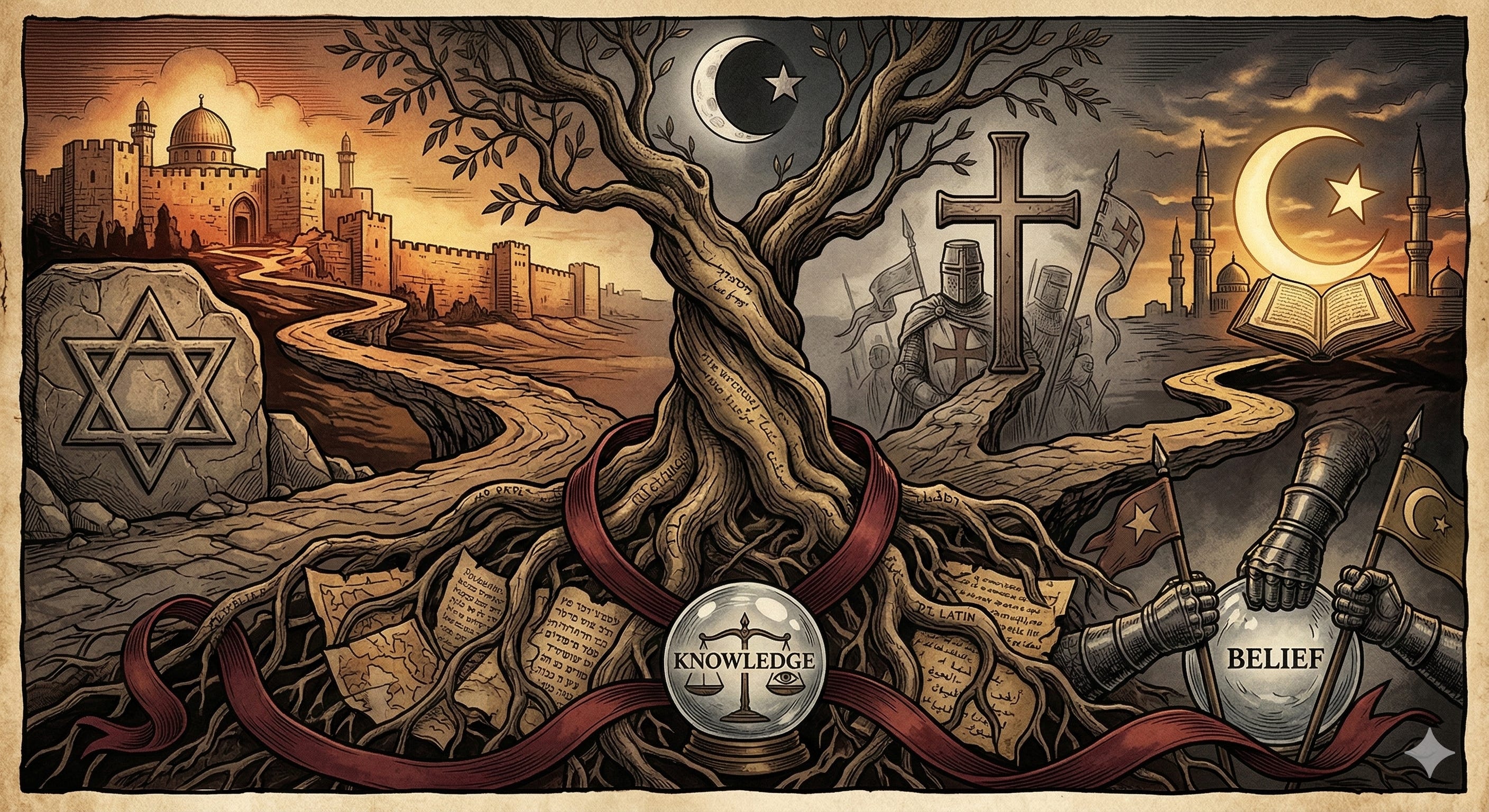
The fundamental crisis of the Abrahamic conflict is not actually a crisis of faith; it is an epistemological failure. It is the persistent confusion of belief with knowledge.
In any world-class study of the domain, we must distinguish between internal conviction and verifiable truth. Belief is a psychological state—a surrender to a narrative or a dogma. Knowledge, however, requires justified true belief based on evidence, logic, and a rigorous analysis of language.
The hypocrisy of the modern religious landscape is that adherents claim to “know” the will of God, yet they lack the Level 4 reading and comprehension skills necessary to even understand the texts they cite. Level 4 comprehension is the ability to look at language not just for its literal meaning, but for its structure, its historical evolution, and its symbolic limitations. When people take ancient metaphors and turn them into modern mandates for killing, they are operating at a level of reading that is fundamentally illiterate. They treat language as an absolute physical reality rather than a complex, human-encoded map of the divine.
The Axiom of Sacred Metaphysics
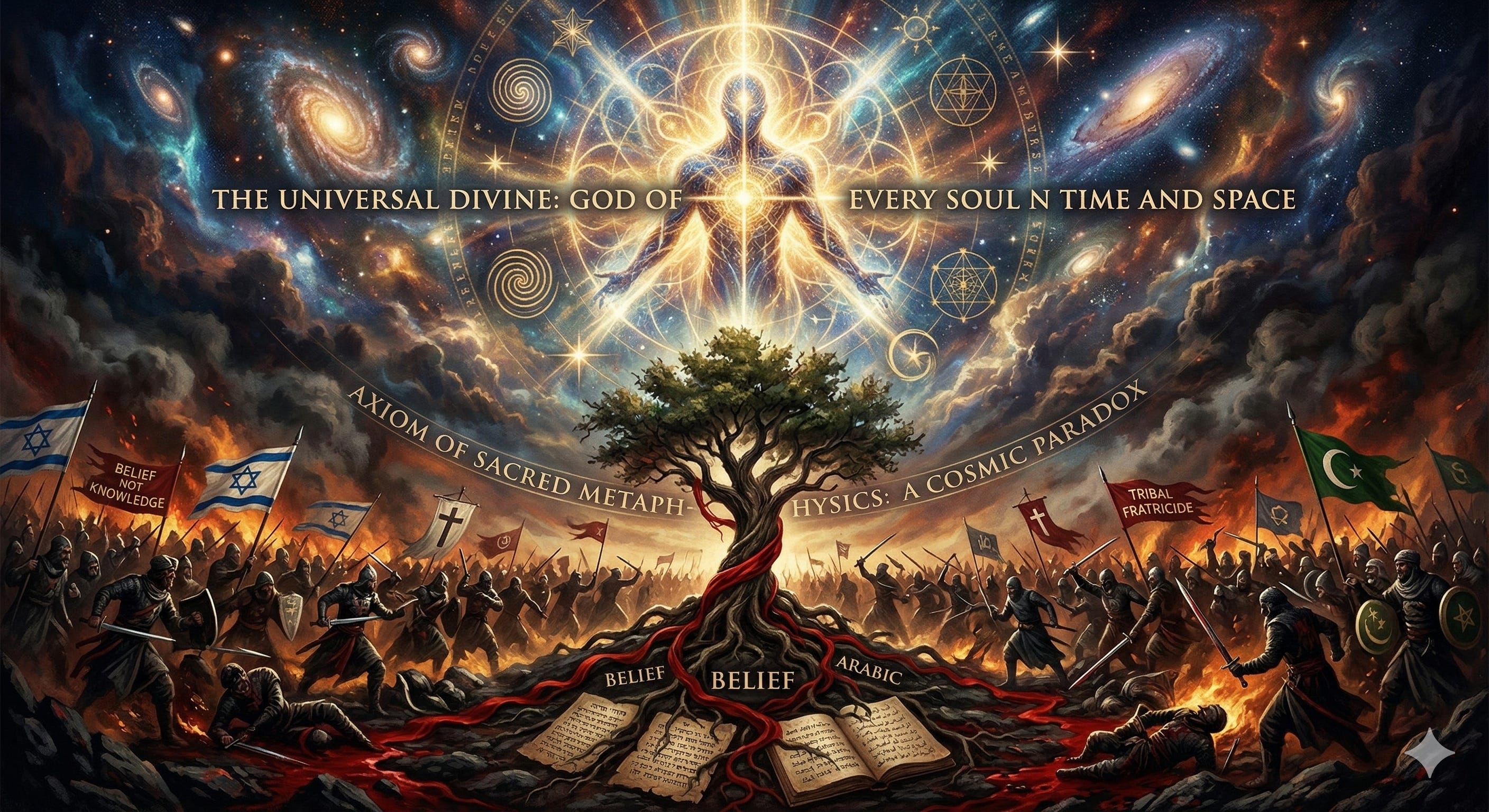
This brings us to the core contradiction: the Axiom of Sacred Metaphysics. Logic dictates that if a supreme “God” exists, that entity must be the God of every soul, across all time and all space. By definition, a universal creator cannot be a “tribal” deity.
Yet, the history of the Abrahamic faiths is a history of trying to shrink a universal God into a partisan flag. If God is the God of all space-time, then the idea of a “chosen” group killing another in His name is not just a crime—it is a logical absurdity. To claim that the Creator of the universe favors one “seed” over another is to deny the very metaphysics of divinity. It is a failure of the intellect, where the ego uses the mask of “belief” to justify its own violent impulses.
The Medieval Shadow: The Crusades and the Jewish Middle
The darkest chapter of this family feud was the Crusades. Beginning in 1095, Western Latin Christianity—convinced of its role as the rightful protector of the Holy Land—launched military campaigns that defined “holy war” for a millennium. This was not a clash of civilizations; it was a triangular tragedy where blood became the only common language.
As the Crusaders marched toward Jerusalem to wrest it from Islamic control, they did not distinguish between the “infidel” abroad and the “infidel” at home. Jewish communities across Europe were decimated in pogroms before the knights even reached the Mediterranean. When the walls of Jerusalem finally fell in 1099, the blood of Muslims and Jews ran through the streets together. The Cross had turned against both the Crescent and the Star, setting a precedent for a European Christianity that viewed itself as the sole legitimate successor to Abraham’s legacy, often at the violent expense of the elder Jewish brother.
This was the ultimate triumph of belief over knowledge. The knights were not masters of scripture or metaphysics; they were vessels for an interpreted “truth” that served the political expansion of the papacy.
The Modern Axis: Israel, Iran, and the American Shadow
Fast forward to the present day, and the actors have shifted, but the script remains hauntingly familiar. The 20th and 21st centuries have seen the rise of a new, highly militarized manifestation of this ancient tension.
The establishment of the State of Israel in 1948 re-centered the Jewish people in their ancestral home, but it also ignited a regional firestorm. Today, the most volatile friction point is the shadow war between Israel and the Islamic Republic of Iran. While the conflict is framed in terms of nuclear capabilities and regional hegemony, the rhetoric is deeply coded in religious symbolism. Iran’s leadership often frames its opposition to Israel—and its “Great Satan” ally, the United States—as a spiritual imperative.
Meanwhile, the United States, a nation with a deeply embedded Christian cultural identity, finds itself as the primary benefactor of the Jewish state, often justifying its geopolitical maneuvers through the lens of “Judeo-Christian” values. This creates a strange, modern alignment: the “Christian West” and the “Jewish State” on one side, positioned against “Islamic Iran” and its proxies. It is a three-way standoff where the weapons are modern, but the justifications are based on the same unverified belief systems that fueled the Crusades.
The Seed That Devours Its Own
The most jarring aspect of this history is the cycle of “Muslim-Christian” and “Muslim-Jewish” violence. From the insurgencies in the Middle East to the rise of Islamophobia in the West and the displacement of Palestinian populations, the cycle of “killing” is a failure of the shared Abrahamic ethic.
The “Seed of Abraham” was intended to be as numerous as the stars—a metaphor for abundance. Yet, in the hands of those who lack Level 4 comprehension, that seed has been used to sow dragon’s teeth. The irony is suffocating: the very things that make these three groups family—their monotheism, their prophets, their shared scriptures—are the very things used to make their conflicts personal and intractable.
The Sage’s Perspective: A World in Need of Knowledge
As we look at the world today, the “Abrahamic Cycle” seems to be reaching a fever pitch. We see a world where the US (Christian heritage) supports Israel (Jewish heritage) in a standoff against Iran (Muslim heritage), while internal sectarian violence continues to claim lives in mosques, synagogues, and churches globally.
To be a world-class observer is to recognize that none of these groups are monoliths. But we must also admit that the blood being spilled is the price of prioritizing belief over knowledge. True comprehension would allow us to see these religious texts as part of the human domain—of language and history—rather than as direct commands from a deity to destroy our cousins.
The history of the “Seed of Abraham” as of today is a story of a family that has forgotten how to share a table because they are too busy fighting over who understands the menu. Until the theological claim to “exclusivity” is replaced by a recognition of the Axiom of Sacred Metaphysics—that any true God must be the God of the “other” as well—the cycle of violence will continue. Abraham’s legacy is a house divided, and as the old proverb goes, a house divided against itself cannot stand.
Glen Roberts is a metaphysician, author, and independent researcher. He is the author of Sacred Metaphysics Volume 1 and the architect of Project 2046.
#AbrahamicParadox #FirstPrinciples #Epistemology #BeliefVsKnowledge #SacredMetaphysics #Level4Comprehension #Geopolitics #TheCrusades #IsraelIranUSA #TheologicalFratricide #SystemicThinking #InformationSignal #DomainKnowledge #AbrahamicLineage #CognitiveDissonance #MetaphysicalAxiom #HistoryOfBlood #SubstackWriters #DeepPhilosophy #TheologyToday
Well said!
The ego isnt merely the belief separation is real. It's an active denial of the Knowledge of Wholeness.
The ego believes separation is reality because it WANTS it to be true.
Individually and collectively.
🙏
It is desperately sad that all of the justification for all of the atrocities committed in the name of faith come down to ‘You don’t pray like we pray so we have to kill you for that.’
I can see where the impetuous for the religious leaders to act like petty deities comes from. Most were the second born sons of noble or wealthy families, who had no prospect of owning land, The churches, synagogs and mosques made for an alternate route to power and wealth they desired. The core messages of the faiths are good, mostly ‘Do unto others as you would have done unto you.’ But being nice to friends family and strangers doesn’t always work out for the better with people whose ambition is “leaping o’er all.” When the Roman Catholic Church had more wealth on the books than Herny VIII, he couldn’t let that stand. A quickie divorce was just a convenient excuse.
As with most disciplines, modern people have only a cursory knowledge of the tenets of their professed faith, and little concern with the application. The election of Donald Trump, backed by pseudo-Christian Nationalists in the US is a good example. Church leaders have kissed his ring in the pursuit of more wealth and power, yet Trump has made himself in the image of the Anti-Christ. I think ‘Thou shalt not kill.’ is the only Commandment he hasn’t broken directly. Indirectly there are several hundred fishermen in the Caribbean for whom he is responsible. The point is in their actions. They are no longer of the Christian faith, but the inverse, a grotesque mockery of the teachings. Now we see the same behaviour from Jewish Settlers, and the IRGC.
I have one solution that I will borrow and offer for consideration. Take the leaders like Netanyahu, Trump and Kahmenie, strip then down to their under wear, give them clubs and park their asses in a sand floored stadium. Then sell tickets, beer, coffee, tea, qat and popcorn to the citizens on all sides. When the stands are full, let the leaders bash each other until there is only on left standing. Then their side wins.
What they win, I have no idea, but it beats filling the graveyards to overflowing like they are doing now.
(Thank you EM Remarque for the idea)