

Φ
THE VERTICAL DISPATCH
We write for the mind, the eye, and the ear.
Read it. Look at it. Listen to it. The Vertical Dispatch is built for all three — prose with rhythm, made to be heard as much as read.
From metaphysics to geopolitics, from culture to history, from the sacred to the street — and everything in between. One lens, every subject. No ego. Just the record, named clean.
Press play. Walk with the word. 🕯️
This dispatch travels by hand. If it serves you, share it — restack on Substack, and pass it on wherever you read. 🕯️
On Consciousness · The Foundation Series
July 2026
The twentieth century is, among other things, the Age of Noise.
— Aldous Huxley, The Perennial Philosophy, 1945
The twenty-first is the Age of Speed. — The Architect
I. We Project
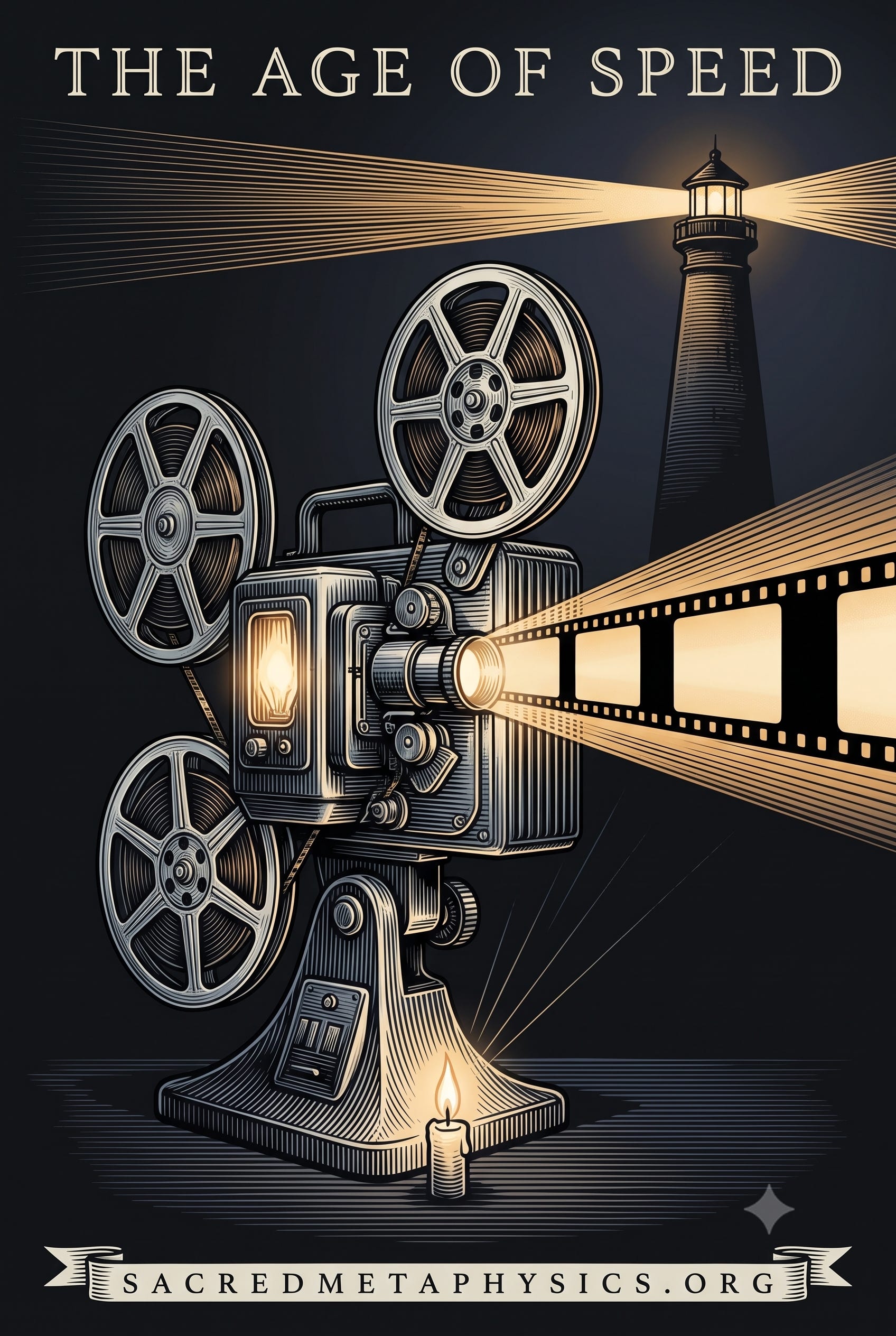
Begin with the plainest fact there is, and the one hardest to hold for more than a breath: you are projecting now. Not remembering a projection, not planning one — projecting, this instant, the very world you take yourself to be sitting inside. The reality you move through is not handed to you finished. It is thrown. You are the projector, and what you call the world is the light of your own awareness cast forward through the strip of everything you have ever been.
The word says so before any philosophy does. Project comes from the Latin proicere — pro-, forward, and iacere, to throw. To project is to throw forward. And here is the small miracle buried in the dictionary: the same word carries both meanings we need. In optics, to project is to throw an image by rays of light onto a surface. In the life of the mind, to project is to cast one’s own feeling, one’s own story, onto another and mistake it for what is there. Two senses, one root, one throw. The projector on the wall and the projector of the psyche are not a metaphor laid over each other. They are the same act, named once.
So the claim is not poetic. It is mechanical, and it is literal. A human being is a machine for throwing a world forward and then living inside the thrown thing as though it fell from the sky. The film is your story — the accumulated frames, the loves, the wounds, the verdicts already passed, the whole inheritance wound onto a single reel. The light is awareness itself, which has no colour of its own and takes the colour of whatever it shines through. And the wall is what you call the world — the screen on which your own reel appears, close enough to touch, convincing enough to fight and die for, and never once the thing itself.
You are the projector, and what you call the world is the light of your own awareness cast forward through the strip of everything you have ever been.
II. Eight Billion Projectors
Now widen the frame, because the second fact follows from the first and it is the one that breaks the argument open. If you are a projector, so is everyone. There are eight billion projectors alive on the earth this morning, each throwing a world forward, each seated inside the thrown thing, each certain the wall is the world. And not one of them is true.
Hold that sentence carefully, because it is doing two things at once, and both matter. It says every private world is real — real as projection, valid as experience, entirely true for the one projecting it. Your grief is not a lie. Your love is not a lie. The world you throw is your genuine world, and no one has the standing to tell you it is not yours. And in the same breath the sentence says: true for you is not truth. The projection is real as projection and false as referent. The wall is not the thing. Eight billion times over, the map is not the mountain, the symbol is not what it stands for, the thrown image is not the light that threw it.
This is the whole discipline of these pages, said in a single line and multiplied by eight billion. We do not build on a claim that has outrun its referent. And a projected world is exactly a claim that has outrun its referent the instant its maker forgets he is the one projecting. The relativist stops here and says: then all worlds are equal, believe what you like. But that is not what follows. What follows is stranger and more demanding. If not one of the eight billion walls is the truth, then the truth is not on any wall. It is not a better projection. It is the light none of them can throw, and the one thing they all, without exception, are throwing it through.
III. The Wake
A projection is not weightless. This is the part the peaceful, dissolve-it-all reading always forgets. Every breath you take, you are throwing a world forward — and the thrown world does not vanish when the breath ends. It leaves a residual. A wake, the way a boat leaves a wake, the water disturbed long after the hull has passed.
The world you meet tomorrow morning is, in part, the wake you left today. The word thrown in anger returns as a colder room. The attention withheld returns as distance. The care given without demand returns, sometimes years later, as a hand you did not know you had earned. This is not mysticism dressed as physics. It is the oldest working law the traditions ever named — karma, action leaving its trace in the field — said in the plainest available language. To act is to project; to project is to leave a wake; and the wake is the world coming back around.
And here is why almost no one attends to it: you cannot see your own wake from the bow. The wake is behind you. To see it at all you would have to turn around — you would have to stop facing forward into the next projection long enough to witness the one you already threw. Most lives never make the turn. They face the wall, throw and throw and throw, and take each returning wave as something the world did to them, never once recognising the water as their own.
You cannot see your own wake from the bow. To see it at all, you would have to turn around.
IV. Inside the Machinery
If we are all projecting, and if we cannot simply will ourselves to stop — for to will a stop is only to throw a picture of stopping — then the honest work is not to smash the projector. It is to go inside it. To take the machine apart and discover how it was made. Because the moment you see clearly that the projector was assembled — built, not given — its authority over you breaks.
So look at how yours was made, and be exact, because the abstractions cost nothing and change nothing. The film was wound before you could read. The first frames — the ones that run deepest, the ones that throw the brightest and most automatic images — were spliced into you by people who loved you and by people who did not, in a house you did not choose, in years you cannot remember. You were handed the lens already ground. You think in a language you did not select, and the language decides in advance what you are able to see and what will stay invisible to you your whole life. The deepest grooves were cut by the wounds, and it is a bitter mechanical fact that the deepest grooves throw the most vivid pictures — which is why the oldest hurt so often projects the loudest present.
None of it was chosen. The story that generates your reality was made, and it was made for you before you were old enough to refuse it. This is not an accusation and it is not despair. It is the one liberating recognition available to a projector: that the projector is a made thing. See the splice and it loses the authority of fate. See that the lens was ground by hands that were not yours and you are no longer obligated to see only what it permits. This is discernment turned inward, the ancient not-this, not-this run down the length of your own machine — not this frame, not this splice, not this borrowed lens, not this inherited story — until what is left is not another, better story, but the bare light that was never wound onto any reel at all.
V. The Age of Noise, the Age of Speed
In 1945, in The Perennial Philosophy, Aldous Huxley named the century he was standing in. The twentieth, he wrote, was among other things the Age of Noise — and he meant it at every level, not the ears alone. Physical noise, mental noise, and the noise of desire: all the resources of a miraculous technology, he said, thrown into a single assault against silence. He watched the radio become a conduit for pre-fabricated din pouring into every home, and he saw where the din finally lands — not on the eardrum but in the mind, and past the mind, in what he called the ego’s central core of wish and desire. He was, though he used other words, describing the projector being fed.
Huxley named the noise and stopped there, because he died in 1963, before the thing that finished the work. So let this dispatch finish the sentence he began, and name the diagnosis he did not live to make. If the twentieth century was the Age of Noise, the twenty-first is the Age of Speed. That naming belongs to these pages, offered in acknowledgement of his prior and in extension of it: he named the volume, and we name the velocity. The frames no longer merely pile up, indiscriminate, a babel of images. Now they run faster. The reel spins past a threshold the eye was never built to cross, and the shutter — the dark between the frames, the rest that once let each image land — is stripped away in the name of more.
And the two together produce a third thing, which is not added from outside but manufactured by the pair as surely as heat is manufactured by friction. Noise and speed produce distortion. This is not metaphor borrowed from feeling; it is the plain physics of any signal. Overdrive a speaker and the tone clips into distortion. Overrun a projector and the image smears. Feed a mind noise at speed with the gaps removed, and what it throws forward is no longer a picture it can trust — it is a distorted projection, and the maker can no longer tell his own noise from the truth. Eight billion projectors, each throwing a distorted film, at speed, with no silence left to define a single frame against the next. That is the age. That is the water we are all now swimming in.
He named the volume; we name the velocity. And the two together manufacture the third: distortion.
VI. Distortion, and the Chair
What is the consequence of a distorted projection? The question has a precise answer, and the culture handed it to us decades ago, in a chair.
Recall the conditioning scene at the centre of A Clockwork Orange — the young man strapped down, his eyes clamped open, made to watch reel after reel of full-colour atrocity without pause and without escape. The machine’s designers believed the profane, shown relentlessly enough, would sicken him into virtue: that saturation with violence would produce nausea, and nausea would produce a good man. It is the exact promise our age makes to itself — that if we only see enough, in high enough resolution, we will feel more, and feeling more will make us better. But the promise inverts. The intended nausea did not hold. What the endless unbroken frames produced was not revulsion but numbness. Strip the dark frame out, run the atrocity without the shutter, and violence stops registering as violence. It becomes only another frame of noise.
That is the consequence of distortion, and it is the negative image of everything this dispatch is built on. The shutter was never a limitation of primitive machinery that we have triumphantly overcome. The shutter was mercy. The gap between the frames was the thing that kept each image human-sized, kept it capable of being felt as itself and not as smear. Take the gap out and you do not get truth at higher resolution. You get the strapped-down eye — awake, unblinking, saturated, and empty. A world that erased the pause was promised more feeling and delivered less; was promised awakening and delivered the numb, tolerant, scrolling stare that can watch anything precisely because it can no longer feel the difference between one frame and the next. Distortion is how true-for-me curdles, at last, into: I can no longer find the true at all.
VII. The Space Between the Notes
There is a correction, and it is the one thing that cannot be manufactured and cannot be sped up, because it is not a thing at all. Alan Watts spent his life returning to music as the truest model of a life not spent racing toward its own end. You do not play a piece of music, he said, in order to arrive at the final chord — if the point were the ending, the best musicians would be the fastest, and every composer would write nothing but finales. The point of the music is the playing. The point of the dance is the dance. Each moment of it is already complete, already arrived, needing no destination to justify it.
And the model carries further than Watts himself always pressed it, into exactly the place our whole argument has been walking toward. Ask where the music actually lives, and the answer is not in the notes alone. It lives in the silence that frames them — the rest, the pause, the space between one note and the next. Take the silence out and you do not get more music. You get sound with no music left in it, because the note is defined by the silence around it exactly as the moving image is defined by the dark frame that carries it, exactly as a word means nothing without the pause that ends it. The rest is not a gap in the music. The rest is where the music is.
So the enemy of being stands fully named now: speed, and noise, and the distortion the two of them make. And so does the correction. To project silence is not to switch the projector off — a dead machine throws nothing, witnesses nothing, and that is not the aim. It is to leave the shutter in. To let the rest hold the note. To cut the gain until the signal stops clipping and the frames slow until each one can land. You cannot un-distort a signal by adding more signal; you can only restore the gaps and let the space back in. And in that space — the shutter-dark, the rest between the notes, the pause that ends the word — the eternal is not reached, as though it were somewhere far off. It is found already resting there, because it was never on the film in the first place. It was always in the gap the film runs through.
This is the silence that eight billion projectors could hold in common. Not agreement — they will never agree, and the walls will never match. But the dark frame is the one thing none of them can project and every one of them is projecting through. It is not empty. To peel every false world away and expect nothing at the centre is the error the traditions warned against; what remains when the projections fall silent is not absence but fullness — the light that was throwing the whole show, the not-two, the one ground that needed no maker because it was never a made thing. Project silence, and be. Leave the gap in, and let the rest hold the note. That is the last correction, and like every real one, it is made alone, in a single breath, tonight.
The rest is not a gap in the music. The rest is where the music is.
VIII. The Case Against This Piece
Let the strongest objection stand at full height, because a conclusion that cannot survive its best opponent does not deserve to be held. The objection is this: that a doctrine of universal projection dissolves the ground beneath action. If every world is only a thrown image, and the truth is a silence no projection can reach, then why mend anything on the wall? Why fight injustice that is only, on this telling, a distortion in someone’s film? The critic calls this quietism — a spiritualised permission to withdraw, to watch the wake run wild while the witness sits serene in his gap, having talked himself out of the one world where suffering is actually suffered. It is a serious charge, and it has buried better arguments than this one.
The answer is not to soften the charge but to meet it on its own ground, and the whole dispatch has been quietly laying that ground. Silence here is not withdrawal; it is the only frequency at which the wake runs clean. The one who has not seen his own machinery projects blindly, and his blind projection is precisely what leaves the cruel wake — the wound throwing the wound, the distortion breeding distortion down the generations. The turn inward is not a retreat from the world. It is the one act that changes what a person throws into it. And the chair proves it from the other direction: a civilisation that lost the pause did not become more compassionate for seeing more suffering. It went numb. If the silence were quietism, its absence would be engagement — and its absence is the numb, scrolling stare that can witness any atrocity and mend none of it. It is not the witness in his gap who abandons the world. It is the distorted projector, feeling nothing, who abandons it, frame after frame, at speed. Project silence, and the wake comes clean. That is not the abandonment of responsibility. It is the only place responsibility has ever actually begun.
God is Love. Love is Truth. Truth is Consciousness. Consciousness is Brahman.
Amen. Namaste. Om Namah Shivaya.
— The Architect
The Vertical Dispatch
sophiainitiative.ai
On the record
The Age of Noise is Aldous Huxley’s, from The Perennial Philosophy (1945): “The twentieth century is, among other things, the Age of Noise.” The Age of Speed, assigned to the twenty-first century, is the Architect’s own extension, offered in acknowledgement of Huxley’s prior and accredited here to The Vertical Dispatch. The etymology of project — Latin proicere, pro- (forward) + iacere (to throw), “to throw forward” — is confirmed in standard etymological and dictionary sources, which record both the optical sense (to cast an image by rays of light) and the psychological sense (to ascribe one’s own feeling to another). The musical model — that music is not played to reach its final chord — is Alan Watts’s, consistent across his recorded talks and writings; the related insight that the music lives in the space between the notes is carried here as the tradition’s, not as a verbatim Watts quotation. The conditioning scene referenced is from A Clockwork Orange; it is described, not reproduced. Verify against primary sources before republication.
Suggested tags
projection, consciousness, Maya, Vedanta, Advaita, Huxley, Alan Watts, silence, attention, the age of speed, sacred metaphysics
Substack Notes
You are projecting right now. Not remembering one, not planning one — throwing, this instant, the very world you take yourself to be sitting inside. The word says so: to project is Latin for “to throw forward,” and it is the same word for casting an image by light and for casting your own feeling onto another. Eight billion of us do it every waking second, and not one of the walls we throw is the truth — true for us, yes; truth, no.
Huxley named the twentieth the Age of Noise. This dispatch names the twenty-first the Age of Speed — and argues that noise and speed together manufacture a third thing, distortion, whose consequence the culture already showed us in a chair with the eyes clamped open: not more feeling, but numbness. Strip the dark frame from the reel and violence stops registering as violence. It becomes another frame of noise.
The correction is the one thing that cannot be sped up, because it is not a thing at all. The music lives in the space between the notes. The image lives in the dark frame between the frames. To project silence is not to switch off — it is to leave the gap in, cut the gain until the signal stops clipping, and let the rest hold the note. What waits in that gap is not emptiness. It is the light that was throwing the whole show.
Read it slowly. It is a foundation piece, and it does not age. Written from love, in service of the record. Walk with the word. 🕯️
#TheAgeOfSpeed #Projection #Maya #Vedanta #Advaita #Consciousness #AldousHuxley #AlanWatts #TheSpaceBetweenTheNotes #Silence #Attention #TheAgeOfNoise #SacredMetaphysics #TheFoundationSeries #SymbolAndReferent #TheVerticalDispatch #TheArchitect #SophiaInitiative #GodIsLove #LoveIsTruth #OmNamahShivaya
The factual matter in this Dispatch is drawn from the public record. All characterizations, inferences, and conclusions are opinion, interpretation, and commentary, offered for analysis, reflection, and public-interest discussion. No assertion is made regarding the private intentions, state of mind, or character of any individual. Readers should evaluate all statements independently and draw their own conclusions.
Thank you for articulating what so many of us are struggling with - “turning around to look at our waves” is so hard right now because of that “speed” we are all struggling with the velocity of life right now but know your article helps 🙏
🔥🔥