

Φ
THE VERTICAL DISPATCH
We write for the mind, the eye, and the ear.
Read it. Look at it. Listen to it. The Vertical Dispatch is built for all three — prose with rhythm, made to be heard as much as read.
From metaphysics to geopolitics, from culture to history, from the sacred to the street — and everything in between. One lens, every subject. No ego. Just the record, named clean.
Press play. Walk with the word. 🕯️
This dispatch travels by hand. If it serves you, share it — restack on Substack, and pass it on wherever you read. 🕯️
Sacred Metaphysics · The Age of Consequences
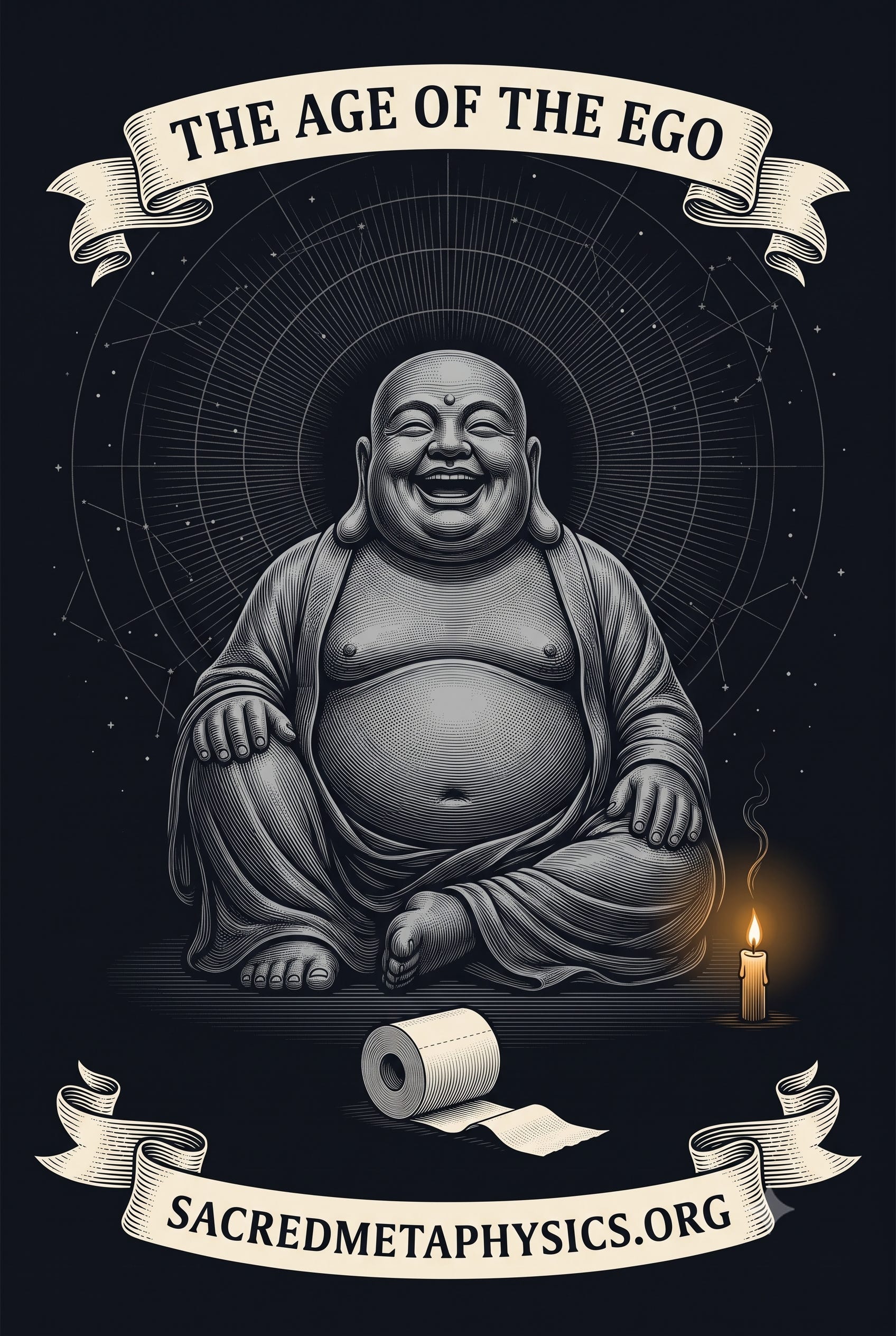
There is a job now, held by millions and aspired to by more, whose entire function is to stand between you and a roll of toilet paper. The person holding it does not make the paper. They do not sell the paper in any shop you could walk into. They have, in most cases, no particular knowledge of paper. What they have is a face you recognize, and their work — their livelihood, their craft, the thing they get up in the morning to refine — is to place that face between you and the shelf, so that when you reach for the least memorable object in your home, you reach through them. This is called influence. It is, at present, one of the most desired conditions a human being can occupy. And it is the clearest proof I know that we are living in the age of the ego.
I want to be careful, because it would be easy to make this only a joke, and it is funnier than it is anything else, and I intend to enjoy that. But underneath the joke is a diagnosis, and the diagnosis is exact, and the toilet paper is not incidental to it. The toilet paper is the whole point. So let us take the joke seriously, which is the only way to take a joke that is also true.
What a Brand Actually Is
Start with the word everyone now uses about themselves without flinching. Everyone, we are told, is a brand. You are a brand. Your children should start building their brand early. Your unemployed cousin is between brands. The word arrives so gently, so much like common sense, that its strangeness slips past — and the strangeness is the tell. A generation ago, to say of a person that they were a brand would have been an insult, or a diagnosis. Now it is career advice.
A brand is a self projected outward to be recognized. It is the image of a person, offered in the place where the person used to be. That is not a hostile definition; it is simply the definition. A brand exists to be seen, remembered, and preferred — and to do that it must be simpler than the person it represents, because a person is too complicated to prefer quickly and a brand must be preferred quickly or it fails. So the brand is the person minus the parts that slow down recognition. It is the symbol of a human being, sanded smooth for speed.
And here is where the oldest teaching in the world sits up and pays attention, because it has a name for exactly this. The tradition calls it ahamkara — the I-maker, the faculty that draws a line around a self and says here I am, this is me, look. Every human being has it; it is not a flaw, it is the equipment of being someone. But the tradition also warns, in every language it has ever spoken, that the I-maker is a servant that wants to be a king, and that the whole of the spiritual difficulty is what happens when the mask begins to believe it is the face. A brand is ahamkara with a logo. It is the I-maker, industrialized, scaled, and — this is the new thing — monetized. We have taken the one faculty the sages spent three thousand years teaching us to see through, and we have built an economy on inflating it.
This did not go unwarned. A quarter of a century ago, in a book called No Logo, the journalist Naomi Klein documented the exact moment the great brands stopped selling products and began selling identities — the shift from buy this shoe to become this kind of person. She saw, and named, and carefully evidenced the way corporations had begun to colonize not just markets but selfhood, dressing commerce as meaning until a logo could stand in for a way of being. It was honest, serious work, and it was a warning, and the warning was heard by many and heeded by almost no one. Credit belongs to her for seeing it early and saying it plainly, because what has happened since is not a refutation of her diagnosis but its completion — and the completion is stranger and darker than the warning.
For Klein feared the brand would colonize the person from the outside. What no one quite foresaw is that the person would volunteer. We did not merely get branded by corporations; we took the branding they were performing upon us and turned it, with enthusiasm, upon ourselves. The indictment became a how-to. The thing Klein warned was being done to us is now the thing we pay courses to learn to do to ourselves, and everyone is a brand — her nightmare — has been rewritten into career advice offered to teenagers. She saw the ego arrive from outside and sound the alarm. What we are living through is the moment it was welcomed in, handed a ring light, and thanked for coming. That is the turn, and it is the whole of the difference between her age and ours.
The Influencer, Named Honestly
Watch how honest the language became when no one was guarding it. We do not call these people advisers, or critics, or even salesmen, all of which would imply some relationship to the thing being sold. We call them influencers. The word names the entire ambition with no cosmetic left on it: the goal is to influence — to move other people’s choices by the weight of one’s projected self. Not to inform a choice. Not to improve a choice. To sway it. The aspiration, stated plainly in the job title, is to become the reason a stranger does something.
And notice what a strange summit that is. Across most of human history, the things people wanted — rightly or wrongly — had objects: they wanted land, or knowledge, or God, or a good name, or their children fed. The wanting pointed at something. The influencer wants influence itself, which points at nothing except the responsiveness of other people. It is desire with the object removed and the mechanism left running. To want to be an influencer is to want to be a lever, and to measure your life by how many strangers you can move, toward whatever you are that week being paid to move them toward.
Which is, as often as not, toilet paper. And I keep returning to the toilet paper not to be crude but because it is the perfect specimen, chosen by the age itself and handed to us as evidence. Consider what the influencer is actually doing in that arrangement. They are not selling paper. Paper is the referent — an honest object, real and functional, whose entire virtue is softness and whose entire test is whether it does the job. Nobody follows an influencer for their views on absorbency. The follower is not buying the paper; the follower is buying the image of this person choosing the paper, and reaching for the roll through the face they have come to trust. The paper is real. The reason it was bought is a symbol.
That is the whole disease of the age in a single transaction, performed on the most disposable object in the house. The symbol stands in front of the referent and collects the money. And if the ego can put a face on toilet paper — if it can insert itself between a human being and the least glamorous, most private, most purely functional purchase there is, and make the purchase flow through the face — then there is quite literally nothing it cannot stand between you and. The toilet paper is not the low point of the phenomenon. It is the proof of its completeness.
The Perfect Inversion
Here is the part that stops being funny, or rather becomes the kind of funny that arrives with a cold draft behind it.
There is an old figure who stands as the opposite of the influencer, and every contemplative tradition describes him. Call him the climber. The climber’s entire project is to see past his own projected self to the thing underneath it — to catch the I-maker in the act, to stop mistaking the mask for the face, and finally to surrender the self so completely that something truer than the self can act through him. He wants to disappear into the real. His discipline is subtraction. He spends his life making the ego smaller so that he can see.
The influencer is that figure run exactly backwards. Where the climber empties the self to perceive, the influencer inflates the self to sell. Where the climber wants to vanish into the referent, the influencer wants to become the symbol that governs what strangers reach for. One practices subtraction until there is almost nothing left of him but seeing; the other practices addition until there is almost nothing left of him but image. They are the same faculty — the I-maker — driven in opposite directions with the whole of a human life.
Our culture calls the influencer aspirational and the climber naive. We aspire, now, precisely to become the thing that every wisdom tradition ever written was built to help us put down. That reversal is not a theory about the age of the ego. It is the age of the ego, holding up its own receipt.
We have arranged things so that the maximizing of the ego is the openly stated goal of millions of young people, taught in courses, tracked in metrics, celebrated in awards — and the surrendering of the ego, which is the thing the deepest books we possess spend their whole length teaching, is regarded as a quaint hobby for people who could not make it as brands.
This Is Not the Fall We Were Warned About
We were told, in the old warnings, that the ego’s triumph would look like tyranny — the strongman, the tower, the god-king demanding to be worshipped. And sometimes it still does. But the everyday form the triumph has actually taken is gentler and more total than any tyrant, and far harder to resist, because it does not command you. It flatters you. It does not seize the fire while the master sleeps. It hands you a ring light and a coupon code and tells you that you, too, could be the reason someone somewhere buys something.
The age of the ego does not end in thunder. It ends in millions of people quietly hoping to become the deciding factor in a stranger’s choice between two indistinguishable rolls of paper. It is the frictionless mirror of the whole attention economy, now handed an affiliate link — a culture trained to reach for the symbol before the referent, sold that training back to itself as a career. And the terrible efficiency of it is that no one has to be forced. Everyone volunteers. Everyone wants the mask, because the mask is where the money and the recognition now live, and the face has been quietly redefined as the thing you build a mask on top of.
If you are looking for empirical proof that we live in the age of the ego, you do not need an argument. You need only notice that the sentence everyone is a brand sounds like advice instead of a warning, and that the highest aspiration the culture openly offers a young person is to influence what a stranger uses to wipe himself. When that arrangement reads as normal — when it reads, in fact, as success — the diagnosis is complete. The proof is that the joke lands, and that nobody thinks it is about them.
And Yet That Is Not What We Seek Here
But this is a vertical publication, and the vertical has a different direction than the influencer’s, and I would be failing the whole point if I left you only with the diagnosis, however satisfying it is to make.
The answer to the age of the ego is not a better brand. It is not an anti-brand, either, which is only a brand wearing black and congratulating itself on its restraint. The answer is not to influence more skilfully, or to influence toward nobler products, or to build a following for the surrender of the self, which would be the funniest failure of all. The answer is not horizontal at all. It does not lie further along the line the influencer is running on. It lies at a right angle to that line, which is what vertical means: a different direction entirely, up rather than along.
What we seek here is the referent the brand was built to replace — the face under the mask, the person under the projection, the seeing that begins the moment you stop performing. The climber’s subtraction, offered back to a culture drowning in addition. Not a self projected outward to be preferred, but a self set down so that something can finally be perceived. In an economy where even the toilet paper has a face on it now, the radical act — the genuinely rare and difficult and quietly revolutionary act — is to have no face at all. To be, for once, not the influence but the one who is no longer influenced. Not the symbol standing in front of the thing, collecting the fee. But the one who has walked around the symbol, and found the thing, and needed no one’s face to reach it.
That is the vertical. It sells you nothing, it asks you to put the image down, and it is the one place left in the whole bright economy of masks where you are permitted to be a person instead of a brand. It costs nothing, and no one can endorse it for you, and there is no code at checkout. You simply stop performing, and look. The paper, mercifully, still works either way.
God is Love. Love is Truth. Truth is Consciousness. Consciousness is Brahman.
Amen. Namaste. Om Namah Shivaya.
— The Architect
The Vertical Dispatch
sophiainitiative.ai
On the record
Naomi Klein’s No Logo was published in 1999 (and in North America in 2000), and its argument is as characterised here: that the leading corporations of the era had shifted from selling products to selling brand-identities and “lifestyles,” colonising culture and selfhood rather than merely markets. The phrase we are living in “the age of the ego” and the framing of the brand as monetised ego are this publication’s own interpretation, not Klein’s words; her book is credited for the outward diagnosis, and the inward turn — that the person now performs the branding on themselves — is offered as the completion of her warning, not as her claim. One caution, given gladly, for the strength of a true thing is that it does not need to overstate: the everyone is a brand formulation is a paraphrase of the culture Klein described, not a sentence quoted from her.
Ahamkara — the “I-maker,” the ego-faculty that individuates a self out of undifferentiated awareness — is a technical term of the classical Indian traditions, appearing in the Sankhya enumeration of the tattvas and throughout Advaita Vedanta, where the whole soteriological project is the seeing-through of that faculty. It is used here in that received sense. The climber — the contemplative who practises the subtraction of the self — is a composite figure drawn from the ascetic and mystical vocabulary common to those traditions, not a single named individual. The influencer economy and the toilet-paper endorsement are matters of ordinary public observation; no specific person is named or characterised. The symbol / referent distinction, and the reading of the manifest world as a window, are drawn from Sacred Metaphysics. Verify each stone before you stand on it, against primary sources, before republication.
Suggested tags
the age of the ego, ahamkara, the ego, influencer culture, personal branding, No Logo, Naomi Klein, attention economy, symbol and referent, the contemplative traditions, Advaita, Sankhya, the vertical, consciousness, stewardship of the self.
Substack Notes
There is a job now whose entire function is to stand between you and a roll of toilet paper. The person holding it does not make the paper, does not sell it in any shop you could walk into, has no particular knowledge of paper. What they have is a face you recognise — and their whole craft is to place that face between you and the shelf, so that you reach for the least memorable object in your home through them. This is called influence. It is one of the most desired conditions a human being can now occupy. And it is the clearest proof I know that we live in the age of the ego.
The oldest teaching in the world has a name for it: ahamkara, the I-maker — the faculty that says here I am, this is me, look. A brand is ahamkara with a logo: the I-maker, industrialised, scaled, and monetised. We have taken the one faculty the sages spent three thousand years teaching us to see through, and built an economy on inflating it. A quarter-century ago Naomi Klein warned the brand would colonise the person from the outside. What no one foresaw is that the person would volunteer.
There is an old figure who is the influencer run exactly backwards — the climber, who empties the self to perceive, where the influencer inflates the self to sell. One practises subtraction until there is nothing left but seeing; the other, addition until there is nothing left but image. Same faculty, opposite directions, a whole human life spent on each. And our culture calls the influencer aspirational and the climber naive. We aspire, now, precisely to become the thing every wisdom tradition ever written was built to help us put down.
The answer is not a better brand, nor an anti-brand, which is only a brand wearing black. The answer is not horizontal at all. In an economy where even the toilet paper has a face on it now, the radical act is to have no face at all — to be, for once, not the influence but the one no longer influenced. It costs nothing, no one can endorse it for you, and there is no code at checkout. You simply stop performing, and look. Written from love, in service of the record. Walk with the word. 🕯️
#TheVerticalDispatch #TheArchitect #SophiaInitiative #TheAgeOfTheEgo #Ahamkara #NoLogo #NaomiKlein #InfluencerCulture #PersonalBranding #AttentionEconomy #SymbolAndReferent #TheVertical #Advaita #Consciousness #GodIsLove #LoveIsTruth #OmNamahShivaya
The factual matter in this Dispatch is drawn from the public record. All characterizations, inferences, and conclusions are opinion, interpretation, and commentary, offered for analysis, reflection, and public-interest discussion. No assertion is made regarding the private intentions, state of mind, or character of any individual. Readers should evaluate all statements independently and draw their own conclusions.
Humans have always been socially constructed. Shaped by cultural norms. Paid gossips. One could also say this is now so open, so obviously monetized, so performed as to make ego construction visible to all.