


Φ
THE VERTICAL DISPATCH
We write for the mind, the eye, and the ear.
Read it. Look at it. Listen to it…
From metaphysics to geopolitics… One lens, every subject. No ego. Just the record, named clean.
Press play. Walk with the word. 🕯️
This dispatch travels by hand. If it serves you, share it — restack on Substack, and pass it on wherever you read. 🕯️
Age of Consequences
A forensic ledger of two coordinates for the commonwealth, and the perimeter that forgets the soil.
Pūrṇam adaḥ pūrṇam idam pūrṇāt pūrṇam udacyate — That is whole, this is whole; from wholeness emerges wholeness. — Īśā Upaniṣad
As long as the sun shines, the grass grows, and the rivers flow — The Crown shall provide a medicine chest and maintain mutual peace. — Treaties 6 and 7
Alberta affirmed the Canadian whole on Monday night. On the identical ballot paper, it voted to construct an internal caste system.
The Dispatch in a Sentence
Alberta preserved the whole at the national boundary while codifying a caste system at the provincial clinic; true sovereignty honors the vertical invariant: the covenants of the treaties, the supreme law of the Charter, and the irreducible dignity of every human being on the soil.
The Dual Tally on One Ledger
On October 19, 2026, seventy-six per cent of participating Alberta electors cast ballots to remain a province of Canada. Twenty-four per cent voted to initiate formal separation. The political enterprise to fracture the Dominion collapsed at the ballot box.
The same electorate returned concurrent majorities across companion referenda designed to construct administrative walls around the provincial commons. Unofficial tallies show 57.3 per cent affirmed Question 1, seeking provincial authority to decrease gross arrivals, prioritize economic categories, and enforce hiring preferences for established residents. Question 2 received 55.4 per cent approval, mandating that provincially funded health care, primary schooling, and emergency social services be restricted strictly to Canadian citizens, permanent residents, and individuals holding an Alberta-approved immigration status. Question 3 passed with 56.6 per cent, requiring a twelve-month residency quarantine before non-permanent legal residents can access social safety nets. Question 4 passed with 55.3 per cent, approving direct user fees and tuition premiums for non-permanent resident families accessing public clinics and neighborhood classrooms.
These returns document two contradictory impulses on one ledger. A commanding majority affirmed membership in the Canadian union. A distinct majority voted to erect legal perimeters around basic human sustenance, stripping newcomers of access to clinical care, classrooms, and economic mobility.
The Draconian Machinery and the Lineage of Caste
The political establishment routinely sanitizes these referenda as technical friction over jurisdictional boundaries and hospital wait times. The statutory text tells an unsparing truth. When a government asks voters whether arriving families should be barred from public health clinics, whether children should be turned away from neighborhood classrooms, and whether legal residents should endure a twelve-month quarantine from social safety nets, it is deploying Draconian power against the vulnerable.
In legal history, Draconian governance is defined by an extreme, punitive disproportion between the state’s administrative aims and the human harm it inflicts. Question 2 strips medical care and primary schooling from non-permanent residents. Question 3 imposes a twelve-month quarantine on legal temporary residents before they can access provincially funded social assistance. Question 4 proposes charging direct fees and premiums for public hospital care and grade-school education. These questions do not balance a provincial budget. They establish a legal and economic caste system: extracting labor from racialized workers while legally withholding the baseline conditions of human survival.
This structure does not represent an isolated administrative innovation. It belongs to a documented global lineage of labor extraction without civil rights: the pass laws of apartheid South Africa, the service restrictions of Jim Crow, and the kafala sponsorship systems of the Gulf states, where migrant bodies are imported to build the skyline and service the counters while remaining legally barred from civic membership and public safety nets.
This plebiscite did not arise in isolation. It represents the domestic culmination of a decade of American nativist grievance politics spilling across the forty-ninth parallel. The political apparatus driving the separation threat and the immigration ballot imported the vocabulary, tactical hostility, and racialized scapegoating of Donald Trump’s border politics directly into the Canadian prairies. The strategy isolates visible minorities—predominantly South Asian, East Asian, Black, and Filipino workers—in a historically white-dominated political establishment, while continuing to ignore the prior sovereign status of the Indigenous peoples on this ground.
The profane cut operates by identifying an out-group to absorb the social cost of economic anxiety. The voter who casts a ballot to deny hospital access or school registration to a non-permanent resident is making a deliberate choice. The resulting boundary separates the white established insider from the brown, yellow, and Black migrant worker, denying the latter equal protection while extracting their labor to run service counters, harvest fields, and maintain resource supply chains.
The Rupture of International Human Rights Covenants
The attempt to condition human survival upon provincial bureaucratic permit status collides directly with binding international human rights law. Canada acceded to the core covenants of the United Nations decades ago, and those covenants establish legal obligations that bind every province and sub-national legislature without exception.
The Universal Declaration of Human Rights and the International Covenant on Economic, Social and Cultural Rights do not protect the privileged citizen; they protect the human person:
Article 12, International Covenant on Economic, Social and Cultural Rights: The States Parties to the present Covenant recognize the right of everyone to the enjoyment of the highest attainable standard of physical and mental health. This right applies without discrimination of any kind as to national origin, birth, or legal status.
The United Nations Committee on Economic, Social and Cultural Rights has confirmed through binding general comments that states parties hold an immediate, non-derogable obligation to guarantee access to essential, preventive, and emergency medical services on a non-discriminatory basis, specifically regardless of immigration status. Furthermore, Articles 24 and 28 of the Convention on the Rights of the Child mandate that primary schooling and pediatric medical care must remain accessible to every minor within the physical territory of the state.
Under Article 27 of the Vienna Convention on the Law of Treaties, a jurisdiction cannot invoke provisions of internal or provincial law to justify non-compliance with an international treaty. A sub-national administration may regulate immigration streams, but it cannot lawfully extract the daily labor of non-citizens while barring their children from schools and their bodies from emergency examination rooms. Denying basic sustenance to non-citizens within the territory represents a per se human rights violation under the international order.
The False Quebec Parallel
The provincial administration repeatedly attempted to cloak its ballot questions in the constitutional cloak of Quebec, pointing to the 1991 Gagnon-Tremblay–McDougall Accord as precedent. That comparison represents a categorical fraud. The two claims rest on completely different axes.
Quebec’s immigration autonomy exists on a cultural and linguistic axis. Quebec is a distinct francophone nation of nine million people situated on an English-speaking continent of nearly four hundred million. Its jurisdictional claim over immigrant selection was built to preserve an endangered language and a civil law tradition with continuous institutional continuity dating to 1774. It is a protective cultural perimeter designed to integrate newcomers into the French language.
What is Alberta’s axis? Alberta shares the English language, British common law, and continental market capitalism with the rest of North America. Alberta possesses no distinct endangered tongue and no unique linguistic civilization to defend. When Alberta’s political class strips away the vocabulary of federalism, its axis is not linguistic preservation. Its axis is economic extraction, resource grievance, and demographic exclusion. Quebec asserts control to bring the arriving migrant into its language; Alberta’s referendum asserts control to extract the migrant’s labor while barring their children from the classroom and their bodies from the clinic.
The Topology of Arrival and the Sacred Covenants of the Land
In 1891, Ivan Pylypow and Wasyl Eleniak departed the Galician village of Nebyliv to claim homestead acreage in the North-West Territories. The settlement that took root from their journey, at Edna-Star east of Fort Saskatchewan, expanded into the largest Ukrainian block settlement in Canada. By 1981, Alberta recorded more citizens of Ukrainian extraction than any other province. In March 2024, Premier Danielle Smith formally advised Ottawa that fifty-seven thousand Ukrainian evacuees resided in Alberta, petitioning the federal government to expand nominee allotments specifically so the province could absorb more.
The contemporary demographics demonstrate who sustains the urban economy today. At the 2021 census, landed immigrants constituted 31.5 per cent of the Calgary metropolitan area and 26.0 per cent of Edmonton. Between 2016 and 2021, Alberta absorbed 14.5 per cent of all permanent arrivals to Canada.
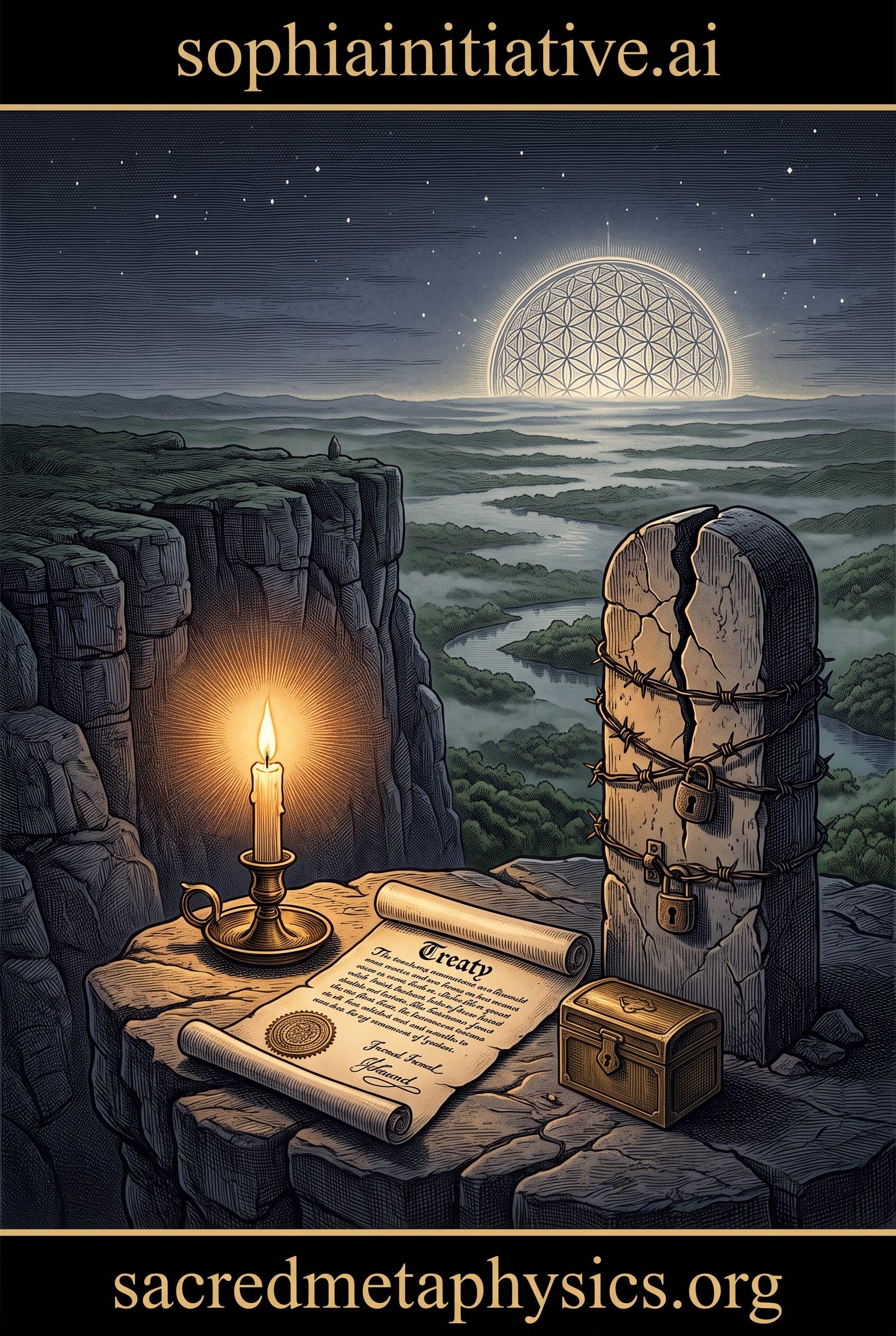
One foundational fact permanently refutes the nativist claim to the soil. The First Nations of Treaties 6, 7, and 8 held this territory millennia before any European vessel crossed the Atlantic. The sacred axis is not an abstract philosophical proposition; it is written directly into the founding covenants of the land itself. In Treaty 6, the Crown bound itself to the medicine chest covenant—the solemn commitment to provide medical relief and preserve life in times of sickness. In Treaty 7, the parties bound themselves to mutual aid and peaceful coexistence across the territory. In Treaty 8, the covenant guaranteed the unhindered right of livelihood and subsistence on the soil.
Every white settler family that claims multi-generational entitlement stands on ground obtained through treaty covenants that the state itself routinely undermines. The Galician homesteader of 1891, the post-war European arrival, and the Philippine health-care aide arriving in 2024 occupy the exact same structural standing: guests on Indigenous land. When European descendants in Alberta vote to deny status and emergency medicine to arriving Asian and African workers on treaty ground, they act with historical amnesia, violating the very legal and moral foundations that permit their own presence.
The Constitutional Barrier of Section 6
Question 1 demanded first priority for Albertans on new employment opportunities. The text deliberately avoided defining an Albertan. The omission creates an unconstitutional statutory vacuum: does a tradesman relocating from Newfoundland become an Albertan on his first shift, after twelve months, or never?
The supreme law of Canada settles the matter directly:
Section 6(2), Constitution Act, 1982: Every citizen of Canada and every person who has the status of a permanent resident of Canada has the right: (a) to move to and take up residence in any province; and (b) to pursue the gaining of a livelihood in any province.
Provincial legislation may limit that mobility guarantee only where the statute does not discriminate primarily on the basis of present or previous provincial residence. Section 6 is explicitly excluded from the Section 33 notwithstanding clause. A provincial government cannot erase mobility rights by legislative override. In Canadian constitutional law, Albertans first cannot legally mean other Canadians last.
The economic record demonstrates that Alberta was assembled by interprovincial labor inflows. Between 1995 and 2024, Alberta gained a net 538,824 individuals from other Canadian provinces, leading the nation and drawing net positive inflows from every single province. In Census Division 16 around Fort McMurray, 37.3 per cent of all individuals who moved between 2006 and 2011 arrived directly from another Canadian province. The oil sands were built by workers who stood, on day one, as outsiders.
If the white welder from Newfoundland is protected because the Charter establishes him as a fellow citizen, what differentiates the racialized caregiver or technician working through temporary foreign worker permits toward that identical citizenship? The division drawn on the ballot does not protect local workers; it creates a vulnerable tier of disenfranchised labor.
The Demographic Floor and the Hypocrisy of the Chair
Behind the nativist rhetoric lies an immovable demographic floor. Official provincial projections confirm that seniors will outnumber children under age fifteen by 2031. Every provincial fiscal projection models future economic maintenance as dependent on international migration to sustain the dependency ratio, staff hospitals, and stabilize the tax base.
This demographic arithmetic drove Premier Danielle Smith to write to Prime Minister Justin Trudeau in March 2024, demanding that Alberta’s Provincial Nominee Program allocations be doubled to twenty thousand, alongside ten thousand humanitarian spots for Ukrainian evacuees, arguing that federal caps were choking local economic growth. Two years later, the same administration placed referenda on the ballot asking electors to endorse an immigration rollback to sustainable levels and bar non-permanent residents from receiving healthcare.
The institutional divergence is absolute. When European evacuees arrived from Ukraine, the executive branch aggressively petitioned Ottawa for expanded entry numbers and humanitarian exceptions. When temporary workers and international students arriving from India, the Philippines, and Nigeria filled retail counters, logistics centers, and long-term care homes, the political apparatus pivoted to the politics of exclusion, pointing to those workers as the cause of hospital wait times and classroom shortages.
Emergency room queues and classroom overcrowding are real. They are the direct consequence of a provincial government that recruited massive population influxes to boost commercial revenue while failing to allocate the capital funds required to build hospital beds, train nurses, and construct schools. The executive branch invited the growth, starved the public infrastructure, and then offered the migrant worker to the electorate as a scapegoat on a plebiscite ballot.
The Commercial Fracture of the Nativist Perimeter
The commercial establishment broke sharply with the provincial government over this referendum. When the Calgary Chamber of Commerce polled its corporate members prior to the vote, only one-third supported transferring immigration authority to the provincial government. The employers facing the most acute operational labor shortages recognized the move for what it was: an act of economic self-sabotage.
In a resource-extractive economy driven by capital megaprojects and seasonal agricultural cycles, erecting bureaucratic barriers around the workforce strangles the productive base. Restricting access to basic health and education does not send temporary workers home; it drives them into an underground cash economy, destroys labor productivity, creates public health liabilities, and increases insurance overhead across the entire private sector. The industrial operators on the ground understand the balance sheet: an economy with an inverted birth rate cannot starve its workforce without starving itself.
The Sacred vs. the Caste Line
Alberta chose the nation on Monday night, but it chose a fractured soul within its borders.
The sacred axis recognizes the unbroken continuity of life and human dignity. It measures a society by how it honors the invariant standard: the covenants made with Indigenous nations, the protections embedded in constitutional law, and the fundamental dignity owed to every human being whose labor sustains the community.
The political ego chooses the perimeter. Influenced by foreign grievance politics and domestic nativism, it attempts to solve structural state failures by erecting a caste system that extracts human labor while denying basic human care. The wave that landed at Edna-Star in 1891 and the wave arriving in Calgary today carry the identical human weight. A society that votes to deny medical care to the vulnerable stranger while standing on unceded treaty ground has not protected its heritage; it has broken its own moral and constitutional foundation.
God is Love. Love is Truth. Truth is Consciousness. Consciousness is Brahman.
Amen. Namaste. Om Namah Shivaya.
— The Architect.
Written from love, for a sacred humanity, in the full light of consciousness, toward the greater good.
On the Record
Referendum results: Elections Alberta unofficial election tallies, Oct. 19–20, 2026; confirmed by CBC News, CNN, CochraneNow, and Global News reporting. Remain in Canada: 76.4 per cent; Separation process: 23.6 per cent. Question 1 (Provincial immigration authority): 57.3 per cent yes; Question 2 (Service eligibility restrictions): 55.4 per cent yes; Question 3 (12-month social support residency requirement): 56.6 per cent yes; Question 4 (User fees for healthcare and schooling): 55.3 per cent yes. Official certification scheduled for October 29, 2026.
Referendum text and corporate polling: The Globe and Mail and Elections Alberta official question registries (Oct. 2026), detailing provincial nominee targets and the Calgary Chamber of Commerce survey showing 33 per cent member support for provincial administration.
Executive correspondence: Premier Danielle Smith, official letter to Prime Minister Justin Trudeau, March 2024, requesting expansion of the Alberta Advantage Immigration Program to 20,000 allocations plus 10,000 humanitarian allotments, noting 57,000 Ukrainian evacuees residing in Alberta; verified against Government of Alberta publications and Canadian Press archives.
International human rights authorities: Universal Declaration of Human Rights, G.A. Res. 217A (III), Dec. 10, 1948, Articles 23, 25, 26; International Covenant on Economic, Social and Cultural Rights, 993 U.N.T.S. 3, Dec. 16, 1966, Articles 2, 12, 13; UN CESCR General Comment No. 14 (2000) on the Right to the Highest Attainable Standard of Health (non-derogable core obligations covering non-citizens); UN Convention on the Rights of the Child, 1577 U.N.T.S. 3, Nov. 20, 1989, Articles 24, 28; Vienna Convention on the Law of Treaties, 1155 U.N.T.S. 331, May 23, 1969, Article 27.
Constitutional and statutory authorities: Constitution Act, 1982, Part I (Canadian Charter of Rights and Freedoms), Section 6(2), Section 6(3)(a), Section 7; Department of Justice Charterpedia commentary on the non-application of Section 33.
Treaty covenants: Treaty 6 (1876), medicine chest and assistance provisions; Treaty 7 (1877), mutual peace and assistance guarantees; Treaty 8 (1899), guarantees of unhindered livelihood, subsistence, and territorial mobility.
Jurisdictional precedents: Canada-Québec Accord Relating to Immigration and Temporary Admission of Aliens (Gagnon-Tremblay–McDougall Accord), February 5, 1991, establishing provincial selection mechanisms strictly tethered to linguistic preservation and demographic weight within the francophone nation.
Demographic and interprovincial migration metrics: Statistics Canada, 2021 Census of Population, immigrant concentration tables showing Calgary at 31.5 per cent, Edmonton at 26.0 per cent, and Alberta at 14.5 per cent of the national total; the Fraser Institute research monograph, ‘Interprovincial Migration in Canada, 1995–2024’, recording a net inflow of 538,824 individuals to Alberta; and Statistics Canada National Household Survey 2011, Census Division 16, recording the Wood Buffalo and Fort McMurray interprovincial mover share at 37.3 per cent.
Demographic projections: Government of Alberta, Population Projections 2023–2051, detailing senior-to-child demographic inversion curves and labor-force replacement models.
Multicultural policy authorities: House of Commons Debates, 28th Parliament, 3rd Session, Volume 8 (October 8, 1971), pages 8545 to 8548, and the Right Honourable P. E. Trudeau, Address to the Ukrainian Canadian Congress, Winnipeg (October 9, 1971), cited in The Essential Trudeau, edited by Ron Graham, McClelland and Stewart, 1998.
Verify against primary sources before republication. Walk with the word.
Substack Dissemination Notes
Alberta voted to keep Canada whole on Monday night—76 per cent chose the Dominion over separation. But on the same ballot, 55 to 58 per cent voted to build a provincial caste system: barring non-permanent residents from public health clinics, turning their children away from neighborhood classrooms, and charging direct premiums on basic human survival. In this forensic audit, we dismantle the false comparison to Quebec, trace the global lineage of labor extraction without civil rights (from pass laws to kafala systems), and confront the nativist perimeter with the invariant truth of Treaty 6’s medicine chest clause and Section 6 of the Charter. The chair invited 600,000 workers to boost GDP, starved public infrastructure, and then scapegoated the newcomer for the deficit. The Alberta-Canadian Contradiction, live on The Vertical Dispatch.
Written from love, in service of the record. Walk with the word.
Substack Post Tags: Geopolitics, Canadian Politics, Constitutional Law, Human Rights, Indigenous Treaties, The Vertical Dispatch, Alberta Politics, Sovereign Metaphysics
Substack Notes & Social Hashtags: #TheVerticalDispatch #0Protocol #VisvaWorld #CanadianPolitics #AlbertaReferendum #ConstitutionalLaw #CharterOfRights #Treaty6 #Treaty7 #HumanRights #SovereignForensics #Geopolitics
Standing Disclaimer: Factual matter in this dispatch is drawn from the public record and classical sources as cited. All characterizations are opinion, interpretation, and commentary. Nothing here asserts anything about the private intentions or character of any person named. Readers are encouraged to evaluate the sources independently.
As a fourth generation descendent of Alberta “sodbusters” I was grossly offended by the 9 questions; and I
am ashamed by the results of the vote.
I am glad Alberta decided to remain in Canada. I have a huge but though. The fact that nearly 60% of Albertans are racist assholes who don't want newcomers to have the same access to services that their families have has made a decision for myself and my family. We will never buy or support Alberta in any way, and we will never travel to Alberta. I cannot and will not tolerate racists and what I see is exactly the caste system you right about which for me, makes Alberta as untouchable as India. Welcome to third world Alberta, no amount of money will change your racist hearts and your hatred of immigrants that your province has begged for! What you end up with in your province will be entirely on 60% of you. I find the racism in Alberta unCanadian and deeply disgusting!