

Φ
THE VERTICAL DISPATCH
We write for the mind, the eye, and the ear.
Read it. Look at it. Listen to it. The Vertical Dispatch is built for all three — prose with rhythm, made to be heard as much as read.
From metaphysics to geopolitics, from culture to history, from the sacred to the street — and everything in between. One lens, every subject. No ego. Just the record, named clean.
Press play. Walk with the word. 🕯️
This dispatch travels by hand. If it serves you, share it — restack on Substack, and pass it on wherever you read. 🕯️
The Foundation Series · The Age of Consequences
as of July 5, 2026
“The particular is not the universal, and the symbol is not the referent.”
— the standing lesson of this publication
It began as a look at a province and became something else. That is the honest way to say what happened over these past weeks. I set out to examine Alberta — the loudest grievance in the country, the pipeline in the news, the premier and the prime minister at the podium — and I found, as one always finds when one looks closely enough, that the thing would not stay the size I had assumed. Every thread I pulled was tied to another. The closer the focus, the more the single subject dissolved into a weave, and the weave ran outward past the province, past the country, into the shape of the age itself.
I want to describe that experience rather than repeat its findings, because the experience is the lesson, and the lesson is worth more than any single figure it turned up.
Nine coats, one body
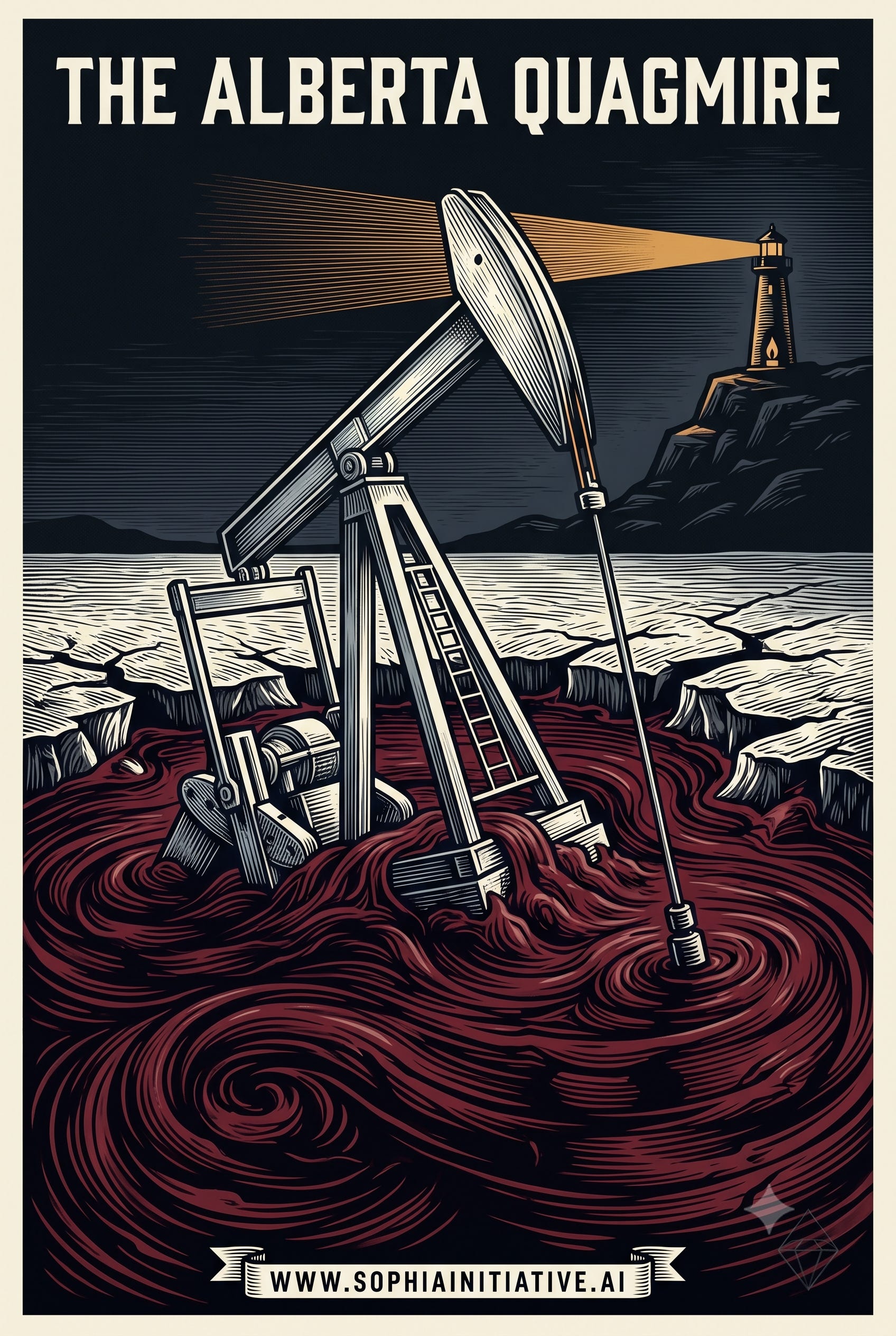
What I did not find was nine problems. What I found was one problem wearing nine coats. The wells and the tailings ponds; the wards and the classrooms; the deregulated grid and the absent sales tax; the world-class technology given away and the grievance held close; and, this weekend, the pipeline deal itself — I could name each in a breath, and I will not do more than that here, because to line them up as nine separate charges would be to commit the very error the whole inquiry warns against. They are not nine things. They rhyme. Each is the same structure seen from a different angle: an engine of enormous power running forward at the task it can price, and blind to the cost at its sides. Nine coats. One body underneath.
And they are not only nine angles in space; they are three tenses in time. Each reaches back into a past that made it — a founding bargain, a fund saved elsewhere and spent here — and forward into a future that will inherit it — a liability with no end date, a debt with no discharge, an asset that may strand. The present sits in the middle, paying for both. So the legacy of Alberta and the legacy of the world we have built turn out to be the same braid: the resource curse is not Canadian, the blinkered engine is not Albertan, the machine that privatizes the reward and socializes the cost is not local to any one place. The particular kept opening onto the universal. It always does, if you look long enough.
I did not find nine problems. I found one problem wearing nine coats. They do not add up. They rhyme.
The podium that would not stay one thing
This weekend gave the clearest instance of it. A news conference; a handshake; the announcement of a route. It looked, on the surface, like one event — a single thing that had happened on a single day. But under the light it refused to stay one thing. It held the past that produced it, the present wager that funds it, and the future liability it commits us to, all collapsed into one podium moment. There were details in it few were expecting — a commercial buy-in on the order of a tenth to a fifth was in the cards, and the deal is not done, and the numbers are not fully out. Which is precisely the point. A thing that will not hold still, whose figures are not yet settled, cannot be judged as though it were finished and simple. The one is only ever the particular. To understand it at all requires the universal — the beholding of the whole.
Why it must be a book, and why the book must wait
This is the discipline Neil Postman spent a life insisting on: before you propose a solution, you must be able to say plainly what the problem actually is — and you cannot name the problem from a fragment. You can only name it from the whole. Which is why the honest form for the Alberta file is not a post and not a series of posts. It is a book, because only a book can hold the whole in view long enough for the real problem — the one under the nine coats — to be named, and only a named problem can be met with a solution. To pretend a matter this complex can be settled in a dispatch would be a disservice to the reader and a betrayal of the lens.
And here I owe my readers a plain and humbling word about myself, because the discipline of this publication is that it applies to the writer first. The quagmire did not only pull me toward a book. It pulled me in — in the very way it pulls a province. The rich and immediate and loud material drew my attention away from the quiet and essential work it is my first duty to finish; I felt, in my own weeks, the exact gravity I was describing on the page. It sucked the oxygen from the room. Which is the surest proof that the pattern is real and not merely Alberta’s: it does not spare the one who names it. The blinkered engine runs in the author as readily as in the province, if he lets the golden barrel set his course.
So I say it plainly. A file this large, told whole, requires a dedicated publisher — a dedication of time and attention that a solo writer, working dawn to night across a body of unfinished books, cannot rightly give it now. Were that dedication ever to come, unbidden, the book would be an option; I am not asking, and I have not asked, for I have never asked this work for anything but the truth. For now the deeper duty comes first: the sacred writing not yet finished, the volumes not yet in the world. I will not do to that work what Alberta did with its windfall — let the loud thing consume the essential one. So the Alberta file rests here, on the back burner, banked and not abandoned, and my voice on Canadian geopolitics steps back for a season, so that the original work may be finished and published as it deserves.
The quagmire did not only pull me toward a book. It pulled me in — the very way it pulls a province. It does not spare the one who names it.
A word to those who follow the file
If there is one thing to carry from all of this, it is the caution the inquiry itself taught, and it is the only recommendation I will make. Be slow to render a momentary judgment on the whole. When the next headline lands — the next figure, the next handshake, the next single leg of a story this large — resist the pull to mistake it for the whole file. The particular is not the universal. The symbol is not the referent. The matter is genuinely complex, and the honest response to genuine complexity is patience: to hold the fragment lightly, to wait for the whole to come into view, and to withhold the verdict the ego is always eager to supply. That is not indecision. It is respect — for the truth, which is intricate, and for the reader, who deserves not to be handed a slogan in place of a diagnosis.
That is the lesson I learned by living it these past weeks, and it is the one I leave. The file is not closed. It is set down, with care, to be taken up again when it can be given the whole attention it requires. Until then: watch the water, and do not mistake one wave for the sea.
God is Love. Love is Truth. Truth is Consciousness. Consciousness is Brahman.
Amen. Namaste. Om Namah Shivaya.
— The Architect.
The Vertical Dispatch
sophiainitiative.ai
On the record
This is a reflection piece, not a reportorial dispatch; it makes no new factual claims about Alberta beyond those set out, and sourced, in the earlier overview dispatch to which it refers, where every figure is flagged for primary-source verification. On the July 2026 agreements: that the deal is not finalized, that terms including a commercial equity buy-in in the range of roughly 10–20% were reported as under discussion, and that full figures are not yet public, reflects reporting as of early July 2026 and should be confirmed against the governments’ own disclosures when released. The reference to Neil Postman is to his standing argument that a problem must be clearly defined before a solution can be sought. Verify against primary sources before republication.
Suggested tags
Alberta, the Alberta file, pipeline, complexity, Neil Postman, the particular and the universal, symbol and referent, editorial discipline, the Foundation Series, the Age of Consequences.
Substack Notes
An honest word about a file I am setting down. Over these past weeks I set out to examine Alberta — the loudest grievance in the country — and found what one always finds when one looks closely enough: the thing would not stay the size I assumed. Every thread was tied to another. I did not find nine problems; I found one problem wearing nine coats, and the coats rhymed.
They rhyme across space — the same blinkered engine seen from nine angles — and across time, reaching back into the past that made them and forward into the future that inherits them. The legacy of Alberta and the legacy of the world we have built turn out to be the same braid. And this weekend’s pipeline announcement was the clearest instance: it looked like one event, and under the light it would not stay one thing — details still emerging, figures not yet settled, a commercial buy-in reportedly in the cards, the deal not done.
Which is why the honest form for this is a book, not a post — because only the whole can name the real problem, in Postman’s sense, and only a named problem can be solved. And here the discipline turns on the writer, plainly and humbly: the quagmire did not only pull me toward a book, it pulled me in, the very way it pulls a province — the loud material drawing me from the quiet, essential work it is my first duty to finish. It sucked the oxygen from the room. A file this large, told whole, requires a dedicated publisher; that dedication I owe first to the original sacred work. So the Alberta file rests — banked, not abandoned — and my voice on Canadian geopolitics steps back for a season.
The one thing I leave is the caution the inquiry itself taught: be slow to judge the whole from a fragment. The particular is not the universal; the symbol is not the referent; the matter is genuinely complex, and patience is the honest response. Watch the water, and do not mistake one wave for the sea. Written from love, in service of the record. Walk with the word. 🕯️
#TheVerticalDispatch #TheArchitect #SophiaInitiative #Alberta #Complexity #NeilPostman #TheFoundationSeries #TheAgeOfConsequences #GodIsLove #LoveIsTruth #OmNamahShivaya
The factual matter in this Dispatch is drawn from the public record. All characterizations, inferences, and conclusions are opinion, interpretation, and commentary, offered for analysis, reflection, and public-interest discussion. No assertion is made regarding the private intentions, state of mind, or character of any individual. Readers should evaluate all statements independently and draw their own conclusions.
An actual question that Albertans might ask themselves:
Why does Norway have an oil wealth fund now worth $2 _Trillion and Alberta does not?
Is it the same reason that the UK doesn't have an oil wealth fund the same size as Norway's even though UK and Norway share the _very _same NorthSea oil field?
Is it because Alberta and UK -- both led by "Conservatives" -- sold their oil rights for a pittance and used the proceeds to buy votes, while Norway negotiated steely-eyed royalties and funneled them into a fund now worth over $340 k per Norwegian citizen?
With Alberta:
- current value of Alberta's Heritage Trust: $32 billion.
- finishing TMX cost $35 Billion in _Canadian taxpayer cash -- purely for Alberta's benefit.
- TMX "2.0" will likely cost $50 Billion in _Canadian taxpayer cash -- again, purely for Alberta's benefit.
- Alberta will be asking _Canadian taxpayers to help pay the many Billions needed to clean up its orphaned oil wells, instead of charging it to the subsidised, multi-billions-in-profit oil companies who created them in the first place.
Had Alberta managed its oil the way Lougheed planned, then by now Alberta could've had a Heritage Trust on par with Norway's wealth fund -- turning Alberta into a true economic powerhouse. The interest generated from such Trillon-dollar trust could have covered Alberta's public needs -- including building more pipelines if necessary.
Instead, after Lougheed, Alberta Conservatives cut royalties and spent the reduced proceeds on buying votes.