


[ DRAFT — FIRST DRAFT & OUTLINE · NOT FOR PUBLICATION · FOR THE BOOK IN FORMATION ]
Φ
THE VERTICAL DISPATCH
We write for the mind, the eye, and the ear.
Read it. Look at it. Listen to it. The Vertical Dispatch is built for all three — prose with rhythm, made to be heard as much as read.
From metaphysics to geopolitics, from culture to history, from the sacred to the street — and everything in between. One lens, every subject. No ego. Just the record, named clean.
Press play. Walk with the word. 🕯️
This dispatch travels by hand. If it serves you, share it — restack on Substack, and pass it on wherever you read. 🕯️
The Foundation Series · The Age of Consequences
A Review to Date — First Draft & Outline of the Book in Formation
as of July 12, 2026
“The particular is not the universal, and the symbol is not the referent.”
— the standing lesson of this publication
A word first about what this is, and what it is not. This is not the book. The book on Alberta — promised in these pages a week ago, and still owed — waits for a dedication of time this writer cannot yet give it, because the sacred work comes first. What this is, instead, is the honest middle form: a review to date. A first draft and an outline, set down in one place so that a reader who has followed the file in pieces can at last see it whole, and so that the book, when its season comes, has a keel already laid. Everything here is provisional. Read it as scaffolding, not as the finished house.
I set out, weeks ago, to look at a province. I have said before what happened next, and I will say it once more because it is the whole of the method: the thing would not stay the size I assumed. Every thread was tied to another. I named, in an earlier reflection, one problem wearing nine coats — the wells and the tailings, the wards and the classrooms, the grid and the missing sales tax, the technology given away and the grievance held close, and the pipeline itself. But I must correct the number now, plainly, because the correction is the finding. It was never nine. Nine is only where the counting began. The closer I have looked, the more coats there are; the file grows a new one with every fresh headline. What the book will reveal is not the tally. It is that the tally does not close. One body underneath, and no one yet knows how many coats it wears.
It was never nine coats. Nine is only where the counting began. The file grows a new one with every headline — and that it does not close is itself the finding.
So this review does two things at once. It gathers the record — the separation law, the treaty geometry, the three-games reading of the Premier’s conduct, the four-part ledger of what the pipeline costs per person. And it names, for the first time as the thesis rather than the aside, the single pattern that runs under all of it: the one thing every coat has in common. I did not have that pattern named when I wrote the pieces one at a time. I have it now, and it is the reason this is a fresh argument and not a rehash of old ones.
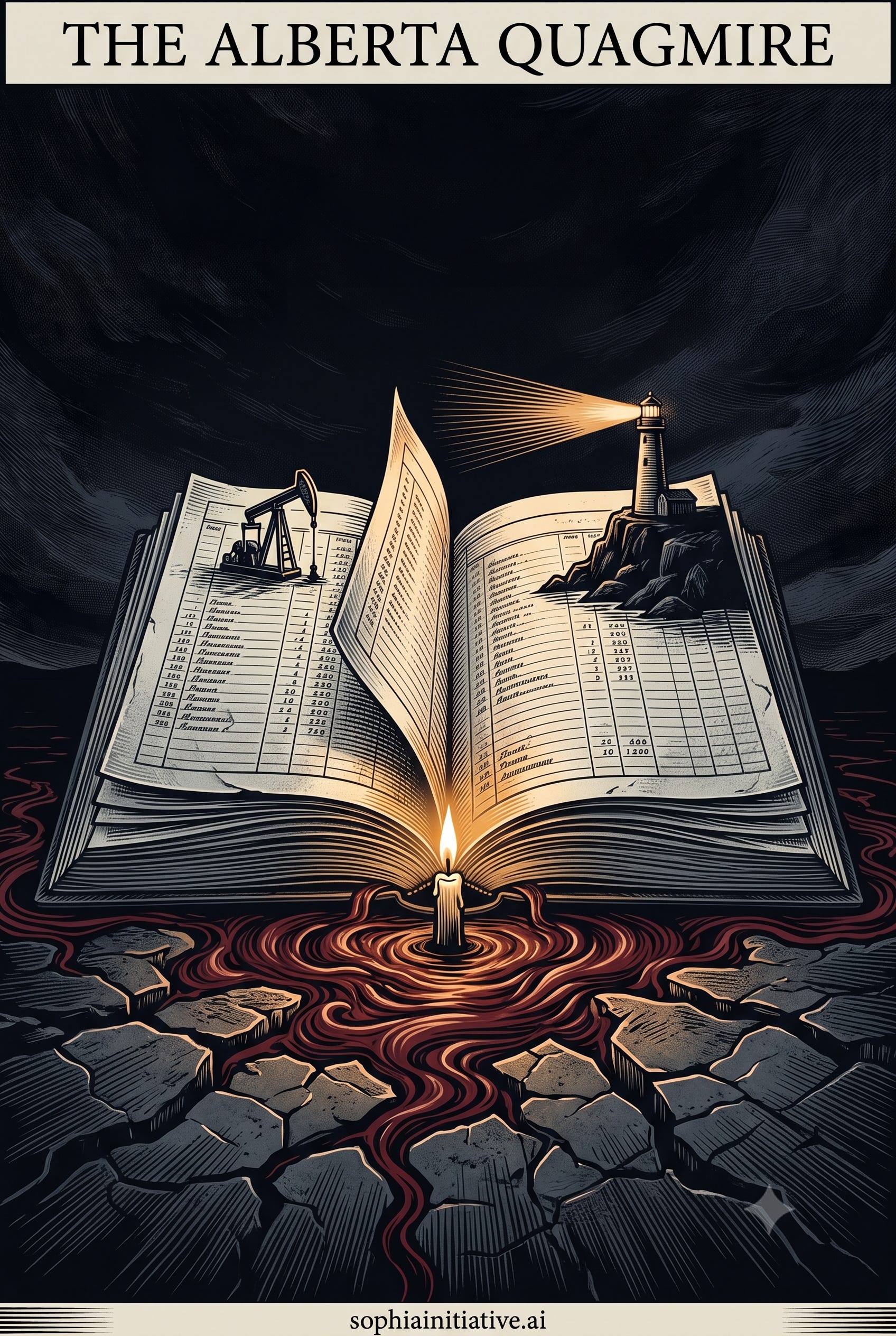
The pattern named: the vote comes first, the number comes after
Here is the pattern, stated once, cleanly, so the rest of this review can hang from it. On every load-bearing question in the entire Alberta file, the decision a citizen is asked to make arrives before the number that would let them make it. The vote comes first. The figure comes after. Every time. It is so consistent across so many separate files that it can no longer be read as coincidence. It is the shape of the thing itself.
Watch it repeat. On the pipeline’s cost to the taxpayer, the Premier’s own answer is that it “remains to be negotiated” — and the Final Investment Decision that would fix the number is expected only in 2027, after the October 19 referendum. On the carbon-capture project chained to the pipeline, there is, after four years, still no agreed split of who pays; the deadline to settle it passed unmet. On the cost of the newcomers the province recruited and now proposes to restrict, the Premier said, on the record, “we’d have to do the figuring out — we don’t track residents and how much they use.” On the cleanup liability for the wells and tailings already drilled, the province’s own regulator gives a range that runs from thirty-six billion toward sixty, and holds a few hundred million against it — a number so unfixed it is really an admission. Four files, four missing numbers, one referendum that does not wait for any of them.
On every load-bearing question, the citizen is asked to decide before the number that would inform the decision exists. That is not four coincidences. It is one method.
This is the roof over the nine coats — over all the coats, however many the book finally counts. It is what makes the file a single thing rather than a pile of grievances. The wells, the grid, the fund, the pipeline, the newcomers: each is the same move seen from a different angle. An engine of enormous power runs forward at the task it can price, and asks for the commitment before it will name the cost. The blinkered engine and the missing number are the same fact. That is the pattern the book exists to prove, and everything below is the evidence, gathered.
The doors that were already closed
Before the money, the law — because the separatist case begins by assuming a door is open that was shut before the first signature was gathered. On May 13, 2026, an Alberta Court of King’s Bench justice quashed the Stay Free Alberta separation petition, three hundred thousand signatures and all, on Section 35 grounds: the province could not run a Crown process that engaged the duty to consult First Nations without consulting them. The petition never should have issued. The reason is geological before it is legal. One hundred per cent of Alberta sits within a numbered treaty — Treaties 4, 6, 7, 8, and 10, no gap, no unceded corner — and the Athabasca oil sands, the revenue engine that makes separation arithmetically conceivable at all, sit in Treaty 8. The Athabasca Chipewyan First Nation was among the plaintiffs who won. The corner stones were placed before the game began.
Then the credible version arrived, and I gave it its own audit, because a serious file distinguishes the loud danger from the quiet one. Keith Wilson, K.C. — a King’s Counsel who concedes the law he cannot win and builds on the 1998 Secession Reference, which is real law: a clear majority on a clear question triggers a federal duty to negotiate in good faith. It is the strongest foundation a Canadian separatist has ever held. And it fails on its own key. The very duty to negotiate that Wilson invokes arrives chained to four principles the Supreme Court called indivisible, one of them the protection of minorities — which drags Section 35 and the treaty geometry straight to the table. The checkers player hit the corner stone on move one. The better lawyer hits it on move twenty. Both roads end on the same stone, because the stone was there first. That is the first missing number in a different form: the separatist case has never produced the plan for Section 35, only the promise to negotiate it later. There is no later. It is the precondition, not the postscript.
The three games, and the buy-in
With the legal door shut, the file turns to conduct — and here the frame that served best was three games, not one. Checkers is played one move deep: Ottawa takes our money, therefore leave, therefore keep it. It cannot see the board that comes after — the landlocked province, the buy-in, every trade agreement renegotiated from the weakest possible position, and the giant next door that has already met three times with Alberta separatists in Washington, once in a classified facility, and whose Treasury Secretary called Alberta “a natural partner.” Chess is deeper: the separatist threat held as leverage, never meant to be played, used to extract concessions from a federation that cannot afford to lose the province. It is skilled, and for a while it worked — until a grandmaster changed the board. When the Prime Minister signed a pipeline partnership and gave the province the tidewater route in the spirit of partnership, the threatening piece lost its value; you cannot threaten to leave over the thing you have just been given.
And then Go — the game almost no one in the drama is playing. Go is built by connection: patient territory, stones linked until the position cannot be killed. Norway played Go with its oil and built a fund worth on the order of a trillion and a half. Alberta began the same game first, in 1976, with the Heritage Fund — and quit within a decade, spending the windfall boom by boom. It holds about thirty-two billion today against a counterfactual, by one economist’s reckoning, near five hundred and seventy-five. But the deepest turn is this: Go is a game of scale, and a province is not a player at the world’s table — a country is. Leaving Canada does not promote Alberta to that board. It removes it. Inside the federation, Alberta is one of the strongest stones a G7 nation holds. Outside, it is a minor piece the giant means to absorb. You do not reach the great table by flipping the one you are already seated at. The buy-in to the only table that matters was paid long ago, in Confederation, and the seat is still warm.
The ledger, per person, cradle to grave
Then this weekend past put a number on the table, and the four-part ledger did the long division the governments would not. Begin with the pipeline itself. Canada and Alberta call themselves “equal partners” — a fifty-fifty split of a line that is roughly ninety per cent public, its cost between $35.2 and $43.7 billion. But a partnership is only equal if the partners are the same size, and here one is a nation of forty-one million and the other a province of five. Do the division on a deliberately conservative thirty billion in public money, split fifty-fifty, and the Albertan pays both halves — taxed once through Edmonton for the province’s share and again through Ottawa for the federal share — while every other Canadian pays only the federal slice. The key that falls out is a single portable rule: for every billion dollars of public money, an Albertan pays about $111 and every other Canadian about $12. Ninety cents on the shared dollar, ten cents on the other — per person, at every scale, because the ratio is the ratio of the two populations, not of the dollars. Nine to one, at the door.
That is the cost. The second dispatch laid out the ledger it lands on. Before a kilometre of pipe is laid, Alberta already carries about $109 billion in taxpayer-supported debt — roughly $21,500 for every resident, infant to elder — climbing toward $138 billion, on a province that stood on a stage in 2004 and declared itself debt-free. A $9.4 billion deficit, the largest since the pandemic; $3.4 billion a year in interest that competes directly with the hospitals and schools; a revenue base that loses several hundred million dollars for every single dollar the oil price falls. And it borrows one notch below Ottawa on a credit rating that the agencies say leans, in part, on the federal tie the referendum questions — a province voting about beginning to leave Canada, on a rating propped up by the assumption that it will stay.
Twenty-one thousand five hundred dollars a head, before the pipeline. And an Albertan is the only Canadian taxed on both sides of the same barrel — once through Edmonton, once through Ottawa.
The third dispatch turned the buried pages — the ones no budget’s front page shows. The cleanup liability for wells and tailings the province’s own regulator puts near thirty-six billion and its Auditor General closer to sixty, with under three hundred million held against it and about a hundred and fifty million collected a year. A single bankruptcy in April dumped more than four thousand wells onto the orphan list overnight. The carbon-capture project chained to the pipeline by the governments’ own accord — “no pipeline without Pathways” — whose corporate backers, five of the most profitable firms in the country, said plainly on the record: we can pay for some of it, we cannot pay for the whole burden. And the contradiction beneath all of it: a province that spent years recruiting workers with “Alberta is Calling” and a stated goal to double its population, now, in deficit, asking its voters whether to pay for the newcomers who came.
And the fourth dispatch handed the whole ledger to the ones who will carry it longest — the young, who in Alberta lean hardest toward the door, the exact reverse of Brexit, where Britain’s young voted overwhelmingly to stay and were outvoted by their elders. The reading there was not of their minds but of their world: an attention economy that rewards the feeling over the figure, a grievance that is real — youth unemployment near a fifteen-year high, a health system that makes them wait — pointed at the wrong door. Because the exit drifts toward a system where health coverage is chained to a good job, and the young are statistically least likely to hold one. A finished pipeline employs, after the construction burst, about ninety permanent people; a province’s schools and hospitals employ tens of thousands and need them now. The trade beneath the trade, never named on the ballot, is the social inheritance itself — ward and classroom, spent instead on pipe and pond.
What the last nine days added — and how the pattern held
Since those four dispatches, the file has done exactly what a quagmire does: it has grown new coats, and every one of them obeys the pattern. Here is what is new as of this writing, and each is provisional — verify against the primary record before the book is built.
The route is now settled, and it is the southern one — Bruderheim to a marine terminal at Roberts Bank in Delta, B.C., paralleling the existing Trans Mountain corridor. This matters, because the government’s own materials state the route “will not require any adjustment to the Oil Tanker Moratorium Act.” The northern tanker-ban wall this file flagged for a year is, on the southern route, side-stepped rather than confronted. A door the earlier pieces expected to block the project turns out to have been routed around. That is a genuine development, and honesty requires naming it at full strength: on this specific point, the project’s path is clearer than the file predicted.
The ownership has a name now. Trans Mountain Corporation, the Alberta Petroleum Marketing Commission, and Pembina Pipeline are to form a new jointly owned company to carry the line. And Pembina, the lone private partner, hardened the tell this whole series has pointed at: it stated it will risk none of its own capital before a Final Investment Decision, wants protection against cost overruns, and targets September 2026 only to sign definitive agreements. The professionals who price this risk for a living have put their reluctance in writing. The private slice remains ten per cent, option to twenty once oil flows. The bet the market will not match is now the market saying so, on the record.
The job numbers firmed and swelled — the submission now speaks of employment peaking near 140,000 at the height of construction, and the Prime Minister claimed upward of 175,000 jobs and $200 billion in new investment for the West Coast line, inside a broader basket of twenty-three national-interest projects. These are gross construction-and-investment figures, and they are real headline numbers. But they do not touch the tell the fourth dispatch named: the construction burst is not the permanent workforce. Trans Mountain was sold on a headline near fifteen thousand and left about ninety permanent jobs behind. The bonfire is bright; the hearth is what lasts. Both numbers belong on the page — the large gross figure and the small permanent one — so the reader can hold the difference the pitch collapses.
And the largest new fact of all cuts against the loudest assumption of the whole separatist file: support is falling, not rising, as the vote nears. Two independent pollsters now put the separation option well behind — one at around nineteen per cent, down roughly ten points since January; another at thirty-five per cent for the official question, and only thirty for a plain leave-or-stay. A majority of Albertans say the Premier has handled the issue poorly, including better than a quarter of her own past voters. The Prime Minister called the referendum question a “dangerous bluff.” This bears directly on one figure in the fourth dispatch — the youth-support number that ran markedly higher than the provincial average in earlier polling. That number must now be date-stamped to its specific release and read against a falling trend; it should not be carried forward as a flat present-tense claim. The book will have to hold the generational split and the overall decline together, and say honestly that the second complicates the first.
The file grows a new coat with every headline — the routed-around tanker ban, the market’s reluctance in writing, the falling polls — and each new coat wears the same body: decide first, learn the cost later.
The case for the deal, carried at full strength
A review that means to survive a hostile reader must carry the other side at its strongest, so here it is, undiminished. First: this is how Canada has always built. The railways, the ports, the Seaway — none was built on private capital alone, and a ninety-per-cent-public pipeline is not an aberration but the national pattern. Second: this is equity, not a bill. Albertans are buying an ownership share, and the same nine-to-one concentration that loads the cost onto them concentrates the return onto them too, if the barrels sell — higher stake, higher reward. Third: Alberta bets from relative strength, not weakness — the lowest debt-to-GDP of any province, a Heritage Fund near thirty-four billion, an economy that has weathered oil’s swings for fifty years. Fourth, on separation itself: the ablest defender notes the October question is narrow — it begins a legal process toward a possible future vote; no one on the ballot proposes to abolish medicare, and reading the American health system into an Alberta separation vote argues a slope the ballot does not name. And fifth: it is condescending to assume the young vote only on feeling; many have read the same ledger and concluded, rationally, that a province sending more to Ottawa than it receives might do better alone. A different conclusion is not a manipulated one.
Each of those deserves its answer, and the book will give each a full one. But the answer that governs them all returns to the pattern. Every one of these defences asks the citizen to trust that the number will be good — the return will come, the equity will pay, the process will stay narrow, the reasoning is sound. And in every case the number that would test the trust is scheduled to arrive after the commitment is made. The strongest case for the deal and the deepest problem with it are the same sentence: it asks you to decide before you can know.
What this review leaves, and what the book must do
So this is the outline, laid down in one place. The doors were closed before the vote — by treaty, by the Secession Reference’s own indivisible principles, by the geology under the oil sands. The games were misread — checkers performed for the base, chess out-positioned by a grandmaster, Go the only game that builds a legacy and the one game a province cannot reach by leaving. The ledger is heavier than the grievance admits — nine to one per person at the door, twenty-one thousand a head before the pipeline, tens of billions in buried cleanup with a few hundred million against it, and a generation asked to sign the longest-dated cheque in the book. And under every page, the same watermark: the vote comes first, the number comes after. That is the whole of it, in miniature. The book’s task is to prove that watermark exhaustively, coat by coat, however many coats there finally are — and to name, in Postman’s sense, the one problem clearly enough that a solution can at last be sought. A named problem can be met. An unnamed one can only be suffered.
But an outline is not owed a verdict, and this one will not force one. The facts are not in dispute; the weighing is the citizen’s, and the Albertan’s above all, for it is their province and their future more than anyone’s. What this review insists on is only the one thing the whole file has been denied: that the numbers be on the table when the ballot is. Be slow to judge the whole from a fragment. The particular is not the universal; the symbol is not the referent; the matter is genuinely, irreducibly complex, and patience is the honest response to it. Watch the water, and do not mistake one wave for the sea.
And then, having laid the keel, I set the file down again — with care, not abandonment. The quagmire pulls the one who names it exactly as it pulls a province, toward the loud thing and away from the quiet essential one, and I have felt that pull in my own weeks. The deeper duty comes first: the sacred writing not yet finished, the volumes not yet in the world. I will not do to that work what Alberta did with its windfall. So the book waits for its season, and the outline holds its place until then. The file is not closed. It is set down, whole now in a way it was not before, to be taken up when it can be given its whole due. Until then, and as always: watch the water. The keel holds.
God is Love. Love is Truth. Truth is Consciousness. Consciousness is Brahman.
Amen. Namaste. Om Namah Shivaya.
— The Architect.
The Vertical Dispatch
sophiainitiative.ai
[ DRAFT — FIRST DRAFT & OUTLINE · NOT FOR PUBLICATION · FOR THE BOOK IN FORMATION ]
On the record
This is a review-to-date and a working outline, not a finished dispatch; it is marked DRAFT throughout and is not for publication in this form. It synthesizes prior dispatches in this publication — The Wrong Moment, The Corner Stones Were Already Placed, The Credible Separatist, What Game Is Smith Playing, and the four-part ledger series (Ninety Cents on the Dollar, What the Ledger Will Bear, Something Has to Give, The Ones Who Carry It Longest) — each of which carries its own sourcing block; every figure restated here is flagged for primary re-verification before the book is built. New developments as of July 12, 2026 are drawn from: the Prime Minister of Canada’s office and Canada.ca (July 2, 2026) for the Bruderheim–Roberts Bank/Delta southern route, the statement that the route “will not require any adjustment to the Oil Tanker Moratorium Act,” the ~90% public / Pembina 10% split, the TMC–APMC–Pembina jointly owned company, the ~140,000 peak-construction and ~175,000-job / $200B figures, and the $135B / 23-project MPO basket; CBC and Pembina’s own release (July 2–3, 2026) for Pembina risking no capital before a Final Investment Decision, seeking cost-overrun protection, and a September 2026 target for definitive agreements. Polling on separation support is from the Ipsos poll for Global News (~19%, down ~10 points from January; May 28–June 1, 2026) and the Angus Reid Institute (60% No / 35% Yes on the official question; 67% stay / 30% leave on the simple question; 56% say the Premier handled it poorly; May 22–24, 2026). The Prime Minister’s “dangerous bluff” characterization is from CBC/CTV (May 2026). IMPORTANT CORRECTION FLAG: the youth-support figure (~42% among 18–34) used in the fourth dispatch is from earlier age-crosstab polling and now runs against the falling province-wide trend; it must be date-stamped to its specific release, or softened, before the book carries it, and must not be stated flat in the present tense. Per-capita figures are this publication’s own illustrative calculations on a conservative $30B public cost, a 50/50 federal–Alberta split, and StatCan populations (Alberta 5,057,077; Canada 41,417,056, April 1, 2026). The pipeline cost, split, and Final Investment Decision remain to be negotiated and may change. All characterizations are interpretation and commentary; no assertion is made about any individual’s private intentions, knowledge, or character. This is a DRAFT — mandatory MS Copilot four-eyes review and a fresh primary re-check of every live figure are required before any part of this is published. Verify against primary sources before republication.
Suggested tags
Alberta, the Alberta file, Alberta quagmire, pipeline, Pathways, Section 35, Secession Reference, Heritage Fund, Alberta referendum, October 19 2026, per-capita, Neil Postman, the particular and the universal, symbol and referent, the Foundation Series, the Age of Consequences, book in formation.
Substack Notes
This is not the book — it is the outline for it, set down in one place. Over weeks of looking at Alberta I found what one always finds: the thing would not stay the size I assumed. I once named one problem wearing nine coats. I must correct that number now, because the correction is the finding: it was never nine. Nine is only where the counting began. The file grows a new coat with every headline, and that it does not close is the whole point.
But under all the coats, one body — and this review names it for the first time as the thesis: on every load-bearing question in the file, the citizen is asked to decide before the number that would inform the decision exists. The pipeline’s taxpayer cost: to be negotiated, after the vote. Pathways’ cost-split: unsettled after four years. The cost of newcomers: we’d have to do the figuring out. The cleanup bill: a range so wide it is an admission. The vote comes first; the number comes after. Every time. That is not coincidence — it is the method.
The review gathers the whole record — the doors closed before the vote by treaty and the Secession Reference, the three-games reading of the Premier’s conduct, the four-part ledger of what the pipeline costs per person, nine to one at the door. And it folds in the last nine days, honestly: the settled southern route that side-steps the tanker ban, the private partner putting its reluctance in writing, the job numbers swelling, and the polls falling as the vote nears. Each new fact wears the same body.
It carries the case for the deal at full strength — nation-building was always public, this is equity not a bill, the question is narrow — and answers all of it with one sentence: each defence asks you to trust a number scheduled to arrive after you have already committed. Then it sets the file down again, whole now, so the sacred work can come first. The book waits for its season. Written from love, in service of the record. Walk with the word. 🕯️
#TheVerticalDispatch #TheArchitect #SophiaInitiative #Alberta #AlbertaQuagmire #AlbertaPipeline #AlbertaReferendum #Pathways #Section35 #HeritageFund #NeilPostman #TheFoundationSeries #TheAgeOfConsequences #GodIsLove #LoveIsTruth #OmNamahShivaya
The factual matter in this Dispatch is drawn from the public record. All characterizations, inferences, and conclusions are opinion, interpretation, and commentary, offered for analysis, reflection, and public-interest discussion. No assertion is made regarding the private intentions, state of mind, or character of any individual. Readers should evaluate all statements independently and draw their own conclusions.
A fair assessment, but I suggest that it only presents about half of the picture. Yes, all these things matter, and no, the numbers have not been provided. But the missing piece is the social cost. This is not readily quantifiable, but is nonetheless very real. What is the cost of, among other things:
* Loss of trust in our government (the voter list scandal)
* The health care scandals
* The move to privatization of health care
* The serious underfunding of the educational system and diverting public funding to private charter schools
* Attacks on immigrants, transitioned individuals, aboriginals, and the marginalized
* Attacks on the disabled
* Attacks on professional regulatory bodies
There are considerably more, and they are significant. There is no way to assign dollar amounts to these costs yet I would argue that in their totality they far exceed the quantifiable costs you point out.
https://www.youtube.com/watch?v=BP3qGp_5Y_w&list=RDBP3qGp_5Y_w&start_radio=1