

There is a moment that happens every day in every city in the developed world, so ordinary that it has ceased to be visible.
A person stands at a checkout counter. They hold a small rectangle of plastic — or a phone, or a watch, a piece of glass no thicker than a fingernail. They tap it against a terminal. A sound chimes. They walk away. Nothing has been given. Nothing has been received in any felt sense. The transaction is complete, and the person who completed it has experienced nothing — no weight of coin, no friction of exchange, no pause in which the reality of what has passed between two human beings can register in the body.
This is where we begin. Not with the luxury car, not with the billboard, not with the influencer holding a bottle of something expensive against a backdrop of somewhere unattainable. We begin with the tap. Because the tap is the end of something ancient. And most of us did not notice when it ended.
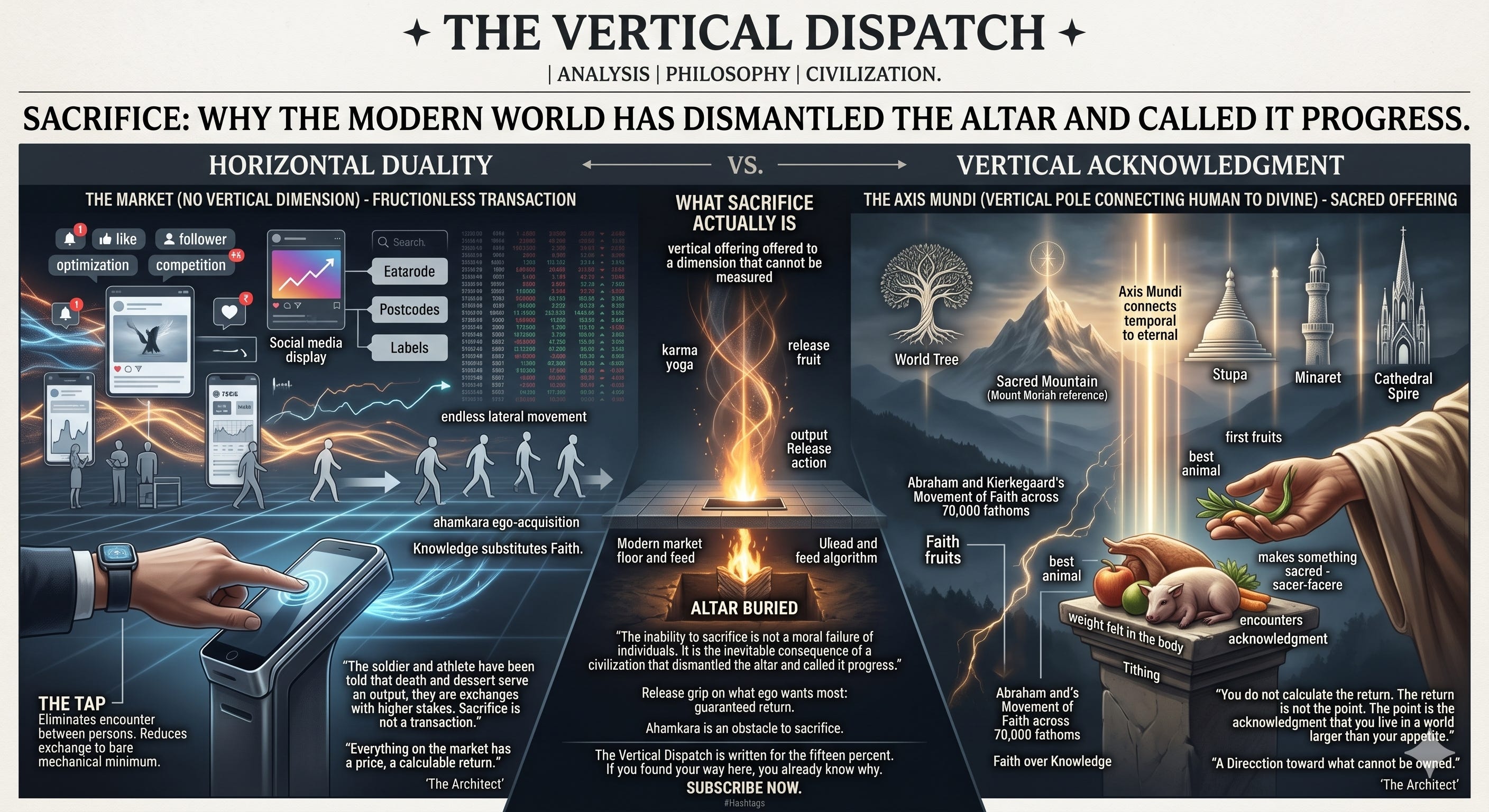
What Sacrifice Actually Is
Before we can talk about why sacrifice has become incomprehensible, we have to recover what it actually means — because the word itself has been so thoroughly evacuated that most people hear it and think either of soldiers dying in wars they didn’t choose, or of athletes giving up dessert before a competition.
Neither of these is sacrifice in the original sense. Both are transactions. The soldier has been told that death serves a national interest. The athlete is trading short-term pleasure for long-term performance. These are exchanges — inputs for outputs, costs for benefits — which is to say they are the same logic as the tap at the checkout counter, only with higher stakes.
Sacrifice in its original and fullest sense is not a transaction. It is an act of vertical orientation. The word itself tells us: sacer — sacred — and facere — to make. To sacrifice is to make something sacred. To take something that belongs to the horizontal world of use and possession and lift it upward, offer it to a dimension that cannot be measured, in an act that produces no calculable return.
This is the act that the modern mind cannot perform. Not because modern people are selfish — they are no more selfish than any other generation in history. But because the vertical axis along which the offering moves has been dismantled. The altar has been taken down. And when the altar is gone, the gesture of offering has nowhere to go. It becomes, in the language of the secular world, waste. Irrationality. Loss without compensation.
The Axis Mundi and Its Disappearance
Every serious civilization in human history has organized itself around what the historian of religion Mircea Eliade called the axis mundi — the world axis. The vertical pole that connects the human to the divine, the earth to the heavens, the temporal to the eternal. It takes different forms in different traditions: the sacred mountain, the world tree, the temple, the cathedral spire, the stupa, the minaret. But the function is always the same. It orients the community in vertical space. It says: there is an up. There is a direction that is not lateral, not horizontal, not about acquisition or display or the accumulation of what can be possessed. There is a direction that moves toward what cannot be owned.
When the axis mundi stands at the centre of a civilization, sacrifice makes immediate sense. You bring your best animal to the altar. You tithe the first fruits of the harvest. You give the hours of the Sabbath back to the source from which all hours flow. You do not calculate the return, because the return is not the point. The point is the orientation. The point is the acknowledgment that you live in a world that is larger than your appetite, older than your ambition, deeper than your understanding — and that this acknowledgment requires a gesture. A real gesture. One that costs something.
The axis mundi of the modern developed world is the market. And the market has no vertical dimension. It has only the horizontal — the endless lateral movement of goods, services, capital, data, attention. Everything on the market has a price. Everything has a calculable return. Everything is a transaction. And in a world where everything is a transaction, the gesture of offering without return becomes not merely impractical but literally meaningless. The category does not exist. The operating system has no directory for it.
Faith Over Knowledge: The Crack in the Modern Foundation
Here is the proposition that the modern world has staked everything on: that knowledge is the highest form of human access to reality. That what can be measured, verified, falsified, and replicated in a laboratory is more real than what cannot. That the movement from faith to knowledge is progress — a maturation of the species, a leaving behind of superstition and shadow in favour of light and evidence.
This proposition is not entirely wrong. The gains of the scientific revolution are real. The precision of empirical method is genuinely extraordinary. No serious framework for understanding reality can afford to ignore what science has learned about the structure of the physical world.
But the proposition is catastrophically incomplete. Because there are things that knowledge, in the empirical sense, cannot touch. Not because the instruments are not yet sophisticated enough. But because the things themselves are not objects of knowledge in that sense. They are objects of faith.
Not faith as the suspension of intelligence. Not faith as the belief in things for which there is no evidence. Faith as the orientation of the whole person toward a reality that exceeds what can be grasped. Faith as the act of standing before what is larger than you and choosing not to retreat into the manageable. Faith as the capacity to act without guaranteed return — which is to say, faith as the precondition of sacrifice.
Søren Kierkegaard saw this with an acuity that has not been improved upon in the century and a half since he wrote it. The movement of faith, he said, is not the movement of reason from premise to conclusion. It is the movement of the whole person across what he called the seventy thousand fathoms — the open water where there is no ground beneath you and no shore in sight and you swim anyway, not because you have calculated the odds but because the alternative is to drown standing still.
This is what Abraham does on Mount Moriah. He does not know the outcome. He cannot know the outcome. Every instrument of knowledge available to him says: this ends in grief. The child you love, the promise you were given, the future you were shown — all of it ends on this mountain. And he goes anyway. Not because he has suspended his intelligence but because his faith operates at a level that knowledge cannot reach. He acts from a ground deeper than calculation. And it is from that ground — and only from that ground — that the gesture of sacrifice becomes possible.
The Ego and the Profane: Why the Modern Self Cannot Give
The self that the modern world has produced — shaped by consumer capitalism, by social media’s architecture of display, by the replacement of community with network and of ritual with content — is a self organized entirely around the horizontal axis.
It acquires. It performs. It optimizes. It measures its worth in the currency of visibility — likes, followers, the quality of the car in the driveway, the postcode, the label on the collar. These are not moral failures. They are the inevitable output of an operating system that has no vertical dimension. You cannot orient toward an axis that your civilization has removed from the map.
The ego — ahamkara in the Sanskrit, the sense of “I am this and not that, I own this and not that, I am seen as this and not that” — is the primary instrument of horizontal navigation. It is exquisitely suited to the market. It calculates. It competes. It accumulates. It protects its holdings. And it experiences sacrifice as pure threat — because sacrifice is the act of releasing what the ego has secured, offering it upward to a dimension the ego cannot enter, trusting a return that the ego cannot calculate.
This is not a new problem. Every wisdom tradition in human history has named the ego as the obstacle to genuine spiritual life precisely because it is the obstacle to sacrifice. The Bhagavad Gita’s entire argument is an extended answer to a man who cannot act because he is trapped in the horizontal — in outcomes, in consequences, in what will be gained and what will be lost. And Krishna’s answer is not to reassure Arjuna that the outcomes will be favourable. It is to relocate the entire question to a different axis. Act from your deepest nature, not from your calculations. Offer the action itself. Release the fruit.
What the Gita is describing is sacrifice in its most refined form: the sacrifice of the outcome. Not the spectacular gesture of the altar, but the quieter and more demanding act of releasing your grip on what the ego most desperately wants — the guaranteed return.
The modern self has been systematically trained out of this capacity. Every design decision in the attention economy is a decision against vertical orientation. The notification, the like, the algorithmically curated feed that shows you what you already believe and want — all of it is architecture for keeping the self in the horizontal, moving laterally, never pausing long enough to feel the pull of the axis that once stood at the centre of things.
The Sacred Exchange
There is something else that the tap at the checkout counter has erased, and it connects directly to why sacrifice has become so opaque.
Exchange, in its original form, was not merely transactional. It was relational. The handing over of coin was a moment of genuine encounter — a pause in which two people acknowledged each other as participants in something larger than either of them. The market, in its ancient form, was a sacred space. The agora was also a place of assembly for the gods. The harvest festival, the feast, the tithe — these were forms of exchange that moved in three directions simultaneously: horizontally between human beings, vertically toward the divine, and temporally across generations. They were acts of membership in a community that extended backward to the ancestors and forward to the unborn.
The tap severs all three relationships in a single gesture. It eliminates the encounter between persons. It eliminates the vertical acknowledgment. It eliminates the sense of participating in something that preceded you and will outlast you. It reduces exchange to its bare mechanical minimum: the movement of a number in one account and its appearance in another.
This is not merely an economic observation. It is a civilizational one. A people who have lost the felt sense of sacred exchange have lost one of the primary mechanisms through which the capacity for sacrifice is maintained. Because sacrifice is not learned in the abstract. It is learned through the accumulated practice of giving — really giving, with the weight of it felt in the body — over a lifetime.
What Burns
Here is what I want to leave you with. Not comfort. Not a solution. Something that burns, because the truth of it requires that it burn.
The inability to sacrifice is not a moral failure of individuals. It is the inevitable consequence of a civilization that dismantled the altar and called it progress. That replaced the axis with the algorithm. That substituted knowledge for faith and called the substitution maturity. That built a world in which the tap replaces the tithe, the feed replaces the liturgy, the brand replaces the icon, and the metrics replace the mystery.
And then wonders why nothing feels like enough.
The hunger that the modern self experiences — and it is everywhere, in every form of compulsive acquisition and digital consumption and the restless movement from one experience to the next — is not the hunger of people who have too little. It is the hunger of people who have lost access to the only kind of nourishment that addresses it. The vertical nourishment. The kind that comes not from receiving but from giving. Not from accumulating but from releasing. Not from knowing but from trusting.
Sacrifice is the act of feeding the hunger by giving away what the ego insists you cannot afford to give. It is the act that makes no sense to the horizontal mind and perfect sense to the one that has found, or is searching for, the vertical axis. It is the act that Abraham performs on the mountain. That the widow performs when she gives her last two coins. That the Gita calls karma yoga — action without attachment to the fruit. That every mystic in every tradition has pointed toward as the gesture that most closely resembles the nature of the divine itself: the outpouring that seeks no return.
The altar is not gone. It has been buried under the market and the feed and the frictionless tap. But buried is not the same as destroyed.
The axis still runs through the centre of things. It ran through them before the first temple was built, and it will run through them after the last one falls.
We do not have to rebuild the altar in stone. We have to rebuild it in the choices we make about what we give, what we release, what we offer upward to the dimension that the ego cannot enter and the algorithm cannot measure.
That is still possible. In fact, it is the only thing that has ever been possible, in any age, for anyone who wanted to live at the full height of what being human means.
Begin there. With the giving. With the release. With the act that makes no sense to the part of you that is keeping score.
That is where the axis is. That is where it has always been.
The Vertical Dispatch is written for the fifteen percent. If you found your way here, you already know why.
#Sacrifice #AxisMundi #FaithOverKnowledge #Kierkegaard #BhagavadGita #Ahamkara #TheEgo #TheSacred #TheProfane #MirceaEliade #ConsumerCulture #AttentionEconomy #KarmaYoga #Abraham #Akedah #TheVerticalDispatch #TheArchitect #UniversalDynamics #SacredMetaphysics #Substack #Philosophy #Consciousness #Civilization #Sovereignty #TheAxis #LongformWriting #Contemplation #WisdomTraditions #ModernMind #WhatWeLost