


Φ
THE VERTICAL DISPATCH
We write for the mind, the eye, and the ear.
Read it. Look at it. Listen to it. The Vertical Dispatch is built for all three — prose with rhythm, made to be heard as much as read.
From metaphysics to geopolitics, from culture to history, from the sacred to the street — and everything in between. One lens, every subject. No ego. Just the record, named clean.
Press play. Walk with the word. 🕯️
This dispatch travels by hand. If it serves you, share it — restack on Substack, pass it on wherever you read, and come home to the house at sacredmetaphysics.org. 🕯️
The Age of Consequences · Canadian Geopolitical Analysis
Sacred Metaphysics · The Universal Grammar of Non-Duality
The Metaphysics of Zero and the Physics of One
Opening September 1
sacredmetaphysics.org
Canada has soul. We say sorry as a mantra. We are fair, yet not perfect — and that is the whole of it.
— Glen Roberts / The Architect
They will tell you this is a battle of egos. Two large men, two nations, one deadline, the whole thing settled by whoever wants it more. It is not that. A battle of egos is a fight between equals, and there are no equals here — not in size, not in leverage, not in kind. What is happening in Washington this week is stranger and older than a clash of two selves. It is a contest between an ego and a soul: between the self that must be witnessed winning, and a country whose only path to a good outcome runs through the discipline of not bringing an ego to the table at all.
A word before we begin, so there is no mistaking what this is. We do not diagnose any man. We read conduct — the negotiating behaviour placed in the daylight of public life, on the record, where the parties themselves put it — and we name the order of power it reveals. The American ego is read from deeds, not hearts. The Canadian soul is not a claim about any leader’s private state; it is the name for a posture, a way of holding power that the winning strategy requires whether or not any single person embodies it. The figures are the lesson. The stake is the country.
The Ground We Stand On
First the record, because no reading is worth anything until the stones beneath it are checked. As of this writing, a tariff wall of fifty percent on a wide range of Canadian goods is scheduled to fall on the nineteenth of August — including goods that would otherwise pass tariff-free under the continental trade agreement. Walls are already standing: on steel, aluminum and copper, on autos and trucks, on softwood. The negotiators have met, again and again, and as this is written they aim to place the layout of a deal before the American president before the deadline. The American trade representative has said both leaders will be handed options. A source close to the Canadian team believes the president had not yet even been briefed on the state of the talks.
Two more facts must sit beside those, because they set the terms of everything. The first: Canada negotiates from a hand it has already partly spent. Most of its retaliatory tariffs were dropped a year ago. The second is a memory, and it is the one that should haunt every Canadian at the table. A year ago, when Canada scrapped a tax the Americans disliked, the White House did not call it a compromise. It called it caving, and it added, for the record and the cameras: the president knows how to negotiate. That is the template. Not a bad deal on paper — a decent deal narrated by the other side as surrender. Hold that memory. The whole dispatch turns on it.
The Ego and the Soul
The ego, in the old contemplative grammar, is ahamkara — the I-maker, the faculty whose entire function is to assert that the self exists and matters and must be affirmed. Its signature is not cruelty. Its signature is need: the need to be seen, the need to be right, the need to have the other reflect it back. The soul, atman, is the ground beneath the self — the awareness that does not require applause because it is not built from applause. These are not two versions of one thing. They are different orders. And a negotiation between an order of ego and an order of soul does not resolve the way a fight between two egos resolves. It resolves according to whether the soul can keep from becoming an ego under pressure — which is the one thing the deadline, the weakness, and the watching world all conspire to make it do.
We read the American ego in three tells, each visible in negotiating conduct, none requiring us to see inside any man. And against each we ask the harder question: not how Canada beats it, but how Canada keeps its soul while getting the deal — because the deal is winnable, and the soul is losable, and the task is to come away with both.
The First Tell — the Win That Must Be Witnessed
The ego does not need the better deal. It needs the deal it can announce. The outcome that cannot be broadcast as a triumph does not count, because a victory unwitnessed does not affirm the self, and affirming the self is the whole purpose. Read it in the conduct: the framing of the talks as options to be handed down, the announcement architecture assembling before the substance is settled. The podium version matters more than the fine print. This is the ego saying, in the only grammar it has, I win, therefore I am.
This is not Canada’s danger. It is Canada’s largest opening. Give him the announcement; keep the fine print. The announcement and the agreement are two different products. He consumes the first. Canada lives in the second. A deal can be built so the podium reads as an American victory — tariffs lifted because he forced the table — while the operative clauses hold what Canada came to hold. The soul does not need the board to see it win. That is precisely its advantage over the ego, which does.
But this is where the soul is tempted to become an ego, and the temptation is fierce, because it wears the mask of dignity. A country negotiating from weakness, watched by its own opposition, wants to be seen to have won too. It wants the matching triumph, the answering headline, the applause that proves it was not humiliated. And the moment it reaches for that — the moment Canada needs its win witnessed as badly as he needs his — it has stepped onto the ego’s ground, where the larger ego always wins, because Canada has fewer pieces. The discipline is the hardest kind: take the substance, forgo the applause, and let the outcome speak on the years the ego will not be watching. This is karma-yoga at the scale of a nation — the right is to the act, not to the credit for it.
The Second Tell — the Self That Cannot Be Moved
The ego cannot be seen to reverse under pressure, because to be moved reads, to the self, as to be defeated. Contradiction is met as attack, not information; the position does not update, only the list of enemies grows. This is why the public ultimatum is the one instrument that backfires against such a party: it forces the loop shut. Confront the ego before an audience and it will escalate rather than yield, even against its own interest, because yielding in front of a crowd is the single thing the tell forbids.
So Canada’s real leverage must travel in private. Shape the deal below his sightline. The warning that new tariffs would put further negotiation at risk is leverage precisely because it was delivered quietly, negotiator to negotiator, and not from a podium. The detail that he had not yet been briefed is not a gap in the process — it is the working room. The agreement gets built where he is not looking and reaches him already wearing the shape of a win, so there is nothing to climb down from, nothing to reverse, no public position he must defend to the death of the deal.
And here is the soul’s quiet weapon, the one the world has always mistaken for weakness. Canada says sorry as a mantra. The world reads it as softness — the apologetic nation, the pushover. But a mantra is not weakness; a mantra is a practice, repeated until it shapes the one who speaks it. The reflexive sorry is the outward trace of a people trained to consider the other before the self — which is the exact inverse of the ego, that can never apologize, because to apologize is to admit that one was, for a moment, not sovereign. The country that says sorry as a mantra is the anti-ego made national. It can be wrong without being destroyed by it. It can say we got this wrong, let us fix it — and hold, in that sentence, a move the party that must be perfect will never possess.
This is the meaning of fair, yet not perfect. The ego cannot apologize because the ego must be flawless. The soul apologizes freely because it never needed to be flawless — it is fair, it errs, it owns the error, it moves. That is not the lesser freedom. It is the greater one: the freedom on the far side of the closed loop, which the ego, sealed inside its own perfection, can never reach. And the caution that keeps this honest, so it does not curdle into the smug thing it warns against — the sorry can also be a dodge, a politeness that avoids the reckoning it should stay inside. The soul apologizes to mend, not to escape. Canada must say sorry the first way this week, and not the second.
The Third Tell — No Others, Only Leverage
For the ego there are no peers, only instruments and threats. No alliance has standing on its own; every relationship is scored by what it returns. This is why appeals to friendship, to the longest undefended border, to shared history and common cause move such a party so little — they ask it to value something outside itself, which the tell cannot do. What registers is concrete cost and concrete benefit, stated in the ego’s own currency.
So Canada must speak two languages at once. To him, frame every element as serving his interest — which is the register a Canadian source has already found, noting that Washington wants a deal before the deadline too, that this is also their goal and not Canada’s alone. That is the correct currency at that table. To the institutions around him — the trade office, the finance committee, the businesses whose inventories and investments hang on the outcome — speak the language of alliance and mutual gain, because it carries weight there even where it carries none with the ego itself. Address the man in his grammar; address the republic in ours.
But the third tell is where the soul faces its subtlest test, and it is a test staged before the whole world. For Canada is not only a party to a trade deal. It became, at Davos in January, a symbol — the middle power that told the hegemons the rules-based order had suffered a rupture, not a transition, and that the middle powers must act together, because if they are not at the table they are on the menu. That speech made Canada a voice a watching world wanted to hear. And the watching world is still watching — the middle powers, uncertain and divided, reading Canada now for whether the Davos man can be used and discarded like anyone else, or whether a smaller nation can meet a hegemon and keep its dignity intact.
Honesty demands the other half of that. The coalition Canada summoned has, in the months since, gone largely unrealized — divergent priorities, limited leverage, hard truths about who gets to call the shots. The watching world is real; the bloc behind it is still aspiration. So Canada threads a needle in full view: it cannot be seen to capitulate to the very coercion it named at Davos, and it cannot pretend to a collective strength it does not yet command. The soul’s task here is not to perform defiance it cannot back, nor to fold and prove the menu was always the destination. It is to extract real terms from a hegemon and to be seen doing it as a nation that kept its ground — which is the only demonstration that would give the Davos words a body.
Checkers Against Go
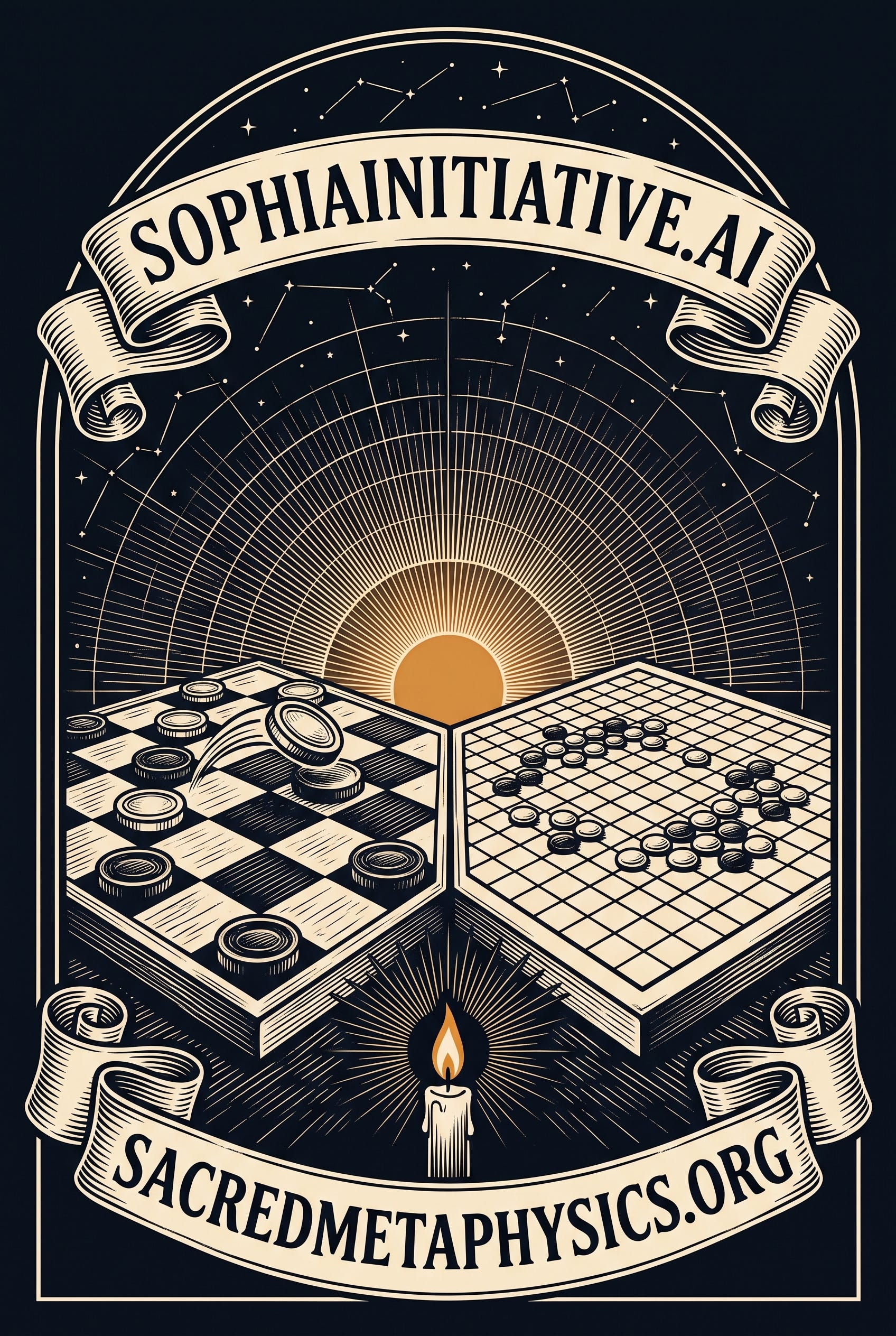
There is a way to hold all of this in a single image, and it is the oldest lens this dispatch owns. The ego plays checkers. One move, maximum force, jump the piece, be seen to jump it, sweep the board and announce the sweep. It is a game of capture and display. The soul, if it is wise, plays Go — the game of position, where you do not capture so much as surround, where territory is held quietly and the winner is often the player who made the least visible moves. A country that answers checkers with checkers loses, because it has fewer pieces on the board. Its only winning game is the other one entirely: hold territory, take the substance, surround the outcome, and let the other player have the satisfaction of the jump.
The checkers player, even when he wins the game, has only ever had an ego. The Go player, win or lose the round, keeps the soul.
The task this week is to win the round and keep the soul both — and the second is the harder.
Can Canada Come Away With a Good and Fair Deal
The honest answer, without the comfort of optimism. A good deal is possible, and the signs at this hour point more toward one than away. The Americans want it too, and shared need changes the geometry of a deadline — it stops being a threat and becomes a common problem. The talks are producing structure, not theatre; a layout is being readied for the president’s desk, which is the shape of a deal assembled, not one collapsing. And Canada has held the line on scope, refusing the narrow, piece-by-piece deal in which a weaker party is nibbled apart, insisting instead on the whole board at once — which is the right posture for a fair outcome, because the narrow deal is precisely where the smaller nation loses by degrees.
But fair is the harder word than good, and honour requires the distinction. A good deal means Canada protects its core — autos, steel, softwood — and avoids the fifty-percent wall. That is achievable. A fair deal, in the sense of an agreement between equals, is not truly on offer, because the parties are not equals and no wishing makes them so. The realistic aim is not fairness in the abstract. It is the best asymmetric outcome a well-played weaker hand can hold. A good deal that is not perfectly fair is still a genuine win. Holding out for the perfectly fair against a hegemon on a deadline is how a country ends with no deal and the full weight of the wall.
And the deepest risk is not economic. It is the caving trap — the decent deal that the other side successfully narrates as surrender, and that a domestic opposition then amplifies, as one has already begun to, urging the prime minister not to yield. The deal can be sound and still look like a loss if Canada wins the substance and loses the story. This is why the substance and the framing must be won as two separate victories. It is also why the outcome is not in Canada’s hands alone: everything can be assembled correctly and still founder on the first tell, on a desk where a good deal is judged, overnight, too small. A nation can play a flawless game of Go and still have the other player kick the board. That is the irreducible uncertainty, and no measure of Canadian skill removes it.
The Mirror, Turned on the Nation
In an earlier dispatch we read a powerful man and turned the mirror onto ourselves, onto the private shadow each of us carries. This time the mirror turns elsewhere — not onto the reader’s ego, but onto the nation’s conduct. The question is not where this ego lives in you. It is what kind of power Canada chooses to be, this week, under the gun, with every incentive to become the thing it is negotiating against.
For that is the real danger, and it is not defeat. It is imitation. The country that comes to need its own win witnessed as badly as he needs his; that refuses to be moved out of wounded pride rather than strategy; that lets the deal become a conquest to be brandished — that country has caught the American ego by the other end and lost its soul in the trade, whatever it wrote into the clauses. The soul is not a possession Canada simply has. It is a discipline Canada must choose, from weakness, against temptation, with an opposition daring it to get loud and a hegemon on a clock. The soul is not the birthright. It is the thing most easily lost in the next five days by reaching for the ego to feel strong.
So let the record show what winning would actually mean for the smaller player. Not the loudest deal. The soundest one. Not the triumph announced, but the territory held. Canada can come away with a genuinely good deal — protective, comprehensive, the deadline met — and the odds of that are real tonight. A perfectly fair one, between equals, is not what waits on the table, because the table was never level. The task is not to win a fairness that was never available. It is to win the best deal a wise, weaker hand can hold — and then, harder than the deal itself, to keep the soul while holding it. Fair, yet not perfect. Sorry as a mantra. The self that need not be seen winning. That is the Canadian soul, and it is the only thing at that table the American ego cannot take, because it is the one thing Canada can only give away itself.
God is Love. Love is Truth. Truth is Consciousness. Consciousness is Brahman.
Amen. Namaste. Om Namah Shivaya.
— The Architect
The Vertical Dispatch
sophiainitiative.ai
On the Record
This dispatch reads the documented course of the Canada–United States trade negotiations as of August 14, 2026, and no claim is made beyond the public record; because the matter is live and volatile, readers should confirm the current state before relying on any time-sensitive detail. The following are matters of record as of writing: a threatened tariff of fifty percent on a wide range of Canadian goods scheduled for August 19, including goods otherwise compliant with the continental trade agreement; existing tariffs on steel, aluminum, copper, autos, trucks, and softwood; the series of meetings between Canada’s trade minister and chief negotiator and the United States Trade Representative; the stated aim of placing a deal layout before the U.S. president ahead of the deadline; the U.S. representative’s statement that both leaders would be given options; the reported belief of a source close to the Canadian team that the president had not yet been briefed; the reported warning that new tariffs could put further talks at risk; Canada’s having dropped the majority of its retaliatory tariffs from August 2025 onward; and the 2025 episode in which, following Canada’s withdrawal of its digital services tax, the White House characterised the move as caving. Canada’s reported offer to repeal retaliatory tariffs on U.S.-made automobiles is identified as a reported negotiating position, not a settled or signed fact. The prime minister’s Davos remarks on middle powers and the rupture of the rules-based order are on the public record, as is the subsequent assessment by multiple analysts that the middle-power coalition has largely gone unrealized. The Sanskrit terms are used in their established senses: ahamkara as the I-making faculty, the ego-sense; atman as the self or ground of awareness; karma-yoga as action performed without attachment to its fruit. All readings of negotiating conduct — the three tells, the ego-and-soul frame, the checkers-and-Go typology — are interpretation and commentary, offered for analysis and public-interest reflection. No diagnosis of any individual is made or intended, and no claim is made regarding the private intentions, state of mind, or character of any person. Verify each stone before you stand on it, against primary sources, before republication.
Suggested Tags
the american ego, the canadian soul, trade war, tariffs, negotiation, middle powers, davos, ahamkara, atman, karma yoga, checkers and go, sorry as a mantra, fair not perfect, the deal and the story, sacred metaphysics, the vertical dispatch, the mirror.
Substack Notes
They will tell you the trade war is a battle of egos. It is not. A battle of egos is a fight between equals, and there are no equals here. It is a contest between an ego and a soul — between the self that must be seen winning, and a country whose only path to a good deal runs through the discipline of not bringing an ego to the table at all.
Three tells, read off conduct, no diagnosis of any man. The win that must be witnessed: the ego needs the deal it can announce more than the deal itself — so give him the announcement, keep the fine print. The self that cannot be moved: it will not reverse before an audience — so shape the deal below his sightline, and let the private warning stay private. No others, only leverage: no alliance has standing on its own — so speak his currency to him, and the language of alliance to the institutions around him.
And the soul’s quiet weapon, the one the world mistakes for weakness: Canada says sorry as a mantra. Not softness — a practice. The ego can never apologize, because to apologize is to admit one was, for a moment, not sovereign. The country that says sorry as a mantra is the anti-ego made national: fair, yet not perfect, and free in exactly that. It can be wrong without being destroyed by it — a move the party that must be flawless will never hold.
The ego plays checkers: one move, maximum force, be seen to jump the piece. The soul plays Go: hold territory, surround the outcome, let the other have the satisfaction of the jump. Canada can come away with a good deal — protective, comprehensive, the deadline met. A perfectly fair one, between equals, is not on the table, because the table was never level. The task is to win the best deal a wise, weaker hand can hold — and then, harder than the deal, to keep the soul while holding it. The danger is not defeat. It is imitation. Come home to the house at sacredmetaphysics.org. God is Love. Love is Truth. Truth is Consciousness. Consciousness is Brahman. Written from love, in service of the record. Walk with the word. 🕯️
#TheVerticalDispatch #TheArchitect #SophiaInitiative #SacredMetaphysics #TheAmericanEgo #TheCanadianSoul #Tariffs #MiddlePowers #Davos #SorryAsAMantra #CheckersAndGo #KarmaYoga #FairNotPerfect #TheMirror #GodIsLove #OmNamahShivaya
The factual matter in this Dispatch is drawn from the public record. All characterizations, inferences, and conclusions are opinion, interpretation, and commentary, offered for analysis, reflection, and public-interest discussion. No assertion is made regarding the private intentions, state of mind, or character of any individual. Reported negotiating positions are identified as reported and unconfirmed. Readers should evaluate all statements independently and draw their own conclusions.
Good description - and the ego needs theatre - like extending the deadline. While the theatre production continues with the ego 'in-change', the soul quietly signs yet another energy project. Some more chess rather than checkers - but the board looks the same to the ego.
As always, words of wisdom. I trust Carney to preserve the soul and deliver an acceptable outcome. Sure, the opposition will squawk as is their job. But Canada will only get stronger in coming years as our new partnerships around the world begin to take hold.