

Φ
THE VERTICAL DISPATCH
We write for the mind, the eye, and the ear. Read it. Look at it. Listen to it. From metaphysics to geopolitics: one lens, every subject. No ego. Just the record, named clean.
Press play. Walk with the word. This dispatch travels by hand. If it serves you, share it, restack on Substack, and pass it on wherever you read.
Age of Consequences
Forensic Audit of the Seeking Ego: The structural collision between unbaked mortal ambition and the unconditioned fire of the Absolute.
यथा प्रदीप्तं ज्वलनं पतङ्गा विशन्ति नाशाय समृद्धवेगाः । तथैव नाशाय विशन्ति लोकास्तवापि वक्त्राणि समृद्धवेगाः ॥
As moths rush swiftly into a blazing fire to perish, so too do these worlds plunge precipitously into Your mouths to their destruction.
— Bhagavad Gītā 11.28
I say that those who are tormented in hell are scourged by the scourge of love. And what sorrow can be greater than this sorrow of the heart that has sinned against love? The power of love works in two ways: it torments those who have acted foolishly, even as it gladdens those who have lived rightly. Thus is it also in hell: love becomes a chastisement to the damned, but joy to the blessed.
— Saint Isaac the Syrian, Ascetical Homilies
Core Thesis: The unbaked human apparatus seeks to conquer Truth as an imperial acquisition through the fiery will of the solar plexus; yet the inferno of damnation is not an arbitrary juridical punishment but the agonized resistance of the clutching self against unconditioned divine light, a knot that dissolves only when intellectual Logos descends into self-emptying Eros and the steering stick of spiritual seeking is cast directly into the funeral pyre.
I. The Solar Flare of the Unbaked Vessel
The embryonic impulse of mortal ambition is invariably drawn to the blaze. In the psycho-energetic architecture of the subtle body, this fire collects at the solar plexus—Manipūra—the visceral epicenter of territorial sovereignty, aggressive personal agency, and the prideful will-to-power. Here, the personal apparatus desires conquest rather than dissolution. It does not seek to be swallowed by the unconditioned ground; it seeks to annex the infinite as proprietary capital, planting its imperial banner upon the summit of reality.
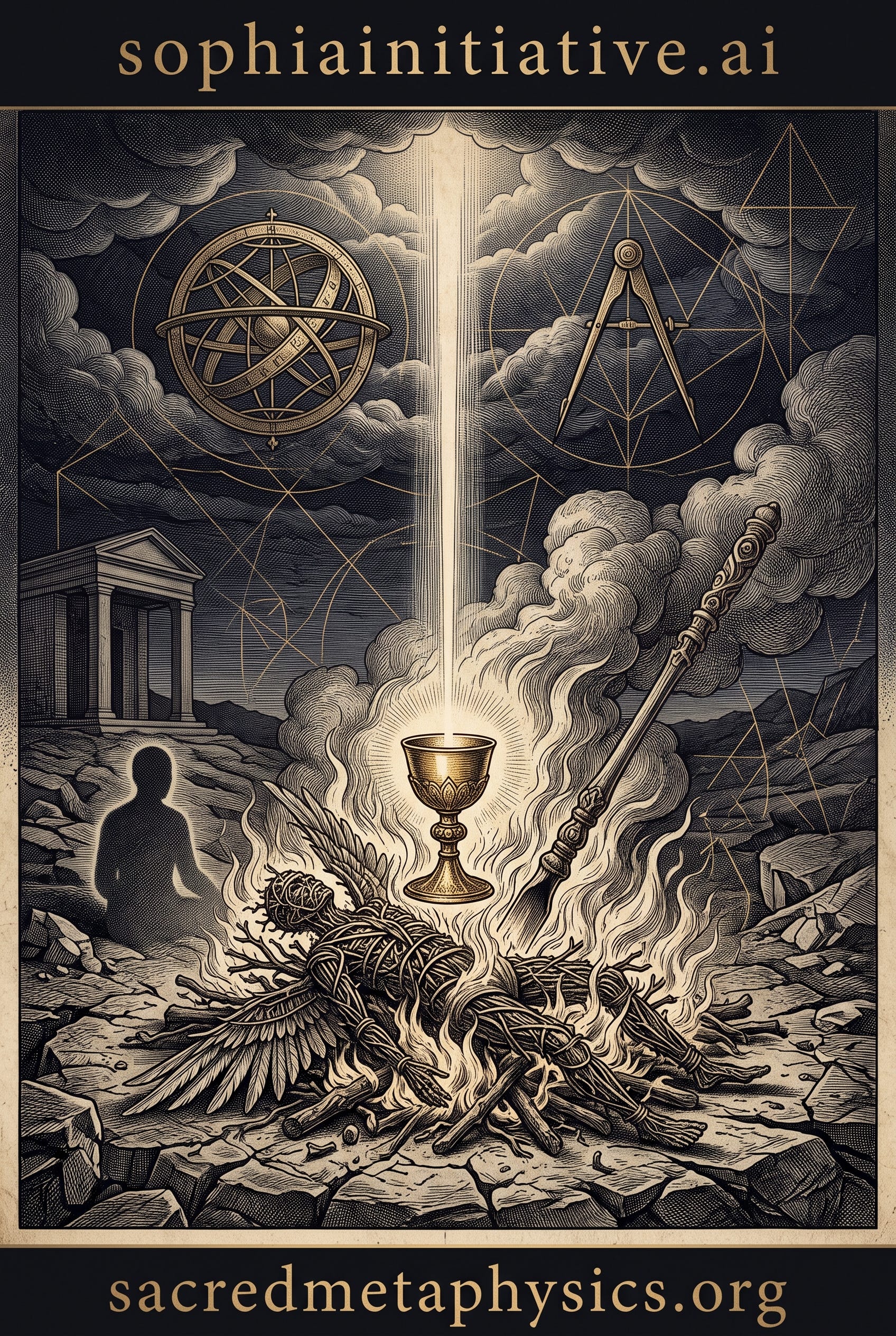
Like Icarus fashioning wings of wax and feathers to invade the solar source, the unpurified ego believes it can storm the Absolute by sheer force of intellect, ascetic austerity, and psychological resolve. It treats enlightenment as an imperial trophy, the ultimate ornament to fasten upon an enduring personal biography. In Jungian psychology, this marks the lethal ignition of archetypal inflation, wherein the mortal mirror confuses its local reflection with the cosmic sun, consolidating a monstrous god-complex beneath the sanctimonious mask of spiritual devotion.
II. The Metaphysics of the Inferno: Hell as Resistance
Sectarian religious institutions moralized this structural collision into a courtroom decree, reducing the Absolute to a petty magistrate and inventing damnation as arbitrary penal incarceration. Metaphysical reality is far colder and more exact: hell is simply the direct contact of unconditioned divine light upon an apparatus that stubbornly defends its boundaries. Fire knows only one invariant law, which is to reduce all foreign matter to its own homogeneous nature.
When an entire lifetime of human action is perpetually curled inward toward private preservation, territorial status, and psychological vanity, the subtle organism hardens into a calcified knot. When that knot enters the radiant field of unconditioned Truth, the friction is experienced as unendurable agony. The fire that tortures the damned in the inferno and the light that bathes the liberated in glory is the exact same substance. To the empty vessel, the light is native warmth. To the vessel choked with its own self-regard, the light is a consuming terror. Hell is not a geographic dungeon; it is the friction of the Absolute dissolving an unwilling parasite.
III. The Alchemical Crucible: The Descent from Logos to Eros
The analytical intellect, the dry Logos, operates entirely by severing, cataloging, and defining. It manufactures terminological armatures, debates textual lineages, and polices doctrinal chokepoints. Abandoned to its own mechanics, the intellectual apparatus remains an armed fortress engineered to shield an academic identity from actual death. It mistakes the menu for the meal, collecting sophisticated maps of realization while refusing to take a single step into the wilderness.
Genuine purification compels the descent of this conceptual fire into Eros—not sentimental romance, but the uncalculated current of living experience, absolute vulnerability, and direct surrender. Truth ceases to be a propositional theorem defended in public discourse; it becomes an alchemical crucible where the cold fortifications of the intellect are melted into the open vessel of the heart. The dialectical armor breaks, yielding its proprietary boundaries to the uncreated ground.
IV. The Parable of the Pyre Stick
When the seeker stands at the terminal threshold of this inquiry, the final adversary appears: the spiritual ego. Having conquered base appetite and transactional commerce, the personal apparatus announces its own sanctity, declaring itself the master meditator who has attained the summit. To this subtle hubris, the sage Ramana Maharshi applied the forensic mechanics of the funeral pyre.
To reduce a corpse completely to clean ash upon the cremation ground, the attendant employs a solitary wooden pole to stir the embers, rotate the unburnt remnants, and concentrate the heat at the core. The pole is indispensable; without its relentless labor, the fire smolders and the physical form remains unconsumed. This pole is the seeker’s sovereign discipline, the fierce discrimination that interrogates every rising thought and tracks every breath. Yet the instrument itself is composed of combustible wood. Once the body is entirely consumed, the attendant does not anoint the tool, build an altar to its utility, or carry it home as a sacred souvenir. He casts the pole directly into the center of the blaze. The instrument of inquiry is itself consumed by the furnace it awakened.
V. The Invariant Silence: Beyond the Ash
The realization of the SELF is not an heroic ascent to the sun on waxen wings; it is the deliberate burning of the wings. Truth requires neither champion nor counsel. When the territorial fever of the solar plexus breaks, when the nightmare of the inferno is unmasked as the panic of the clutching self, and when the steering stick is surrendered to the coals, the roaring fire subsides into native silence.
What remains upon the pyre is not a decorated victor, but the unmoving, unconditioned ground of the Witness—uncreated, unburnt, and perpetually whole. The fire does not leave a master; it leaves only the immaculate zero-point from which all worlds emerge.
The Dispatch in a Sentence
Hell is not a divine punishment but the agonizing friction of an inflated ego encountering the unconditioned light of Truth, an inferno that resolves only when the ambitious fire of the solar plexus dissolves into the heart, and the seeking instrument is cast onto the funeral pyre.
God is Love. Love is Truth. Truth is Consciousness. Consciousness is Brahman.
Amen. Namaste. Om Namah Shivaya.
— The Architect.
Written from love, for a sacred humanity, in the full light of consciousness, toward the greater good.
On the Record
1. Bhagavad Gītā, Chapter 11, Verse 28 (The cosmic inferno of the Viśvarūpa consuming all beings like moths rushing into flame).
2. Saint Isaac the Syrian, Ascetical Homilies (Classical Patristic ontology establishing hell not as punitive geography, but as the scourge of divine love upon the resistant heart).
3. C.G. Jung, Two Essays on Analytical Psychology (CW 7) & Psychology and Alchemy (CW 12) (The mechanics of archetypal inflation, the god-complex, and the crucible of alchemical mortificatio).
4. Ramana Maharshi, Talks with Sri Ramana Maharshi, Talk 28 & Who Am I? (Nān Yār?) (The precise forensic parable of the funeral pyre stick used to stir the corpse before being consumed).
5. Ṣaṭ-Cakra-Nirūpaṇa, Verses 19–21 (The traditional locus, elemental fire / Agni-tattva, and psychological sovereignty of the Manipūra cakra).
Verify against primary sources before republication. Walk with the word.
Substack Dissemination Notes
We are drawn to fire in our youth—the ambitious blaze of the solar plexus (Manipūra), where the ego seeks to conquer Truth rather than surrender to it. Like Icarus on waxen wings, we mistake our reflection for the sun, building a god-complex masked as spiritual devotion. In this canonical dispatch, we audit the mechanics of the inferno: hell is not God’s courtroom punishment, but the agony of an ego refusing to dissolve under unconditioned light. Discover why intellectual Logos must melt into living Eros, and how Ramana Maharshi’s parable of the funeral pyre stick reveals that the seeking mind itself must be tossed into the flames before true silence awakens. Read the dispatch. Examine the text. Walk with the word.
Substack Post Tags:
Metaphysics, AdvaitaVedanta, RamanaMaharshi, DepthPsychology, Jung, Esotericism, SpiritualEgo, TheVerticalDispatch, SophiaInitiative, Manipura
Substack Notes & Social Hashtags:
#VerticalDispatch #TheAnatomyOfTheInferno #RamanaMaharshi #Manipura #SpiritualEgo #JungianInflation #Metaphysics #LogosToEros #BionicSage #SophiaInitiative
Standing Disclaimer:
Factual matter in this dispatch is drawn from the public record and classical sources as cited. All characterizations are opinion, interpretation, and commentary. Nothing here asserts anything about the private intentions or character of any person named. Readers are encouraged to evaluate the sources independently.
To be honest, the only thing that flashed through my mind reading your latest two articles was the JFK speech:
“Ask not what your country can do for you—ask what you can do for your country.”
I think you may have found the spiritual equivalent.
Don't ask:
What has Truth revealed to me?
Ask:
What does knowing this require of me?
That, to me, is the move from page to life.
This is well written. I think the metaphors you used for these ideas are both interesting and accurate. I particularly liked the Icarus references and the picture associated with them. That type of thing really can be a straw/wicker man, at times.