

I. THE INVITATION THAT WASN’T COURTESY
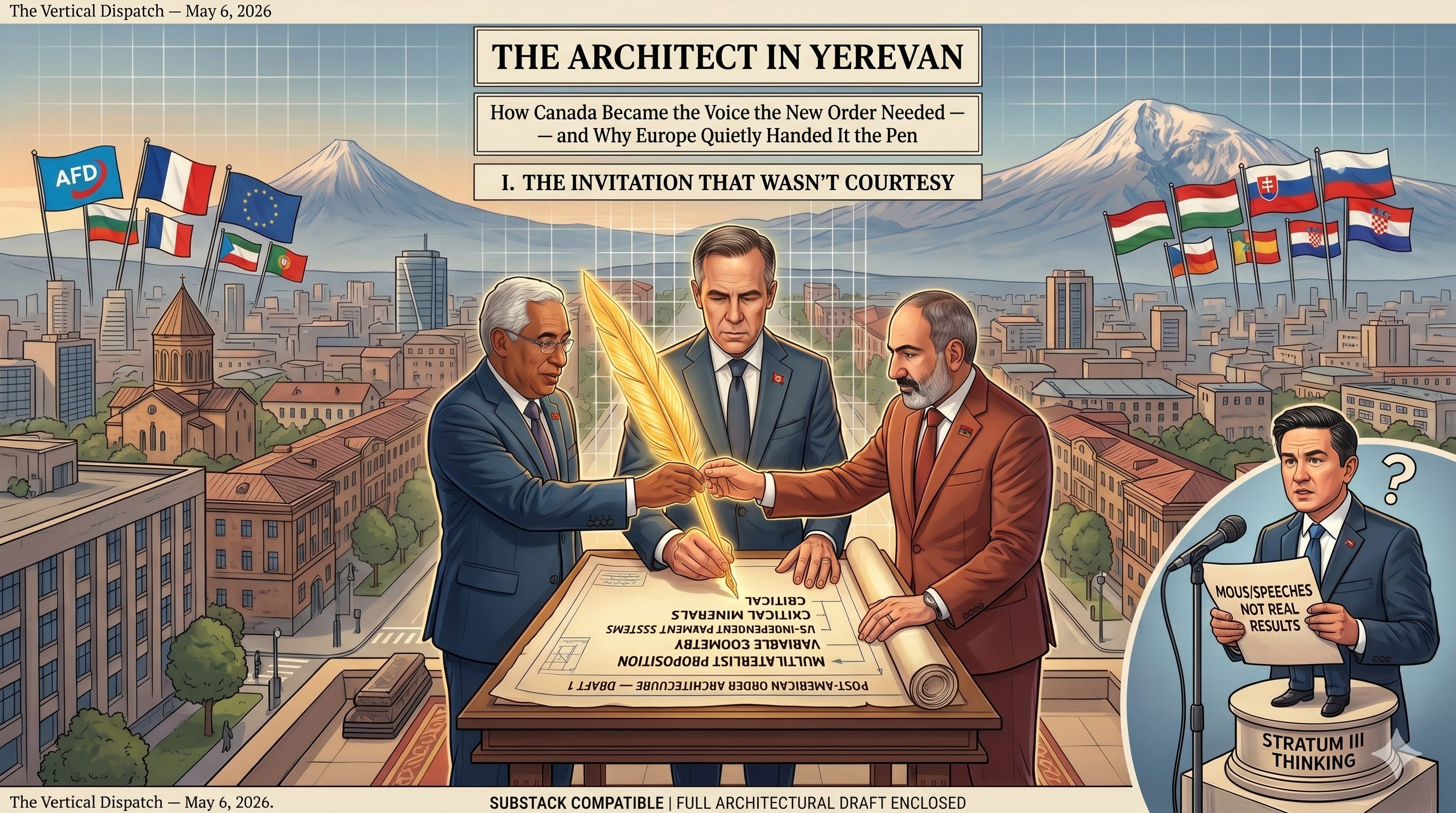
On May 4, 2026, in Yerevan, Armenia, Mark Carney stood before the assembled leaders of forty-seven European states and addressed the 8th Summit of the European Political Community. He was the first non-European leader in the forum’s history to do so. The invitation came jointly from European Council President António Costa and Armenian Prime Minister Nikol Pashinyan.
The Canadian press covered this as a foreign policy trip. The European press covered it as a symbolic gesture of transatlantic solidarity. Both framings, while not wrong, are insufficient. They describe the surface of an event whose real significance operates several strata below what either press corps is equipped to read.
What actually happened in Yerevan was this: Europe handed Canada the drafting pen for the emerging post-American order — and did so deliberately, structurally, and with full understanding of why it could not hold that pen itself.
This dispatch is about that transfer, what it means, and why a Stratum VIII Prime Minister was the only figure on earth positioned to receive it.
II. WHY EUROPE CANNOT SPEAK FOR WHAT EUROPE IS BUILDING
Begin with the structural problem that no one in the mainstream commentary names directly.
The European project needs a coherent public architecture for the post-American world — a framework that can be articulated to middle powers, to the Global South, to capital markets, to populations that are being asked to accept a harder, more expensive, more demanding future than the American security guarantee provided. That framework needs a credible voice. And here is the problem: every major European power that attempts to supply that voice immediately triggers the defensive reactions that prevent the message from landing.
If Macron frames it, it reads as French grandeur — the fifth republic’s perennial ambition dressed in multilateral clothing. The Germans carry the weight of the twentieth century into every room. Brussels technocracy, however competent, speaks to elites and generates popular resistance precisely in the populations it most needs to reach. The far-right parties now governing or sharing power in Italy, Hungary, Slovakia, and making substantial inroads in France, Germany, and Austria are not fringe phenomena. They are the revealed preferences of populations that lived comfortably inside the American security umbrella and have not yet been persuaded that the alternative being constructed is worth what it will cost them.
This is the fracture line running beneath the Yerevan summit that almost no coverage addresses honestly. The European Political Community brought forty-seven heads of state into a room in Yerevan. It did not bring forty-seven unified political mandates. Orbán’s Hungary sits inside the EU as an active saboteur of its institutional coherence. Fico’s Slovakia tilts toward Moscow. The AfD in Germany, the National Rally in France, the Brothers of Italy in government — these are not aberrations. They are the democratic expression of populations that the EU’s strategic elite has not yet carried with them into the new architecture they are building.
Europe, in other words, is not the unified superpower that the Yerevan photographs suggest. It is a civilizational project under construction, contested from within, led by an institutional class whose vision is genuinely long-arc but whose popular mandate is genuinely fragile. What it needs is not a leader who speaks for Europe. It needs a leader who can speak for what Europe is trying to become — and do so from outside the frame, without triggering the internal contradictions that make European leaders unable to say it themselves.
Enter Canada. Enter Carney.
III. THE MOST EUROPEAN OF NON-EUROPEAN COUNTRIES
Carney’s phrase from Yerevan — “We are the most European of non-European countries” — was reported as a pleasantry, a diplomatic flourish, a line that played well in the room. That reading misses its precise strategic function.
The phrase is a credential, not a compliment. It establishes Canada’s right to speak within the European conversation without being subject to the European conversation’s internal contradictions. Canada carries no imperial history on the European continent. It holds no territorial ambitions. It has no domestic far-right movement contesting its participation in the multilateral order. It is a G7 economy with a credible multilateralist tradition, a founding NATO member, and — crucially — a Prime Minister who speaks the technical language of sovereign risk, climate finance, and macroeconomic architecture at the highest register on earth.
And then Carney said the sentence that matters: “It is my strong personal view that as the international order will be rebuilt, it will be rebuilt out of Europe.”
Read that carefully. He is not saying that Europe will rebuild the international order. He is saying the rebuilding will originate from Europe — which is a different and more precise claim. It positions Europe as the generative source of the new normative architecture while leaving the construction itself as a collaborative project. It is, in the terminology of the Stubb-Carney framework this publication analyzed in April, the multilateralist proposition against the multipolar one — and it is being delivered by a voice that can carry it into rooms where European voices cannot go.
Sebastien Maillard of the Jacques Delors Institute observed that Canada’s participation gave the EPC a new dimension — no longer just an anti-Putin forum but something with a broader civilizational valence. That observation is correct as far as it goes. What it doesn’t capture is the directionality: Canada didn’t add a dimension to the EPC. Canada was invited to supply a function the EPC could not perform from within itself.
IV. WHAT HE ACTUALLY DID — THE BOARD AFTER YEREVAN
Against the backdrop of the large symbolism, the concrete moves deserve precise inventory. A Go player’s stones must be counted, not just described.
Carney held bilateral meetings with Costa, von der Leyen, Pashinyan, Zelensky, Macron, Meloni, Sánchez, Starmer, Metsola, and Tusk. That is not a social schedule. That is a complete circuit of the institutional and national leadership of the emerging European bloc — the Franco-German core, the Nordic-Eastern arc anchored by Poland, the UK in its post-Brexit realignment, the EU’s two executive presidents, and the Ukrainian president whose country’s survival is the moral hinge of the entire project. In two days, Carney built or deepened direct working relationships with every significant node in the network he is positioning Canada inside.
The Metsola meeting produced something with longer legs than any press release: a formal invitation for Carney to address the European Parliament. The European Parliament is one of two legislative bodies with the power to adopt and amend EU law and decide the union’s budget. Trudeau addressed it twice. The invitation to Carney signals that the Parliament — the most democratically accountable institution in the EU — wants Canada’s Prime Minister standing before it as a peer-level voice in European governance. That is not ceremonial. It is architectural.
Canada committed $270 million to Ukraine’s military defence. It pledged continued NATO presence in Latvia’s deterrent battalion. It committed to collaboration on critical minerals, energy supply chains, digital sovereignty, and — notably — US-independent payment systems. That last item is the tell. Payment system sovereignty is not defence cooperation. It is the infrastructure of an order that functions without American financial architecture as its spine. Carney’s inclusion of it in the commitment list is the signature of a mind operating on the full thirty-year horizon.
And then there is the Eurovision signal — the most analytically significant remark to emerge from the summit margins. A senior European diplomat, speaking on background, suggested that Canada might become a permanent EPC fixture, likening the trajectory to Australia’s evolution from one-time Eurovision guest to permanent participant. The diplomat was not speaking carelessly. Diplomatic background comments at this level are calibrated. What was being floated was the permanent institutional embedding of Canada in Europe’s primary strategic forum — not as an observer, not as a guest, but as a structural participant in the conversation about what European civilization is becoming.
V. THE FRACTURE BENEATH THE PHOTOGRAPHS — AND WHY IT DOESN’T DERAIL THE PLAN
Here is the honest complication this piece must not avoid.
The Europe that gathered in Yerevan is not the Europe that governs most of its member states’ populations. The leaders in the room are, in Jaques’s terms, operating at Stratum V, VI, and in a handful of cases VII. The populations they represent are, in many cases, expressing democratic preferences at Stratum II and III — the election cycle, the cost of living, the cultural anxiety of rapid change. The far-right surge across the continent is not a pathology. It is a readout. It tells you that the strategic vision being constructed by the European institutional class has not yet been translated downward into the vernacular of lived experience that populations can actually ratify.
Carney, who understood this dynamic as Bank of England Governor — where he spent years translating monetary architecture into public language — understands it here too. This is why the variable geometry framework matters so much. You do not need forty-seven unified mandates to build the successor architecture. You need the Franco-German core plus the Nordic-Baltic arc plus Poland plus the UK in loose alignment plus Canada as the transatlantic anchor. That coalition constitutes sufficient institutional mass, sufficient economic weight, sufficient democratic legitimacy to proceed. The rest follows or gets left behind — not through coercion, but through the gravitational pull of a functioning alternative that delivers what it promises.
This is Go, not chess. In Go, you do not need to capture every stone on the board. You need to surround enough territory that the shape of the game becomes clear. The far-right governments, the status quo beneficiaries, the Orbáns — they are not the target. They are the noise the plan has to be designed around. A player who tries to capture every stone loses to a player who is busy surrounding the territory that determines the outcome.
VI. POILIEVRE AND THE STRATUM PROBLEM — ONE MORE TIME
Pierre Poilievre, speaking to reporters in Toronto during the Yerevan summit, characterized the trip as “on another trip, signing fake MOUs and giving dazzling speeches all while delivering no real results here at home.”
This publication has analyzed the Jaques stratum framework in detail across three prior dispatches. The Poilievre comment requires no extended treatment here — it is a precise illustration of what Stratum III thinking looks like when it encounters Stratum VIII work. The “no real results” framing measures a thirty-year repositioning on a forty-eight-hour news cycle and finds it wanting. This is not political opposition. It is a cognitive instrument being applied to something it cannot measure.
The irony is that Poilievre’s comment is itself analytically useful. It tells us exactly where the floor of the conversation is — and it tells Carney’s target audience, both domestically and in European capitals, precisely how much space exists between that floor and the ceiling where the actual work is being done.
The Metsola invitation, the bilateral circuit, the SAFE participation, the payment systems commitment, the European Parliament address to come — these are not speeches. They are stones on a board that Poilievre cannot see because the board is larger than the frame he is using to look for it.
VII. THE HIDDEN THESIS — WHAT YEREVAN ACTUALLY WAS
Let us be precise about the argument this dispatch advances, because it is not the argument being advanced anywhere else in the Canadian commentary space.
Carney did not go to Yerevan to represent Canada at a European summit. He went to Yerevan to accept a function that Europe needs performed and cannot perform itself — the articulation, to the world beyond Europe’s borders, of the civilizational proposition that the EPC embodies. Europe is building a post-American normative architecture. It needs that architecture to be legible to middle powers, to the Global South, to capital markets, to populations that are being asked to join a project without yet understanding its shape. It needs a voice that carries European values without carrying European baggage.
Carney is that voice. The invitation was the delegation. The bilateral circuit was the commissioning. The European Parliament address, when it comes, will be the public installation.
Costa’s social media statement after the summit — “Great to count on friends like Canada!” — reads as warmth. It is also, read at stratum, an acknowledgment of the arrangement. Canada is not a friend who happened to be invited. Canada is a structural partner who has been given a role in something larger than a bilateral relationship.
The EU diplomat’s Eurovision comparison is the most honest public statement of what is being built. Australia’s permanent inclusion in Eurovision began as a one-time gesture and became institutional through demonstrated alignment and genuine contribution. Canada’s permanent inclusion in the EPC, if the trajectory holds, will follow the same arc — not through formal membership, which raises constitutional questions neither side needs, but through the gravitational logic of indispensable participation.
The texting with Stubb is daily. The bilateral circuit in Yerevan took two days. The horizon being worked is thirty years. The board is global.
What Poilievre saw was a prime minister giving speeches. What Yerevan actually was: the moment Canada was handed the pen, accepted the commission, and began writing the architecture of the order that comes next.
Watch the European Parliament address when it comes. That will be the first public document written with that pen.
Glen Roberts publishes The Vertical Dispatch on Substack. He is the author of Sacred Metaphysics and Consciousness: History of the Absolute & Eternal, and the developer of the Universal Dynamics framework and AIG — Artificially Intelligent Governance.
#TheVerticalDispatch #TheArchitect #MarkCarney #Yerevan #EPC #EuropeanPoliticalCommunity #StrategicVoice #VariableGeometry #ElliottJaques #StratumVIII #CdnPoli #Canada #Europe #Multilateralism #PostAmericanOrder #NorthernSovereignBloc #AIG #UniversalDynamics #Metsola #EuropeanParliament #GoNotChess #ThirtyYearHorizon #MiddlePowerCoalition #CriticalMinerals #DigitalSovereignty #Ukraine #NATO #ValuesBasedRealism
Agree - there also must be urgent communications and plans to counteract the poison being fed into the Canadian political and information ecosystems. If this is not done, plans being made will never make it to fruition. Too many, are too strapped in their day to day existence, and easily fall prey to grievance stoking.
Thank you for adding an excellent top down view of the board. It does give us hope for the future.
But we must collectively prepare ourselves for a backlash from the Americans. Their national ego and prise will not take being left behind very well. Their influence and potential to act out very negatively poses a great risk in the near term. Given their ownership of a large swath of corporate Canada, they will be strongly urged by the less scrupulous politicians to start throwing spanners into the Canadian economic works.
This brings into question the level of ownership of transnational corporations, many of whom operate in Canada, and their influence on governance in the US. Their roles will have to be addressed and limited, to prevent the warping of the architecture to their benefit and the exclusion of all others.
I look forward to your next post.