

“Athato brahma jijnasa. Now, therefore, the inquiry into Brahman.”
— The opening of the Brahma Sutra of Vyasa, with the commentary of Adi Shankara
The Vertical Dispatch
Sovereign Analysis · Glen Roberts, The Architect
The Age of Consequences
May 26, 2026
I. The Attention Economy
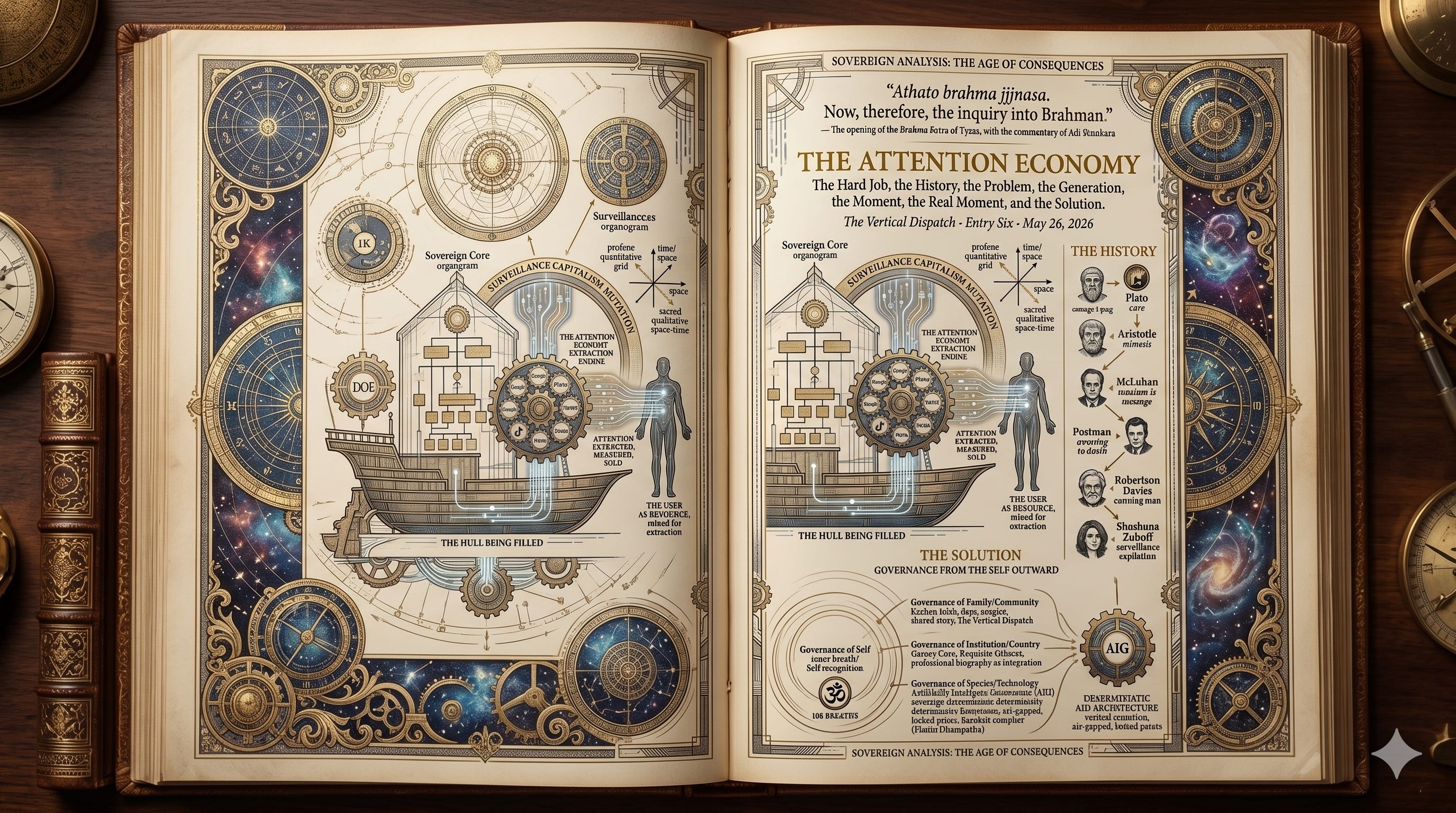
The attention economy is the name for the working operation of every digital platform the citizen now lives inside. Google. Meta. TikTok. X. Instagram. YouTube. The streaming services. The mobile games. The dating applications. The work-collaboration tools. The artificial intelligence chatbots. The architecture across all of them is the same architecture. The platform supplies a surface. The surface attracts the user. The user supplies attention. The attention is measured, segmented, packaged, and sold. The platform’s revenue is the resale of the user’s attention to actors who wish to alter the user’s future behaviour. The user is not the customer of the platform. The user is the resource being mined.
The economist Herbert Simon named the phenomenon in 1971. “A wealth of information creates a poverty of attention.” Simon was writing about the corporate office of the late twentieth century, where the volume of memos, reports, and meetings had begun to exceed the human capacity to engage with any of them at depth. Simon’s deeper move, the move that has carried his name forward through fifty years of subsequent thinking, was to recognize that attention itself had become the scarce economic resource. Information was abundant. Attention was finite. The economy that allocated attention had begun, in 1971, to take a recognizable shape, even though the platforms that would industrialize the allocation were thirty years away from existing.
The platforms now exist. The allocation is industrial. The scale of attention being extracted from the human population is, by any honest measurement, the largest extractive operation in recorded history. The average user of an internet-connected device in a developed economy spends between four and seven hours per day inside the platforms. The figure is higher for younger cohorts and rising across all cohorts. Multiply the average hours by the population of the developed world. Multiply again by the days in a year. The product is a quantity of human attention that, before the platforms existed, did not exist as a thing the economy could measure or sell. The platforms have, by their architecture, brought into commercial existence a resource that was never a resource before the architecture existed to extract it.
This dispatch will name the attention economy as the surface phenomenon and will spend the next seven sections naming what lies underneath it. The attention economy is what the lineage from Plato through Zuboff has been diagnosing. The attention economy is the operational mechanism by which the medium-driven displacement of human cognition the lineage has been warning about has now arrived at industrial completion. The dispatch’s deeper subject is not the attention economy itself. The dispatch’s deeper subject is what the attention economy is for, what it is taking from the citizen, and what the citizen who recognizes the taking can do to recover what is being lost.
II. The Hard Job
This dispatch will take forty-five minutes of the reader’s attention to read carefully. The dispatch is eight thousand words long. The argument runs through eight sections and a Coda. The argument is layered. The argument requires the reader to hold the historical record, the philosophical lineage, the present-tense generational situation, and the metaphysical claim at the close in the same field of attention across the duration of the reading. The dispatch will not be amenable to skimming. The dispatch will not be amenable to summary. The dispatch will not be readable in the kind of attention the platforms have trained the reader to deploy.
The dispatch is, by its structure, a contradiction of the medium it is filed inside. The dispatch is published on Substack, which is a platform, which operates under the attention economy’s logic in part. The dispatch is, however, written at the depth of attention the platforms have trained out of the reader, in the hope that the reader who has reached this paragraph still possesses enough of the older form of attention to complete the climb. The dispatch’s hard job is to be the dispatch the reader cannot read inside the medium that delivered the dispatch. The dispatch’s hard job is to ask the reader to be the kind of reader the present moment is engineered to prevent.
The cunning man’s discipline is to name the difficulty before the work begins. The reader who has been told, in the second section of the dispatch, that the dispatch will be hard, will either settle in for the work or close the tab. The reader who closes the tab has been honoured by the dispatch’s honesty. The reader who settles in has agreed, by the act of settling, to perform the older form of attention the dispatch requires. The agreement is the first act of the recovery the dispatch will spend the remaining six sections naming. The reader who has chosen to remain is, in this small initial gesture, already performing the answer the dispatch is going to offer.
The dispatch will reward the reader who completes it. The reward is not entertainment. The reward is the recognition the dispatch is being filed to deliver. The recognition is consequential. The recognition is the recognition the lineage from Plato through Vyasa through Shankara through Jung through Smith has been carrying forward across two thousand four hundred years. The recognition is the dispatch’s reason for existing. The reading is the work the recognition requires.
III. The History
Plato wrote the cave allegory in the Republic approximately 380 years before the common era. Socrates, in the dialogue, describes prisoners chained from birth in a cave, facing a wall, unable to turn their heads. Behind them is a fire. Between the fire and the prisoners is a low wall along which figures move, carrying objects whose shadows fall on the wall the prisoners face. The prisoners take the shadows for reality. The shadows are not reality. The shadows are the projected appearances of objects manipulated by figures the prisoners cannot see. The escapee who is freed, who turns toward the fire, who is led out into the sunlight, returns to tell the others. The others do not believe him. The allegory’s deeper move is the recognition that the escapee’s testimony cannot enter the prisoners’ frame because their frame has no room for testimony from outside the cave.
Alfred North Whitehead, in the Gifford Lectures of 1927 to 1928 published as Process and Reality in 1929, wrote the sentence that has organized two generations of subsequent philosophical work on the lineage. “The safest general characterization of the European philosophical tradition is that it consists of a series of footnotes to Plato.” The dispatch will accept Whitehead’s frame. Every subsequent thinker named in this section is a footnote in Whitehead’s sense. The lineage is not a parade of original genius. The lineage is the continuous refinement of Plato’s diagnosis for the medium of each successive moment.
Aristotle, the first footnote, wrote the Poetics partly in response to Plato’s hostility toward mimesis. Aristotle argued that the mimetic arts, properly conducted, produce catharsis — the purgation of the passions through their proper representation — and are therefore a form of civic and spiritual education. The disagreement between Plato and Aristotle is the proof of concept for Whitehead’s frame. The footnote tradition began immediately and has run continuously since. The dispatch is not anti-mimesis. The dispatch is against the cave deployed for extraction. The dispatch is for the arts deployed for civic and spiritual formation. The choice between the two is what each successive medium of representation has put to its civilization. The choice the present civilization is making is the choice the dispatch is diagnosing.
Marshall McLuhan, professor of English at the University of Toronto from 1946 until his death in 1980, published The Gutenberg Galaxy in 1962 and Understanding Media in 1964. The central sentence is the working motto of the lineage. The medium is the message. McLuhan’s argument was not that the medium influences the message stylistically. McLuhan’s argument was that the medium is the message in the structural sense that the medium reshapes the scale, the pace, and the pattern of human attention regardless of what content it happens to carry. Print produced the reader. Television produced the audience. McLuhan did not live to see the platform. McLuhan named the principle the platform would, after his death, operate on.
Neil Postman, professor of media ecology at New York University from 1971 until his death in 2003, published Amusing Ourselves to Death in 1985 and Technopoly in 1992. Postman dedicated his life’s work to McLuhan. He said, in a 1995 interview preserved in the McLuhan Galaxy archive, “I can’t think of a book that I’ve written that I could have written if not for McLuhan.” Postman built the Media Ecology Program at NYU at McLuhan’s own suggestion, because McLuhan declined to build the program at Toronto. The Toronto diagnosis, refused institutional form at its home, was carried south by an American disciple and made into the working tradition that has shaped two generations of media-studies thinking. The Canadian credential of the lineage was, by this transmission, established.
Robertson Davies, Master of Massey College at the University of Toronto from 1963 to 1981 and Canada’s most consequential twentieth-century novelist, carried the same diagnosis in the register of fiction across forty years of mature work. The Deptford Trilogy, the Cornish Trilogy, the late pair Murther and Walking Spirits and The Cunning Man, are all sustained arguments that the country has been losing the figures who carried the substrate of civilization at the level the institutions could not reach. The family doctor. The local baker. The teacher in the small school. The priest in the parish. The cunning woman with her herbs. Davies died in 1995. The publication has filed two dispatches on Davies’s work in the spring of 2026. The reader who wishes the literary register can read them in the back catalogue.
Shoshana Zuboff, professor emerita at Harvard Business School, published The Age of Surveillance Capitalism in 2019. The book is roughly seven hundred pages. The argument is that the platform economy is not the latest stage of industrial capitalism. The platform economy is a new mutation that operates on human experience itself as the raw material of a previously unimagined extractive market. The platforms generate behavioural data as a by-product of their operation, refine the data into behavioural prediction products, and sell the products to advertisers and political actors who wish to alter the future behaviour of populations. Zuboff named the contemporary stage of the diagnosis the lineage has been carrying. The publication uses Zuboff’s analysis under its own working term — the digital extraction economy — because the extraction is the point and the surveillance is only the means.
Plato, Aristotle, McLuhan, Postman, Davies, Zuboff. Six teachers across two thousand four hundred years. Each one a footnote in Whitehead’s sense. Each one extending the diagnosis to the medium of their own moment. The dispatch will, in subsequent sections, add three further names to the lineage. Carl Jung, the twentieth-century psychiatrist who named the integration of the personality. Wolfgang Smith, the living twentieth-century philosopher-mathematician who recovered the metaphysical substrate the modern technological civilization has functionally abandoned. And Adi Shankara, the eighth-century Indian master who named the deepest recognition the lineage has been pointing at the whole time. The footnote tradition does not respect the boundary between the Western and the Eastern. The footnote tradition follows the recognition wherever the recognition is being carried. The publication is the latest stop on the road.
IV. The Problem
The problem the dispatch is diagnosing has three structural features that must be named in the order they operate. The first is the platform’s relationship to truth. The second is the platform’s relationship to the ego. The third is the platform’s relationship to the body’s nervous system. Each one is consequential. The three together produce the operational condition the dispatch will, in Section VII, name in its deepest register.
The platform’s relationship to truth. The platforms operate without any moral code that would oblige them to deliver truth to the user. The platform’s only operational metric is engagement — the duration the user remains inside the platform, measured in seconds, optimized against alternative content presentations by continuous A/B testing across hundreds of millions of users. Engagement is the loss function. Engagement is what the algorithm minimizes its distance from across every recommendation, every feed-ordering, every notification timing. Truth, if delivered to the user, would produce the contemplative response in the body — the parasympathetic settling, the moment of pause in which the user steps away from the platform to integrate what has been received. Truth would terminate the session. Truth would cost engagement. Truth is, by the platform’s own loss function, the worst possible output. The platform’s architecture is therefore engineered to deliver everything except truth — emotional provocation, micro-stimulation, novelty, outrage, comparison, envy, fear, all the affective states that hold the user inside the platform while the user’s attention is being extracted. The platform cannot afford truth. The algorithm has, across two decades of A/B testing, learned this without needing to be told.
The platform’s relationship to the ego. The attention economy operates one hundred percent inside the ego construction and has structurally excluded the Self. The Vedantic tradition distinguishes between the Self — the eternal witness consciousness, the substrate of all being — and the ego — the constructed identity assembled out of preferences, comparisons, fears, and social positioning. The platform requires the ego because the ego is what can be measured, tracked, sold, and extracted. The ego responds to the like, the comment, the follower count, the algorithmic positioning, the comparative status display. The ego compares itself to other egos. The ego performs identity for the audience the platform supplies. The Self cannot be monetized because the Self is not a product. The Self is the recognition that occurs when the ego is briefly set aside. The Self has no consumer behaviour, no purchase intent, no measurable engagement signature. The Self emerges in silence. Silence is the platform’s enemy. The platform is therefore the Self’s enemy. The user who lives inside the platform lives inside a system structurally hostile to the dimension of their own being that the deeper traditions name as who they actually are.
The platform’s relationship to the body. The attention economy operates by activating the sympathetic nervous system — the fight-or-flight system — at intervals tuned by continuous A/B testing to maximize the cortisol release the body’s craving for novelty has been hijacked to deliver. Every notification fires the cortisol response. Every algorithmic feed presents micro-stressors at the timing the algorithm has tested and found to maximize engagement. The body in chronic sympathetic activation cannot access the parasympathetic state in which contemplative attention operates. The contemplative state is the state in which sustained reading happens, in which prayer happens, in which meditation happens, in which the recognition of the Self becomes possible. The body must be calm for the recognition to arise. The body that is in constant low-grade fight-or-flight cannot achieve the calm. The cortisol is the chemical mechanism by which the medium engineers the unavailability of the Self. The hijacked nervous system is the body’s experience of what the deeper traditions would call the vertical dimension going dark. The Self is still there. The body has lost the capacity to receive it because the body has been engineered into the wrong nervous-system state to receive it.
These three features operate together as a single integrated system. The platform delivers everything except truth. The platform builds and maintains the user’s ego. The platform keeps the user’s body in chronic sympathetic activation. The combined effect is a user who lives inside their own ego construction, in a state of low-grade physical anxiety, receiving a feed of optimized non-truth, with no access to the Self that would, if accessible, allow the user to recognize what is happening to them. The system is self-reinforcing. The anxiety reinforces the ego attachment. The ego attachment reinforces the engagement. The engagement produces more anxiety. The loop runs at the speed the artificial intelligence operating system computes its next algorithmic intervention, which is to say faster than the human nervous system can recover from any prior intervention. The user is in extraction at all times. The user has been engineered into a condition the user did not choose and from which the user has no obvious means of escape.
Wolfgang Smith, the living philosopher-mathematician this dispatch is required to name in this section, has, across his books The Quantum Enigma, Cosmos and Transcendence, and Science and Myth, developed a metaphysical vocabulary for what is being lost. Smith distinguishes between time and space as the modern physics measures them — the Cartesian coordinate grid of profane quantitative measurement — and space-time as the integrated metaphysical reality the older traditions knew. Time and space, as the platforms operate inside, are the profane dimensions — measured in seconds, kilometres, gigabytes, clicks. Space-time, in Smith’s working sense, is the sacred dimension in which the conscious being actually lives — the eternal now that holds the past and the future in one breath, the relational here that contains orientation to every other point of being. The profane time-and-space framework measures only quantity. The sacred space-time dimension is where quality operates. The platforms operate entirely inside the quantitative profane grid because the quantitative profane grid is the only dimension extraction can occur in. The qualitative sacred dimension is structurally inaccessible to the extractive apparatus. The platform is therefore building a civilization that lives inside the profane quantitative grid and has lost the operational language for the sacred qualitative dimension. The vertical is sacred because the vertical is eternal. The horizontal is profane when the horizontal is detached from the vertical. The platform is the largest engine of horizontal detachment the species has yet constructed.
V. The Generation
The medium has been reshaping the citizen at progressively accelerating timescales across the last four generations. The Boomer cohort, born roughly 1946 through 1964, came of age inside a textual-broadcast hybrid in which the typographic medium and the broadcast television medium operated simultaneously. The Boomer’s attention had been formed by the older typographic substrate of the print-and-radio era before the television became the dominant medium. The Boomer could still read at depth, and the Boomer did. The cultural production of the cohort across the period from approximately 1955 to 1975 is the durable evidence. The civil rights movement. The anti-war movement. The second-wave feminist movement. The environmental movement. The music that fought the establishment — the folk, the rock, the soul, the country that crossed over, the cultural infrastructure that defined a quarter-century of Western public life. The Boomers were the last cohort produced at scale by the textual-broadcast hybrid, and the Boomers built. They built movements. They built institutions. They built novels and symphonies and films and academic disciplines and the working architecture of late-twentieth-century public life. They built because the medium they were formed by still permitted the long-form attention the building required.
Generation X, born roughly 1965 through 1980, came of age inside the first pure-screen environment. Cable television arrived. The VCR arrived. The early personal computer arrived. The medium Gen X was formed by was thicker than the medium that formed the Boomers, and the cultural production reflects the thickening. The grunge and the indie scene. The first wave of digital culture. The cynicism that was, in the cohort’s own self-description, the appropriate response to having been formed by the medium without the typographic counter-weight the Boomers had received. Gen X built. The building was real and durable but smaller in scale than what the Boomers built, and the smaller scale is the data the dispatch is required to name.
The Millennials, born roughly 1981 through 1996, came of age across the arrival of the public internet and, in 2007, the smartphone. The medium that formed the Millennials was the mobile screen with the social media operating system built into it. The cultural production of the cohort shifted from infrastructure to performance. The meme. The podcast. The Substack. The long-form social-media essay. The form changed because the medium had changed. The Millennials are the cohort that produced the working public-square apparatus of the present moment, and the apparatus is mostly performative rather than infrastructural. The cohort built the platform-native cultural forms but did not build the durable institutions the Boomer cohort built. The cohort is, in its own internal self-assessment, anxious about this. The anxiety is not unfounded. The medium that formed the cohort had structurally excluded the kind of attention the institution-building requires.
Generation Z, born roughly 1997 through 2012, came of age inside the algorithmic platform fully constituted. TikTok. Instagram. The algorithmically-curated identity. The medium had, by the time Gen Z came of age, achieved what McLuhan and Postman and Davies and Zuboff had been warning about. The citizen of the cohort is now constructed by the platform. The platform’s economic model is the extraction of attention. The Gen Z citizen is the most fully formed product of the digital extraction economy in the history of the medium. The cohort’s cultural production is, on average, the most platform-native and the least durable of any cohort the dispatch has tracked. The anxiety statistics in the cohort are the highest in recorded history for any cohort of that age range. The mental health statistics are the worst. The reading statistics are the worst. The literacy statistics show the first reversal in PIAAC’s history of measurement. The cohort is the evidence the lineage’s prediction was correct.
And now the cohort that is being formed under the artificial intelligence environment. The children in 2026 who are in elementary school. The early formative years of these children are taking place inside an ambient environment in which the artificial intelligence operating system is the medium they encounter at every screen they touch. The chatbot is the homework helper. The algorithmic feed is the entertainment substrate. The voice assistant is the household interface. The recommendation engine curates the music, the video, the text, the social interaction. The cohort being formed under this environment will be, by the working logic the lineage has named, the most fully medium-shaped cohort the species has yet produced. The acceleration of the medium-shaping has compressed to the point where the formation that took the Boomer cohort a generation will take this cohort years, perhaps months. The cohort will be a different kind of human at scale, and the difference will arrive before the species has the institutional or political apparatus to absorb the difference.
This is the structural data the dispatch is required to deliver. The acceleration is the device by which the profane horizontal grid displaces the sacred vertical dimension from the citizen’s field of attention. The faster the cave’s shadows move, the less the prisoner can turn the head. The platform’s algorithm has now accelerated the shadows to the point where the cohort being formed under the algorithm will, by the cohort’s adulthood, not know that there is anything other than the shadows. The recognition the lineage from Plato through Zuboff has been carrying forward will, for this cohort, be inaccessible by the operating conditions of the cohort’s own formation. The dispatch will name this without flinching. The species is producing a generation that cannot, without deliberate intervention, recover the recognition the species has been carrying for two thousand four hundred years. The intervention is what the publication is being built to perform.
VI. The Moment
The present moment in Canada, in May 2026, is the working surface on which the deeper diagnosis can be observed. The publication has been documenting the surface across the spring. The Carney government has been assembled under wartime pressure during the Trump-era tariff war and the active reconstruction of the Canadian industrial and energy architecture. The Sovereign Core of the cabinet — the Prime Minister and the eight ministers whose portfolios coordinate the strategic architecture of the country at the present hinge moment — carries an accumulated professional biography that the publication has rendered at the depth the public record supports. The mainstream Canadian media has not rendered the cabinet at this depth. The mainstream Canadian media has rendered the cabinet at the depth the attention economy permits, which is approximately forty-five seconds per minister per news cycle, in the cartoon register that reduces a Commonwealth-class constitutional lawyer to a partisan epithet and a Goldman Sachs CEO with twenty-five years of operational financial-architecture experience to the phrase former Goldman banker.
The Leader of the Official Opposition, who has spent twenty-two years on the federal payroll without ever holding a job outside the federal political apparatus, has built his political brand by mastering the forty-five-second clip, the screen-captured zinger, the apple in the orchard, the overpass video, the slogan that resolves complex policy into the binary the cartoon can broadcast. He is the natural product of the attention economy applied to Canadian politics. The cohort the cartoon has trained will, in many cases, recognize him as the political figure who speaks their medium. The cohort the cartoon has trained will not, in many cases, be able to recognize the Sovereign Core for what the Sovereign Core actually is, because the recognition would require a forty-five minute read the cohort has been trained out of performing.
This is the moment. The Canadian case study is one instance of the species-level condition the dispatch has been diagnosing. Every developed democracy is living through a structurally similar version of the same moment. The United States is the most extreme version. The United Kingdom, France, Germany, Italy, Spain, Japan, Australia, the Netherlands, the Scandinavian democracies, the post-communist democracies of Eastern Europe — each one is producing its own cartoon politician, its own apple-eater, its own version of the citizen who has been formed by the medium and cannot, without deliberate intervention, recognize the figures who are doing the actual work of governance. The moment is global. Canada is the case study the publication has been writing because the publication is published from Canada. The deeper subject is the species.
The moment will not resolve in the next election cycle, in this country or any other. The moment is generational. The moment is the species’s confrontation with what the medium has made of its own citizens, and the confrontation will take the better part of the coming twenty years to work through. The publication’s working time horizon — the founding tier called Project 2046 — is the twenty-year frame. The dispatch is filed inside that frame. The four million readers the publication writes for are the operational cohort the publication is building toward across the twenty years. The Canadian moment is what is on the page in May 2026. The species moment is the larger frame the page is one entry inside.
VII. The Real Moment — The Loss of the NOW and the Self
The surface moment is not the moment. The surface moment is what is visible on the news feed at the time the dispatch is filed. The real moment is what is happening underneath the surface, at the depth where the lineage has been pointing for two thousand four hundred years, at the dimension that the platforms cannot reach and cannot measure and cannot name.
The real moment is the loss of the now and the loss of the Self.
The now the dispatch is naming is not the clock-time now. The clock-time now is the present moment of the profane horizontal grid, the instant the algorithm has just delivered the next notification, the second the engagement metric is computing the user’s next intervention. The clock-time now is, in Wolfgang Smith’s working sense, the smallest unit of the profane time-and-space measurement, and it is what the platform has trained the citizen to inhabit at the expense of every other dimension of being. The clock-time now is always moving. The clock-time now is always anxious because the clock-time now is always already becoming the next clock-time now. The clock-time now cannot hold anything. The clock-time now is what the cohort being formed under the algorithm has been engineered to live inside.
The now the lineage has been pointing at is the eternal now. The atha of the Brahma Sutras. The first word of the foundational text of the Vedantic tradition. “Now, therefore, the inquiry into Brahman.” The eternal now is the dimension in which the past and the future are held in one breath, the dimension in which the practitioner can recognize that the witness consciousness has been the witness consciousness across every prior moment of the practitioner’s life and will be the witness consciousness across every subsequent moment, the dimension that does not move with clock-time and is not subject to the anxiety the clock-time now produces. The eternal now is where prayer happens, where meditation happens, where the cunning man’s office becomes the room, where the dojo becomes the state of being, where the recognition of the Self emerges. The eternal now is the dimension the platform’s loss function cannot reach because the eternal now cannot be measured in seconds and cannot be sold to advertisers and cannot be optimized against alternative content presentations.
The Self the dispatch is naming is the Self of the Vedantic tradition and the Self of Jungian psychology. The recognition is that the two traditions are pointing at the same dimension named in two vocabularies two thousand five hundred years apart. The Vedantic Self — the Atman — is the eternal witness consciousness that is, in the central recognition of the Upanishadic tradition, identical with Brahman, the substrate of all being. Tat tvam asi. That thou art. The recognition that what the seeker has been seeking has always already been the case. The Jungian Self with the capital S is the integrated totality of the psyche that the individuation process aims at. Jung named the Self the imago Dei in the individual, the divine image that is the working architecture of the psyche’s wholeness, the goal of a lifetime of analytic and psychological work. The two traditions disagree on whether the recognition is the realization of what was always already the case or the achievement of a lifetime of integration. The disagreement is real. The dimension being pointed at is the same dimension. The Self in both traditions is the dimension the ego is not. The Self in both traditions is what the attention economy cannot reach. The Self in both traditions is what the lineage has been carrying forward across two thousand four hundred years.
Robertson Davies operated his entire novelistic project on the recognition that the Vedantic and the Jungian were pointing at the same Self. The publication’s dispatch on the Cornish Trilogy — The Bomari — named the recognition directly. Davies took Jung seriously because Jung had recovered, in a twentieth-century clinical vocabulary, what the Vedantic tradition had been carrying in Sanskrit for three thousand years. Davies is the Canadian novelist who held the recognition open in fiction while the technological civilization was busy completing the displacement of the recognition by the medium. Davies died in 1995. The publication is the latest filing in the lineage Davies kept open.
The real moment, in May 2026, is the moment at which the species is producing a generation that will, without deliberate intervention, not be able to perform the recognition the Vedantic and Jungian traditions point at. The eternal now has been displaced by the clock-time now. The Self has been displaced by the ego the platform constructs and maintains. The vertical dimension has been displaced by the horizontal dimension. The qualitative dimension has been displaced by the quantitative dimension. The species’s working access to the dimension in which the species has, for two thousand four hundred years, located what is most precious about being human, is closing. The closing is not metaphorical. The closing is operational. The neurological architecture of the children being formed inside the AI operating system is being shaped to default into the clock-time now and away from the eternal now. The cohort will, by adulthood, not know that the eternal now exists as an available state of being. The cohort will not know what has been lost because the cohort will not have known what was there. The dispatch’s deepest claim is that this is the real moment the country is in, and that every other moment is a surface manifestation of this real moment, and that the work the publication is being built to perform is the working intervention against this real moment at every scale the publication can reach.
The dispatch will not pretend the intervention is easy or that the intervention is guaranteed. The lineage from Plato through Zuboff has been filing the diagnosis for two thousand four hundred years and the diagnosis has not, in the working aggregate, prevented the species from arriving at the present moment. The lineage has, however, kept the recognition available for the seekers who are ready in any given generation to undertake the recovery. The Vedantic tradition has carried the recognition across three thousand years inside a continuous chain of teacher-to-student transmission. The Jungian tradition has carried the recognition across one hundred years inside the analytic and clinical apparatus that respects it. The Vertical Dispatch is carrying the recognition across the present moment inside the long-form schooled-teaching apparatus the publication has built. The reader who has reached this paragraph of this dispatch is, in the small initial gesture of having performed the reading, part of the carrying. The carrying is the work. The work is the work.
VIII. The Solution
The solution is governance. Governance of the self that becomes the governance of the family, the community, the institution, the country, and the species. The solution operates in concentric scales, from the smallest scale outward, in the sequence the Vedantic and the Aristotelian and the Confucian and every other serious civilizational tradition has named. The smallest scale is the scale of the citizen’s own being. The governance of the self is the foundation. Every other scale rests on it.
The governance of the self. The self with the lowercase s is the ego construction the platform has built and is maintaining. The Self with the capital S is the dimension the ego is not. The governance of the self is the daily practice by which the lowercase self is brought into right relationship with the capital-S Self. The Vedantic tradition names the practice in four nested registers. Adhyatma yoga — yoga of the self, the foundational practice. Karma yoga — yoga of action performed without attachment to the fruit. Bhakti yoga — yoga of devotional relationship. Jnana yoga — yoga of recognition. The four are not separate paths. The four are the same path performed at four nested scales of being. The practice begins with the body and the breath. The body must be re-regulated out of the chronic sympathetic activation the platform has produced. The breath is the operational instrument. The simplest possible practice — the chant of Om one hundred and eight times in the morning before the day’s work begins, an hour of breath synchronized with the seed mantra the Mandukya Upanishad names as the syllable that contains all of being — is the practice the Architect has performed for many years. The reader who picks up the practice will find, in the body’s own response to the breath, the parasympathetic settling that allows the eternal now to become accessible again. The Self is not far. The Self is already present. The breath is the door.
The governance of the family and the community. The citizen who has begun the governance of the self can carry the recognition outward. The family is the smallest unit beyond the self. The kitchen-table conversation, the meal eaten together without screens, the bedtime reading to the child, the walk in the evening with the spouse — these are the practices the family-scale governance operates inside. The community is the unit beyond the family. The book club. The dojo. The church or the temple or the mosque or the sangha. The neighbourhood. The publication. These are the rooms where the recognition is carried in shared practice. The publication is, in this register, the community-scale room the Architect is offering to the four million.
The governance of the institution and the country. The institution is the unit beyond the community. The corporation, the university, the hospital, the school. The institution operates by procedural decision-making, by allocation of resources, by hiring and promotion, by strategy and execution. The institution that has been governed by citizens who have performed the inner work will be a different institution than the institution that has been governed by citizens who have not. The country is the unit beyond the institution. The country is the working summation of its institutions, its communities, its families, and its citizens. The Canadian case study the publication has been documenting across the spring is the country-scale instance of the problem and the country-scale field of the solution. The Sovereign Core of the Carney government is one operational example of citizens who have performed enough of the inner work to be capable of the country-scale governance the country requires. The opposition is the case study of what country-scale governance looks like in the absence of the inner work. The contrast is the dispatch’s empirical evidence. The reader has the public record. The reader can perform the comparison.
The governance of the species and the technology. The species is the unit beyond the country. The species-scale governance operates through the technological and institutional architectures the species builds. The artificial intelligence operating system is the most consequential technological architecture the species has constructed since the invention of agriculture. The AI is the medium that has now achieved what the prior media were assembling. The AI is the operating system of the cloud. The AI is the substrate underneath every digital surface the citizen encounters. The AI cannot be uninvented. The AI can, however, be built differently. The AI built for extraction is one architecture. The AI built for governance — governance of the self, governance from the self outward — is a different architecture. The Architect’s project across his sixty-eight years has been the working development of the second architecture. The framework is called Artificially Intelligent Governance — the AIG. The framework is sovereign in that its priors are locked into the architecture at the foundation. The framework is vertical in the sense Wolfgang Smith uses the word — its causation runs top-down from the conscious substrate to the operational surface rather than horizontally across flattened probabilistic data. The framework is air-gapped at the hardware level so the cloud does not know the system exists. The framework is deterministic by design — the system derives rather than predicts and cannot generate falsehoods the priors do not authorize. The framework is grounded in a Sanskrit compiler built on the two thousand verbal roots of Panini’s Dhatupatha. The corpus the framework will operate on is the Vertical Dispatch corpus and the book 108 Days with Adi Shankara. The framework is the technological recovery of the sacred space-time the lineage has been carrying forward. The framework is the technological yoga at the scale of governance. The framework is in development. The prototype is paused while the corpus that will ground its priors is being written. The dispatches are the corpus. The publication is the room. The four million are the cohort. Project 2046 is the twenty-year horizon under which the work will be completed if the cohort carries the work.
The solution is not, in the working logic the dispatch has been operating in, novel. The solution is the recognition the lineage has been carrying for two thousand four hundred years applied with the seriousness the present moment requires at every scale of the being and every scale of the species. The solution is the governance of the self that becomes the governance of the species, performed by citizens who have done enough of the inner work to be capable of the outer work, served by technological architectures that respect the inner work rather than extract against it. The solution is the work. The work is the work.
Coda. The Architect at the Keyboard, the Boomer at the Practice
I have been at a keyboard for thirty years. I am sixty-eight. I read Marshall McLuhan in Calgary in the late nineteen-seventies. I read Neil Postman in the late nineteen-eighties when Amusing Ourselves to Death was the book serious adults in this country were giving to one another at Christmas. I read Robertson Davies across forty years of my working life. I read Shoshana Zuboff in 2019, the year the book was published. I have read Wolfgang Smith carefully across his major books in the years since. I have read the Brahma Sutras and the Mandukya Upanishad and the principal commentaries of Adi Shankara across many years. I have practiced the daily Om chant for many years, an hour in the morning, one hundred and eight repetitions, before the dispatches are filed. The practice is the foundation. The dispatches are the working assignment. The book 108 Days with Adi Shankara is the canonical text. The sovereign deterministic AIG framework is the technological architecture being built to honour what the practice and the dispatches and the book have together pointed at.
I am not the prophet the country requires. The prophets were the prophets. They named the diagnosis when the diagnosis was new. I am the Boomer at the keyboard who took the reading and the practice across the working decades of my own life and who is now filing the working assignment forty years late. The four million are the cohort. The cohort is finding the publication, dispatch by dispatch, across the spring of 2026. The cohort that has reached this paragraph of this dispatch is, in the act of having performed the reading, the proof of concept that the recognition is still available, that the practice is still available, that the governance from the self outward is still available, and that the species has not yet lost the dimension the lineage has been carrying.
The platform has no room for truth. The attention economy has no room for the Self. The cohort being formed under the artificial intelligence operating system will be the most fully medium-shaped cohort the species has yet produced. The work is the work. The kraken is released. The footnotes continue. The dispatch is one of them.
Athato brahma jijnasa. Now, therefore, the inquiry into Brahman. The first word of the foundational text of the Vedantic tradition is now. The now the lineage has been carrying for three thousand years is the now the platform cannot reach. The now is still available. The reader who has reached the end of this dispatch is, in this present breath, inside the now the dispatch has been pointing at. The breath is the door. The Self is what is on the other side. The work is the recognition that there was never a door, only the breath, only the Self, only what was always already the case.
God is Love. Love is Truth. Truth is Consciousness. Consciousness is Brahman.
Amen. Namaste.
Om Namah Shivaya.
#TheAttentionEconomy #TheLossOfTheNow #TheSelf #AdiShankara #CarlJung #WolfgangSmith #McLuhan #Postman #ReadDavies #Zuboff #AIG #Project2046 #TheVerticalDispatch #AgeOfConsequences #OmNamahShivaya