


There is a moment in every serious political career when a leader is given the chance to reveal, by a single decision, the cognitive register from which they would actually govern. Pierre Poilievre was given that moment on March 31, 2026. He stood at a podium in Ottawa, and he told the country exactly who he is.
He came out against the Alto high-speed rail project. The Toronto-to-Quebec-City corridor. The first true high-speed rail line in Canadian history. Ninety billion dollars, thirty-year build-out, connecting more than half the country’s population through the densest economic geography in the nation. He called it a Liberal boondoggle. He called it pie-in-the-sky. He framed it as a vanity project for wealthy passengers, and he proposed redirecting the money toward tax relief.
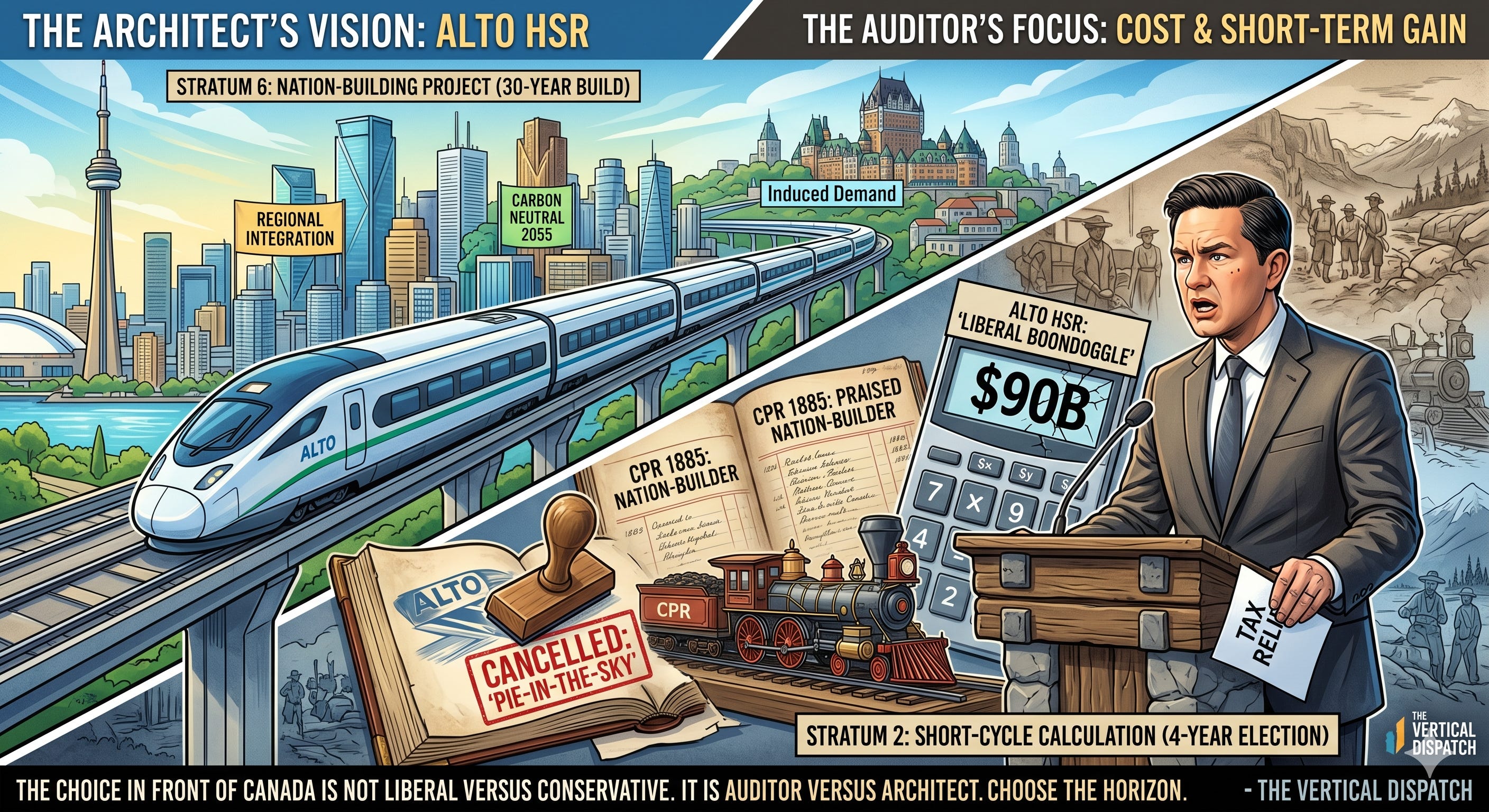
Then, in the same week, in a different speech, he praised the Canadian Pacific Railway. He invoked it as the model of what real Canadian nation-building looks like. The kind of project the country used to be capable of executing before, in his framing, the Liberals turned governance into bureaucracy.
I want to spend this piece on the gap between those two positions, held by the same man, in the same week, in front of the same public — because that gap is not a contradiction Poilievre will eventually clean up. That gap is the entire structure of his candidacy. And the country needs to see it clearly, because the choice in front of us in the next election is not what it appears to be.
It is not Liberal versus Conservative. It is not left versus right. It is not even establishment versus populist.
It is whether Canada is going to be governed by an architect or audited by a clerk.
The railway he praises
The Canadian Pacific Railway, completed in 1885, was the largest, riskiest, most fiscally controversial public-private infrastructure project in Canadian history. The federal government provided the syndicate with twenty-five million dollars in direct cash subsidies — an almost unimaginable sum in nineteenth-century terms, equivalent to a substantial fraction of the entire federal budget of the era. It granted twenty-five million acres of Crown land. It transferred a thousand kilometres of already-completed track at zero cost. When the syndicate ran out of money mid-construction in 1884, John A. Macdonald’s government went back to Parliament for a twenty-two-and-a-half-million-dollar emergency loan and survived the no-confidence vote that followed by a margin so thin that historians still argue about whether it should have held at all. The Pacific Scandal of 1873 had already brought down one government over the railway’s financing arrangements.
The opposition at the time called the project reckless. They called it a giveaway to private interests at public expense. They called it fiscally irresponsible, badly governed, and structurally corrupt. They were not wrong about everything. The land grant terms were extraordinarily generous. The labour conditions, particularly for the Chinese workers who built the most dangerous sections through the Rockies, were brutal and in some cases lethal. The financial engineering was opaque even by the standards of the era. Western alienation, born partly in those land grant arrangements, echoes through Canadian politics to this day.
And the country exists in its current geographic shape because Macdonald’s government made the bet anyway. The alternative was not fiscal prudence. The alternative was British Columbia leaving Confederation in 1881 — which it had explicitly threatened to do if the railway promise was not kept — and a Canada that ended at the Manitoba border. The United States understood this perfectly well. Washington was watching the western half of the continent with considerable interest, and the question of whether Canada would consolidate its Pacific claim or surrender it was, in the 1870s, genuinely open.
The railway was the answer to that question. Not a market answer. Not a prudent answer. Not an answer the cheque-balancers of the era would have endorsed. A national answer, made under duress, on a horizon longer than any single political career.
This is the railway Pierre Poilievre invokes when he wants to sound like a nation-builder.
And by every standard he himself currently applies to public infrastructure, it is the railway he would have voted to cancel.
The railway he refuses to build
High-speed rail is not an experimental technology. Japan has been operating the Shinkansen since 1964. Sixty-two years of continuous operation. A passenger fatality rate of zero across more than ten billion passenger journeys. France has been operating the TGV since 1981. China built the largest high-speed rail network in human history in less than two decades — over forty thousand kilometres of track, more than the rest of the world combined. Spain, Germany, Italy, South Korea, Taiwan, Saudi Arabia, Morocco, the United Kingdom, and yes, the United States, all operate or are actively building high-speed rail systems. The technology is mature. The financial models are well understood. The benefits are documented across multiple continents and multiple decades of operation in real economies running real numbers.
In every one of those countries, high-speed rail was treated as a thirty-to-fifty-year strategic investment. Not because their governments were profligate. Because the economics demand it. The capital expenditure is enormous and front-loaded. The operational benefits compound across generations. The carbon savings, the road and airport congestion relief, the regional economic integration, the property value uplift around stations, the induced demand that rebalances national mobility — all of these accrue over decades, not years. They are nearly invisible to anyone evaluating the project on a four-year electoral timeline. They are obvious to anyone evaluating the project on the timeline at which infrastructure actually has to be planned.
The Toronto-to-Quebec-City corridor would, when complete, connect Montreal, Ottawa, Toronto, and Quebec City through three to four hour journeys at speeds Canadian rail has never seen. More than half of Canada’s population lives in that corridor. The economic activity inside that triangle is the engine of the entire national economy. The carbon savings, conservatively estimated, are in the millions of tonnes annually once full operation is achieved. The reduction in short-haul flights between Toronto and Montreal would free landing slots at Pearson and Trudeau for the international routes Canadian trade actually depends on. The economic integration of the corridor is the single most consequential domestic infrastructure project Canada has considered since the St. Lawrence Seaway.
This is the railway Pierre Poilievre has just committed to cancelling.
There is no economic argument against the project that does not also retroactively condemn every major piece of infrastructure Canada has ever built. The CPR. The St. Lawrence Seaway, which nearly bankrupted the Canadian and American governments in the 1950s and is now the foundation of Great Lakes commerce. The Trans-Canada Highway, an eighteen-year build-out that no single election cycle could have justified. The Trans-Canada Pipeline, which nearly brought down the St. Laurent government in the 1956 parliamentary crisis that ended careers. The national electricity grid. Universal healthcare. The Charter of Rights and Freedoms. Every one of these projects had serious, intelligent, fiscally articulate opponents who could explain in detail why proceeding was reckless. Every one of those opponents was, in the only sense that matters, wrong.
They were wrong because they were asking the wrong question. They asked whether the project balanced on a four-year horizon. The relevant question was always whether the country that would exist without the project was the same country as the one that would exist with it. The honest answer, repeatedly across Canadian history, was no.
Pierre Poilievre is asking the wrong question about Alto. He is asking it on purpose. And he is asking it because the wrong question is the one that produces the political result he wants, regardless of what it costs the country.
The cognitive layer he is governing from
Readers of this Substack have seen the Elliott Jaques framework before. The Level 8 Mind in a Level 4 World — the piece that broke through last week, that earned the largest reader response anything I have published has ever generated — laid it out in detail. The short version, applied here.
Jaques argued that human cognitive capacity sorts into discrete strata defined by time horizon. Not intelligence. Not eloquence. Time horizon — the longest stretch of future a person can hold in their mind, plan against, and execute toward without losing the thread. A Stratum 2 mind operates on a three-month-to-one-year horizon, in linear cause-and-effect terms, focused on immediate problems with concrete solutions and visible results. Stratum 2 is not stupid. It is the cognitive layer at which most daily work in any society is correctly done. We need Stratum 2 thinking. Bills get paid at Stratum 2. Schedules get kept. Inventory gets managed. There is honour in Stratum 2 work, and a country runs on the people who do it well.
A Prime Minister is not one of those people.
A Prime Minister is required to operate at Stratum 5 or Stratum 6 — the five-to-twenty-year horizon at which national infrastructure, fiscal architecture, multilateral relationships, demographic transitions, and constitutional structures actually have to be planned. The role demands it. The complexity of the country demands it. The decisions that cross a Prime Minister’s desk demand it. A leader who reasons at Stratum 2 in a Stratum 6 role is not unintelligent. They are operating in the wrong cognitive register for the responsibilities of the office, and the mismatch produces a specific kind of error: every long-horizon investment is reframed as a short-horizon expense, every strategic decision is reframed as a tactical line item, every multi-decade national project is reframed as money that should have been spent on something visible and concrete this fiscal year instead.
This is what Poilievre’s position on Alto reveals. Ninety billion dollars across thirty years, generating compounding returns across the next century, is presented as ninety billion dollars that could have been used for tax cuts in the next budget cycle. The capital-versus-operating distinction collapses entirely. The multiplier effects vanish from the analysis. The horizon shrinks until only the cheque visible today remains, and the cheque visible today is always larger than the imagined benefit decades from now. This is not an argument. This is a cognitive limitation, dressed up in the language of fiscal responsibility, performed for an audience the politician has decided will respond to it.
You can see the same pattern across every major Poilievre policy position. Carbon pricing — abolished, on Stratum 2 grounds, with no plan for the multi-decade transition the science requires. Bank of Canada governance — attacked, on Stratum 2 grounds, with no apparent understanding of what central bank independence is structurally for. The CBC — defunded, on Stratum 2 grounds, with no analysis of what national broadcasting infrastructure does for civic cohesion across a country this large. Housing — reframed entirely as a municipal red-tape problem, on Stratum 2 grounds, ignoring the demographic, financial, and supply-chain realities that any honest housing policy has to integrate.
A pattern is not a coincidence. It is a cognitive signature. And the signature on Pierre Poilievre’s policy portfolio reads, with unusual clarity, this person is operating two strata below the role he is seeking.
The auditor versus the architect
Here is the framing that I think actually captures what is in front of the country.
Mark Carney, whose Stratum 8 frame I have written about at length in the piece that has become the most-read thing I have ever published, is an architect. He is asking architectural questions. What does Canada need to be in 2055? What infrastructure has to exist by then? What alliances? What industrial base? What constitutional and legal architecture? What relationship to the Arctic, to the Pacific, to Europe, to the rising powers of the global south? How does the country position itself for the carbon transition, the demographic transition, the technological transition, the geopolitical transition, all of which are occurring simultaneously and on horizons longer than any single mandate?
These are architect questions. They demand long horizons, comfort with complexity, willingness to invest in outcomes the architect will not personally see, and the temperamental discipline to refuse the short-cycle pressures that every architect faces from people who do not understand what is being built.
Pierre Poilievre is an auditor. He is asking auditor questions. What did this cost? Who paid? Where is the receipt? Can we cut it? Is there waste? Why are we spending money on this when people are struggling today? These are not unworthy questions. They are necessary questions. Every well-functioning organization needs auditors. The country needs an honest opposition that asks them.
The country does not need an auditor as Prime Minister. It needs an architect as Prime Minister, and an auditor as Leader of the Opposition. Those are different roles, requiring different cognitive registers, demanding different temperaments, producing different governments. Confusing them is a category error. Electing the auditor to the architect’s chair is how countries lose decades they cannot afford to lose.
The Alto file is the cleanest test we have been given of which role each man is suited for. One of them looked at ninety billion dollars across thirty years and asked, what kind of country does this make Canada in 2055. The other looked at the same number and asked, what slogan will this fit on a clip this week. The architect funded the project. The auditor wants to cancel it.
This is the choice. Not Liberal versus Conservative. Not left versus right. Architect versus auditor. Stratum 6 versus Stratum 2. The cognitive register at which the next decade of national decisions is going to be made.
What the country actually wants
Here is what I think is happening underneath the noise of the daily polling, which I have stopped reading because the polling is measuring the wrong thing.
A large portion of the Canadian public — I would argue a majority, when they are asked the right question — is exhausted by Stratum 2 governance. They have lived through fifteen years of political leaders, in multiple parties, who reasoned about the country on the timeline of the next news cycle. They watched climate commitments get made and unmade. They watched housing become unaffordable while every level of government blamed the other. They watched the United States become an unreliable partner while their own political class kept performing the rituals of a relationship that no longer existed. They watched the world shift, decade after decade, while their governments responded with slogans calibrated to thirty-second clips.
They are tired. They are not stupid. They can tell the difference between a leader who is building something and a leader who is performing something. They sense, even when they cannot articulate it, that the country has been administered for fifteen years instead of governed, and that something has been lost in the difference.
Mark Carney is the first leader in a generation who is offering the architectural answer. His coalition is forming around that recognition. The piece on his Stratum 8 frame broke through last week not because of clever writing — there is plenty of clever writing on the internet — but because the framework named what readers were already sensing. Yes. Finally. Someone is doing the work on the right horizon. We have been waiting for this. The hundred likes, the forty restacks, the thirty-five comments are not a metric. They are a signal that the country is hungry for analysis that takes the long view seriously, because the country itself is starting to take the long view seriously.
Pierre Poilievre’s coalition is the inverse. It is forming around a refusal of the long view. It is forming around the demand that government answer Stratum 2 questions in Stratum 2 terms — what did this cost, why are we doing it, give me my money back — and that any leader who answers in Stratum 5 or 6 terms be denounced as out of touch, elitist, captured by experts. The coalition is real. It will produce a strong showing in the next election. It is not, however, a majority of the country. It is the loud portion of a frustrated minority, amplified by a political-media ecosystem that confuses volume with weight.
The Alto position is the test of whether that coalition is large enough to govern. A leader who would cancel the most consequential domestic infrastructure project in seventy years, while invoking the most consequential infrastructure project in Canadian history as his rhetorical model, is showing the country, with unusual clarity, what kind of governance he intends to deliver. The country is going to have to decide whether it wants that.
I do not think it does. I do not think a majority of Canadians, asked clearly and given a fair frame, would choose to cancel high-speed rail in order to fund a tax cut they will not feel. I do not think a majority of Canadians, asked clearly, want their country governed by an auditor when the moment requires an architect. I think the silent middle of this country — the people who do not show up in polling because they are working, who do not appear at rallies because they are raising children, who do not post on social media because they are tired — is closer to Carney than to Poilievre, and is going to remain so as long as the choice is framed honestly.
That last condition is the work. The choice has to be framed honestly. That is what The Vertical Dispatch is for.
The river still moves
Heraclitus wrote, twenty-five hundred years ago, that πάντα ῥεῖ — all is change. You cannot step into the same river twice, because by the time your second foot enters, the river is already a different river, and you are already a different person. The wisdom in that line is not poetic. It is operational. It tells us that the country we will live in twenty years from now depends, in every meaningful sense, on the decisions made about the river we are standing in right now.
The Canadian Pacific Railway was a decision made about a river the people making it could not see the far bank of. They made it anyway, because the alternative was a smaller country or no country. The Alto high-speed rail is a decision of the same kind, on a different river, in a different century. We can choose to make it, knowing that we will not personally live to see the full result. Or we can refuse it, on the grounds that the result is not yet visible and the cheque is.
Pierre Poilievre is asking us to refuse it. He is asking us to refuse it while invoking the railway built by people who refused that refusal. He is asking us to praise their courage while declining to repeat it. He is asking us to govern the way they would not have governed, and to call that decision conservative in their name.
It is not conservative. It is not nation-building. It is not, by any honest reading, what the people who built the CPR would have chosen for the country they died to consolidate.
It is auditing dressed up as leadership. It is Stratum 2 reasoning performed in the cognitive register of Stratum 6 ambition. It is, in plain language, an unqualified candidate for the office he is seeking, telling the country with unusual honesty that he does not have the horizon the role requires.
We should believe him.
The river still moves. The honest watcher is the one who watches it move and asks, in every generation, whether we are willing to build for the country we will not live to see. That is what governance is. Everything else is administration.
Canada has had fifteen years of administration. It cannot afford another four. The man at the podium on March 31 told us, in his own words, what he would deliver. The country, if it is paying attention, will decline the offer.
The choice in front of Canada is not Liberal versus Conservative. It is auditor versus architect. We elected an architect. The auditor wants the chair. He is showing us, with his own words, why he should not have it.


Glen Roberts is the author of Sacred Metaphysics and Consciousness: The History of the Absolute and Eternal and the developer of Universal Dynamics and the Vajra sovereign AI architecture.
Full set: #TheVerticalDispatch #PierrePoilievre #AltoHighSpeedRail #HSR #CanadianPacificRailway #CPR #NationBuilding #InfrastructureCanada #Stratum2 #Stratum6 #ElliottJaques #RequisiteOrganization #TheLevel8MindInALevel4World #LongHorizon #MarkCarney #CanadianPolitics #PublicInvestment #CapExVsOpEx #StLawrenceSeaway #Heraclitus #ProjectTwentyFortySix #SophiaInitiative #ArtificialIntelligenceGovernance #SubstackEssay #LongFormJournalism #AuditorVsArchitect
The old saying is that there are 2 types of politicians, those who want to be something vs. those who want to do something.
So beautifully written