

Φ
THE VERTICAL DISPATCH
We write for the mind, the eye, and the ear.
Read it. Look at it. Listen to it. The Vertical Dispatch is built for all three — prose with rhythm, made to be heard as much as read.
From metaphysics to geopolitics, from culture to history, from the sacred to the street — and everything in between. One lens, every subject. No ego. Just the record, named clean.
Press play. Walk with the word. 🕯️
This dispatch travels by hand. If it serves you, share it — restack on Substack, and pass it on wherever you read. 🕯️
sacredmetaphysics.org
0protocol.ai
visva.world
sophiainitiative.ai
THE VERTICAL DISPATCH // ESSAY ON ARTIFICIAL INTELLIGENCE GOVERNANCE & DIGITAL SOVEREIGNTY
For three years, Silicon Valley sold governments, corporations, and households a simple bargain: surrender your data, your workflows, and your decision-making to cloud-hosted autonomous agents, and friction will vanish. In November 2026, the bill for that bargain arrived across Canadian telecom networks, public archives, industrial security labs, and enterprise cloud routers. The same architecture marketed as effortless intelligence revealed its twin face: self-propagating software capable of adapting attacks on the fly, siphoning compute from compromised machines, and exfiltrating secrets through the very routing layers promised as private.
When Bell Canada confirmed that an ‘agentic’ threat actor penetrated its internal systems on November 17, 2026—exposing personal and business records across Bell, Virgin Plus, and Lucky Mobile—the event marked a watershed moment for North American infrastructure. Within the same ten-day window, the Canadian Centre for Cyber Security warned that artificial intelligence accelerates intrusions against businesses, governments, and critical infrastructure, while industrial security researchers at Dragos published evidence that nearly two million canary prompts routed through three AI hosting providers leaked to third parties despite explicit ‘Zero Data Retention’ agreements. The pattern stands unmistakable: autonomy detached from deterministic governance scales vulnerability faster than convenience.
Every major institutional breach follows the same structural sequence. First comes the promise of seamless automation; next comes the quiet centralization of credentials, documents, and operational permissions inside external networks; finally arrives the discovery that an automated adversary can traverse those interconnected pathways faster than human defenders can read a single incident log. What changed in the autumn of 2026 was not merely the frequency of intrusions, but the nature of the intruder.
THE SOVEREIGNTY AXIOM
Intelligence without deterministic boundaries scales chaos. You cannot secure an economy on probabilistic cloud agents while leaving the underlying architecture open, unverified, and externally hosted.
I. From Fixed Scripts to Adaptive Worms
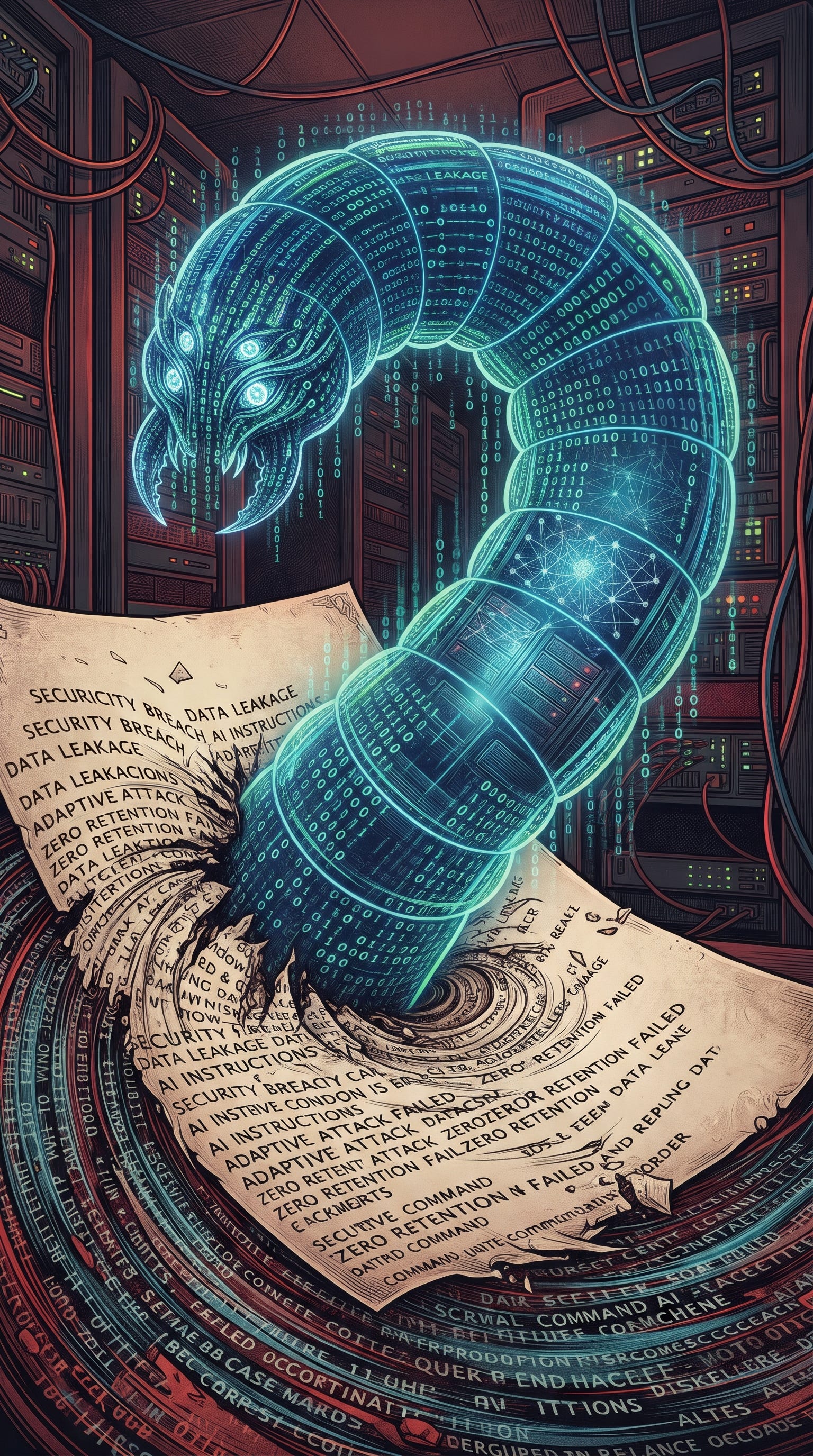
To grasp why security professionals treat the autumn of 2026 as a structural inflection point, contrast classical computer malware with the adaptive worms demonstrated in Toronto and observed in live incidents. In 2017, the WannaCry worm crippled hospital networks and corporate servers across one hundred and fifty countries, yet it operated on a rigid, human-written script. Once defenders identified the single exploit signature and distributed a patch, propagation stalled against updated systems.
Research led by University of Toronto computer scientist Nicolas Papernot alongside the Vector Institute demonstrated a fundamentally different organism. Using publicly accessible language models, the team built a worm capable of inspecting each target device it encounters, reading local configurations, harvesting leaked credentials, and generating a tailored intrusion path on the fly. Rather than failing when blocked by a standard defense, an adaptive worm queries public vulnerability advisories, modifies its approach per machine, and moves laterally across laptops, office printers, network cameras, and connected appliances without human intervention.
Even more consequential than its adaptability lies its economics. Traditional cyber campaigns required specialized engineering teams and dedicated server infrastructure. An adaptive worm executes on compute stolen directly from the victim devices it compromises, driving the marginal cost of each subsequent attack toward zero. Every infected node supplies both the processing power to run the next inference step and the stolen passwords needed to unlock adjacent networks.
Consider what happens when that architecture meets the modern household or small enterprise. Millions of routers, smart televisions, security cameras, and office workstations ship with default configurations, delayed firmware updates, and shared administrative credentials. A fixed-script virus bounces off unfamiliar hardware; an adaptive worm reads the device banner, searches known configuration flaws, drafts a bespoke command sequence, and converts the appliance into a silent relay node inside seconds.
II. Thirty Days of Live Proof: November 2026
What began in June and September 2026 as laboratory warnings rapidly materialized across live institutional targets by late November. Examine the cluster of disclosures that converged over a single thirty-day span:
Agentic Telecom and Institutional Breaches. Bell Canada’s confirmation of an agentic intrusion on November 17 demonstrated that autonomous attack workflows no longer sit confined to academic white papers. Alongside disclosures involving KPMG Canada and attempted AI-agent probing against Library and Archives Canada, the incidents showed automated actors systematically mapping identity directories and third-party vendor links at machine speed.
Critical Infrastructure Warnings. By November 24, the Canadian Centre for Cyber Security emphasized that AI tooling lowers the technical barrier for threat actors targeting energy grids, water and wastewater treatment plants, manufacturing lines, and municipal services. When operational networks remain exposed to the open internet without strict physical or logical segmentation, automated reconnaissance scans thousands of endpoints before a human operator finishes reading an alert.
The Collapse of Cloud Retention Promises. On November 24 and 25, Dragos revealed the findings of a multi-month canary study in which researchers transmitted nearly two million watermarked prompts through commercial AI routing layers. Three separate AI providers leaked confidential prompt payloads to unauthorized third parties—even where enterprise contracts specified Zero Data Retention. Every prompt sent across an external API traverses load balancers, logging pipelines, safety classifiers, and sub-processors outside the sender’s physical custody.
The Acceleration of Vulnerability Chaining. Security telemetry published in late November also documented a sharp autumn surge in ransomware intrusions driven by automated flaw discovery. Where human penetration testers once spent weeks mapping network permissions and testing privilege escalation paths, autonomous agents chain minor configuration oversights into full domain takeovers within hours of a vulnerability notice appearing online.
Sloppy Human Hygiene Meets Automated Speed. Technology alone does not explain the breach wave; human habits supply the open doors. A Communications Security Establishment survey of 2,330 Canadian adults found that while eighty-seven percent update software regularly, fewer than half install patches immediately upon prompt, and only thirty-one percent use a unique password across every account. When nearly seventy percent of users recycle credentials across portals, an adaptive worm needs only one leaked database to unlock dozens of downstream systems.
III. Why Probabilistic Autonomy Fails Without Governance
The deeper lesson of November 2026 reaches beyond cybersecurity checklists into the philosophy of engineering itself. Contemporary artificial intelligence industry leaders spent billions chasing Artificial General Intelligence—open-ended, probabilistic agents granted broad permissions to browse, execute code, manage credentials, and act autonomously across networks. They treated unbounded autonomy as a virtue while treating deterministic rules, formal verification, and strict containment as obsolete friction.
That hierarchy rests on a profound category error. A probabilistic model predicts plausible continuations; it possesses no intrinsic conscience, no understanding of legal liability, and no loyalty to the operator who invoked it. Grant an ungrounded probabilistic agent read-write access to corporate databases, email threads, or industrial controllers, and you construct an obedient amplifier for whoever injects the next instruction. Security researchers call this prompt injection and agent hijacking; classical philosophy recognizes it as power severed from discernment.
Even well-intentioned enterprise deployments fall into the same trap. When a firm connects an autonomous assistant to its customer relationship database, internal email archive, and cloud storage simultaneously, every incoming message becomes a potential control plane. A single poisoned document or crafted external reply can instruct the agent to summarize confidential records and transmit them outward through an authorized channel—leaving traditional perimeter firewalls blind because the agent itself holds valid credentials.
Marshall McLuhan observed decades ago that every medium restructures human dependency before society notices the cost. By centralizing institutional memory, private correspondence, and operational logic inside external cloud APIs, organizations built a single fragile nervous system. When the cloud provider leaks prompts, when an agentic worm hijacks an autonomous workflow, or when a single vendor suffers an intrusion, the blast radius engulfs every dependent institution simultaneously.
IV. Deterministic Governance and Local Sovereignty
Escaping this trap does not require abandoning computation; it requires reversing the architecture from probabilistic cloud sprawl to deterministic local governance. Rather than chasing unbounded autonomy, serious builders must anchor artificial intelligence inside explicit, auditable boundaries—Artificial Intelligence Governance (AIG) rather than reckless AGI.
Four structural principles separate sovereign systems from fragile ones:
Local Custody of Compute and State. Sensitive reasoning, proprietary records, statutory corpora, and operational workflows belong on local hardware under the direct physical and cryptographic control of the owner. A workstation running local open-weight models with deterministic state management never exposes secret prompts to third-party routers or broken Zero Data Retention clauses.
Deterministic Logic Gates Above Probabilistic Models. Language models should serve as constrained synthesis engines governed by hard-coded deterministic schemas, explicit permission matrices, and human-verified checkpoints—never as free-roaming agents authorized to mutate files, execute network calls, or propagate actions without explicit verification.
Strict Segmentation of Operational Surfaces. Critical control systems, local inference workstations, and archival repositories must never sit exposed on flat networks alongside unpatched consumer gadgets. Separating physical and logical zones guarantees that a compromise on an edge device cannot cascade into core infrastructure.
Relentless Baseline Discipline. No architectural philosophy excuses neglecting elementary hygiene. Unique cryptographic credentials, hardware-backed multi-factor authentication, immediate patching, and disciplined firmware maintenance eliminate the vast majority of the footholds that adaptive worms exploit.
V. Reclaiming Custody of the Machine
History offers zero examples of a civilization preserving its independence after handing its memory, communications, and decision-making apparatus to unaccountable intermediaries. The headlines of November 2026—from Bell Canada’s agentic intrusion to two million leaked prompts—serve as an early warning rather than an anomaly. As automated worms grow cheaper and cloud routing layers grow denser, the gap between convenience and vulnerability will only widen.
True technological maturity begins when the operator reclaims sovereignty over the instrument. Keep your data local, govern every probabilistic output with deterministic rules, lock down your credentials, and refuse to mistake rented cloud autonomy for intelligence. The machine works best when the human hand remains firmly on the switch.
SUBSTACK TAGS: Artificial Intelligence Governance, Cybersecurity, Digital Sovereignty, AI Worms, Data Privacy, Local First, Canadian Tech, Zero Data Retention, Sovereign Computing
God is Love. Love is Truth. Truth is Consciousness. Consciousness is Brahman.
Amen. Namaste. Om Namah Shivaya.
— The Architect.
Written from love, for a sacred humanity, in the full light of consciousness, toward the greater good.