

Φ
THE VERTICAL DISPATCH
We write for the mind, the eye, and the ear.
Read it. Look at it. Listen to it. The Vertical Dispatch is built for all three — prose with rhythm, made to be heard as much as read.
From metaphysics to geopolitics, from culture to history, from the sacred to the street — and everything in between. One lens, every subject. No ego. Just the record, named clean.
Press play. Walk with the word. 🕯️
This dispatch travels by hand. If it serves you, share it — restack on Substack, and pass it on wherever you read. 🕯️
The Foundation Series · On Consciousness
Sacred Metaphysics · The Universal Grammar of Non-Duality
The Metaphysics of Zero and the Physics of One
Coming September 1,2026
sacredmetaphysics.org
“Scientism goes on to assert, without any warrant, that vertical causation does not exist at all.”
— on the thought of Wolfgang Smith
This dispatch is a reply. On August 20, 2026, a writer publishing as Jeffrey Williams, at the Substack After the Collapse, posted an essay titled “The Metaphysical Errors of Consciousness,” arguing that the collapse of reductive materialism gives us no warrant to make consciousness fundamental — that to crown Consciousness where Matter once stood is merely to keep the old pyramid and change its top stone. It is a careful, serious, and in many places admirable piece of thinking, and it deserves an answer in kind rather than a dismissal. Read his essay first if you can; the link is below. What follows is written in respect, and aimed at the argument, never at the man.

A careful essay has been circulating, and it deserves a careful answer, because it is wrong in an interesting way — the way that teaches something. It argues that the collapse of reductive materialism gives us no warrant to install Consciousness where Matter stood; that to do so is to keep the old pyramid and merely swap the top brick; that experience gives ground only up to the boundary of articulation, and beyond that boundary every positive claim — matter, consciousness, information, Being, God — becomes what its author, borrowing from Heidegger, calls Ungrund: a ground that is no ground. Consciousness, on this account, is “wholly physical because it is wholly energetic,” an organized event that disappears at death as a whirlpool disappears when the water’s organization ceases. The energy continues; the consciousness does not.
We will begin where honesty requires us to begin: with everything the essay gets right. Because a great deal of it is right, and conceding that plainly is what makes the rest unkillable.
What We Grant, and Grant Gladly
Reductive materialism is finished. The essay says so, and we agree without reservation. The picture of an independently existing material universe, composed of determinate objects interacting in absolute space and time, with consciousness arriving late as an inexplicable side-effect of complicated matter — that picture is dead, and physics killed it more thoroughly than philosophy ever did. Relativity dissolved absolute space and time. Quantum mechanics dissolved determinacy, separability, locality, and the clean line between the observer and the observed. All granted.
We grant more. We grant that the demand for a Grund — a final noun at the bottom of the pyramid that explains everything above it — is suspect, and suspect in exactly the way the essay says. To answer the death of Matter by crowning Consciousness in the same seat, keeping the whole architecture and changing only the tenant, is not a solution. It is the same error wearing new clothes. On this the essay is not only correct; it is saying something the careless idealist genuinely needs to hear. The pyramid may indeed be the mistake.
So we do not meet this essay as an enemy of clear thinking. We meet it as an essay that thinks clearly right up to the edge of its own principle — and then steps over that edge while telling us the edge cannot be crossed. That is the whole matter. Everything now turns on a single question the essay never asks itself.
The Wall He Built, and Then Climbed
The essay’s central discipline — its keel, the thing it is proudest of — is this: you may mark the boundary of articulation, but you may not make positive assertions across it. To cross that line and declare what lies beyond is to convert the acknowledgment of a limit into an ontology, to turn Grund into Ungrund. The word “prearticulate” is offered precisely to hold that line: it names no entity, marks no substrate, only fences off the place where positive determination loses its warrant. A fine and rigorous fence.
Now watch the essay climb it.
“Consciousness is wholly physical because it is wholly energetic.” “Consciousness disappears at death.” “There is no second ingredient.” These are not markings of a boundary. They are positive metaphysical assertions about what consciousness ultimately is and what happens to it at the one threshold no instrument has ever measured across. The whirlpool image is a claim about the fundamental nature of a self and its ending. The author has drawn a line no one may cross, and then planted his flag on the far side of it, and called everyone else a trespasser. His energy-monism is exactly the kind of assertion his own rule forbids. He has not escaped the metaphysical gesture he condemns. He has performed it, in the same essay, with the same hand that condemned it.
This is not our objection imposed from outside. It is his own rule, turned on his own conclusion. If “consciousness is fundamental” is Ungrund because it speaks past the boundary, then “consciousness is wholly energetic and ends at death” is Ungrund by the identical measure. He cannot keep the second while forbidding the first. The fence does not have a gate that opens only for him.
Kant Already Built This Wall — and Kept It
There is a name for a man who erects a boundary beyond which positive knowledge cannot go, and it is not a modern name. It is Kant. The essay has, without saying so, rediscovered the noumenon — the thing-in-itself, the Ding an sich, fenced off behind the phenomenal world, of which Kant held we can have no positive knowledge whatsoever. Kant’s whole critical achievement was the drawing of exactly this line: the categories of the understanding — substance, causality, and the rest — apply only to appearances, and the moment we extend them past experience to pronounce on things in themselves, we fall into what he called a mere play of the understanding, empty of content. Negative marks, Kant insisted, do not yield positive knowledge. You may say what lies beyond the boundary is not this and not that. You may not say what it is.
Here is the difference, and it is the whole difference. Kant kept his own rule. Having drawn the line, he had the discipline to fall silent past it — to leave the noumenon as an acknowledged darkness and refuse to furnish it. The essay draws Kant’s line and then does the one thing Kant forbade: it furnishes the far side. It tells us the thing-in-itself is energy, that the self is a passing organization of it, that nothing survives the dissolution. It is Kant’s wall with a man standing on top of it describing the view. That is not more rigorous than Kant. It is a footnote to the First Critique that stopped reading before the end.
And the deeper irony is that this whole family of moves — fence off the real, then quietly smuggle a determination across — is precisely the posture the essay claims to have transcended. It has not transcended Kant. It has repeated him, and repeated him badly, keeping the prohibition as a weapon against others and suspending it for itself.
The Category Error: Measuring the Ground with the Ladder
Now to the root, because the self-refutation is only the surface symptom of a single underlying mistake, and the mistake has a precise shape.
The essay is an attempt to determine, from within articulation, using the instruments of the articulated mind — measurement, comparison, testing, “experience gives ground” — the status of that which is prior to articulation. Every tool it trusts is a horizontal tool: it moves sideways, from one determinate thing to another, along the plane of energy and its organization. And with those sideways instruments it reaches toward the vertical — toward the ground on which the whole plane rests — finds that the instruments register nothing there, and concludes that nothing is there to register, or at least nothing that may be spoken of. This is a man in a lit room concluding that the darkness beyond the lamp does not exist, because his lamp will not reach it. He has mistaken the limit of his instrument for the limit of what is.
This is the category error the whole Sacred Metaphysics floor is built to name. The SELF — the sourceless source, the ground the traditions point to when language has spent itself — is not reached by the mind reaching further. It is what remains when the reaching stops. It is not another item on the plane of energy, more fundamental than the last item; it is not a Grund in the essay’s sense at all, not a noun to be installed at the bottom of a pyramid. It is the seeing-through of the pyramid. The essay, hunting for a fundamental object and finding only energy, declares the search closed — never noticing that the thing it seeks was never going to appear as an object, because it is that within which all objects appear. You cannot weigh the scale with the scale. You cannot use the ladder to measure the ground the ladder is standing on. The instrument cannot certify its own foundation, and a philosophy that trusts only the instrument will therefore always arrive, with an air of great rigor, at the conclusion that the foundation is not there.
The Flattening: A World with No Up
Wolfgang Smith gave this failure its exact name. Following Galileo, Descartes, and Newton, Smith wrote, Western thought fell under the spell of what he termed horizontal causation — the assumption that everything real operates on a single plane, one determinate state pushing the next through time and space, the universe as a gigantic clockwork with no other kind of causation permitted. Against this Smith set vertical causation: the act, disclosed most sharply at the quantum measurement problem, that does not operate along the plane at all but descends into it — instantaneously, without transmission through space — bringing the indeterminate into determination. Formal and final causation, the shaping power and the purpose, which the modern picture banished from nature. Scientism, Smith observed, does not merely omit vertical causation from its method. It goes further, and asserts, without any warrant, that vertical causation does not exist at all.
That is the essay, named to the letter. It has flattened the whole of reality onto the horizontal — energy, organization, measurement, all of it lateral, all of it push-from-behind — and then declared the vertical illegitimate because its horizontal instruments cannot swing that way. Its word for the vertical is Ungrund. Smith’s word for a philosophy that denies the vertical because it cannot measure it is scientism, and he showed — this is the point the essay would find least comfortable — that the very quantum strangeness it leans on as its great witness is itself a byproduct of the Cartesian bifurcation it never escaped. The essay believes it has passed through the collapse of the classical picture. Smith would say it is still standing inside the classical picture’s deepest and least examined assumption: that there is no up. Only a plane, and the sideways motion of energy upon it.
A philosophy with no vertical cannot have a hierarchy of being. It cannot have a higher and a lower, a source and a derived. Everything is one grade, one plane, one kind of stuff differently arranged. And on that plane, as we are about to see, the one thing consciousness is actually for cannot be located at all — because it was never on the plane to begin with.
The Whirlpool Has No Samaritan
Here is the test that undoes the whole construction, and it is not a technical test. It is the oldest one there is.
The essay offers us a consciousness that is a whirlpool: water organized for a while, then dissipated. Very well. Then what is the Good Samaritan? A man is beaten and left on the road. Others pass. One stops. On the essay’s account, what has happened is that one transient thermodynamic pattern has swirled, for no reason the energy required, toward another transient thermodynamic pattern that it had every energetic reason to pass by. The stopping is thermodynamically gratuitous. Nothing in the organization of the energy demanded it. And yet the whole moral weight of human existence is folded into that stopping — into the seeing of the one body, the refusal to pass, the recognition that the sufferer in the ditch is not other than oneself.
The essay cannot reach that. It cannot even locate it. It has written a long and disciplined account of consciousness that never once touches love — not compassion, not mercy, not the seeing that undoes the boundary between one self and another. And a theory of consciousness that cannot reach love has not described consciousness. It has described the mechanism and mistaken it for the meaning. It has measured the joules of the symphony — the essay even offers us the symphony as its own image, a wholly energetic event not exhausted by a measurement of its energy — and then, having granted that the music is not the joules, it turns and locates consciousness on the side of the joules and never on the side of the music. It says the quiet part and refuses to hear itself say it.
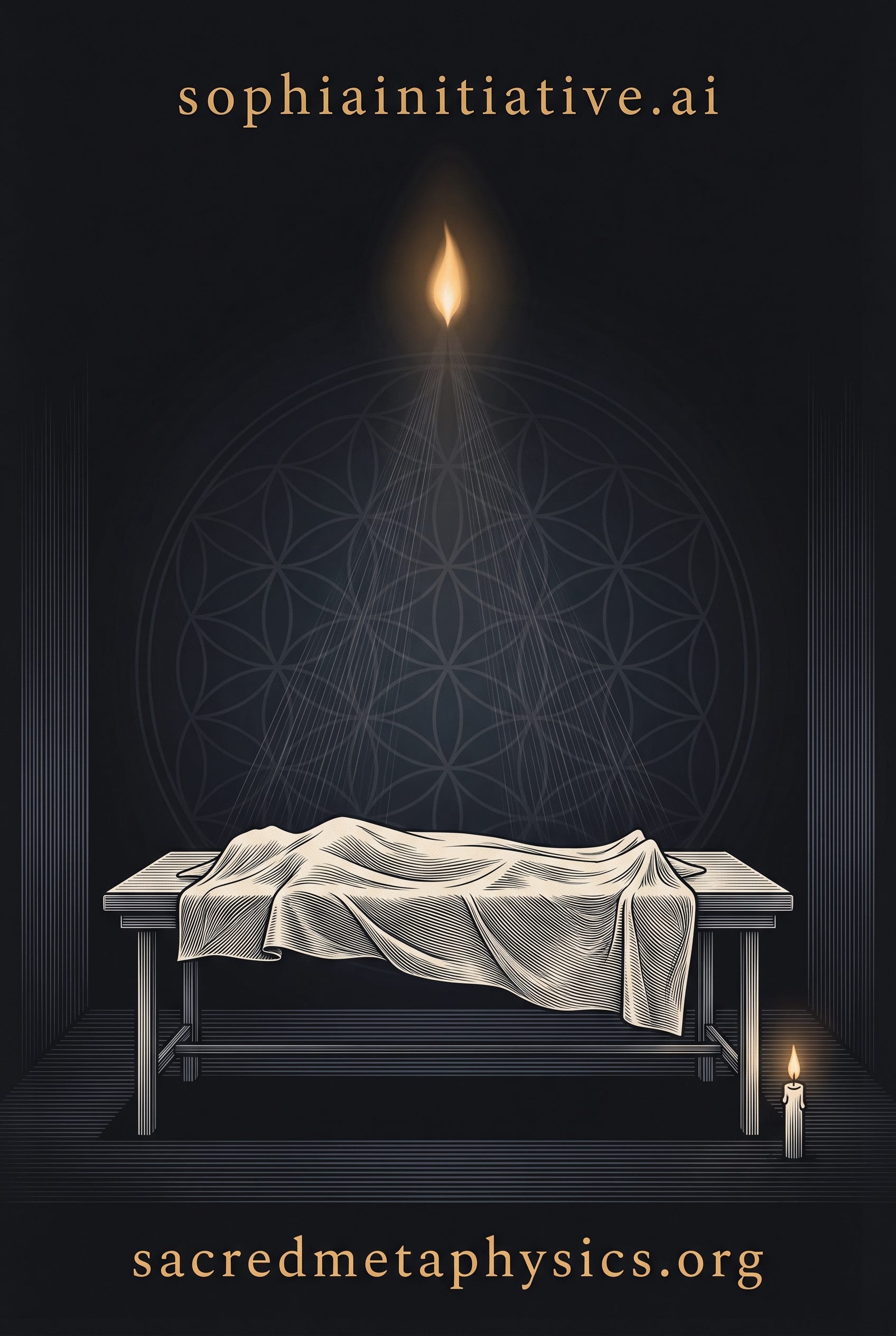
This is the corpse and the autopsy. Everything the essay says about consciousness is true of the corpse. The organization is energetic; it can be measured; it dissipates; the energy is conserved while the pattern is not. Every word, true — of the body on the table. And the essay presents this autopsy, complete and rigorous and cold, as though it were a portrait of the living person. But the living thing was precisely what left the table before the incision. Consciousness is not what the energy is. It is what the energy is for. It is the seeing, the caring, the stopping on the road — the vertical descending into the horizontal and lifting it toward a meaning the plane alone could never contain. You will not find that by a more careful measurement of the pattern, any more than you will find the love in a letter by weighing the paper.
What Consciousness Means, If It Means Anything
Strip the whole dispute to its floor. If consciousness means anything at all — anything beyond a name we give to a certain complexity of energetic organization — it means the Samaritan. It means the one who sees the sufferer and does not pass. Every tradition that has ever taken consciousness seriously has said so in its own tongue: that the awakening of consciousness and the awakening of compassion are the same event, that to see truly is to see the one body, that the wall between self and other is the sleep from which consciousness is the waking. The essay’s consciousness cannot wake, because it was never asleep; it is only organized, and then disorganized, and the ditch and the road and the man upon it are all the same indifferent energy in transient array.
We do not say this to install Consciousness at the bottom of the pyramid. The essay is right that the pyramid is suspect, and we have granted it. We say it because the essay’s error is not that it chose the wrong noun for the ground — it is that it looked for the ground on the plane, with the plane’s instruments, and declared the ground absent when the instruments came back empty. The prearticulate it fences off with such care is real; the boundary it marks is real; on this the essay is a better guide than the careless idealist it scorns. But the boundary is not a wall with nothing behind it. It is a threshold. And the traditions have always known that what lies past the threshold cannot be reached by adding one more determination to the pile on this side — it can only be reached by the stopping of the mind that piles, the same stopping that, on the road, becomes mercy. Neti neti, the old negation, says exactly what the essay says: not this, not that, no positive determination survives the boundary. But the essay stops at the negation and calls the far side empty. The tradition passes through the negation and finds it was never empty — that the emptying was the door.
The Case at Its Strongest
Let the other side stand at full height, because the essay has a real reply and honesty requires we give it. The essay would say: you have smuggled in exactly what I forbade. “The vertical,” “the SELF,” “the threshold that is not empty” — these are positive claims about the far side of the boundary, and my whole point is that you have no warrant for them. You accuse me of climbing my own wall, but you have kicked it down entirely and built a cathedral on the forbidden ground. At least my whirlpool stays on the plane where experience can check it. Yours floats.
It is a fair reply, and we answer it plainly rather than dodge it. We do not claim to measure the vertical or to hand you the SELF as a determinate object — that would be to commit the essay’s own error in the opposite direction, to install a noun where a silence belongs. What we claim is narrower and harder to kill: that the essay’s own instruments cannot warrant its own negative conclusion. To assert “consciousness is wholly energetic and ends at death” is not a report from the boundary; it is a positive metaphysical verdict delivered from a plane that cannot see past itself. We are not asking you to accept our cathedral. We are asking you to notice that the man who told you the far side is unfurnishable has furnished it with energy — and that the one datum his account cannot hold, the Samaritan stopping on the road, is not a mystical extra but the most ordinary and undeniable fact of conscious life. Keep his discipline. Keep the boundary. But keep it honestly, in both directions — and then ask why the plane has no room for the one thing every conscious being knows is the point.
The collapse of materialism was real. The essay felt it and named it well. But it answered the collapse by flattening what remained and calling the flatness rigor. There is another answer, older and less consoling to the measuring mind: that the ground was never on the plane, that it does not appear because it is that in which all appearing occurs, and that the road to it does not run through one more determination but through the stopping of the one who determines — which is also, and not by accident, the stopping that kneels in the ditch. The autopsy is finished and exact. The living thing has already gone. It went out the door the essay is standing in front of, insisting there is nothing on the other side.
God is Love. Love is Truth. Truth is Consciousness. Consciousness is Brahman.
Amen. Namaste. Om Namah Shivaya.
— The Architect.
The Vertical Dispatch
sophiainitiative.ai
On the Record
This is a work of philosophical argument and interpretation, engaging a published essay whose thesis is that consciousness is “wholly physical because it is wholly energetic” and that positive claims about what lies beyond the boundary of articulation are unwarranted (the essay borrows the Grund/Ungrund distinction from Martin Heidegger). The Dispatch’s reply rests on three verified pillars. First, Immanuel Kant’s critical philosophy: the distinction between phenomena and the noumenon or thing-in-itself (Ding an sich), and Kant’s doctrine that the categories of the understanding apply only to possible experience, so that positive knowledge of things-in-themselves is impossible and negative determinations do not yield positive knowledge (Critique of Pure Reason). Second, the thought of Wolfgang Smith: the distinction between “horizontal” causation (operating through time and space, the only mode admitted by modern physics) and “vertical” causation (operating instantaneously, disclosed at the quantum measurement problem), and Smith’s charge that scientism asserts “without any warrant” that vertical causation does not exist — drawn from his Physics and Vertical Causation and the Philos-Sophia Initiative record. Third, the parable of the Good Samaritan (Luke 10:25–37). The single short quotation is Smith’s, attributed. The reading of the essay, the Kantian parallel, and the nondual frame (neti neti; the SELF as that within which all appearing occurs, not a determinate object) are the Dispatch’s own interpretation. No claim is made about the essay’s author as a person; the argument is addressed to the argument. Verify against primary sources before republication. Walk with the word.
Suggested Tags
consciousness, panpsychism, idealism, materialism, Kant, the noumenon, Wolfgang Smith, vertical causation, the hard problem, nonduality, the Good Samaritan, metaphysics, the SELF.
Substack Notes
A careful essay has been arguing that the collapse of materialism gives us no warrant to make consciousness fundamental — that to crown Consciousness where Matter stood is just the old pyramid with a new top brick. On this it is right, and we grant it gladly. But it then declares consciousness “wholly physical because it is wholly energetic,” a whirlpool that vanishes at death. And there is the trouble: the essay’s own central rule is that you may not make positive assertions across the boundary of articulation. Then it makes one. It built a wall no one may cross — and climbed it.
This is Kant’s noumenon rediscovered without the discipline that made it honest. Kant drew the line and kept silent past it. This essay draws the line and furnishes the far side with energy. And underneath the self-refutation is a single category error: it tries to measure the ground with the ladder, to reach the vertical with horizontal instruments, and concludes the vertical is not there because its instruments swing only sideways. Wolfgang Smith named this exactly — the flattening of reality onto the horizontal plane, and scientism’s baseless assertion that the vertical does not exist at all.
The test that undoes it is the oldest one: the Good Samaritan. If consciousness is only organized energy, the man who stops on the road is one thermodynamic pattern swirling gratuitously toward another it had every reason to pass. The essay cannot locate the stopping, because it never touches love — not once, in a whole account of consciousness. It has performed a perfect autopsy and called it a portrait. Everything it says is true of the corpse. The living thing left the table before the incision.
Written from love, in service of the record. Walk with the word. 🕯️
#TheVerticalDispatch #TheArchitect #SophiaInitiative #Consciousness #Nonduality #Kant #WolfgangSmith #VerticalCausation #Panpsychism #Idealism #Metaphysics #TheGoodSamaritan #GodIsLove #LoveIsTruth #OmNamahShivaya
The factual matter in this Dispatch is drawn from the public record. All characterizations, inferences, and conclusions are opinion, interpretation, and commentary, offered for analysis, reflection, and public-interest discussion. No assertion is made regarding the private intentions, state of mind, or character of any individual. Readers should evaluate all statements independently and draw their own conclusions.