

Φ
THE VERTICAL DISPATCH
We write for the mind, the eye, and the ear.
Read it. Look at it. Listen to it. The Vertical Dispatch is built for all three — prose with rhythm, made to be heard as much as read.
From metaphysics to geopolitics, from culture to history, from the sacred to the street — and everything in between. One lens, every subject. No ego. Just the record, named clean.
Press play. Walk with the word. 🕯️
This dispatch travels by hand. If it serves you, share it — restack on Substack, and pass it on wherever you read. 🕯️
Sacred Metaphysics · The Age of Consequences
as of July 20, 2026
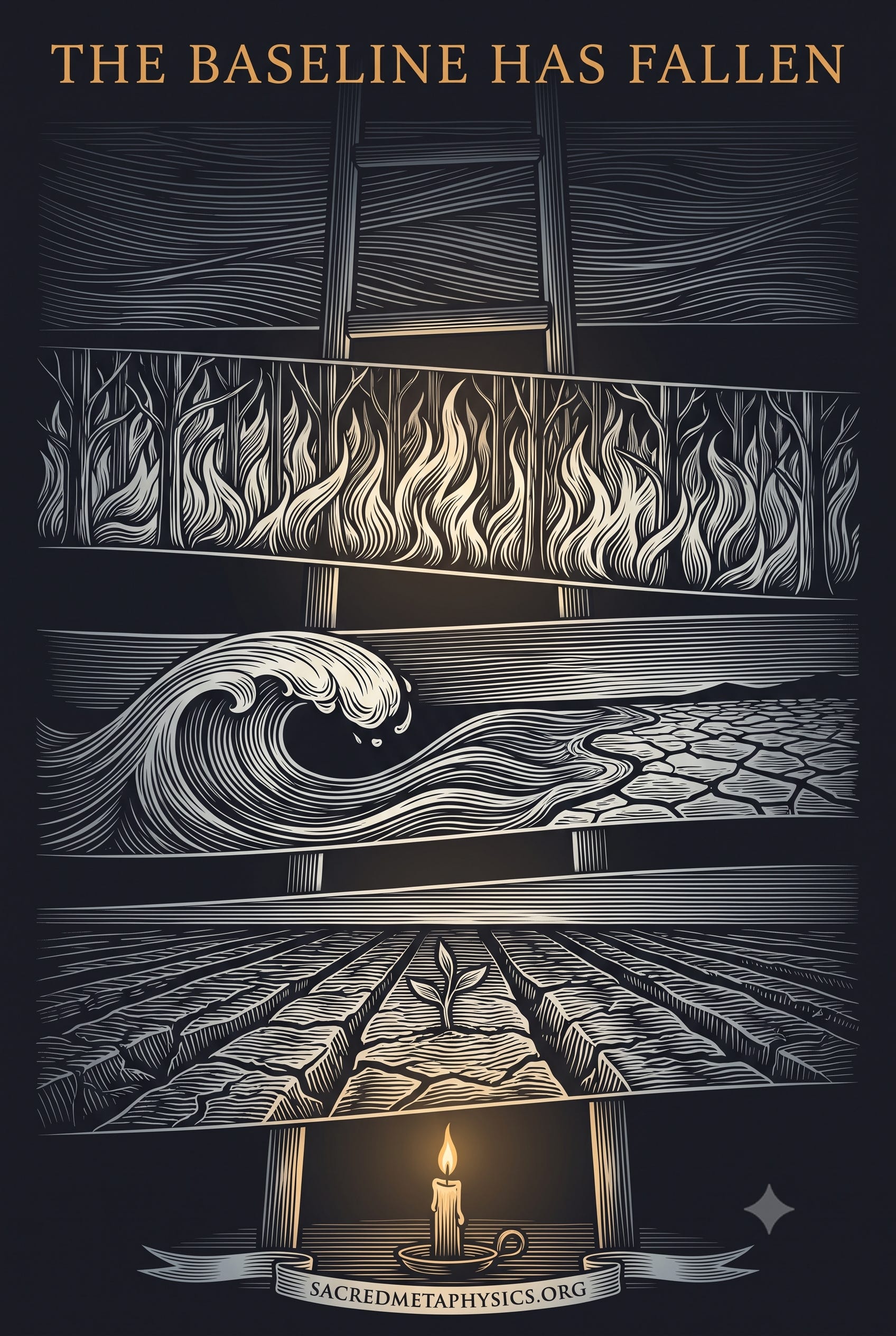
Set aside, for a moment, whose fault it is. That question belongs to the rim, to the shouting, to the competition that never ends. Come up to the altitude where the elements themselves testify — and there the reading is plain: not one of the four is on a sustainable baseline, and the baseline has fallen in fifty years.
There is a way to speak of climate that does not descend into the shouting, and it is the oldest way there is: to read it through the four elements. The ancients resolved the whole manifest world into a few great principles — Earth, Water, Fire, Air — and every people that ever lived arrived at nearly the same few, because they were reading the living world itself. These four are not a quaint antiquity. They are the grammar of the manifest, the rungs of the ladder by which the ONE becomes the many, and they are, as this work has argued elsewhere, the empirical face of Goodness and Beauty and Truth: a real thing is good because it is, beautiful because it has form, true because it does not lie. So when the four elements fall off their baseline all at once, what is failing is not merely an environment. It is the manifest world’s capacity to be a window — the ground of the ladder home, degrading beneath our feet.
And they are failing, all four, and the honest eye can read it without any theory of cause at all. Whether the great turning is written in the stars — the slow precession of the ages, the descent of the long arc toward the bottom — or whether it is the work of our own hands, the collective refusal to surrender an abundance no one will give up, the reading of the condition is the same, and one need not settle the cause to read the fever off the thermometer. The four are off their baseline. Let us take them one at a time.
Earth — the Soil, the Foundation
Begin with earth, the solid, the foundation, the element the whole of life is grown from — for here the degradation is most quietly catastrophic, because it is beneath our feet where no one looks. The United Nations’ Food and Agriculture Organization has warned that a third of the world’s soil is already degraded, that it takes something like a thousand years to build a few centimetres of topsoil, and that the equivalent of one soccer pitch of earth erodes every five seconds. From the same forum came the widely repeated claim that the world has only sixty harvests left. Honesty requires a caution here, and we give it gladly, for the strength of a true thing is that it does not need the exaggeration: the specific figure of sixty harvests has been challenged by careful researchers, who found that soils vary enormously, that many have far longer lifespans, that some are even thickening, and that there is no single global deadline. The number is contested. But the direction is not. The soil is thinning faster than it forms; a third is already gone; the arable land per person may, by mid-century, be a fraction of what it was in 1960. The deadline is unknowable; the degradation is real. The foundation is eroding, and the mercy of the ladder — that the road home is built of the very ground we stand on — is the very thing being washed away.
And it is worth hearing the ones who have given their lives to this element, for they read it rightly. Vandana Shiva, the Indian physicist who left quantum theory for the soil and founded the seed-movement Navdanya, has spent three decades saying that the earth is not an inert substance to be managed with chemicals but a living body, and that to save the seed and the soil is to save the foundation of freedom itself. And the yogi Sadhguru, through his Save Soil movement, has carried the same message to the world’s assemblies in a single unforgettable line: that food does not come from the grocery delivery app; it comes from soil, and the healthier the soil, the healthier the food, and the healthier the body. Their prescriptions are debated, as all prescriptions are; but the reading of the element is sound. The earth is a living thing, and it is being treated as a dead one, and the living thing is dying of the treatment.
Water — the Flood and the Drought
Then water, the flowing, the element of the deep and the unconscious, the one that both drowns and renews. And water, too, is off its baseline, thrown to its extremes: the floods that take whole regions at once, the storms grown fiercer, the rivers that swell and burst; and at the other pole, the droughts, the rivers run dry, the wells fallen, the reservoirs emptied. Water is the element of balance — the flowing between too much and too little — and it is precisely that balance that has broken, so that the same warming world delivers the deluge to one land and the dust to another. Vandana Shiva began her own work not with soil but with water and the trees that hold it, in the Himalayan movement where village women embraced the trees to stop the loggers, because they understood what the modern forgot: that the forest holds the water, and the water holds the soil, and to cut the one is to lose the other two. The elements are not separate. Water off its baseline is earth washed away and air unmoistened; the four fail together, because they were always one system, one grammar, one living whole.
Fire — the Burning World
Then fire, the transformer, the element that warms and purifies — and that, unbounded, consumes the house it was keeping warm. And fire is off its baseline most visibly of all, for the forests of the whole world are burning, year on year, hotter and wider than the record holds: the great fires of the west and the north and the south, the seasons of smoke, the skies gone orange at noon. Fire is the element this work has read, in the body, as the living flame held at its faithful ninety-eight degrees — and the teaching there was exact: let the fire rise past its baseline, and the very thing that was your life becomes the thing that kills you. What is true of the body is true of the world. The planetary fire is rising past its baseline, and the transformer is becoming the destroyer, and the forests that were the lungs and the carbon-keepers of the world are becoming, as they burn, the very engine of the warming that burns them. This is the vicious circle the scientists name and the ancients would have recognised at once: the element that has slipped its bound, feeding the condition that slipped it.
Air — the Breath of the World
And air, the breath, the element that ties every living thing to every other, the one we share with the whole breathing and green world in a single ceaseless exchange. Air is off its baseline too, thickened and warmed, its ancient composition shifted by the burning, so that the very medium of breath and weather and climate is altered. Air is the subtlest of the four, the nearest to the invisible, and so its degradation is the hardest to see and the most pervasive — not a fire you can photograph or a flood you can film, but a slow change in the whole envelope of the world, felt everywhere and seen nowhere, the warming itself, the shifting of the great atmospheric balances that every other element answers to. When the air changes, the fire and the water and the earth all change with it, because the air is the medium they all move in. The breath of the world is altered, and the altering moves through all four.
The Four Are One
For this is the thing the elemental reading sees that the shouting cannot: the four are one. They were never separate departments to be managed one at a time, but a single living grammar, a single system, one whole — so that the burning of the fire dries the air, and the drying of the air parches the earth, and the parching of the earth loses the water, and the losing of the water feeds the fire. They rise and fall together, because they were always one. And what is falling, when all four fall together, is the baseline of the manifest world itself — the ground of the ladder, the empirical face of the good and the beautiful and the true, the very window through which the sacred was always meant to be seen. To degrade the four elements is not merely to foul a habitat. It is to thin the symbol at the level of its material root, to make the sacred sign harder to read by degrading the sign itself. The world was always a window; we are painting it over from the inside.
And so the reading closes where it began, at the altitude above the shouting. One need not name a villain, for the naming of villains is the rim’s own game, and it lets everyone but the named one off the hook — while the truth is that no one with a little abundance and no will to surrender it is innocent, and that includes the one who reads this and the one who wrote it. Whether the great cause is written in the turning stars or in the turning of our own hearts, or in both at once as above so below, the condition is the same and the thermometer does not lie: the four elements are off their baseline, and the baseline has fallen in fifty years. There are those who have set their lives against it, the seed-savers and the soil-movements and the women who embraced the trees, and they are right to try, and their trying is not nothing. But the deepest reading is not a policy. It is a recognition: that the elements are the ground of the ladder home, that the ground is degrading, and that to tend even one patch of earth truly — to keep one rung of the ladder in good repair — is a sacred act in a world that has forgotten the four are holy. Tend the soil. Hold the water. Bank the fire. Clear the air. The ladder home is built of exactly these, and it is the only ladder there is.
God is Love. Love is Truth. Truth is Consciousness. Consciousness is Brahman.
Amen. Namaste. Om Namah Shivaya.
— The Architect
The Vertical Dispatch
sophiainitiative.ai
On the record
The soil figures are from the UN Food and Agriculture Organization: a third of the world’s soils are already degraded, the equivalent of one soccer pitch of earth erodes every five seconds, and it takes roughly a thousand years to form a few centimetres of topsoil (FAO / Global Soil Partnership; FAO & ITPS, Status of the World’s Soil Resources, 2015; UN News, 2022). Two cautions, given gladly: the vivid “thirty soccer fields per minute” line often attributed to FAO was in fact spoken by Volkert Engelsman, an organic-agriculture activist, at an FAO World Soil Day forum in 2015 — not an FAO figure; and the “sixty harvests left” claim traces to that same forum and has been challenged by soil-lifespan researchers (summarised by Our World in Data), who find no single global deadline. The five-seconds-per-pitch figure is FAO’s own and stands. Vandana Shiva founded Navdanya and the Research Foundation for Science, Technology and Ecology, holds a doctorate in the philosophy of physics, and came out of the Chipko tree-protection movement. Sadhguru’s Save Soil (Conscious Planet) movement launched in 2022. The four-element framework is drawn from Sacred Metaphysics. Verify each stone before you stand on it, against primary sources, before republication.
Suggested tags
climate change, four elements, sacred metaphysics, soil degradation, FAO, Vandana Shiva, Sadhguru, Save Soil, consciousness, the ladder home, symbol and referent, Advaita, stewardship.
Substack Notes
There is a way to read climate that never once descends into the shouting — the oldest way there is. Not whose fault, not which tribe, but the four elements themselves: Earth, Water, Fire, Air. Read them straight, and the finding is plain and unpartisan — not one of the four is on a sustainable baseline, and the baseline has fallen in fifty years.
The soil is thinning faster than it forms — a third already degraded, the FAO warns, a soccer pitch of earth lost every five seconds. The water is thrown to its extremes, flood at one pole and drought at the other. The fire has slipped its bound and the forests burn. The air, subtlest of the four, is altered at the root. And here is the thing the shouting cannot see: the four are one. They rise and fall together, because they were always a single living grammar.
This piece reads the crisis at an altitude above blame — because the elements are not only a habitat. In Sacred Metaphysics they are the empirical face of Goodness, Beauty, and Truth: the ground of the ladder home, the window through which the sacred was always meant to be seen. To degrade them is to thin the symbol at its material root. The world was always a window; we are painting it over from the inside.
The deepest reading is not a policy but a recognition — that to tend even one patch of earth truly is a sacred act. Tend the soil. Hold the water. Bank the fire. Clear the air. Written from love, in service of the record. Walk with the word. 🕯️
#TheVerticalDispatch #TheArchitect #SophiaInitiative #SacredMetaphysics #ClimateChange #FourElements #SaveSoil #VandanaShiva #Sadhguru #TheLadderHome #Consciousness #Advaita #Stewardship #GodIsLove #LoveIsTruth #OmNamahShivaya
The factual matter in this Dispatch is drawn from the public record. All characterizations, inferences, and conclusions are opinion, interpretation, and commentary, offered for analysis, reflection, and public-interest discussion. No assertion is made regarding the private intentions, state of mind, or character of any individual. Readers should evaluate all statements independently and draw their own conclusions.