

NO
It arrived on a Wednesday afternoon, like so many political texts do—uninvited, vaguely robotic, asking for allegiance.
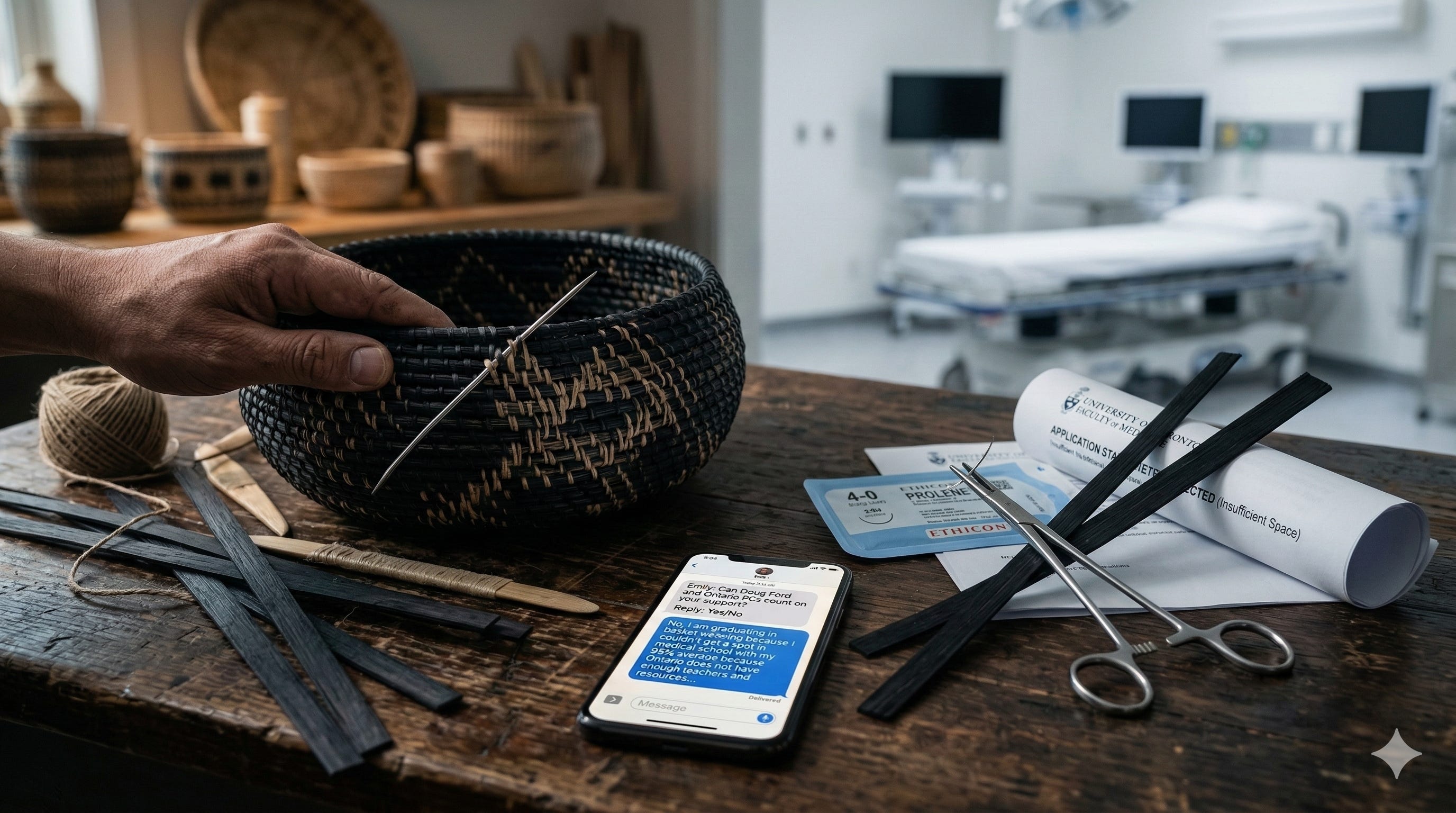
“Hi, it’s Emily from the PC Ontario Fund. Can Doug Ford and the Ontario PCs count on your support? Reply: Yes / No.”
Most people ignore these. Some reply “Stop.” One person, somewhere in Ontario, replied with something else entirely.
“No, I am in the process of graduating university in basket weaving because I could not get a spot in medical school with my 95 percent average because Ontario does not have enough teachers and resources, but thank you.”
Sarcasm, yes. But also: data. Also: a thesis statement about the state of the province, delivered in 35 seconds to a robot named Emily.
And somewhere, perhaps in a downtown office tower, perhaps at the dining room table of a house in Etobicoke, that message landed in the vicinity of a man who had spent the better part of a year telling students to stop wasting their time on exactly that.
The Philosopher of the Patio
Let us be clear about what Doug Ford does not have.
He does not have a university degree. He attended Humber College for two months in the 1980s and left. He does not have a book of philosophical reflections. He has not written on metaphysics, ethics, or the nature of the good society. He does not, as far as the public record shows, sit in a pew on Sunday mornings with any consistency. There is no deacon’s pin on his lapel, no Sunday school class he has taught for forty-two years, no faith-based ministry where he volunteers weekly.
What he has is slogans.
For the people.
The buck stops here.
Get it done.
Protecting the taxpayer.
These are not arguments. They are not philosophies. They are bumper stickers on a car going 140 kilometers an hour in the left lane with no signal.
And one of his greatest hits, repeated in February 2026 while defending cuts to student grants, was this: “You’re picking basket-weaving courses, and there’s not too many baskets being sold out there.”
The line landed. It got laughs from his base. It got nods from people who have always suspected universities are full of nonsense. It got filed away in the memory of one student who, months later, would reply to a robot named Emily with a piece of performance art.
What the Artisan Knows That the Premier Doesn’t
Here is the thing about basket weaving that Doug Ford does not know, because Doug Ford has never needed to know it, because Doug Ford has never been an Indigenous artist trying to make a living in a province that doesn’t always value what it doesn’t understand.
Spencer Lunham Jr. is a third-generation basket maker. He is Indigenous. He learned from his father, who learned from his grandmother. He sells his baskets for between $150 and $3,000 each. He sells hundreds of them a year. He makes, by any reasonable definition, a good living.
When he heard what the Premier said about basket weaving, he told a reporter that Ford “doesn’t know what he’s talking about.” He called the comments disrespectful. He kept weaving.
A member of the Toronto Guild of Spinners and Weavers, asked about the economic prospects of her craft, put the range at “zero to $150,000 a year.” The upper end of that range is not nothing. The upper end of that range is a house. The upper end of that range is a life.
But Ford does not traffic in ranges. Ford traffics in certainties. Basket weaving: worthless. Trades: valuable. STEM: valuable. Medicine: valuable. Everything else: a punchline.
The student who replied to the text message understood this. He had a 95 percent average. He wanted medical school. He could not get in, not because he wasn’t smart enough, but because Ontario does not have enough teachers or resources. So he is graduating in basket weaving—probably not literally, but the metaphor lands—and he is laughing, and he is sad, and he is correct.
The Logical Conclusion Nobody Wants to Draw
Let us be clinical for a moment, because the man himself prefers slogans to clinical, but the evidence demands it.
On the five-level scale of adult literacy and comprehension—the one used to measure how humans integrate information, synthesize complex texts, and evaluate competing evidence—Doug Ford lands, by any honest assessment of his public record, at Level 3.
Level 3 is functional. Level 3 can manage a budget. Level 3 can run a meeting. Level 3 can repeat a slogan with conviction. Level 3 cannot, however, consistently demonstrate the ability to synthesize dense philosophical arguments, engage with metaphysical questions, or evaluate policy tradeoffs with nuance. Level 3 does not write books on ethics. Level 3 does not sit in church pews contemplating the divine. Level 3 does not evolve into Level 4 or Level 5, because Level 3 does not see the point.
There is no evidence in his public life that Ford has ever sought that evolution. No late-night reading of Hannah Arendt. No conversion experience on the road to Ottawa. No sudden interest in the ontological arguments of Anselm of Canterbury. He is what he is, and what he is is a man who believes that complex problems yield to simple slogans, and that voters want a fighter, not a thinker.
He may be right about the voters. That is a separate argument.
But here is what the student with the 95 percent average understood, in the moment he typed his sarcastic reply to a robot named Emily: the man asking for his support does not understand him. Does not understand the field he is studying. Does not understand why he couldn’t get into medical school. Does not understand that basket weaving, in the right hands, is not a joke but a tradition, a livelihood, an art form older than the province itself.
The Hypocrisy They Won’t Admit
The word hypocrisy gets thrown around too much. Usually it just means “politician said one thing and did another.” But here, the hypocrisy runs deeper.
Ford tells students to pursue jobs of the future. Then his government cuts the grants that make those jobs accessible. A medical sciences student at Western University spelled it out: “If I listen to Doug Ford’s advice about choosing in-demand fields, I am actually going farther into debt.” The Premier urges young people toward expensive programs while making those programs less affordable. That is not a contradiction. That is a system.
Ford tells students to stop wasting time on useless courses. He has never taken a useless course in his life, because he has never taken a course at all beyond two months at Humber College. He is lecturing from a position of ignorance, and the lecture is about ignorance, and the irony would be delicious if it weren’t so damaging.
Ford presents himself as a man of the people, a regular guy who doesn’t do fancy talk. But the people he claims to represent include Indigenous artisans who make a living with their hands. They include students with 95 percent averages who can’t get into medical school. They include the weavers and the spinners and the ceramicists and the poets and everyone else who does not fit neatly into his categories.
And those people, unlike the Premier, are not Level 3. They are Level 4. They are Level 5. They are weaving baskets and writing code and suturing wounds and, occasionally, replying to political text messages with the kind of quiet, devastating accuracy that no slogan can touch.
Truth
The student’s message will be read by a machine. It will be logged, categorized, and forgotten. The Premier will never see it. Emily will not reply.
But for a moment, in the digital space between a voter’s phone and a political party’s database, a truth was spoken.
I could have been a doctor. But Ontario didn’t have the space. So I’m learning to weave.
That is not a joke. That is a diagnosis.
And the man who needs to hear it never will, because he does not read long documents, and he does not engage with complex ideas, and he does not, as far as anyone can tell, sit in stillness long enough to wonder whether basket weaving might be, for some people, not a punchline but a prayer.
This article is based on public statements, verified news reports, and the logical analysis of available evidence. The author welcomes correspondence at the usual place.
Glen Roberts is a metaphysician, author, and independent researcher. He is the author of Sacred Metaphysics Volume 1 and the architect of Project 2046.
#OntarioPolitics #DougFord #HigherEducation #BasketWeaving #StudentDebt #ONpoli #MedicalSchool #ArtsAndCulture #IndigenousArt #EducationFunding #OntarioStudents #PolicyDebate #PoliticalCommentary #SocialCommentary #StudentStruggles #WorkforceDevelopment #UniversityLife #ArtisanCraft #PoliticalSlogans #HealthcareCrisis #OntarioPC #CanadaPolitics #VoterEngagement #EconomicDevelopment #EducationalEquity #CulturalValue #ThePhilosopherOfThePatio #FutureOfWork #EducationMatters #ArtIsWork