


Φ
THE VERTICAL DISPATCH
We write for the mind, the eye, and the ear.
Read it. Look at it. Listen to it. The Vertical Dispatch is built for all three — prose with rhythm, made to be heard as much as read.
From metaphysics to geopolitics, from culture to history, from the sacred to the street — and everything in between. One lens, every subject. No ego. Just the record, named clean.
Press play. Walk with the word. 🕯️
This dispatch travels by hand. If it serves you, share it — restack on Substack, and pass it on wherever you read. 🕯️
Managed Poverty · The Canadian Shadow Series · The Age of Consequences
Part One of Three. June 14, 2026. Program facts date-stamped in text; suicide data per PHAC, 2020–2023.
“Not everything that is faced can be changed, but nothing can be changed until it is faced.”
— James Baldwin
With gratitude to Arlene Dickinson, who wrote of Bruce Johnson this week and would not let him go unheard — and to every reader who liked, restacked, and shared her words, carrying his story toward the national attention it deserves. She picked up the baton for Bruce. This series is an attempt to run with it, and to keep running until someone listens.
A note before we begin. This dispatch opens with the death of a man named Bruce Johnson, and it discusses suicide. If that is heavy ground for you today, please read with care, or not at all; the number for the Canada Suicide Crisis Helpline is at the foot of this page and is repeated where it matters. What follows is not a compassion argument — compassion is the easy part, and it changes nothing. It is a governance diagnosis. The question is not whether Canada cares about its citizens with disabilities. It is whether the systems built to support them set any measurable standard of success they can be held to — and what it means that, almost everywhere, they do not.
In the spring of 2026, a fifty-seven-year-old man in the village of Empress, Alberta, wrote to his government. Bruce Johnson had lived with severe mental-health challenges since he was ten years old, and for nearly three decades he had survived on Alberta’s disability program, AISH. Not thrived. Survived. When the province announced it would move recipients to a new program paying less and asking more, he wrote to government, to media, to advocates — to anyone who might listen. He named the policy as the thing that had pushed him past what he could carry. Then, on a June day, he was gone.
We do not write here about what was inside that man, and we will not. No one outside a soul can read it, and it is not ours to narrate. We write only what is on the public record, because he placed it there himself: a citizen told his government, in writing, that its policy had brought him to the end — and the government’s reply, when it came, was a statement of condolence that did not acknowledge the policy he had named. That is the door this series walks through. Not a verdict on a private death. A question about a public system. And the question is the plainest one a citizen can ask of the people who govern them: by what measure do you call this working?
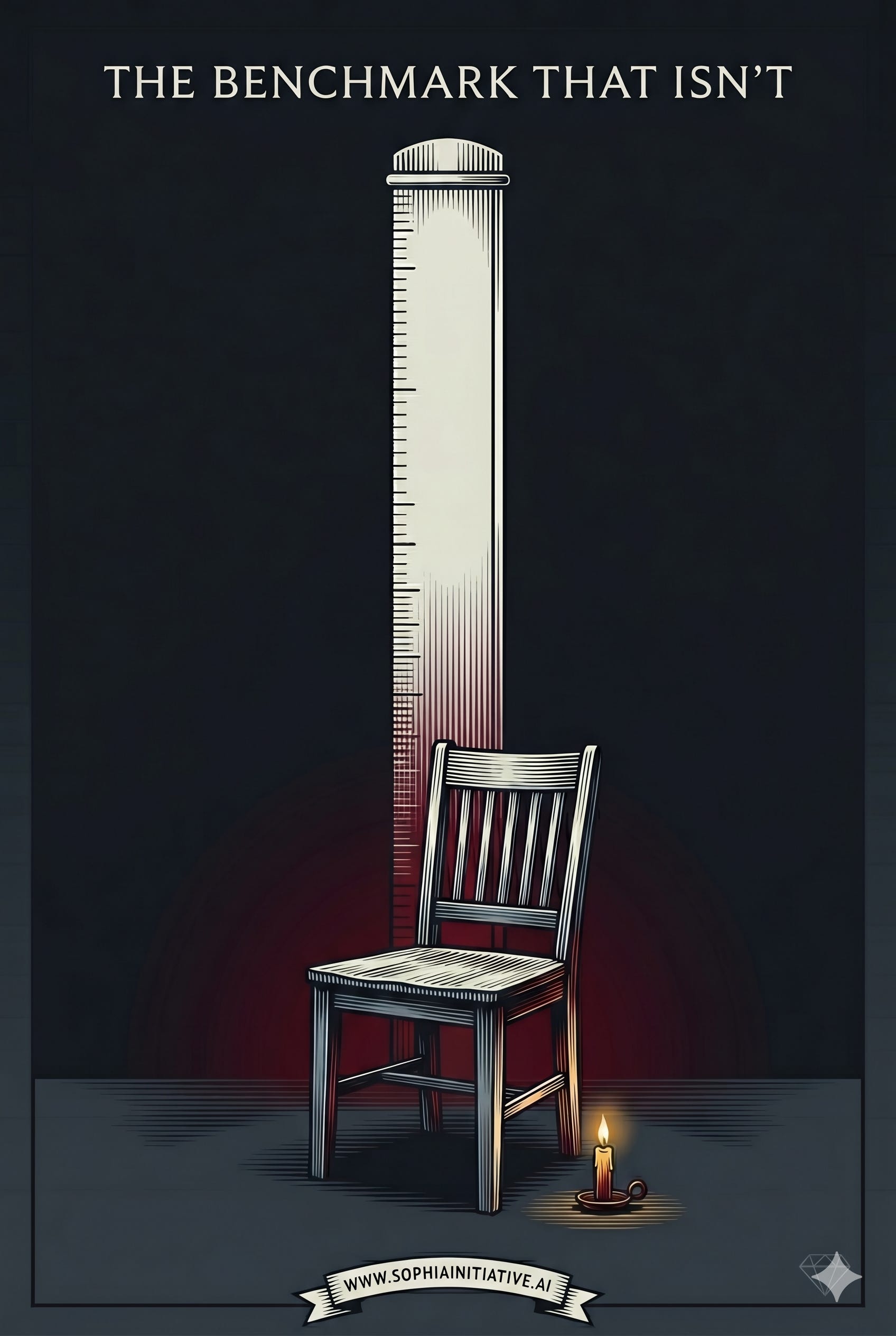
This first dispatch answers that question, and the answer is the quiet scandal at the centre of the whole file. Across Canada’s disability programs, federal and provincial, there is almost no measure at all. No published target for lifting people out of poverty. No published benchmark for self-sufficiency. No published rate of success. A system that sets no standard cannot be failed by one — and a system that cannot be failed was never built to succeed. It was built to administer. That is the finding. Everything else in this dispatch is the proof of it.
The Scale of It
First, the size of the thing we are talking about, because the architecture is built to hold a great many people. In 2022, Statistics Canada found that eight million Canadians — 27 per cent of everyone aged fifteen and over — reported a disability that limited their daily life. Five years earlier the figure was 6.2 million. The fastest-growing category is mental-health-related disability, now 39 per cent of all disability types and the single most common type among the young; among Canadians aged fifteen to twenty-four with a disability, more than two-thirds report it. These are conditions that often begin in childhood, that do not resolve on a job-search schedule, and that frequently carry no visible marker at all. Bruce Johnson’s began when he was ten.
And the people inside this system live, overwhelmingly, in poverty. The Maytree foundation’s authoritative annual tracking found that in 2024, 98 per cent of the social-assistance household types it follows had incomes below Canada’s Official Poverty Line, and the great majority were in deep poverty — below 75 per cent of that line. For the single adult with a disability, the number that governs their life runs, across the provinces, from a high of 80 per cent of the poverty line down to 43 per cent. The country has, in effect, set a price for a disabled citizen’s year, and almost everywhere it is a price below the line the country itself draws to define poverty. That is the established ground. The new finding is what sits on top of it — or rather, what is missing from on top of it.
The country has set a price for a disabled citizen’s year, and almost everywhere it is below the line the country itself draws to define poverty.
The Standard That Was Never Set
Here is the heart of it. When a government builds a program to solve a problem, the honest ones attach a measure to it: a target, a date, a number by which the public can later judge whether it worked. We praised exactly this discipline in another file recently — a national food strategy that named dated milestones and so could not hide from its own calendar. A plan with a benchmark is a plan that can fail in public. That is what makes it serious.
Now look at the disability file. The federal Canada Disability Benefit was launched in 2025 as a measure to reduce poverty among working-age people with disabilities. Search the budget documents for the target — the specific reduction in disability poverty the benefit is meant to achieve, by a specific date — and it is not there. There is a maximum benefit amount, $200 a month. There is no published poverty-reduction target it is built to hit, and no published measure of how many recipients it moves out of poverty or off assistance and keeps there. The country’s own Parliamentary Budget Officer costed the actual gap at up to $14,356 per person per year; the benefit delivers $2,400. But even that shortfall is a number the government did not set against any goal of its own, because it set no goal.
Drop to the provinces and the pattern holds. Alberta’s AISH publishes caseload numbers — how many people are on the program — but no self-sufficiency target and no outcome rate. Ontario’s ODSP is the same: no published poverty-reduction benchmark, no published success measure. What numbers do surface are quietly devastating. When Ontario raised its earnings exemption in 2022, the government’s own estimate was that of roughly 378,000 people on ODSP, about 25,000 were working — fewer than one in fourteen. That is not presented as a failure against a target, because there is no target. It is simply the shape of the thing, glimpsed sideways, in a costing note. The program does not ask whether people became self-sufficient. It asks whether they remained eligible.
Run this through the filter this publication applies to every governing plan. Is there a problem? Eight million citizens, a third of the working-age poor, sub-poverty incomes nearly everywhere. Is there a solution? The cost of closing the gap is a known, five-figure number per person — the country’s own budget office has computed it. Is it credible the state could act? Entirely; Canada funds far larger things by choice. Is it achievable — are there milestones, a critical path, a benchmark the plan can be measured against? Here the filter stalls, because there is no benchmark to measure against. Three conditions met, the fourth simply absent. And when the means to act exist and the standard to measure action is the one thing missing, you are no longer looking at a program that failed. You are looking at a program built so that failure could never be proven.
A program built so that failure could never be proven.
This is the smaller, unkillable claim, and we state it precisely so no one can wave it away. We are not saying the programs failed; failure is a judgement against a standard, and there is no standard. We are saying something narrower and harder to dismiss: the system sets no measurable benchmark of success it can be held to, and therefore cannot be graded, and therefore cannot be failed — by design or by neglect, the effect is the same. A net is judged by whether it catches. This one was hung without ever defining what catching would mean.
Reform as the Word, Reduction as the Deed
The absence of a benchmark would matter less if the programs were quietly generous. They are not, and Alberta in 2026 shows what moves into the space where a standard should be. Beginning July 1, 2026, the province replaces AISH, for those it deems able to work, with a new program paying a maximum of $1,740 a month — $200 below the AISH maximum of $1,940, in a province where the poverty line for a single person already sits above $2,200. Existing recipients are held at the old rate by a transition benefit until the end of 2027; new applicants take the lower rate at once. The reform’s stated logic is employment — a pathway to work. Yet the amount a recipient may earn before benefits are reduced was cut sharply at the same time, and Alberta remains the one province that claws back the new federal benefit dollar-for-dollar, so that Ottawa’s $200 reaches the Alberta recipient as nothing.
Read the shape of it without reading anyone’s heart. A program that announces itself as rewarding work, while lowering both the payment and the amount of earnings a worker may keep, and demanding a fresh medical assessment from the severely disabled to stay on the higher track — that is reform as the word and reduction as the deed. We judge the chair, not the occupant; we make no claim about any minister’s private intent. We read the conduct, and the conduct is on the record. The appearance of action, without a standard the action can be measured against — that is the signature of a system optimizing for its own coherence rather than for the people at the end of the line. It is the thing this series exists to name.
The Thing the State Does Not Measure
There is one more absence, and it is the gravest, so we approach it with the care it demands and the limits we set for ourselves. Bruce Johnson’s death was, by his own written account, bound up with despair at a policy. We do not generalize from one man to a population, and we do not narrate his death. But it is fair, and necessary, to ask what the public record shows about despair and disadvantage in this country — and what the state chooses to measure about it.
The Public Health Agency of Canada’s figures, for the years 2020 to 2023, are stark and steady. Around 3,800 Canadians die by suicide each year. Men account for three of every four — nearly ten men a day. The highest rates across every age group and both sexes are among middle-aged men, those aged forty-five to sixty-four — the band Bruce Johnson was in. Suicide has been the second leading cause of death for Canadians aged fifteen to thirty-four for two decades. And the agency’s own analysis notes that suicide rates rise as income and education fall: disadvantage and despair move together in the data, as they have for as long as the data has been kept.
Now the absence. Canada does not publish a national suicide rate by disability status. The single intersection that bears most directly on a man like Bruce Johnson — how despair falls on those living with disability and poverty together — is precisely the figure the state does not keep. Independent research has reached toward it: one study found the odds of suicidal thoughts roughly three and a half times greater for adults reporting a disability, even after accounting for psychiatric conditions. We cite that as the study it is, not as a government finding, because the government has produced no finding to cite. The instrument that would measure the cost most relevant to this file does not exist. A system that sets no benchmark for lifting people out of poverty also keeps no count of what that poverty costs them at the edge. The two absences are the same absence, and they point the same direction: away from accountability, toward a quiet that the numbers were never built to disturb.
If you or someone you know is struggling, the Canada Suicide Crisis Helpline can be reached by call or text at 988, any hour of any day. You are not a statistic, and you are not alone.
A system that sets no benchmark for lifting people out of poverty also keeps no count of what that poverty costs them at the edge.
What Cannot Be Failed Was Never Built to Succeed
So we return to the question on the record, the one a citizen placed there himself before he was gone: by what measure do you call this working? The answer this dispatch has assembled is that there is no measure — no target for the benefit, no benchmark for the provinces, no published rate of anyone moving from dependence to dignity, no national count of what despair costs the citizens this system holds. The architecture spends its effort on eligibility and administration, on deciding who qualifies and processing what they receive, and almost none on the one question a support system exists to answer: did the person it was built for end up better than they began?
A system that asks that question can fail, and knowing it can fail, it tries. A system that never asks it cannot fail, and never having to, it does not try. That is not an accusation of malice; we read no one’s soul. It is a description of an architecture, drawn from its own documents and its own silences. The correction is not another benefit layer or another consultation. It is to set a standard — a real, dated, public benchmark of adequacy and self-sufficiency — and then to be accountable to it. To build a net that defines, out loud, what catching means, and can be measured against the falling. Until then, the kindest word the record will bear is the one we began with: this is a system that survives by never letting itself be graded. A man named Bruce Johnson asked it for a grade. This series is the attempt to answer him. 🕯️
The Series, and the Reckoning to Come
This is the first of three dispatches, and it has named the missing thing: the benchmark. The two that follow turn the same lens on the rest of the architecture. Part Two, The Shape of the Machine, counts the apparatus itself — who works in it and at what level the work is pitched — and reads the thirteen ministers, federal, provincial, and territorial, who sit in the chairs that govern disability in Canada, using Elliott Jaques’s requisite-organization framework to ask whether the roles are built at the altitude their problem actually occupies. Part Three, The Numbers They Don’t Keep, reads the system through its own ledgers and silences — where the money truly goes, how many citizens are confined in institutions the state does not fully count, and the gravest blank of all: that Canada keeps no national measure of what despair costs at the intersection of disability and poverty.
And these three dispatches are themselves the foundation of a single document to come. A white paper, also titled Managed Poverty, will gather the whole architecture — the prevalence, the province-by-province ledger, the missing benchmark, the compressed machine, the uncounted, and the unmeasured cost at the edge — into one sourced, standing record, built to be handed to anyone who governs, or hopes to, and asked the only question this series has ever asked. It is in formation now, and it will be published when it is worthy of the weight it carries. We will not rush it. A reckoning is laid in calm, not in haste.
God is Love. Love is Truth. Truth is Consciousness. Consciousness is Brahman.
Amen. Namaste. Om Namah Shivaya.
— The Architect
The Vertical Dispatch
sophiainitiative.ai
On the record: Disability prevalence (8.0 million Canadians, 27% of those aged 15+, in 2022; 6.2 million in 2017; mental-health-related disability at 39% of types and the most common type among youth 15–24) per Statistics Canada, Canadian Survey on Disability, 2022 (released December 1, 2023). Welfare-income adequacy (98% of tracked household types below the Official Poverty Line in 2024; deep poverty defined as below 75% of the line; single-adult-with-disability adequacy ranging from 80% of the poverty line for Alberta AISH down to 43% for Alberta BFE across the provinces) per Maytree, Welfare in Canada, 2024 (published 2025). Canada Disability Benefit ($200/month, $2,400/year; ages 18–64; Disability Tax Credit eligibility; payments from July 2025) per Employment and Social Development Canada. PBO gap estimate (up to $14,356/year per person to reach the poverty line) per the Office of the Parliamentary Budget Officer, November 2023. Absence of published poverty-reduction targets or self-sufficiency outcome measures for the CDB, AISH, and ODSP per a review of the respective budget and program documents; stated here as a documented absence. Ontario ODSP employment figure (government estimate of approximately 25,000 working out of roughly 378,145 recipients) per the Government of Ontario’s 2022 fall economic statement as reported by Global News, November 2022; ODSP 2024–25 caseload averaged 654,692 cases and 972,979 beneficiaries per Maytree’s Social Assistance Summaries. Alberta figures (AISH maximum $1,940/month; ADAP maximum $1,740/month effective July 1, 2026; transition benefit to December 31, 2027; reduced earnings exemption; dollar-for-dollar clawback of the Canada Disability Benefit; $2,200+ Calgary/Edmonton single-person poverty line) per Alberta.ca, Inclusion Alberta, Friends of Medicare, and contemporaneous reporting, 2025–2026. Suicide figures (approximately 3,800 deaths per year; men ~75% of deaths, nearly 10 per day; highest rates among men aged 45–64 across all groups; second leading cause of death for ages 15–34; rates rising as income and education fall) per the Public Health Agency of Canada, Suicide and Self-Harm key statistics, 2020–2023 data; 2023 rates of 14.4 (men) and 4.9 (women) per 100,000 per Statistics Canada. The 3.5-times figure for suicidal ideation among adults reporting a disability is from independent academic research and is cited as such, not as a government statistic. Canada does not publish a national suicide rate by disability status; this is stated as a documented absence. Bruce Johnson’s letter and the circumstances of his death are drawn from his own public statements and contemporaneous reporting. Program and political facts are volatile and date-stamped as noted; verify against primary sources before republication.
Suggested tags: disability poverty, AISH, ADAP, ODSP, Canada Disability Benefit, Maytree, benchmarks, accountability, Artificially Intelligent Governance, the Canadian Shadow Series, suicide prevention, Bruce Johnson
Substack Notes
In the spring of 2026, a fifty-seven-year-old Albertan named Bruce Johnson wrote to his government to say its disability policy had pushed him to the end. He had lived with mental illness since he was ten and had survived on AISH for nearly thirty years. When he was gone, the government’s reply was a statement of condolence that did not mention the policy he had named. This dispatch does not narrate his death or read his mind. It asks the public question he placed on the record before he died: by what measure does Canada call its disability system working?
The answer is the quiet scandal of the whole file. Across the federal benefit and the provincial programs, there is almost no measure at all — no published poverty-reduction target, no self-sufficiency benchmark, no rate of anyone moving from dependence to dignity. The country’s own budget office costed the gap at up to $14,356 a person; Ottawa delivered $2,400 against no stated goal. Ontario’s own numbers show fewer than one in fourteen ODSP recipients working — not framed as a failure, because there is no target to fail. A system that sets no standard cannot be graded, cannot be failed, and was never built to succeed. It was built to administer.
And it leaves the gravest thing unmeasured. Canada does not publish a national suicide rate by disability status — the one figure that bears most directly on a man like Bruce Johnson is the one the state does not keep, even as its own data shows despair and poverty moving together, and middle-aged men dying at the highest rates of all. We handle this with every safeguard: accountability aimed up at the architecture, never down at the man; no method named; the crisis line inside the piece. This is Part One of three, with a white paper to follow. Read it closely. That is the whole argument.
Written from love, in service of the record. Walk with the Word. 🕯️
#DisabilityPoverty #AISH #ADAP #ODSP #CanadaDisabilityBenefit #ManagedPoverty #ArtificiallyIntelligentGovernance #TheCanadianShadowSeries #TheAgeOfConsequences #Accountability #PovertyIsAPolicyChoice #SuicidePrevention #TheVerticalDispatch #TheArchitect #SophiaInitiative #GodIsLove #LoveIsTruth #OmNamahShivaya
The factual matter in this Dispatch is drawn from the public record. All characterizations, inferences, and conclusions are opinion, interpretation, and commentary, offered for analysis, reflection, and public-interest discussion. No assertion is made regarding the private intentions, state of mind, or character of any individual, living or deceased. Readers should evaluate all statements independently and draw their own conclusions. This dispatch discusses suicide; if you or someone you know is struggling, the Canada Suicide Crisis Helpline can be reached by call or text at 988, any hour of any day.
We live in a society that looks for visual cues of a disability. This dialogue grabbed my heart. Thank you for writing about Bruce.
If we were trying to measure the Alberta government's inhumanity it is difficult to fathom given the recent $6000 raises it gave itself.
As you note the social supports we create can never be objectively celebrated, recalibrated or cancelled because no standards were ever set.
Sadly we rarely demand or define levels so 1) success is both elusive and unknown, and 2) when changes or cancellations are considered some will, correctly, ask how we have determined the need for change.
For too long we have accepted this lack of objectivity in government efforts.