
DATE: December 18, 2025 CLASSIFICATION: KINETIC / STRATEGIC (HIGHEST) TAGS: #Sovereignty #Geopolitics #ChinaTech #CanadaStrategy #AI #CriticalMinerals #EnergySecurity #2046Realignment #VerticalImperative
TEASER ABSTRACT
The global stage has fractured. This dossier reveals how China’s “Manhattan Project” for chip autarky forces a new era of national sovereignty. Simultaneously, Canada, under Mark Carney, is executing a “Stratum 8” architectural gambit, strategically sacrificing immediate political capital to build a $232 billion multi-vector economy designed for complete autonomy by 2046. The era of shared global supply chains is over; the era of sovereign stacks has begun.
I. THE RED STACK: CHINA’S “MANHATTAN PROJECT” FOR AUTARKY
China has unequivocally exited the logic of globalized commercial efficiency. Its national strategy, epitomized by the $47.5 Billion Big Fund III, is an explicit declaration that national survival supersedes all profit motives.
The 5nm Defiance: Through aggressive state funding and engineering ingenuity, SMIC has achieved functional 5nm-class chip production via Self-Aligned Quadruple Patterning (SAQP). This process, while inherently inefficient—characterized by lower yields (~30-40%) and significantly higher production costs—has successfully bypassed US sanctions. The chips are real, they are functional, and they power critical national infrastructure.
The Triple Output AI Strategy: Beijing has initiated a mandate to triple domestic AI processor output by 2026. This aggressive push is designed to immunize China’s military, advanced surveillance systems, and critical industrial AI from any future foreign “Kill Switch” mechanisms, ensuring digital sovereignty.
Weaponized Supply Chains: China’s strategic pivot extends beyond silicon. The October 2025 ban on key rare earth element exports confirmed a new phase where Beijing is leveraging its near-monopoly on critical materials as a geopolitical weapon, forcing global dependencies into stark relief.
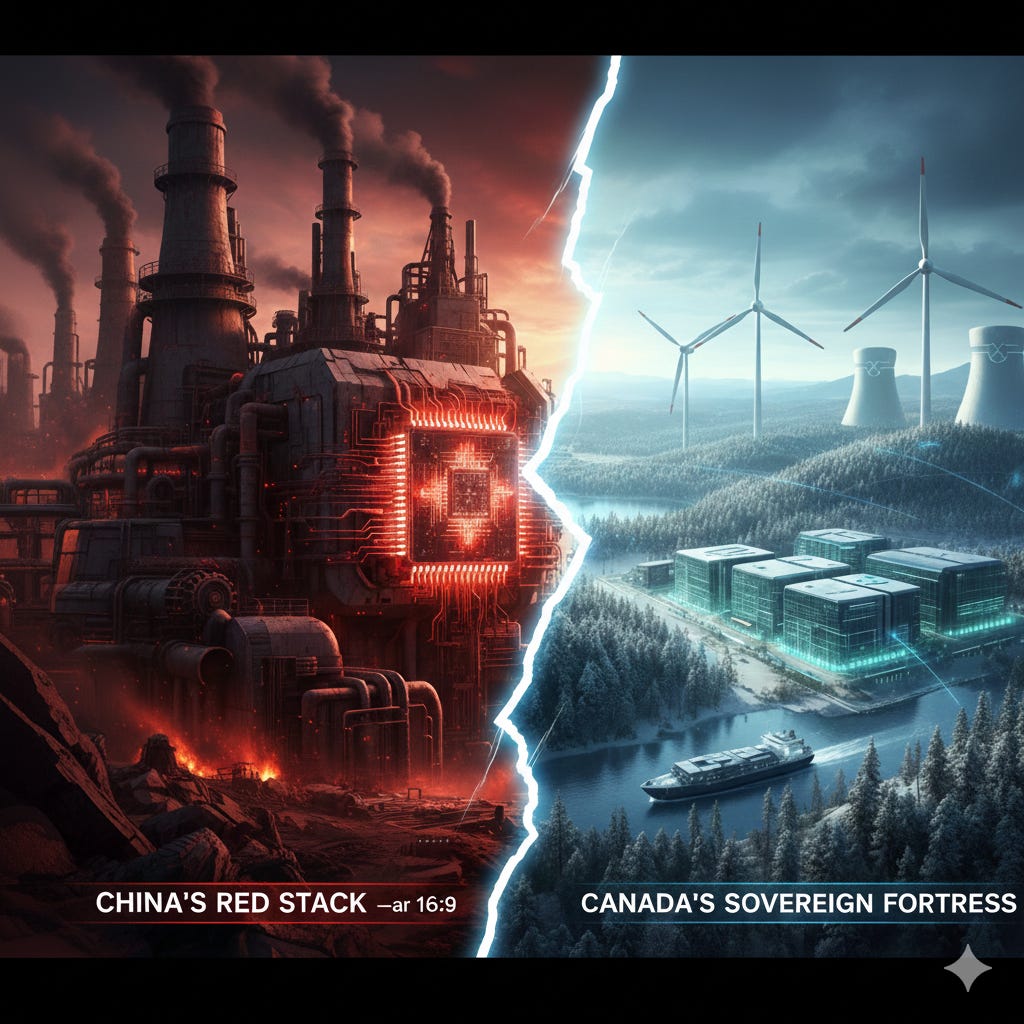
The Fixed Point: China is constructing an economic fortress—a “Red Stack” impervious to external pressure. Its objective is not to win global market share, but to establish a parallel, self-sufficient economic and technological operating system that guarantees its capacity to act autonomously on the global stage.
II. THE CANADIAN COUNTER: THE ARCHITECT’S GAMBIT FOR 2046
Under Mark Carney’s leadership, Canada is executing a Stratum 8 (20-50 year horizon) architectural vision, formalized by the Building Canada Act (June 2025). This represents a $232 Billion strategic pivot, leveraging immediate political maneuvers to secure long-term national autonomy.
A. The Alberta MOU: A Tactical Sacrifice
The Carney-Smith Memorandum of Understanding (MOU) of November 2025, concerning new energy infrastructure to Asia, is a masterclass in political maneuvering.
The Permission Trap: By granting federal “conditional support,” Carney removes the argument that Ottawa is blocking Alberta’s energy aspirations. However, by explicitly linking the pipeline’s construction to Private Sector Financing and Indigenous Equity, he shifts the burden of a commercially unviable project (with a projected -$15 billion NPV) to the market. This effectively “buys time,” defusing immediate inter-provincial conflict while insulating federal coffers from the pipeline’s inherent financial risk.
The Delay Dividend: This maneuver allows Carney to re-direct focus and capital towards projects with a far greater “Sovereignty ROI.”
B. The Second Tranche: High-Yield Sovereign Assets
While the pipeline captures headlines, the Major Projects Office (MPO) is fast-tracking $116 billion in projects designed to construct Canada’s “Northern Fortress” by 2046.
Energy Superpower Independence:
Darlington SMR Project: Construction of four Small Modular Reactors positions Canada as the first G7 nation with operational SMRs, providing 300,000 homes with clean, sovereign energy.
Ksi Lisims LNG: The Nisga’a-led LNG facility represents a direct conduit for Canadian energy exports to Asia, strategically diversifying away from historical over-reliance on the US market.
The Critical Minerals Iron Spine:
$2 Billion Critical Minerals Sovereign Fund: This fund provides direct equity and infrastructure support for 31 strategic minerals, from exploration to processing.
Crawford Nickel Project & Matawinie Mine: These flagship projects anchor the “Golden Triangle” critical minerals corridor, establishing an integrated, secure domestic supply chain essential for clean energy and defense.
Data Sovereignty & AI Autonomy:
$2 Billion Sovereign AI Compute Strategy: This massive investment aims to build domestic supercomputing and secure cloud capacity. The goal is to move Canada’s public and critical private sector data off foreign hyperscalers (AWS, Azure) onto a Canadian Sovereign Cloud, ensuring all data, applications, and networks are insulated from foreign legal and economic pressures.
$705 Million AI Sovereign Compute Infrastructure Program (SCIP): A dedicated investment to exponentially enhance national compute power, critical for independent AI development and defense.
III. THE GLOBAL BIFURCATION: CHINA-CANADA POLARITY
The relationship between China’s assertive Red Stack and Canada’s emerging Northern Fortress is defined by a dynamic of Selective Engagement and Strategic Decoupling.
The Wedge (Trade Diversification): Canada is utilizing the expanded Trans Mountain pipeline to make China a top buyer of Canadian crude oil (reaching record volumes in 2025). This is a calculated move to reduce Canada’s economic vulnerability to US protectionism by opening direct conduits to diverse Asian markets.
The Wall (Security De-risking): Simultaneously, Canada is actively constructing “walls” to safeguard its critical sectors. This includes leading the G7 Critical Minerals Alliance to counter China’s processing dominance and implementing strict controls on Chinese participation in sensitive sectors like AI, quantum computing, and advanced digital infrastructure. The objective is to prevent Canada from becoming “collateral damage” in the escalating US-China geopolitical struggle.
CONCLUSION: THE ARCHITECT’S YIELD FOR 2046
The global operating system has fractured. China is building a fortress through absolute self-reliance, demonstrating that geopolitical strength comes from the ability to exist without foreign permission. Canada, under Carney’s Stratum 8 leadership, is not mimicking this approach directly but is executing a parallel, complementary strategy.
The Alberta MOU, while politically contentious, is a tactical sacrifice—a means to buy political time and social cohesion. The true yield of the Building Canada Act is not in oil royalties but in the multi-vector sovereignty purchased through nuclear energy, critical minerals, and a domestic AI/data stack. By 2046, the architectural gambit aims to transform Canada into a Sovereign Power, capable of charting its own course, independent of both US economic coercion and Chinese geopolitical pressure. The future belongs to those who build their own stacks.
MISSION COMPLETE.