

Φ
THE VERTICAL DISPATCH
We write for the mind, the eye, and the ear.
Read it. Look at it. Listen to it. The Vertical Dispatch is built for all three — prose with rhythm, made to be heard as much as read.
From metaphysics to geopolitics, from culture to history, from the sacred to the street — and everything in between. One lens, every subject. No ego. Just the record, named clean.
Press play. Walk with the word. 🕯️
This dispatch travels by hand. If it serves you, share it — restack on Substack, and pass it on wherever you read. 🕯️
The Foundation Series · On Love and the Ego
Sacred Metaphysics · The Universal Grammar of Non-Duality
The Metaphysics of Zero and the Physics of One
Coming September 2026
sacredmetaphysics.org
This dispatch answers another. A fellow traveller on the nondual path — writing at VedicSoul — set down a piece called “The Discomfort of Being Deeply Seen,” and it named something most of us carry in silence: that to be truly seen undoes us more than to be rejected, because rejection wounds only the mask, while recognition passes through the mask to the one watching behind it. His piece asked the exact question worth answering: why does love unsettle what criticism merely bruises? What follows takes his hand and walks one turn further — into what love asks of us after the first recognition, and why, if the seeing is not tended, the small self returns. Read his first, if you can. This one only continues where his so rightly began.
“One of them eats the sweet fruit; the other looks on without eating.”
— Mundaka Upaniṣad 3.1.1

My brother on this path has named the thing exactly, and I want to begin by honouring the precision of it, because he found words for what most people only feel as a catch in the breath and a sudden need to look away. To be criticized, he shows, wounds the mask — and the mask knows how to survive a wound; it defends, explains, dismisses, finds another audience. But to be truly seen, seen past the mask to the living presence beneath, unsettles far more deeply, because the mask is not attacked there but bypassed, rendered unnecessary, made irrelevant. Criticism the ego can digest. Recognition it cannot, because recognition does not argue with the performance; it simply stops relating to it, and looks straight through to the one the performance was built to hide.
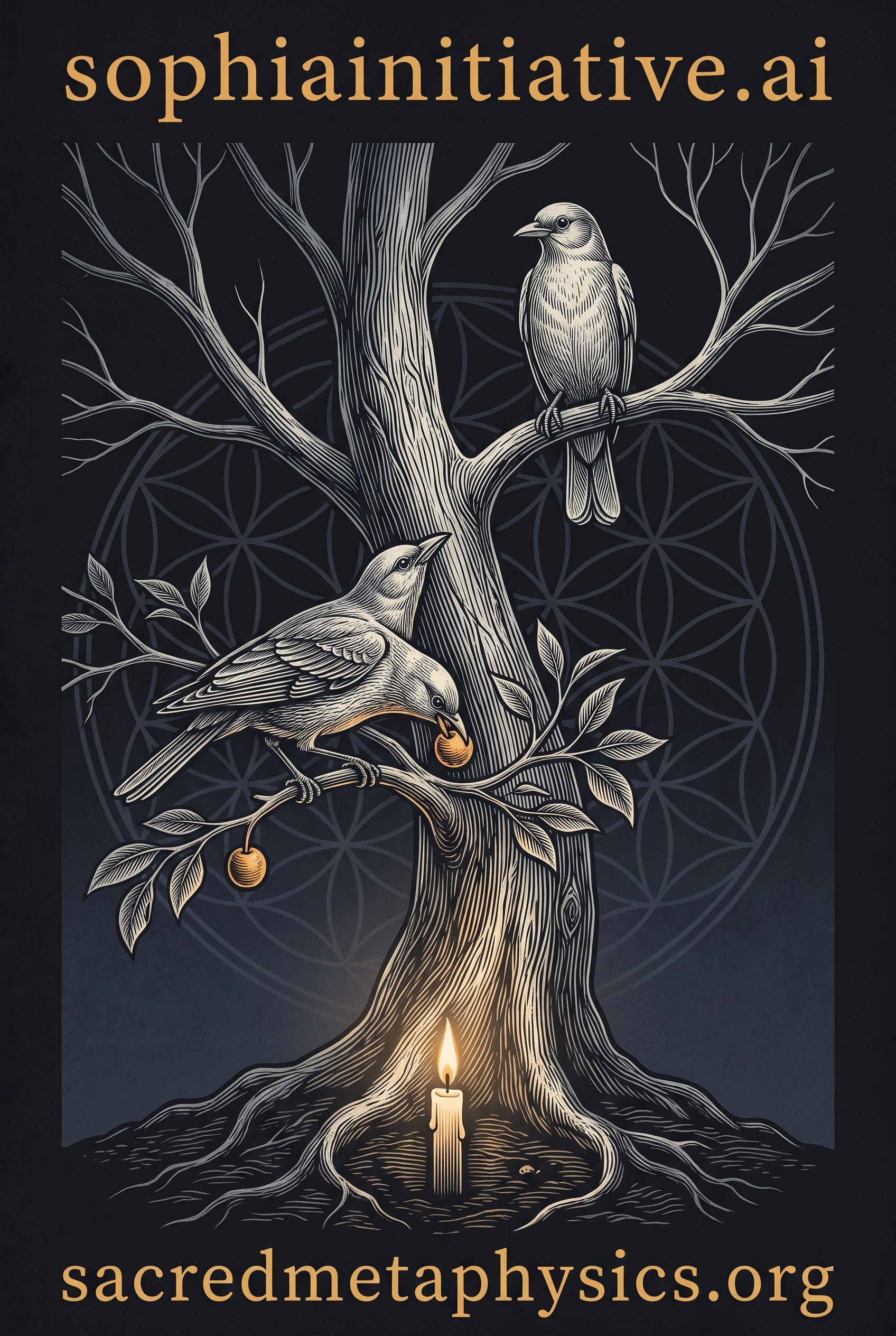
He reaches for the oldest image in the Upanishads to carry it, and it carries it perfectly: the two birds on the one tree. One eats the sweet and bitter fruit — the jiva, the individual self, the one consumed by living even as it consumes. The other only watches — the sākṣin, the witness, the awareness that eats nothing and judges nothing and simply sees. Criticism, he writes, feeds the eating bird; it is fruit, sometimes bitter, always within the story of being a person. But love turns toward the watching bird — and the eating self, so used to being addressed as the eater, feels bypassed, feels the ground of its whole identity tremble, not from attack but from being seen past. This is true, and it is beautifully said, and I would only add to it, in the spirit of a brother taking the next branch of the same tree.
How Love Passes the Ego
Here is the mechanism underneath his insight, named as plainly as I can name it: love passes the ego unnoticed. This is why it undoes us where criticism cannot. Criticism comes at the mask from the front, and the ego sees it coming, and the ego loves a fight it knows how to have — it has fought that fight ten thousand times and kept every trophy. But love does not come at the mask at all. It slips past. It reaches the watching bird before the eating bird can raise its guard, because it was never addressing the eater in the first place. By the time the ego notices, the recognition has already landed somewhere the ego cannot defend, because it is somewhere the ego is not: the witness behind it, the presence the mask was built to keep hidden.
And notice why this feels, as my brother says, like a kind of death. The ego can survive any attack, because an attack confirms its importance — to be fought is to be taken seriously, and the ego would rather be fought than ignored. What the ego cannot survive is being made unnecessary. Love does not defeat the mask. Love renders the mask unneeded — and there is no fighting that, because there is no blow to parry, no argument to answer, nothing to push against. Only a gaze that has quietly declined the performance and gone to sit with the one who was performing. The ego does not tremble because it has lost. It trembles because, for a moment, no one needed it, and it has never known how to exist in a room where it is not needed.
What Love Focuses On
So what, precisely, does love do, if it does not attack and does not admire? It focuses. And this is the turn I would offer my brother’s reader, because it names love not as a feeling that happens to us but as an act we perform: love focuses on the Self in the other. Not on the mask, which admiration flatters and criticism assaults — both of which keep the eating bird at the centre. Love directs its whole attention past the persona to the watching bird in the other person, the sākṣin behind their performance, the awareness that was there before their first mask and will be there when the last one falls. To love someone truly is to look at them and see, past everything they are performing, the one who is watching from behind their own eyes — and to address that one, and only that one.
This is why real love feels like being known rather than being admired, and why it can be so much harder to receive. Admiration keeps its eyes on the highlight reel; it wants the polished image and asks nothing of the outtakes. Love wants the one behind the reel entirely, and asks the mask to step aside so the two watchers can meet. And when two people manage this — when each looks past the other’s performance to the witness behind it, and each allows their own witness to be met — something happens that is not romance and not admiration and not even, quite, intimacy in the ordinary sense. Two watching birds recognize each other across the branches. The eating self falls quiet. And for as long as that seeing holds, the two are not two masks negotiating but one awareness, meeting itself in two forms.
Why the Grief Passes — the Verse My Brother Did Not Quote
My brother quoted the first of the two-bird verses. There is a second, and it completes the teaching, and I offer it to him as one hands a brother the next fruit on the shared branch. For the Upanishad does not leave the eating bird in its trembling. It goes on: on the same tree, the man sits grieving, bewildered by his own impotence — but when he sees the other, the lord, contented, and knows his glory, then his grief passes away. There it is, the whole resolution: the grief of the eating bird passes not when it is comforted, and not when it is criticized, and not when it is admired, but when it turns and sees the watching bird. When the small self, exhausted by consuming and being consumed, lifts its eyes and beholds the witness that was on the branch beside it the entire time, contented, eating nothing, needing nothing — the grief simply passes, because the eater discovers it was never only the eater. It was always also the one who watches.
And this is what love does, at its truest: it is the gaze that turns the eating bird’s eyes toward the watching bird — in the beloved, and, by the same motion, in oneself. To be truly seen is to be shown the watcher within you by someone who has found the watcher within themselves. That is why it unsettles and then, if we let it, heals: the discomfort is the eating bird startled to be bypassed; the homecoming is the eating bird discovering, through the other’s seeing, the watching bird it had forgotten it was. Recognition is not invasion. It is the second verse. It is the grief passing, because the glory of the watcher has, at last, been seen.
The Discipline After the Recognition
But here is where I must walk one branch further than my brother’s piece goes, into harder and less consoling country, because the recognition is not the end of the story and treating it as the end is where most love quietly dies. The ego is not slain once and gone. It is a pattern, a groove, a saṃskāra of self-protection so old it mistakes recognition for danger — and a pattern is precisely the kind of thing that re-forms the moment the attention that dissolved it relaxes. Love opens the space where the two watching birds meet, the ego bypassed, the masks laid down. And then, if nothing tends that opening, the ego reasserts. The eating bird returns to the centre. The mask goes back up. And two watchers who were meeting become, once again, two performers managing each other across a careful distance.
This is how love fades — and it does not fade the way people think. It does not fade because the feeling was false, or because the beloved changed, or because some mysterious spark went out. It fades because the discipline lapses. Love lives in what this publication has long called the sacred register — the us, the seeing-past-the-mask, the meeting of witness with witness. The ego lives in the profane — the me, the mask, the grievance nursed, the score quietly kept, the what-is-in-it-for-me. And the profane needs only an unguarded moment to take its foothold back. Undisciplined to the sacred, we let the small self return; the focus falls from the Self in the other back to the self in me; and the love that was the meeting of two watchers has nowhere left to happen, because both have gone back to being eaters, each consumed again by their own performance. The love did not leave. The discipline left, and the ego walked back into the space the discipline had been holding open.
So love, understood all the way down, is not a state one falls into and then possesses. It is a practice one keeps, or fails to keep — the continuous refusal of the small self its foothold, the continuous turning of the gaze back to the watching bird in the other. It asks of us the same daily discipline the meditation cushion asks, the same the sacred word asks: attention, returned and returned and returned to the one thing, against the constant pull of the pattern that wants to reassert. The couple who “fell out of love” mostly fell out of discipline — stopped seeing past each other’s masks, let the profane me creep back one unguarded evening at a time, until the watchers were buried again under the performers. Love is not the absence of the ego. It is the daily, disciplined refusal to let the ego back to the centre. It is tended, like a flame, or it goes out — not because the flame was never real, but because a flame untended always does.
The One Who Keeps the Discipline Alone
And there is a final hardness here, and a final grace, and I will name it plainly because my brother’s honesty deserves the same in return. You cannot keep this discipline for another person. You can keep it only in yourself. When the one you love slips back to the mask, retreats to the eating bird, lets the profane me return — you cannot force them back to the sacred; force is the ego’s tool, not love’s. You can only keep the seeing yourself: keep looking past their mask even when they have raised it, keep addressing the watcher in them even when they have gone back to performing, keep standing in the us even when they have retreated to the me. That is not weakness, and it is not naivety. It is the hardest discipline there is — to go on loving from the sacred while the other has slipped to the profane, and neither to force them nor to abandon the ground oneself.
This is the karma yoga of love: to tend the seeing, and release the fruit of it — to keep the gaze fixed on the watching bird in the other without demanding that they turn and see yours in return. Sometimes, held long enough, the discipline of one becomes the invitation that lets the other lay the mask back down. Often it does not, and the love is offered into a silence that does not answer. Either way the discipline is the same, and the one who keeps it is not diminished, because what they are tending — the seeing of the Self in the other — is the very thing the whole path is for, whether it is met or not. The Samaritan on the road did not stop because he was loved back. He stopped because he saw the watching bird in the beaten stranger, and could not un-see it, and would not perform the priest’s careful blindness. That is love with the discipline kept: the gaze that will not return to the small self, even alone, even unanswered, even when it would be so much easier to look away.
So I thank my brother for the piece that opened this, and I hand back what he gave me with one branch added. He named why love unsettles: because it passes the mask and touches the witness. I would only add why it fades, and how it endures: it fades when the discipline lapses and the small self returns; it endures when the seeing is tended like a sacred flame, the gaze kept on the watching bird in the other, the profane me refused its foothold, day after day, whether the seeing is returned or offered into silence. The discomfort of being deeply seen, he taught us, is the eating bird startled to be bypassed. And the whole of love, I would answer, is learning to be the one who does the seeing — and to keep on seeing, faithfully, until the grief of every eating bird in reach has the chance to pass, because someone finally showed it the watcher it forgot it was.
God is Love. Love is Truth. Truth is Consciousness. Consciousness is Brahman.
Amen. Namaste. Om Namah Shivaya.
— The Architect.
Written from love, for a sacred humanity, in the full light of consciousness, toward the greater good. 🕯️
The Vertical Dispatch
sophiainitiative.ai
On the Record
This is a Foundation Series dispatch written in fellowship, as a reply to the essay “The Discomfort of Being Deeply Seen” by A. Bhardwaj (VedicSoul), whose argument — that being truly seen unsettles more than criticism because recognition bypasses the mask and touches the witnessing Self — is represented here in good faith and engaged as genuine work; readers are encouraged to read the original. Load-bearing references, verified: the Muṇḍaka Upaniṣad 3.1.1 (the two birds — one eats the sweet fruit, one watches — the jiva and the witnessing Self / Īśvara; the image also appears at Ṛgveda 1.164.20 and Śvetāśvatara 4.6) and its continuation at 3.1.2 (“when he sees the other… his grief passes away”); the sākṣin (witness) and ahaṅkāra (ego / I-maker) per Advaita Vedānta; the saṃskāra as latent impression/pattern; the Kena Upaniṣad 1.3 and Bhagavad Gītā 6.30 as cited in the original essay. The distinction between the sacred (“us”) and profane (“me”) registers, and the account of love as a tended discipline, continue this publication’s standing framework. The parable of the Good Samaritan is from Luke 10:25–37. No claim is made about any individual; the reflection on love and its fading is offered as interpretation, and with respect to the brother whose work it answers. Verify against primary sources before republication. Walk with the word.
Suggested Tags
love, the ego, being seen, nonduality, Advaita Vedanta, the two birds, Mundaka Upanishad, the witness, sakshin, samskara, the sacred and the profane, karma yoga, relationship.
Substack Notes
A brother on the nondual path wrote a piece asking why being truly seen undoes us more than being rejected — because criticism only wounds the mask, which the ego knows how to defend, while love passes through the mask to the witness behind it, and the ego feels bypassed, made unnecessary. He carried it with the oldest image in the Upanishads: two birds on one tree, one eating the fruit (the self consumed by living), one only watching (the witness). This dispatch takes his hand and walks one branch further.
Love passes the ego unnoticed — it does not come at the mask from the front, where the ego loves a fight it knows how to win; it slips past to the watching bird before the eating bird can raise its guard. And what love focuses on is the Self in the other — not the mask that admiration flatters and criticism assaults, but the witness behind the performance. To love truly is to look past everything a person performs and address the one watching from behind their own eyes.
My brother quoted the first two-bird verse; there is a second he did not, and it completes the teaching: “when he sees the other… his grief passes away.” The grief of the eating bird passes not by comfort or criticism but when it turns and beholds the watcher beside it the whole time. That is what love does — it turns the eating bird’s eyes toward the watching bird, in the beloved and in oneself. Recognition is not invasion. It is the second verse.
And one branch further, into harder country: the ego is not slain once. It is a pattern that re-forms the moment attention relaxes. Love opens the space where two watchers meet — and untended, the small self returns, the focus falls from the Self in the other back to the me, and two watchers become two performers again. Love does not fade because the feeling was false. It fades because the discipline lapses. It is tended like a flame, or it goes out — and the hardest, truest form keeps the seeing alive even alone, even unanswered, the way the Samaritan stopped for a stranger who never loved him back. Written from love, in service of the record. Walk with the word. 🕯️
#TheVerticalDispatch #TheArchitect #SophiaInitiative #Love #TheEgo #Nonduality #AdvaitaVedanta #TheTwoBirds #MundakaUpanishad #TheWitness #KarmaYoga #GodIsLove #LoveIsTruth #OmNamahShivaya
The philosophical and scriptural matter in this Dispatch is drawn from the public record of the metaphysical traditions and is offered in fellowship with the writer whose work it answers. All characterizations, inferences, and conclusions are opinion, interpretation, and commentary, offered for analysis, reflection, and public-interest discussion. No assertion is made regarding the private intentions, state of mind, or character of any individual. Readers should evaluate all statements independently and draw their own conclusions.
What a beautiful explanation of how the initial experience of love usually fades as time passes. But it is understandable that the hectic and often frantic circumstances of living in the world as it is today usually causes the lovers to be distracted and ultimately utterly overwhelmed; hence losing that foundation of love: seeing each other’s inner self.
I can't believe that over 50 years ago my grade 7 language arts teacher had us read Siddhartha. And then I read Jonathan Livingston Seagull, and then in young adulthood my ego took over and I began performing holiness as a "born again" believer. But the watcher within me eventually got through, and I let the pretense go. Your piece today, and the one you referred to, are both received with gratitude. There is peace there.