

“What’s bred in the bone will not out of the flesh.”
— Robertson Davies, What’s Bred in the Bone
The CanLit Files · Glen Roberts, The Architect
The Teaching of Canada
I. The Sentence That Is Not a Joke About the Weather
Robertson Davies wore a beard like an Old Testament prophet on purpose. He wrote like one. He looked at the polite Canadian inheritance — the inheritance that taught the country to be modest in public and unexamined in private — and he refused it for sixty years, in seven novels and dozens of essays and a thousand pages of letters, with the steady high-Anglican certainty of a man who had read Jung in the original German and decided the man was right.
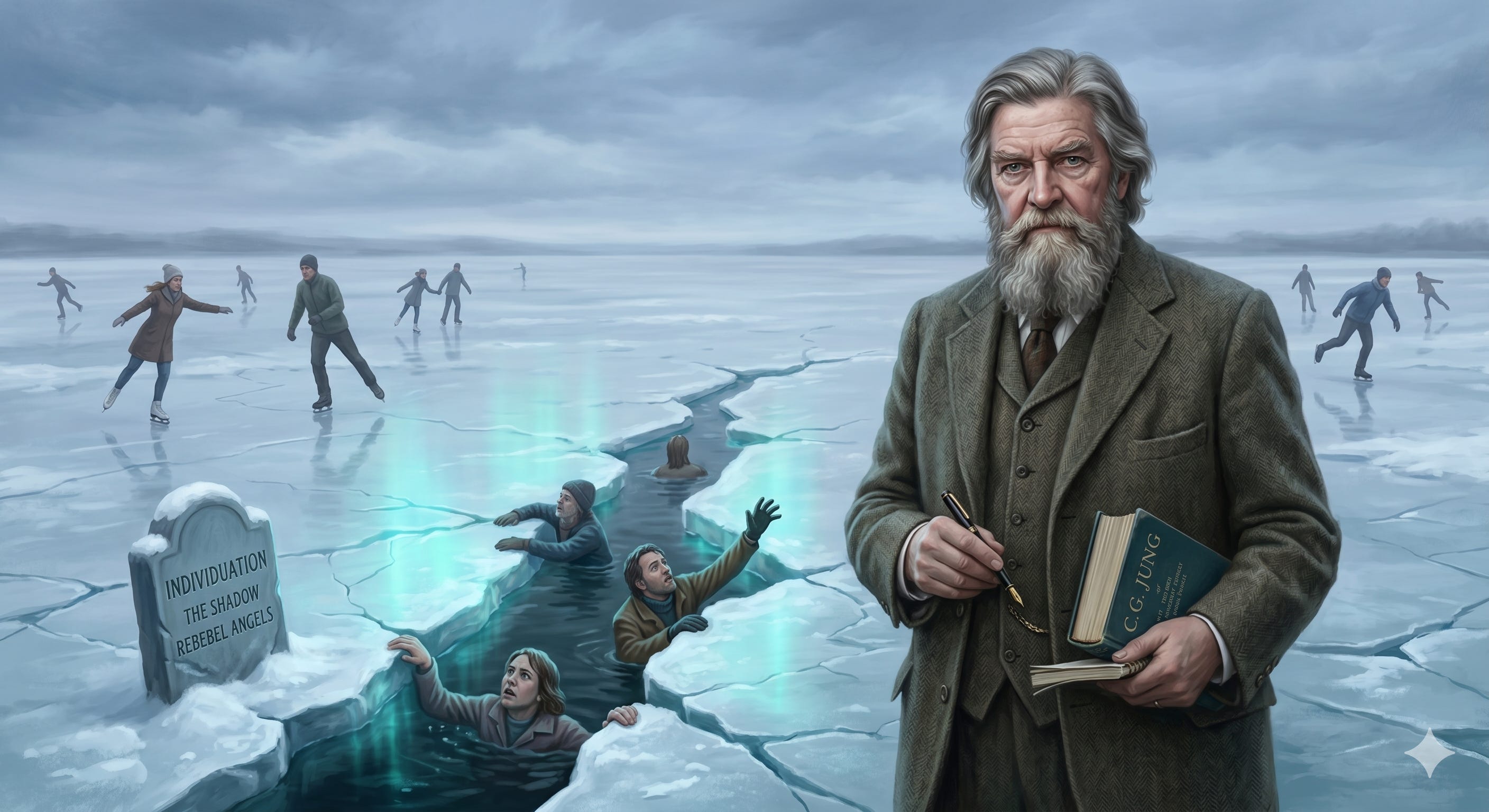
We all skate on thin ice. Unfortunately, very few fall through.
That is the Davies sentence most often quoted. It is almost always read as the dry Canadian joke about the country’s weather. It is not a joke about the weather. It is the Jungian statement of the human condition that Davies built his life’s work on. The ice is the surface life. The thin ice is the surface life of a person who has not done the work. Falling through is the encounter with the material beneath — the shadow, the inheritance, the buried portion of the self the daylight personality refuses to acknowledge. Davies’s point, the part the dry-joke reading omits, is the second sentence. Very few fall through. Most people skate their whole lives on the surface, manage it competently, and die without ever having met themselves.
That is the verdict the dispatch begins from. Davies thought the modern condition was the unfallen-through life. He thought the country he lived in — provincial Ontario, the small towns and the universities — was an unusually clear case of the universal pathology, but he never thought the pathology was Canadian. He thought it was human, and that the country he was born into was simply the version of the human he had been given to diagnose.
The dispatch that follows reads Davies the way he asked to be read. Not as a quaint regional novelist. Not as a comfortable middlebrow entertainer. Not as the man with the beard who wrote about magicians. As the Canadian writer who told his country, and through his country the world, to do the work the modern personality is organized to refuse. He gave the work a name. He gave it images. He gave it a vocabulary that survives him. The vocabulary is the inheritance. The dispatch is about whether the inheritance is being claimed.
II. The Method — Why Davies Read Jung and What He Did With It
Davies discovered Carl Jung in middle age and never let him go. He read the Collected Works. He underwent analysis. He wrote about Jung in essays and lectures for the rest of his life. He used the Jungian vocabulary the way a serious craftsman uses a set of tools — not as decoration, not as theory borrowed for the sake of seeming deep, but as the working terminology for what he had always seen and now had names for. The novels after the conversion are Jungian novels. They are also Canadian novels. Davies did not think these were different things. He thought the Canadian condition was a particularly resistant case of the universal psychological one, and the Jungian tools were the tools the case required.
The Level 4 reader needs the four words. The dispatch will use them without academic apology. Davies expected his readers to learn them from the prose. Jung’s vocabulary, in the form Davies used it, has four operative concepts.
The persona. The mask the personality wears in public. The professional face. The competent citizen. The polite Canadian. The persona is not a lie — it is a necessary social instrument — but it is also not the person. It is what the person presents. The trouble begins when the personality forgets the mask is a mask and identifies with it completely.
The shadow. The material the persona was built to conceal. The disowned portion of the self. The aggression, the appetite, the cruelty, the longing, the unspoken inheritance from family and culture and the dead. The shadow is not evil by nature. It is what the conscious mind has refused to acknowledge as belonging to it. Jung’s formulation, which Davies repeated in his own voice for fifty years: the shadow is not destroyed by repression. It is energized by it. The unexamined shadow runs the life from underneath.
The anima and the animus. The contrasexual figure in the psyche — the inner woman in the man, the inner man in the woman — through which the personality engages the world and especially the beloved. Davies wrote anima-encounters into every major novel. Liesl in the Deptford trilogy is anima. Maria Theotoky in The Rebel Angels is anima in a graduate-student’s body. The encounter is always educational. The personality that meets its anima honestly is changed. The personality that refuses the encounter remains a boy in a man’s suit.
Individuation. The name Jung gave to the whole process. The lifelong work of bringing the unconscious material into relation with the conscious personality so the person becomes, in Jung’s phrase, what they are. Not happy. Not adjusted. Not successful in the social sense. Whole. Davies thought individuation was the only project worth a human life, and that the cultures that did not train their people to attempt it were producing not citizens but partial men.
These are the four words. The dispatch uses them now without further introduction. The reader who has not met them before has now met them. The reader who knew them already knows the dispatch is not theorizing — it is naming the instruments Davies actually used.
III. Two Doors. One House.
Most readers come to Davies through one door. Fifth Business, 1970, the novel that put him on the international map and the only one most book clubs ever assigned. The reader who stops there has met Davies the way a tourist meets a city — from the lobby of the hotel. The method is invisible from the lobby. The method requires two doors.
The first door is the small town. Fifth Business. Deptford, Ontario, 1908. Two boys walking home from school in winter. The town bully, Percy Boyd Staunton, throws a snowball at the narrator, Dunstan Ramsay. Dunstan ducks. The snowball strikes Mrs. Mary Dempster, the young pregnant wife of the Baptist minister, in the back of the head. She goes into premature labour. Her son Paul is born small and odd. She herself is never quite right again. Years later, Dunstan discovers what Boy Staunton — the boy has changed his name to Boy — did not tell anyone. There was a stone inside the snowball.
The stone is the novel. The stone is what Dunstan Ramsay carries the rest of his life. Boy Staunton denies it. Boy Staunton refuses to remember it. Boy Staunton becomes rich and powerful and respected and one of the most successful men in Canada, and the stone he put in the snowball when he was ten years old is buried in the unexamined portion of his life, and the buried stone runs everything he does and everything he becomes and eventually it kills him. Dunstan, who saw the stone, picks it up. He carries it. He keeps it on his desk for fifty years. He looks at it. He does the work. He becomes a strange, lonely, learned, alive man — a teacher of saints, a friend of magicians, a person who has met himself. Boy Staunton, who refused to look at the stone, ends his life face-down in Toronto Harbour with the stone in his mouth.
That is the Jungian arc, rendered as a novel about a snowball. The stone is the shadow. The carrying of the stone is individuation. The refusal to carry it is death by water at the height of social success. Davies wrote it in 1970, in plain English, in a small-town Ontario setting, and the country received it as a quaint regional masterpiece and missed what it was about.
The second door is the university. The Rebel Angels, 1981. The first volume of the Cornish trilogy. The setting is the College of St. John and the Holy Ghost — known as Spook — a Canadian university modelled closely on Massey College at the University of Toronto, where Davies served as the founding Master. The cast is graduate students, professors, priests, a defrocked monk, a millionaire art collector recently deceased, and the millionaire’s executors fighting over the contents of his estate. The novel is comic. It is also a campus thriller, a romance, a Rabelais scholar’s daydream, and a sustained Jungian instruction in what happens when the academic mind tries to live entirely above the neck.
The heroine is Maria Magdalena Theotoky. Greek name, meaning bringer of God. Graduate student in medieval studies. Beautiful. Brilliant. In love with her supervisor, Professor Clement Hollier. Daughter of a Polish-Hungarian father and a Gypsy mother — Romani, in the Kalderash tradition — whose family fled Europe before the war. Maria has spent her conscious life climbing out of the Gypsy inheritance into the daylight world of the Canadian university. She wears the academic persona perfectly. She has buried the mother, the language, the wagon-trade, the dung-fires, the cards and the songs and the violins, in the basement of the rented house where her mother actually lives, two streetcar stops from the campus. Maria has done what immigrants’ daughters do. She has built the persona that the new country requires.
Davies’s achievement in the novel is to send Hollier — the medievalist, the rational scholar, the man who studies the pre-rational past from a safe historical distance — down the basement stairs to meet Maria’s mother. What Hollier finds in the basement is the central image of the novel. What Hollier finds is the bomari.
IV. The Bomari
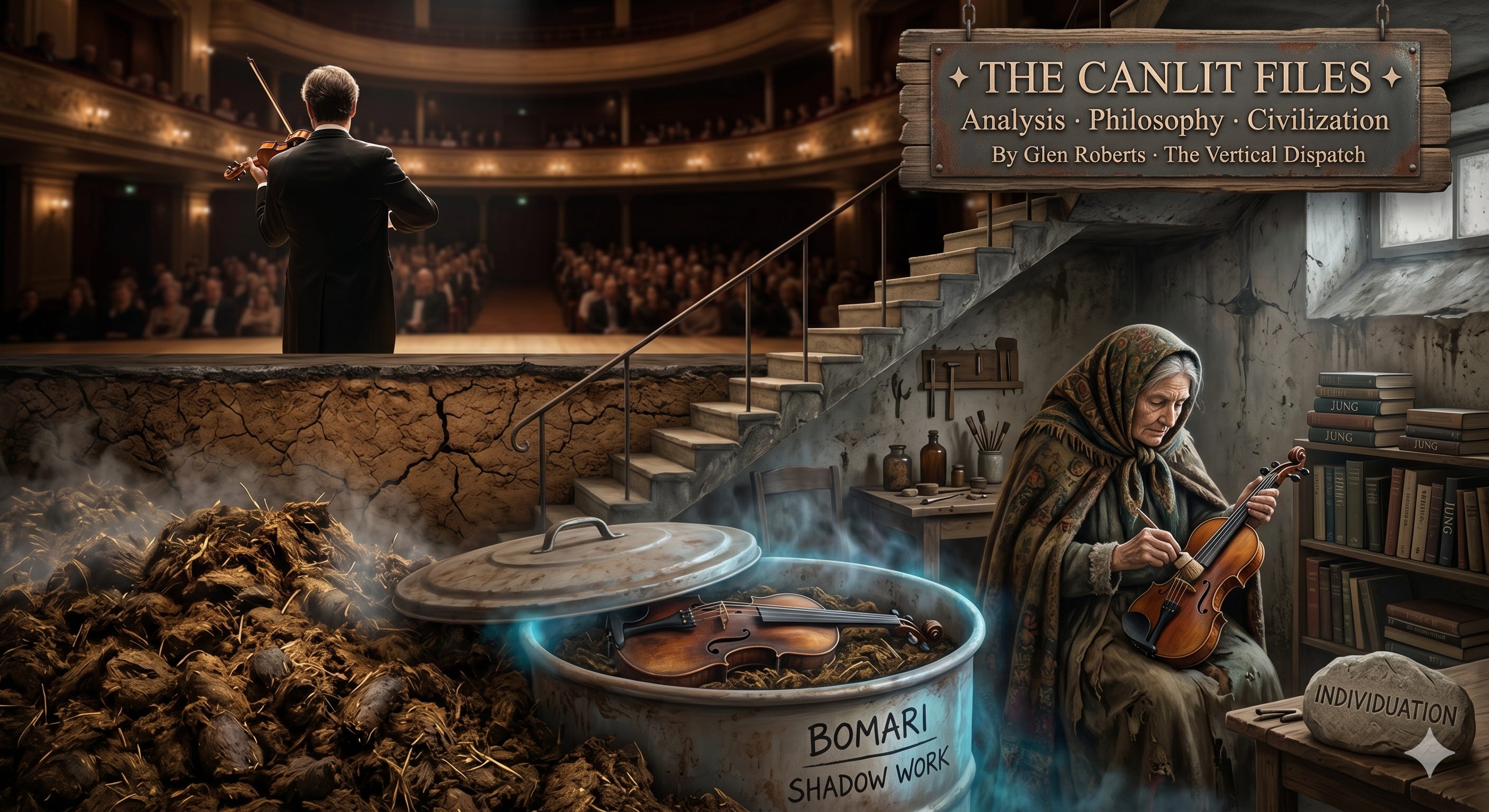
Maria’s mother — Mamusia Laoutaro, Gypsy widow, returned to her maiden name since the death of her gadjo husband — is a luthier. She restores old violins. The Canadian symphony brings her instruments that have lost their voice — Italian instruments, three hundred years old, made in workshops that no longer exist, by makers whose secrets died with them, in cities that have changed their names. Mamusia restores them. The instruments come back singing. The symphony pays her. No one in the symphony asks how.
Hollier, in the basement, asks. Mamusia, who has decided Hollier may be a worthwhile match for her daughter, shows him. She takes him to a room behind the kitchen. The room contains a large covered vat. The vat contains horse dung. Inside the dung, packed carefully, suspended in the warm slow biological furnace of the manure, are the violins of the Canadian symphony. The instruments rest in the dung for weeks. The microbial heat works on the wood. The decomposition breathes its slow gas into the grain. The dried-out fibres of three centuries soften and resonate again. The instrument comes out of the dung restored. The technique is called the bomari. It is older than the violins themselves. It is older than the cities the violins were made in. Mamusia learned it from her mother, who learned it from hers, and the chain reaches back into the European medieval and beyond.
Hollier, the medievalist, has spent his life studying the pre-rational past from his office above the quadrangle. He has now descended into a basement in a Canadian city and found the pre-rational past at work, restoring the most refined instruments of European high culture, in a vat of shit, run by a woman who reads cards and curses her enemies in Romani and whose daughter is the most brilliant graduate student in his department. The novel turns on this scene. Davies makes the turn visible without ever calling attention to it. The thing the daylight world calls filth and disposes of is the medium of resurrection for the most refined instrument the daylight world knows how to make. The concert hall’s sound depends on the stable floor. The high European art of the violin requires the most ancient and humble organic process. The bomari is the lesson.
Read it as Jung. The violin is the conscious personality — refined, trained, capable of carrying meaning at the highest civilizational level. The dung is the shadow. The bomari is individuation. You cannot get the music back without burying the instrument in the rejected material. You cannot recover the voice without going through what the persona was built to deny. There is no shortcut. There is no clean version. The basement is necessary. The dung is necessary. The work is necessary. And the work, done properly, produces an instrument more alive than it was before it lost its voice.
That is the whole Davies project, rendered as a violin-restoration technique, in a campus novel, in 1981. The country reviewed the novel for its comic energy and missed what was being shown.
V. Wonder and the Theatre of the Sacred
Davies had a second word for the work the bomari describes. The second word is wonder. Wonder is the capacity to stand in front of the world and let the world act on you without immediately reaching for the instrument that reduces it to a problem to be solved. Wonder is what the rational personality, the persona, the daylight academic mind, is organized to defend itself against. Davies thought the modern West had trained wonder out of itself in the centuries after the Reformation and the Enlightenment, that the Protestant rationalist inheritance was a magnificent achievement and a catastrophic loss in the same motion, and that the recovery of wonder was the spiritual project of the age.
He gave the lost capacity a name in the third Deptford novel. He called it the Magian World View. The Magian World View is the way of seeing in which the world is alive, the dead are present, ritual does real work, costume reveals rather than disguises, and the boundary between the natural and the supernatural is permeable in both directions. Davies did not think the Magian World View was childish or pre-scientific in the dismissive sense. He thought it was older and more durable than the rational personality that had displaced it, and that the rational personality could not actually live without it — could only pretend to, at the cost of producing the half-people the twentieth century kept producing in such alarming numbers.
This is why Davies loved the theatre. He grew up in the theatre. He acted at Oxford. He worked at the Old Vic. He wrote plays before he wrote novels. He helped found the Stratford Festival. He filled his fiction with magicians, illusionists, opera, masques, and staged transformations. The theatre, for Davies, was the last surviving institution in the modern West that practised the Magian World View without apology. The audience knew the magician was performing tricks. The audience also knew the tricks were doing real work. Both things were true at once, and the theatre was the place where the modern personality was permitted, for two hours, to hold them both.
This is also why Davies loved the high-Anglican church. The church, for Davies, was theatre that had remembered what it was for. The vestments, the liturgy, the procession, the bell, the candle, the bread, the wine — these were not decorations on a moral lecture. These were the technology of the Magian. The Eucharist is staged transformation. The priest is performing the trick. The congregation knows the priest is performing the trick. The congregation also knows the trick is doing real work. The Protestant impulse to strip the church of its theatre — to make it plain, rational, sermon-centred, transparent to the daylight mind — was for Davies a tragedy. It removed the instrument the population most needed and replaced it with a lecture. The lecture was clearer. The lecture was also useless for the work the church had been built to do.
Davies loved the theatre of the church the way he loved the violin restored by the bomari. Both were the daylight personality’s most refined achievements — high art, high ritual — kept alive by ancient processes the daylight personality would have called primitive if it had bothered to look. The theatre is where the country, for two hours, is permitted to fall through the thin ice on purpose. The church, when it remembers itself, is the same instrument with a longer history.
VI. What the Shadow Requires
I read Davies in the bone. I was given Fifth Business in my twenties by someone who knew what they were doing. I did not understand it then. I understood the snowball and I understood the stone, and I missed everything that the snowball and the stone were standing in for. I came back to Davies in my forties, when the persona I had built was no longer carrying the load and the basement door had started to open by itself. The second reading was the reading he wrote for. The first reading was the costume.
This is the Davies experience that the country, in my generation, was supposed to have and largely did not. Davies wrote at a Level 4 register that assumed his readers were doing the work in their own lives — that they were meeting their shadows, encountering their animas, attempting individuation, and would recognize the work being done on the page because they were doing it themselves. He was wrong about how many of them there were. He kept writing as if he were right. The novels are addressed to the readers who exist. The country produced fewer of them than he hoped.
The cost of the refusal is not abstract. The unintegrated shadow runs the life. A nation of personae, with no national practice for the bomari work, produces a national character that looks competent on the surface and is increasingly unrecognizable to itself underneath. The polite Canadian register that Davies wore the beard against is not a charming quirk. It is the country’s persona, identified-with, defended, and refused examination. The shadow it conceals does not disappear because the persona has decided not to look. It accumulates. It comes out sideways. It comes out in the public life, in the policy made by people who have not done the work, in the institutions run by personae that have forgotten they are personae, in the children raised by parents who never met themselves.
Davies did not say all of this in a lecture. He said it in seven novels, by showing it. He showed Dunstan Ramsay carrying the stone for fifty years and becoming a man worth reading about. He showed Boy Staunton refusing the stone for fifty years and dying at the height of his success with the stone in his mouth. He showed Maria Theotoky climbing out of the basement and Hollier descending into it and the daughter and the scholar meeting, finally, in the room with the vat of dung where the violins were learning to sing again. He showed Magnus Eisengrim, the boy from Deptford who had been carried out of the town in the bottom of a carnival wagon, becoming the world’s greatest illusionist by mastering the theatre of wonder the modern world had forgotten how to honour.
Each novel is the same instruction. The work is necessary. The work is refused at the cost of the life. The refusal looks, from the outside, like a successful life. The refusal is a death the person performs on themselves, slowly, in installments, while the persona collects the awards.
VII. The Reading Davies Required
Reading Davies at the level the work requires means refusing the costume version. The costume version is Davies-as-regional-charmer, Davies-as-quaint-Ontario-eccentric, Davies-as-the-beard-and-the-anecdotes. The costume version is what the publishing industry sold and what the high school syllabus mostly assigned. The costume version is harmless. Davies wrote against it for sixty years and the country bought the costume anyway.
Reading Davies at the level the work requires means holding Fifth Business and The Rebel Angels open on the desk at the same time — the small-town door and the university door, the Deptford shadow and the Toronto basement, the stone and the bomari — and seeing that they are not two novels but the same instruction delivered from two angles. It means reading World of Wonders for the theatre and What’s Bred in the Bone for the inheritance and The Cunning Man for the late synthesis. It means understanding that Jung is not decoration in these books. Jung is the engineering.
It also means doing the work the books are about. Davies did not write self-help. He wrote novels for adults who were already engaged in the project of becoming people. The novels are not the work. The novels are the company a reader doing the work can keep on the journey. They are the kitchen table where the work is acknowledged and named and treated as the only project worth a serious adult’s time. The country that does not do the work cannot read Davies, because the books are written in the vocabulary of the work and the costume reader has not learned the vocabulary.
That is the bind. Davies wrote the books that would have taught the country how to read them, but the country needed to be doing the underlying work to receive the teaching. He kept writing the books anyway. He was eighty-two when he died in 1995, with the third Cornish novel The Lyre of Orpheus behind him and The Cunning Man published the year before his death, and the body of work complete on the shelf where it has been waiting ever since.
The question is the question the series keeps arriving at. The question is whether enough readers exist to claim the inheritance. The four million who can read at Level 4 in this country are the readers Davies wrote for. The inheritance is on the shelf. The basement door is unlocked. The bomari is still running, in any room where a serious reader meets a serious book and refuses the costume reading.
Davies told the country to know its own shadow. The teaching is universal. The shadow is not Canadian. The refusal is not Canadian. The work is the human work, and Davies, the Canadian writer with the Old Testament beard and the Jungian library and the unfashionable insistence on wonder, was one of the writers of his century who said so most plainly. He told Canadians because Canadians were the people in the room. He was telling everyone.
Coda. The Violin in the Dung
Picture the room behind the kitchen, two streetcar stops from the Canadian university where the symphony’s first violinist will perform tonight. The vat is covered. The dung is warm. Inside the dung, packed in straw, are the instruments that have lost their voice — three hundred years old, made in Cremona, made in Mirecourt, made by men whose names are on the labels and whose secrets are in the wood. The Gypsy woman in the basement knows the secret. She did not invent it. She inherited it. She is passing it to her daughter, who does not yet want it, and to the scholar from the university, who does not yet know what he has been shown.
Tonight the violinist will lift the instrument and the concert hall will go still and the music will rise into the room the way music rises when the instrument has remembered itself, and no one in the audience will know about the basement, and no one in the audience will know about the dung, and no one in the audience will know that the sound they are receiving — the sound that is making the hairs on their arms stand up, the sound that is the closest most of them will come this year to the encounter with the sacred — came up out of a vat of shit in a rented house, restored by an old woman in a head-scarf who learned the trick from her mother.
That is the country. That is every country. That is the human condition Davies spent his life describing. The surface is the concert hall. The basement is the bomari. The work is the burial of the precious thing in the rejected material so the precious thing can come back resonant. The refusal of the work is the silent violin. The refusal of the work is the stone in the snowball, carried unexamined, until the snowball finds the back of someone’s head and the unborn life is lost and the man with the stone in his pocket has fifty years to pretend he does not know what he did.
Pick up the book. Fifth Business first, because the stone is the entry point and every reader knows what a snowball is. Then The Rebel Angels, and stay in the basement long enough to see what Hollier sees. Then the rest. Read them the way he wrote them, with the Jungian library open on one side of the desk and your own basement door open on the other, and the discipline to refuse to look away from either.
Because the country that has forgotten how to do the work cannot hear the music the work produces. And the violin, restored or unrestored, does not care whether the country is listening. The violin is what it is. The dung is what it is. The bomari is the technology that connects them. Davies gave us the diagram. The diagram has been on the shelf for forty-five years.
It is waiting.
God is Love. Love is Truth. Truth is Consciousness. Consciousness is Brahman.
Amen. Namaste.
#TheBomari #ReadDavies #FifthBusiness #TheRebelAngels #ShadowWork #CanLitDispatch #TheTeachingOfCanada #BecomeTheBook #AgeOfConsequences
Thank you Glen, for showing me a side of R D that I was completely ignorant of. I read most of his books many years ago, but in a superficial way. I also have read some of Jung’s works; now I intend to do some serious re-reading.
Well, this has served as a most timely reminder to re-read these, which I actually thought of doing very recently, but hadn't followed up. Now I see many of his novels are actually available on the Libby app. Thank you.