

Φ
THE VERTICAL DISPATCH
We write for the mind, the eye, and the ear.
Read it. Look at it. Listen to it. The Vertical Dispatch is built for all three — prose with rhythm, made to be heard as much as read.
From metaphysics to geopolitics, from culture to history, from the sacred to the street — and everything in between. One lens, every subject. No ego. Just the record, named clean.
Press play. Walk with the word. 🕯️
This dispatch travels by hand. If it serves you, share it — restack on Substack, and pass it on wherever you read. 🕯️
The Departure Lounge · The Church and the Red Letters
As of July 15, 2026
There is a kind of book you do not write so much as follow.
You set out looking for something small — a clean way to say one true thing — and the thing keeps opening, and you keep walking into it, and by the end you look up and find you have been led somewhere you never planned to go. You did not build it. You witnessed it assemble itself, according to a logic older than your intentions, and your only real work was to keep your hands steady and refuse to look away.
That is the book I have finished. Over these recent weeks it took its final shape — but do not mistake that for the whole of the labor. This book has been forming for a very long time: thirty years in the Vedic science of consciousness, five years at the bedside of the dying, a lifetime of loving Jesus, and one long winter, years ago, of ten thousand words written by hand before any tool existed to help me. The shape came recently. The book came slowly. It will be released this fall — alongside The Ascent — for the season when the light goes low and people begin to bank in for the winter, when the mind turns inward and there is finally time to sit with something that asks to be sat with. This is a winter book. It is not for the beach. It is for the long evening, the second cup, the hour when the house is quiet and you are willing to be changed.
I want to tell you what it is, without telling you the ending. There is a turn in this book that I will not give away here — it would be like handing you the last page of a mystery, and this particular ending is one you have to arrive at yourself, walking, or it does not land. So consider this a dispatch from base camp, not a map of the summit.
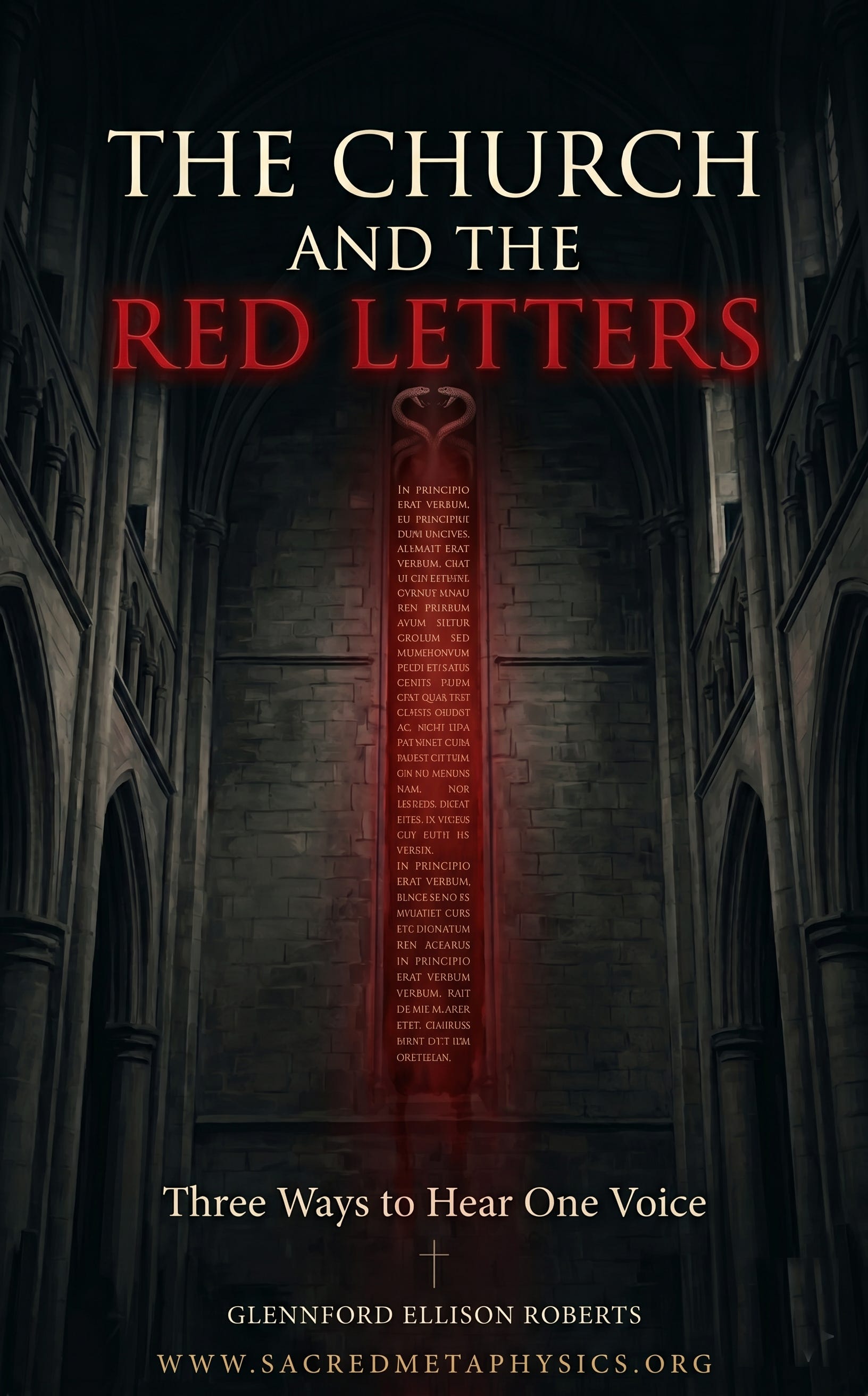
Everything in this book turns on three words: lost in translation.
Here is the wound the whole book is built to heal. You have never read the words of Jesus. Not once. You have read an English translation of a Greek text that is itself a reconstruction of copies of copies of a voice that first spoke in Aramaic, on a hillside, two thousand years ago. Between that voice and your eyes stand centuries of scribes, translators, councils, and printers — each one faithful, most of them reverent, and every one of them a pane of glass, slightly tinted, slightly warping, between you and the light. It came down a stair of languages, and something was lost on every step.
Let me give you the first theft, because it is the one that started me on this whole road, decades ago. It is a single word: catholic.
When you say the creed — I believe in one holy catholic and apostolic church — you think, most likely, that the word names a denomination, the great church in Rome. It does not. Not originally. Catholic is a Greek word, katholikos — kata, according to; holos, the whole. According to the whole. Universal. It was a philosopher’s word long before it was a churchman’s; the plain Greek term for the universal as opposed to the particular — the whole as opposed to the part. The earliest Christians used it exactly this way: the catholic goodness of God, the general resurrection, the winds from every quarter. It meant everyone, everywhere, the whole.
And then it was captured. The word that means there is no wall, this is for all was made the name of one house among the houses — capitalized, claimed, turned into a flag. By the time the Reformation came, Catholic with a capital C had become the banner of a single tribe. They took the very word for universal and built a wall out of it. They took belonging to all and made it belonging to us. That is the first lost-in-translation, and it may be the sharpest of them all, because millions still say it every Sunday — professing the universal church while hearing the name of a tribe. They speak the whole, and hear a part.
When I first saw that contradiction — years ago now — I could not un-see it. Because it was not an accident. It was a pattern. And once I saw it in catholic, I began to see it everywhere, and the largest instance of it stands at the very opening of John’s Gospel.
In the beginning, John writes, was the Logos. We translate that word as Word — In the beginning was the Word. But Logos never meant merely a word. It meant the ordering principle of the cosmos, the reason that runs through all things, the ratio, the pattern, the divine intelligence in which everything holds together. The Greeks had carried that word for centuries; it was one of the largest ideas their language could hold. And we shrank it to Word — a thing on a page, a unit of speech. The ocean, poured into a cup. When the Logos became the Word, the vertical was lost, and the voice went flat.
And this is the thing few stop to consider: the New Testament was written in Greek. Not in the plain tongue of the fisherman who spoke it, but in Greek — and Greek is a philosophical language, the language of Plato and Aristotle, shaped for centuries to carry ideas like the universal, the Form, the Logos. So the moment the voice entered Greek, it inherited all of that — the whole architecture of Greek thought came in with the words. The Gospel is soaked in philosophy at the level of its very vocabulary. Which means the recovery of what was lost is not a matter of faith against reason. It is a matter of reading the words as carefully as the philosophers who first shaped them. The truth was not lost because it was too holy to keep. It was lost because the words that carried it were larger than the translations that received them.
The book is called The Church and the Red Letters. And it begins where the wound begins — with history.
The first part of the book simply walks the story of how the voice came down to us. It is not metaphysics and it asks nothing of you but attention: the man before there was ever a church; the movement that became an empire; the councils that defined the words; the marriage of Athens and Jerusalem, where Greek philosophy wedded Hebrew faith; the hammer on the door and the breaking of the house; the Word carried at last into the mother tongue, and coming home into English stained by every hand that had carried it; and the one house splitting into a thousand houses. It is the honest story of the stair of languages — told plainly, so that by the end you understand, in your bones, why the voice needs recovering at all. Only then does the book turn to the recovering.
And here is what that history teaches, told without malice and without flattery: the ego — which is the whole history of civilization — cannot be trusted with the truth. Whether by design or by ignorance, the record is the same. The symbol gets watered down to whatever the self can hold and rule; the universal is captured into the particular; the light that has no wall is made a house you must be admitted to. That is not a charge against any one hand. It is the shape the record keeps making, on every step down the stair.
The red letters are the actual spoken words of Jesus — the ones printed in red in certain old Bibles. And for two thousand years they have been heard in more than one way: by those who held the old center, by those who broke its walls, and by those who went quiet and inward and mystical. Three ways of hearing one voice. The book takes the sharpest of his sayings and lets all three companies hear each one, in turn, without ever telling you which is right. And here is the thread that ties it to the wound: the reason there are three ways to hear one voice is that the voice was lost in translation in the first place. Where the meaning goes dim, the hearings multiply.
And underneath the three, a fourth thing kept rising — the science of consciousness the Vedic seers set down in the forests of India three thousand years before the Sermon on the Mount was ever preached. It does not compete with the red letters. It restores them. It gives back what was lost in translation. The teaching Christ gave and the teaching the seers gave turn out, read closely enough, to be one teaching, spoken in two tongues on two sides of the earth — divided only by the languages that carried them, and by everything those languages could not hold.
At the very end, the book returns the whole Sermon on the Mount to its oldest recoverable tongue — the Greek, every paragraph, with a fresh translation and a plain note wherever the source says something the familiar English had smoothed away. Be perfect, the King James commands — an impossible, crushing word. But the Greek says be complete, be whole, be brought to your fullness. A different teaching entirely, hiding under a single mistranslated word.
But before a line of Greek, I had to say the hardest thing. There is no original. Not one. The pages the evangelists actually wrote are gone. What survives is copies of copies of copies, and no two agree. Even the Greek we call the source is a reconstruction; the oldest complete copies were written some three hundred years after the Sermon was preached. The voice was not lost at one step. It was lost all the way down — past the English, past the Greek, past the source-tongue itself, to the plain fact that no original hand survives.
I tell you this not to unsettle your faith but because it is the deepest confirmation of everything the book is about. If the voice was lost that completely — if even the source is a veil — then you will not find him in a text. Not in any language. The words can only ever point. Where he is actually to be met is not on any page.
That is where the book ends. And that is exactly where I will stop telling you, because the rest is yours to walk to. There is a turn at the end — and it is not the one you are bracing for.
Why I do this at all. Because I have had a rich and full life across many rooms of the faith and thirty years in the science of consciousness alongside them. And because for five years I sat with the dying and the post-surgical, at the exact threshold this whole book is about — watching what falls away and what remains when everything a person clung to is stripped from them. You do not learn what I am writing about from a seminary or a pulpit. You learn it in that room, holding those hands. This book was paid for in those hours.
I love Jesus. I have my whole life. That is the ground I stand on, and it is the first thing the book says. And it took me until now to finally understand what he was showing me all along. The Vedic gave me the logic. He gave me the image, and the love. And it took a lifetime, and a long walk back through the tinted glass, to let the two become one seeing.
Come find it this fall, when the light goes low. Bank in for the winter. Sit with it.
And then close the book, and go.
God is Love. Love is Truth. Truth is Consciousness. Consciousness is Brahman.
Amen. Namaste. Om Namah Shivaya.
— The Architect.
The Vertical Dispatch
sophiainitiative.ai
On the record
This dispatch is a personal, forthcoming-book announcement; its load-bearing claims are matters of textual and etymological history. Catholic: from Greek katholikos (kata, “according to” + holos, “the whole”), meaning universal; first attached to the church by Ignatius of Antioch, c. 110 AD; capitalized into the name of a particular communion in later usage. Logos (John 1:1): rendered “Word” in English; in Greek philosophical usage the ordering principle / reason of the cosmos. New Testament composed in Koine Greek. “Be perfect” (Matthew 5:48): Greek teleios, “complete, whole, brought to fullness.” No autograph manuscripts of the Gospels survive; the earliest complete copies date to roughly three centuries after the events. Vedic dating (“three thousand years before”) is the author’s traditional framing, not a fixed scholarly date. All characterizations are the author’s interpretation; verify against primary sources before republication.
Suggested tags
The Church and the Red Letters, lost in translation, Logos, catholic universal, Sermon on the Mount, textual criticism, Vedic consciousness, forthcoming book, winter reading, The Architect.
Substack Notes
New from The Architect — a forthcoming book, coming this fall: The Church and the Red Letters. You have never read the words of Jesus. Not once. You’ve read an English translation of a Greek reconstruction of copies of copies of a voice that first spoke Aramaic on a hillside two thousand years ago. Something was lost on every step down the stair of languages. This is the story of that loss — and the long walk back through the tinted glass.
It begins with a single stolen word: catholic — Greek for universal, “according to the whole,” for everyone, everywhere — captured into the name of a single house. Same theft as Logos shrunk to Word: the ocean poured into a cup. A third of the book is the honest history of how the voice came down to us, told without malice and without flattery. Then it turns to the recovering — three ways one voice has been heard, and the Vedic science of consciousness rising underneath to give back what the languages could not carry.
A winter book. Not for the beach — for the long evening, the second cup, the hour the house goes quiet and you are willing to be changed. There is a turn at the end I will not give away. This dispatch is base camp, not the summit.
Written from love, in service of the record. Walk with the word. 🕯️
#TheVerticalDispatch #TheArchitect #SophiaInitiative #TheChurchAndTheRedLetters #LostInTranslation #Logos #SermonOnTheMount #Consciousness #Vedanta #GodIsLove #LoveIsTruth #OmNamahShivaya
The factual matter in this Dispatch is drawn from the public record. All characterizations, inferences, and conclusions are opinion, interpretation, and commentary, offered for analysis, reflection, and public-interest discussion. No assertion is made regarding the private intentions, state of mind, or character of any individual. Readers should evaluate all statements independently and draw their own conclusions.
Fascinating! I'm curious and looking forward to reading your book.
Looking forward to it