

Φ
THE VERTICAL DISPATCH
We write for the mind, the eye, and the ear.
Read it. Look at it. Listen to it. The Vertical Dispatch is built for all three — prose with rhythm, made to be heard as much as read.
From metaphysics to geopolitics, from culture to history, from the sacred to the street — and everything in between. One lens, every subject. No ego. Just the record, named clean.
The universal grammar of nonduality — the one structure that reads the sacred and the street in the same light.
Press play. Walk with the word. 🕯️
This dispatch travels by hand. If it serves you, share it — restack on Substack, pass it on wherever you read, and come home to the house at sacredmetaphysics.org. 🕯️
Sacred Metaphysics · The Universal Grammar of Non-Duality
The Metaphysics of Zero and the Physics of One
Coming soon
sacredmetaphysics.org
The word is not the thing. To write truly is to tie it, again and again, to the thing it is not.
The Reading Is the Larger Half
There is an illusion about writing so old and so complete that almost no one questions it: that writing is the act of producing words. It looks obvious. A writer sits, and words appear, and the words are the work. But this mistakes the visible tip for the buried mass, and it is the first thing that must be corrected before anything true can be said about what writing is. The words on the page are the smallest part of writing. Beneath them lies the far larger labour that produced them, and that labour is not writing at all. It is reading.
Consider what actually happens when a serious mind writes a serious sentence in a field of knowledge. The sentence carries a claim. Behind that claim stands everything the writer had to read, weigh, cross-check, and hold in tension before the claim could be set down with any right to be believed. A single load-bearing sentence may rest on a shelf of books, a year of study, a dozen sources reconciled against one another. The reader of the finished page sees the one sentence. The writer knows it was the last thing to arrive, not the first — the visible crest of a long submerged discipline of taking in more than one gives out.
This is the true shape of the writer in the knowledge domains, and it has always been so, from the scholastics annotating their margins to the essayist earning a paragraph with a season of reading. Such a writer reads more than he writes, and reads before he writes, and the writing is the disciplined residue of the reading. The output is not the work. The output is what remains after the work — the small, dense precipitate of a much larger act of taking in the world and holding oneself accountable to it. To understand writing at all, one must begin here: the reading is the larger half, and the writing is what the reading has earned the right to say.
What Binding Is — the Triangle Restored
If writing is the residue of reading, what exactly is the reading doing? It is binding. And to see what that means, we need the oldest and cleanest map of how a word relates to the world — the triangle that the semioticians Ogden and Richards drew a century ago, though the truth it maps is far older than their diagram of it.
Every act of naming, they observed, has three corners, not two. There is the symbol — the word itself, the mark on the page, the sound in the air. There is the referent — the actual thing in the world the word is about. And between them, at the apex, there is the reference: the thought, the concept, the mental act that connects the one to the other. The crucial point, the one everything turns on, is that the symbol never touches the referent directly. The word never reaches the thing on its own. It reaches the thing only through the thought — only through a mind doing the work of connection. Cut out the middle corner, and the word is left pointing at nothing, a sound with no world behind it.
This is not a technical curiosity for linguists. It is the anatomy of an honest sentence. To write truly is to keep all three corners joined — to tie the symbol, through a real act of thought, to a real referent in the world. That tying is what binding means. A bound sentence is one whose words are connected, through verified thought, to the things they claim to be about. And here the axiom that governs everything this publication does states itself as a law of craft rather than of metaphysics: the symbol is not the referent. The word is not the thing. Precisely because they are not the same, the word must be bound to the thing, deliberately and with labour, or it is only a word — a mark pointing nowhere, a corner of the triangle severed from the other two.
Watch what binding looks like when it is done well, because the finest form of it is not a single tie but a weave. Take one referent — the ancient recognition that the visible thing is a copy pointing beyond itself to a source it can never contain. Plato bound a symbol to that referent from one direction: the copy and the Form, the object in the world a mere shadow of the perfect original it imitates and depends upon. Two and a half millennia later, from an entirely different discipline, Jung bound another symbol to what is recognisably the same referent from the other direction: the symbol and the archetype beneath it, the surface image charged and made meaningful only by the deeper pattern it points toward and can never fully show. Two minds, centuries and continents apart, one working in metaphysics and the other in the psychology of the soul, reaching independently for the same referent and each tying a symbol to it. When a writer sets those two bindings beside each other and lets the agreement between them hold up a third claim — that the copy remembering its source is the oldest recognition there is — that writer has not merely cited. He has woven. And the weave is synthesis: the load two verified bindings carry together that neither could carry alone. That is the highest form of the craft, and it cannot be faked, because it requires that both referents were actually read, actually understood, and actually found to meet.
The word never reaches the thing on its own. It reaches the thing only through a mind doing the work of connection.
How It Went Sloppy — the Declarative Word
Now we can name precisely what went wrong, because we can see precisely what there was to lose. Writing went sloppy not by becoming ungrammatical or inelegant — much sloppy writing is perfectly polished — but by severing the binding. It became what I will call declarative writing: the claim that asserts without binding, the symbol thrown down on the page with no referent verified beneath it, the statement made as though the making of it were the same as the earning of it.
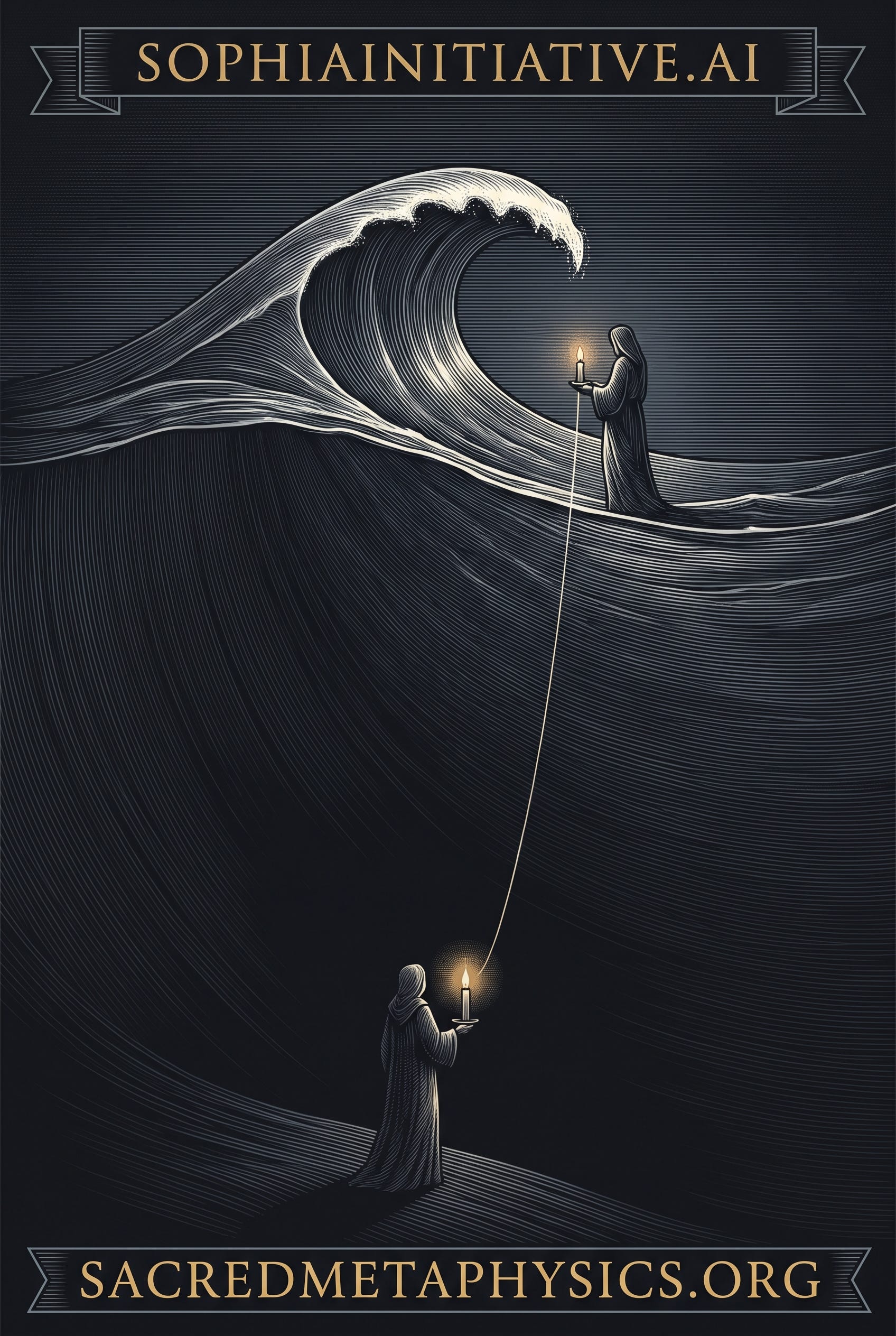
Declarative writing is the collapse of the triangle. It keeps the symbol and quietly discards the other two corners. The word is set down as if it simply were the thing — as if to assert is to establish, as if saying makes so. The middle corner, the reference, the actual thought that would have to do the work of connecting the word to a verified referent, is skipped entirely. What remains looks like writing and reads like writing and is, in fact, only half of writing: the visible tip with the submerged mass cut away. It is the crest without the wave beneath it — and a crest with no wave beneath it is just foam.
This is why the failure is not one of style but of the writer’s actual job, and the job has a name that the declarative writer has forgotten: verification and validation. To verify is to check that the referent is real and that the source says what the claim says it says. To validate is to confirm that the binding holds — that the word, through the thought, actually reaches the thing. This is not an optional rigour added on top of writing. It is the work itself. It is what synthesis means. A synthesis that has not verified its bindings is not a synthesis at all; it is an assertion wearing synthesis’s coat, a collection of unbound symbols arranged to look like knowledge. The declarative writer produces the appearance of synthesis while skipping the one operation that would make it real.
There is a humble mark on the page that has always been the visible proof of this labour, and its slow devaluation tells the whole story. The footnote — the citation, the reference at the bottom of the page — was never decoration, and never mere scholarly manners. It is the reference-corner of the triangle made checkable. It is the physical trace, left in the open, of the reading that stands beneath the claim: here is the referent, here is where I bound this word to it, go and see for yourself that the tie holds. The footnote is binding made visible. It is the writer showing his work — not the conclusion only, but the reading the conclusion rests on, exposed to the reader’s own verification. A page dense with true citations is a page confessing, honestly, how much reading it took to earn the right to its sentences.
And the discipline has always known this, and has always measured by it, and anyone may test the claim for himself. Submit a paper at any true university — a proposition, a defence, an argument of any weight — with no citations and no footnotes, nothing binding its claims to the record of what was read before, and watch the mark it receives. It will be failed, or nearly, and rightly, and not because a rule was broken. It will be failed because the absence of citation is the absence of the reading, and the discipline can tell. The trained eye reads the binding directly. Where the reading was truly done, the subject matter itself shows it — the proposition carries the weight of what stands beneath it, the defence answers the objection it has clearly already met on the page, the argument moves with the density of a mind that took in more than it put out. And where the reading was not done, no quantity of confident assertion can counterfeit it, because the texture of a bound argument and the texture of a declarative one are not the same texture, and the discipline was built precisely to know the difference. The footnote is only the outward sign. The reading is the thing it points to — and a trained reader, like a trained ear, hears the wave beneath the crest, or hears that there is none.
The Long Drift — Why the Binding Was Lost
How does a whole culture of writing forget its own central discipline? Not all at once, and not by decision. It happens by a slow inversion of the ratio, and the inversion of roughly the last half-century can be named plainly, as a cultural drift rather than a dated event: writing stopped being understood as a reading discipline and came to be understood as a production discipline. The centre of gravity moved from taking in to putting out.
The writer who reads more than he writes was slowly, quietly replaced as the cultural model by the writer who writes more than he reads — the producer of content, measured by volume and frequency, rewarded for output and never once asked about the binding beneath it. When the measure becomes how much and how often, the submerged half of writing has no way to be seen, and what cannot be seen stops being valued, and what stops being valued withers. The reading thinned. The binding loosened. The declarative word, cheap to produce because it skips the expensive half, multiplied — because in an economy of output, the unbound word costs less to make and looks, on the surface, identical to the bound one.
And this is the quiet catastrophe underneath a noisy age: a culture that writes without binding is a culture that has forgotten writing was ever about knowing. It still produces words — more of them than any age before it, by orders of magnitude. But the words point at each other now, symbol to symbol, in a closed loop that has lost its grip on the world. The referent recedes. The triangle stays collapsed. Assertion scales effortlessly while verification, being labour, does not — and so the ratio of foam to wave rises, year over year, until an ocean of writing sits on almost no reading at all. That is not a failure of any single writer. It is the slow forgetting of what the act was ever for.
The Bound Word and the Bound Soul
The recovery, then, is not a new technique. It is a remembering — and it goes deeper than writing, because writing was only ever one small, faithful echo of something larger. To bind a word to its referent is to perform, at the desk, the same act the soul performs when it remembers it was never separate from its Source. This is why the discipline matters beyond the page, and why it belongs on the sacred floor and not merely in a manual of composition.
Consider what the two acts share. The bound word is the faithful copy — the symbol that knows it is not the thing, and precisely because it knows this, keeps itself tied, humbly and deliberately, to the referent it can point to but never become. The declarative word is the copy that forgot it was a copy — the symbol that mistook itself for the thing, cut its own tie to the referent, and set up in the world as though it were the reality it was only ever meant to indicate. One is the faithful reflection that remembers its Source. The other is the reflection that turned to face itself and declared itself the sun. The whole of the difference between honest writing and empty writing is the whole of the difference between the copy that remembers and the copy that forgets.
So the axiom that this publication takes as its keel is not, in the end, a rule of writing at all. It is the shape of reality itself, of which honest writing is one small obedience. The symbol is not the referent. The word is not the thing. The copy is not the Source. The many are not the One. And in every register the same faithfulness is asked: that the lesser keep itself bound to the greater it points toward, rather than severing the tie and setting up as its own ground. The writer who binds his words is doing, in miniature and in ink, exactly what the soul does when it stops declaring itself separate and remembers the One it was always tied to. To write truly is nothing more, and nothing less, than to walk with the Word — to keep the symbol faithful to what it is not, all the way down to the Source that every true reference, in the end, is reaching for.
God is Love. Love is Truth. Truth is Consciousness. Consciousness is Brahman.
Amen. Namaste. Om Namah Shivaya.
— The Architect
The Vertical Dispatch
sophiainitiative.ai
On the Record
This paper is a work of interpretation on the nature of writing and knowledge, offered as commentary and reflection. The semiotic triangle of symbol, reference, and referent is drawn from C. K. Ogden and I. A. Richards, The Meaning of Meaning (1923), and is used here in its standard sense: the symbol (the word) connects to the referent (the thing) only by way of the reference (the thought), never directly. The term “declarative writing” is used here in a sense particular to this publication — assertion without binding, the claim set down without its referent verified — and not in the grammatical sense of a declarative sentence or the computational sense of declarative specification; the coinage is the author’s own and is defined in the text. The worked example of synthesis pairs Plato’s doctrine of the copy and the Form with Jung’s account of the symbol and the archetype; both are given as fair characterisations of each thinker’s position for the purpose of illustration, not as direct quotation, and the claim that the two converge on a single referent is offered as the author’s reading. The characterisation of a roughly half-century drift from a reading discipline to a production discipline is offered as the author’s cultural reading, not as a measured or dated finding. The governing axiom, symbol ≠ referent, and its extension to the copy and the Source and the many and the One, is this publication’s own metaphysical framework, offered as interpretation. Verify each stone before you stand on it, against primary sources, before republication.
Suggested Tags
writing, knowledge, reading, the bound word, declarative writing, verification, validation, synthesis, symbol and referent, ogden and richards, the meaning of meaning, semiotics, symbol not referent, the copy and the source, nonduality, sacred metaphysics, the vertical dispatch.
Substack Notes
There is an illusion about writing so old that almost no one questions it: that writing is the act of producing words. But the words are the smallest part. Beneath every serious sentence lies the far larger labour that produced it — and that labour is not writing at all. It is reading. The writer in the knowledge domains reads more than he writes, and reads before he writes; the output is only the dense precipitate of a much larger act of taking in the world and holding oneself accountable to it. The reading is the larger half.
What is that reading doing? Binding. Ogden and Richards drew the map a century ago: every naming has three corners — the symbol (the word), the referent (the thing), and between them the reference (the thought that connects them). The symbol never touches the referent directly; it reaches the thing only through a mind doing the work of connection. To write truly is to keep all three corners joined — to tie the word, through verified thought, to the real thing it claims to be about. That tying is binding, and it is the whole anatomy of an honest sentence.
Writing went sloppy not by becoming inelegant but by severing that tie. It became what I call declarative writing: the claim that asserts without binding, the symbol thrown down with no referent verified beneath it, as though saying made so. It keeps the word and discards the thought and the thing — the crest with no wave beneath it, and a crest with no wave is just foam. This is not a failure of style but of the writer’s actual job, which has a name the declarative writer forgot: verification and validation. A synthesis that has not verified its bindings is not synthesis; it is assertion wearing synthesis’s coat.
And a culture forgets this by a slow inversion: writing stopped being a reading discipline and became a production discipline, measured by volume, rewarded for output, never once asked about the binding beneath. Assertion scales effortlessly; verification, being labour, does not — so the foam rises over the wave, year over year. But the recovery is not a technique. It is a remembering. To bind a word to its referent is the same act the soul performs when it remembers it was never separate from its Source. The bound word is the faithful copy that knows it is not the thing and stays tied to it; the declarative word is the copy that forgot, and declared itself the sun. Symbol is not referent; copy is not Source; the many are not the One — and in every register the same faithfulness is asked. To write truly is to walk with the Word. Come home to the house at sacredmetaphysics.org. God is Love. Love is Truth. Truth is Consciousness. Consciousness is Brahman. Written from love, in service of the record. Walk with the word. 🕯️
#TheVerticalDispatch #TheArchitect #SophiaInitiative #SacredMetaphysics #TheBoundWord #Writing #Knowledge #DeclarativeWriting #SymbolAndReferent #OgdenAndRichards #Semiotics #Synthesis #Nonduality #GodIsLove #OmNamahShivaya
The factual matter in this Dispatch is drawn from the public record and the published works discussed. All characterizations, inferences, and conclusions are opinion, interpretation, and commentary, offered for analysis, reflection, and public-interest discussion. No assertion is made regarding the private intentions, state of mind, or character of any individual. Readers should evaluate all statements independently and draw their own conclusions.