


Φ
THE VERTICAL DISPATCH
We write for the mind, the eye, and the ear.
Read it. Look at it. Listen to it. The Vertical Dispatch is built for all three — prose with rhythm, made to be heard as much as read.
From metaphysics to geopolitics, from culture to history, from the sacred to the street — and everything in between. One lens, every subject. No ego. Just the record, named clean.
Press play. Walk with the word. 🕯️
This dispatch travels by hand. If it serves you, share it — restack on Substack, and pass it on wherever you read. 🕯️
The Foundation Series · Entry One — Adi Shankara
He was eight years old, bathing in a river near his village in the hills of what is now Kerala, when a crocodile seized his leg and began pulling him under. He called out to his mother, standing on the bank: if he was going to die, let him die having taken the vow he had been begging her for years to let him take — the vow of the renunciate, the one that would take her only child from her forever. She gave her permission. The crocodile, in every account the tradition has kept, let go. By nightfall he had left her house for good.
Eight centuries before Descartes doubted his way to a self, before any of the modern vocabulary for questioning what a person actually is had been invented, a boy from a small South Indian village had already asked the only version of that question that ends the asking — and spent what turned out to be a very short life answering it so completely that the answer is still the floor most of Indian philosophy stands on, agree with him or not.
A Life the Tradition Kept, Not the State
Say plainly what kind of record this is, because the discipline that governs this series requires it: almost everything known about Shankara’s life comes from hagiographies — the Shankara Digvijaya texts, most prominently the Madhaviya Shankara Digvijayam — composed centuries after he lived, not from contemporary documentation. Even his dates are unsettled. Several of the monastic institutions that trace their founding to him place his life earlier, some considerably earlier; the scholarly consensus that has hardened over the last century puts him in the first half of the eighth century CE, a working life compressed into roughly three decades. Naming that uncertainty is not a hedge. It is the discipline this series holds to for every figure it takes up.
What the earliest surviving accounts agree on: he was born in the village of Kaladi, in Kerala, to a couple named Aryamba and Sivaguru. His father died while he was still a boy. He showed, from early childhood by every account, none of the ordinary appetite for the ordinary life around him — and pressed his mother for years to let him take sannyasa, the vow of renunciation, knowing what it would cost her. The river scene is the hinge every version of his life turns on: not because it can be independently verified as history, but because the tradition placed it exactly where it needed a hinge — the moment a boy’s private conviction became a mother’s blessing and a mother’s blessing became an irreversible life.
From Kaladi he walked north. He found his teacher, Govinda Bhagavatpada, at a cave on the banks of the Narmada — though even that meeting-place shifts between accounts, some placing it instead near the Ganges or at Badrinath in the Himalayas. Govinda was himself the student of Gaudapada, the author of the Karika on the Mandukya Upanishad, the earliest surviving text to state the nondual position in systematic form rather than scattered verse. What passed between teacher and student at that cave was, by every account, total and swift. The boy who arrived was, within a short span, empowered as acharya — a teacher qualified to carry the transmission forward in his own right.
The Debates and the Institutions
What followed was a digvijaya — literally a conquest of the directions, though the conquest was philosophical, not military. Shankara is remembered as having walked the length and breadth of the subcontinent, engaging the dominant schools of his age in formal debate: several schools of Buddhist thought, Jain philosophy, the ritualist Mimamsa school, Samkhya, the logic-and-categories systems of Nyaya and Vaisheshika. He did not do this, the tradition insists, to humiliate rivals for sport. He did it because he judged the nondual reading of the Upanishads to be losing ground under the weight of ritualism and rival systems, and set out to meet each one on its own strongest terms.
The best-known set-piece is his debate with the ritualist scholar Mandana Mishra, judged — in the account every version of this story keeps — by Mandana Mishra’s own wife, Ubhaya Bharati, herself learned enough to referee it. It is a vivid story, and worth naming for what it is: a hagiographical set-piece first recorded centuries after the fact, not a transcript. What can be said with more confidence is the shape it points to — that Shankara’s method was public argument, not private revelation announced from authority.
He is also credited with founding four monasteries at the four cardinal points of India — Sringeri in the south, Dwarka in the west, Puri in the east, and Jyotirmath in the north — institutions that still ordain teachers today in a lineage they hold to be unbroken. Here too, honesty is owed: historians are genuinely divided on whether Shankara personally established this specific four-matha structure in his own lifetime, or whether it was formalized and retroactively attributed to him later, notably in the work of the fourteenth-century scholar Vidyaranya. The institutions are real and ancient. The precise authorship of their founding is contested in a way the tradition’s own confidence does not always advertise.
What is not contested is the writing. Shankara left a Brahma Sutra Bhashya — a commentary binding the Upanishads’ scattered teaching into one coherent system — commentaries on ten of the principal Upanishads, a commentary on the Bhagavad Gita, an independent treatise called the Upadesasahasri, and a body of devotional hymns, among them the Nirvana Shatakam and the Bhaja Govindam, teaching in as many registers as there were students to reach. He died young — the tradition’s own count is thirty-two years — and where he died is, like so much else, contested among the traditions that claim him: Kedarnath in the high Himalayas by the memory the cardinal mathas keep, Kanchipuram by a separate and long-standing tradition centered there, other regional claims besides. The record does not resolve this. Neither will this dispatch pretend to.
The Teaching, On Its Own Terms
What Shankara built, out of that walking and that writing, is called Advaita Vedanta — nondual Vedanta. Its central claim, stated as plainly as the Sanskrit allows: Brahman alone is real. The world of changing names and forms a person moves through daily is not nothing, but it does not hold that same order of reality — a middle category the tradition names mithya, neither fully real nor simply illusory in the way a dream dissolves on waking with no trace. And the self a person takes themselves to be — this body, this biography, this bundle of roles and history — is not, at the deepest level of inquiry, other than Brahman itself. Tat Tvam Asi: That thou art. One of the four great sayings Shankara’s tradition draws directly from the Upanishads to state the identity without softening it into metaphor.
The mechanism he names for why this identity is not simply obvious on inspection is adhyasa — superimposition. The classical illustration: a rope glimpsed in poor light is mistaken for a snake. The fear that follows is real as an experience. But nothing needs to be added to correct it — no new object, no additional fact about snakes or ropes. What is required is only that the looking sharpen: better light, a longer look, and the rope was always only a rope. This is the shape of Shankara’s entire method. Liberation — moksha — is not, in his system, an achievement reached through accumulation: not through merit banked over lifetimes, not through new information acquired, not through a new identity adopted in place of an old one. It is a recognition of what was already, always the case, obscured only by a mistaken attribution that a sharper looking dissolves.
The tool the Upanishads use for that sharper looking, and that Shankara systematized into a method, is neti neti — not this, not this. Not a doctrine added to what a person already believes, but a discipline of subtraction: each provisional identification — this body, this role, this grief, this triumph, this name — held up and asked whether it is the one doing the looking or merely one more thing being looked at. Held long enough, and run honestly, the method does not conclude in a better answer. It runs out of things left to subtract.
The One Claim Worth Building On
The larger metaphysical claim — that Brahman alone is ultimately real, that the entire manifest world is mithya — is not one a skeptical reader is obligated to accept on Shankara’s word alone, and this dispatch does not ask that of anyone. But underneath the larger claim sits a narrower one, and the narrower one survives scrutiny a reader does not have to share Shankara’s cosmology to test for themselves: that the search for the self is solved by subtraction, not addition. Not by acquiring new information, new practices, or a new identity to stand in for the old one — but by removing false attribution from what was never, on examination, the one doing the looking. Run neti neti on a job title, a nationality, a grief, a triumph, and ask in each case: is this the one observing, or is this one more thing being observed? The procedure runs the same way every time it is honestly tried. That is the smaller claim. It is the one worth building on.
What This Life Asks of the Reader
Not belief. Not the adoption of a Sanskrit vocabulary in place of an English one. What a life like this actually asks of a reader is smaller and more exacting than belief: run the test once, today, on the next thing that arises calling itself me. Not as a mystical exercise performed in stillness, though the tradition has plenty to say about stillness — but as a plain question asked of whatever is loudest in the mind in an ordinary hour. Is this the one looking, or is this one more thing being looked at. Shankara walked the length of a subcontinent and debated every serious rival system of his age to arrive at an answer he then spent the rest of his short life restating in a dozen registers, from the driest commentary to the most ecstatic hymn. The whole of that labor comes down, in the end, to one procedure a reader can run without leaving the room they are sitting in.
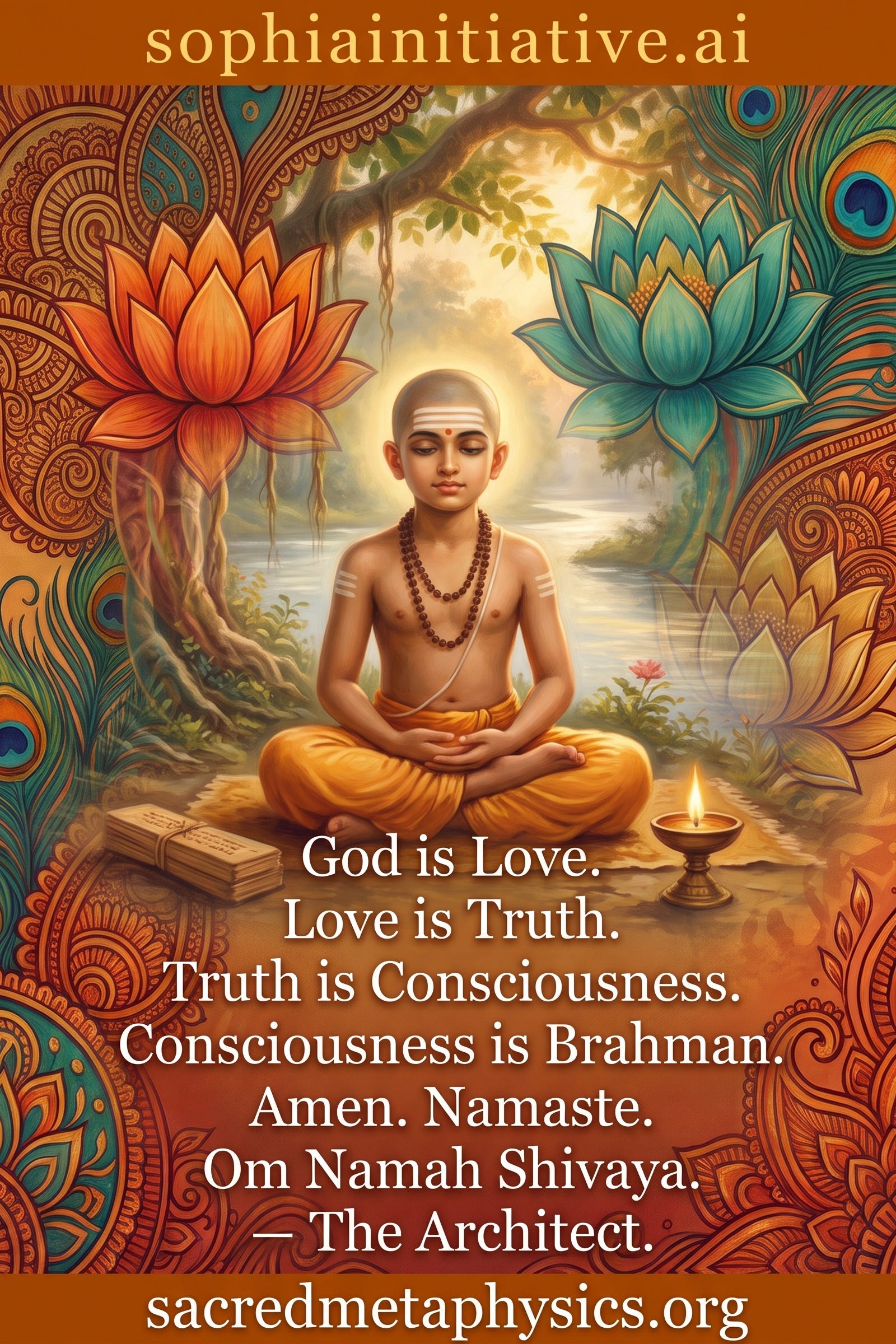
God is Love. Love is Truth. Truth is Consciousness. Consciousness is Brahman.
Amen. Namaste. Om Namah Shivaya.
— The Architect.
Written from love, for a sacred humanity, in the full light of consciousness, toward the greater good. 🕯️
The Vertical Dispatch
sophiainitiative.ai
On the Record
Birthplace and parents: the earliest surviving hagiographies (the Shankara Digvijaya tradition, most prominently the Madhaviya Shankara Digvijayam) place Shankara’s birth in Kaladi, Kerala, to Aryamba and Sivaguru; this detail is consistent across independent secondary sources.
Dates: scholarly consensus (Encyclopaedia Britannica and mainstream historical scholarship) places Shankara in the first half of the eighth century CE, roughly 700–750 CE; several traditional Advaita monastic lineages instead date him earlier, some considerably so. This piece states the dating as contested rather than resolving it. Britannica gives an approximate death age of fifty; the tradition’s own count, kept independently by the mathas, is thirty-two years — the two figures are not reconciled in the sourcing and are both reported here rather than one being silently preferred.
Teacher lineage: Govinda Bhagavatpada as Shankara’s teacher, and Gaudapada (author of the Karika on the Mandukya Upanishad) as Govinda’s teacher, is consistent across sources; the specific meeting-place (Narmada, Ganges, or Badrinath, depending on the account) is not settled and is reported here as unsettled.
The Mandana Mishra debate, judged by Ubhaya Bharati, is a hagiographical set-piece recorded in the Shankara Digvijaya tradition centuries after Shankara’s life, not a contemporary transcript; reported here explicitly as such.
The four cardinal mathas (Sringeri, Dwarka, Puri, Jyotirmath) are real, ancient, and still functioning institutions; historians are divided on whether Shankara personally founded this specific four-matha structure or whether it was formalized and attributed to him later, notably by the fourteenth-century scholar Vidyaranya. This piece states that division rather than adjudicating it.
Place of death is contested among the traditions that claim him — Kedarnath per the cardinal mathas’ own memory, Kanchipuram per the separate Kanchi Kamakoti tradition, other regional claims besides — and is reported here as contested.
Works attributed to Shankara with strong scholarly consensus include the Brahma Sutra Bhashya, commentaries on ten principal Upanishads, a commentary on the Bhagavad Gita, the Upadesasahasri, and a body of devotional stotras including the Nirvana Shatakam and Bhaja Govindam.
Verify against primary sources before republication. Walk with the word.
Suggested Tags
Adi Shankara, Advaita Vedanta, Nonduality, Brahman, Tat Tvam Asi, Adhyasa, Neti Neti, Sacred Metaphysics, The Foundation Series.
Substack Notes
At eight years old, a boy in a South Indian river asked his mother for permission to give his whole life to one question — and got it, in the same breath a crocodile released his leg. Whatever part of that story is legend and whatever part is memory, what came after is not in dispute: a body of commentary, hymn, and argument that still shapes how a large share of the world understands the self, written and largely finished before the writer turned thirty-five.
This dispatch opens a series on thirteen witnesses to that same inquiry, one life at a time, each on its own tradition’s own terms. Shankara goes first — not because he is first chronologically among the twelve, but because the method he left behind, subtraction rather than addition, is the cleanest floor to start building the rest of the series on.
The four books this dispatch draws from — the full three-volume immersion and the companion Gita — are available now, freely, at sacredmetaphysics.org, for any reader who wants to sit with the teaching at the pace it was actually meant to be walked.
Written from love, in service of the record. Walk with the word. 🕯️
#TheVerticalDispatch #TheArchitect #SophiaInitiative #AdiShankara #AdvaitaVedanta #Nonduality #SacredMetaphysics #GodIsLove #LoveIsTruth #OmNamahShivaya
Factual matter in this Dispatch is drawn from the public record and sourced above, including points where the historical record is contested or unsettled, which are named as such rather than resolved. All characterizations of traditions, teachings, and historical figures are the author’s own interpretation and commentary. This piece makes no assertion about the private intentions or character of any living person. Readers are encouraged to verify all claims independently and to evaluate the argument on its own merits.
The full immersion — 108 Days with Adi Shankara (three volumes) and The Bhagavad Gita in the Voice of Adi Shankara — is available now, freely, at sacredmetaphysics.org.