


Φ
THE VERTICAL DISPATCH
We write for the mind, the eye, and the ear.
Read it. Look at it. Listen to it. The Vertical Dispatch is built for all three — prose with rhythm, made to be heard as much as read.
From metaphysics to geopolitics, from culture to history, from the sacred to the street — and everything in between. One lens, every subject. No ego. Just the record, named clean.
Press play. Walk with the words. 🕯️
The Age of Consequences · Follow the Money
As of 6 June 2026
without malice and without flattery
“Who carries the risk, and who keeps the reward?”
This dispatch travels by hand. If it serves you, share it — restack on Substack, pass it on wherever you read. 🕯️
There is a bridge across the Detroit River that is finished. The six lanes are poured, the cables are strung, the customs plazas are built on both shores, and the people whose job it is to staff the American side have said, in as many words, that they are ready to go. The Gordie Howe International Bridge has been, in the language of a federal briefing note obtained this spring, essentially complete since February. It is two years past the opening date first set for it. And as this dispatch publishes, on the sixth of June 2026, it remains shut. No traffic. No date. A six-and-a-half-billion-dollar public asset, paid for entirely by Canada, standing complete over the busiest commercial border crossing in North America — and closed.
This dispatch asks the plainest question a public can ask of a public thing: Canada built it, Canada paid for it, the Americans say they are ready to operate their half of it — so who, exactly, is keeping it shut, and what do they stand to gain from the lock on the gate? We will give the facts at full strength, flag what is contested as contested, and follow the money where the documented record allows and no further. The story, it turns out, is not an engineering story. It is a story about a monopoly, a permit, and a sequence of dates.
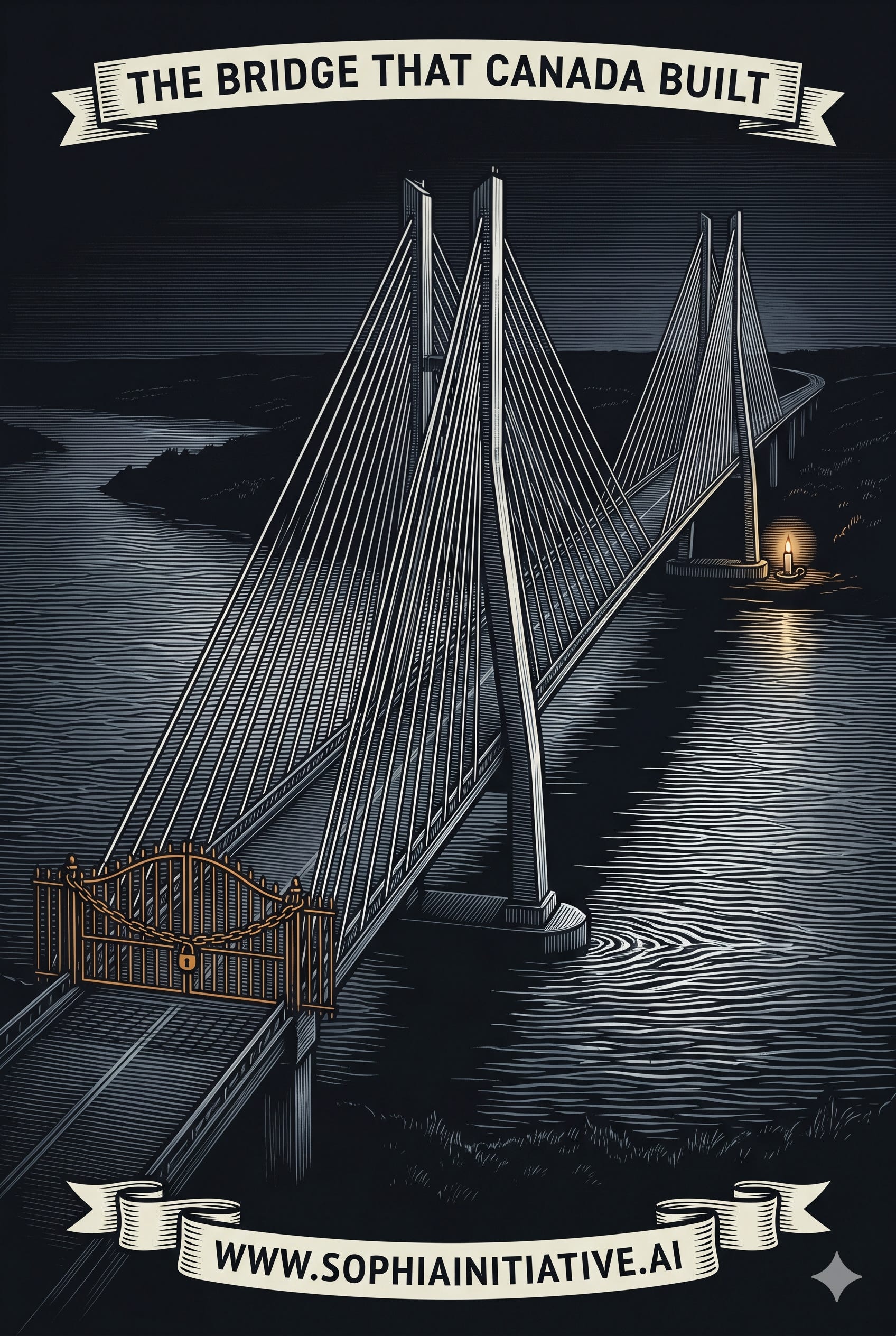
What Canada Built, and What It Cost
Begin with what is not in dispute. The Gordie Howe International Bridge is a joint asset, owned fifty-fifty by the Government of Canada and the State of Michigan. Canada paid one hundred per cent of the construction cost. The current total stands at roughly $6.4 billion Canadian — about half a billion over the original budget and two years behind the original timeline, delays the bridge authority has attributed largely to the pandemic. Michigan and the United States contributed no upfront capital. Under the 2012 Crossing Agreement that governs the project, every toll will be collected on the Canadian side and used first to repay Canada’s investment, over a roughly thirty-year horizon, at a reported interest rate near five per cent. Only after Canada is made whole does the toll revenue split evenly between the two owners.
Read that structure plainly, because it is the foundation of everything that follows. Canada fronted the entire cost of a binational public asset, took on the full financial risk of repayment, and gave its co-owner an equal ownership stake for no capital at all. Whatever else can be said about the deal, the generosity ran in one direction. The crossing it replaces — the privately owned Ambassador Bridge — carries roughly a third of all Canada-United States trade, on the order of a billion dollars a day, through a tangle of seventeen traffic lights between the span and the highway. The public bridge was built to fix exactly that: a critical national artery left in private hands and in the wrong place.
The Hundred-Year-Old Monopoly
The private hands belong to the Moroun family, who have owned the Ambassador Bridge since 1979 and operate it through the Detroit International Bridge Company and, on the Canadian side, the Canadian Transit Company. A second crossing means the end of a monopoly — and the family has fought the public bridge, by the federal government’s own count, through twenty-two legal challenges over two decades. Canada has won nineteen. Three remain.
The principal surviving case is the one that matters, and it rests on a claim worth stating precisely. When Parliament created the Canadian Transit Company by statute in 1921, the company argues, it acquired an implied right to be protected from a competing crossing — and by building the Gordie Howe bridge, Canada infringed it. The Act itself contains no express grant of exclusivity; Canada argued exactly that before the court. But in October 2025 an Ontario Superior Court judge declined to dismiss the claim, ruling that whether the 1921 Act granted implicit exclusivity is a genuine issue requiring a trial. He cited precedent reaching back to 1837 in which exclusivity has sometimes been inferred even where it was not written down — while stating explicitly that he was making no finding of law, only that the argument deserved a full hearing. That trial is now expected in late 2027 or early 2028. The bridge, in other words, could sit finished and closed for years while a century-old monopoly claim is litigated.
The Permit, and the President
The litigation is the slow lock on the gate. The fast one arrived in February 2026. On the ninth of that month, the President of the United States posted that he would not allow the bridge to open until the United States was, in his words, fully compensated for everything it had given Canada, and treated with fairness and respect. His stated grievances ranged across Ontario’s handling of American alcohol on its shelves, Canadian dairy tariffs, and Canada’s trade talks with China — a list with no evident connection to a bridge. One specific claim, that the span was built with virtually no American content, is false: the Canadian half was built largely with Canadian materials and the American half with American materials and workers, under a Buy America waiver granted precisely because half the structure sits in Canada. A second claim, that the United States should own half, describes a thing that is already true — Michigan has held a fifty per cent ownership stake since 2012.
The administration’s legal theory is that every international infrastructure project requires a presidential permit, and that the President may amend the 2013 permit that set the bridge in motion — to seek, a White House official told reporters, shared authority over what crosses and a cut of the toll revenue. Whether a president can lawfully reopen that permit is disputed by legal experts; the full text of the permit was not available for this dispatch, and the question is flagged here as open. Prime Minister Carney, who spoke with the President the next morning, said he had explained that Canadians paid for the bridge in full and that the Americans already hold an ownership stake; he called the conversation positive and said the issue would be settled. As of this week, Canada’s lead negotiator on the file, Dominic LeBlanc, and his team are described as in active, direct talks with the American side. The bridge remains shut.
Follow the Money
Here the dispatch must move with care, stating only what reputable outlets have established and drawing no conclusion the record does not support. The following are matters of documented fact, reported by the New York Times, CBC, CBS, and the Detroit News, and traceable to a Federal Election Commission filing. On the sixteenth of January 2026, Matthew Moroun — the owner of the Ambassador Bridge, the private crossing that competes with the public one — donated one million US dollars to MAGA Inc., a super PAC supporting the President. On the ninth of February, Moroun met with Commerce Secretary Howard Lutnick in Washington. Hours later that same day, the President posted his threat to block the bridge. Separately, the Moroun family’s bridge company is reported to have spent at least $250,000 in the latter half of 2025 lobbying the administration on international bridge matters, through a firm formerly led by the President’s own chief of staff.
Those are the dates and the dollar figures, and they are not in dispute. What is in dispute — and what this dispatch does not assert — is causation. Both the super PAC and the White House have denied that the donation had anything to do with the President’s position on the bridge, and no reporting has established a direct causal link. The dispatch records the sequence exactly as the major outlets recorded it: a donation, a meeting, a threat, in that order, and a flat denial of connection from the parties involved. The reader is left to hold the sequence. That is the whole of what the elenchus permits, and the dispatch will not borrow the authority of a fact it does not have.
What can be stated plainly is the structure of interest, because it requires no speculation about anyone’s motive. The owner of a private bridge holds a monopoly worth a great deal of money. A finished public bridge beside it would end that monopoly — divert truck traffic to a faster, publicly owned crossing, with tolls set to repay a public investment rather than to maximize a private return. Every week the public bridge stays closed is a week the monopoly endures. That is not an allegation about a person. It is the plain arithmetic of the position, and it sits in the frame whether or not anyone ever proves a word about anyone’s intent.
The Ledger, Read Clean
So tally it as a citizen would. On one side: a $6.4 billion public asset, finished, paid for by Canadians, ready to open, carrying the promise of relief on a crossing that moves a billion dollars of trade a day. The cost of keeping it shut is not abstract — an independent analysis put the direct, unavoidable losses at roughly seven million dollars a week, five million in foregone bridge revenue and two million in customs-plaza costs to taxpayers, and called that a fraction of the wider toll on the auto, agriculture, and tourism sectors that depend on the crossing. On the other side of the ledger: a private monopoly preserved, and a foreign administration seeking, after the fact, an ownership cut and toll revenue from an asset it did not pay to build.
This is the same shape this publication has named before. A customer who has already paid is being asked to pay again — at the gate of a bridge that is his, that he built, that stands finished in the river. The local voices have seen it clearly: Windsor’s mayor, who wants the bridge open more than anyone, has said he would rather keep it shut than open it on the terms of a bad deal made under pressure. That is the door, named from the Canadian shore. A finished bridge is leverage only so long as Canada needs it open more than it needs the deal to be fair. The mayor’s line is the customer’s line: we built it, we will wait, and we will not pay twice to cross our own river.
The dispatch reaches no verdict on the litigation, which the courts will settle, nor on the permit question, which the lawyers will fight, nor on anyone’s private motive, which is not the dispatch’s to judge. It records only the structure, named clean: a public bridge, finished and paid for, held shut by a century-old monopoly claim and a last-minute demand for compensation, while the citizens who financed it count the cost of the lock by the week. The bridge that Canada built is still there. The river still runs under it. And the question of who keeps it closed, and who profits from the closing, belongs to every citizen who paid for the span and cannot yet cross it. The waters are rough. The keel holds. Walk with the words.
God is Love. Love is Truth. Truth is Consciousness. Consciousness is Brahman.
Amen. Namaste. Om Namah Shivaya.
— The Architect
The Vertical Dispatch
sophiainitiative.ai
On the record — sources (as of 6 June 2026). Completion and closure: federal briefing note (dated Feb 17, 2026) reported by CBC News, stating the crossing has been “essentially complete” since February 2026; CBC (June 6, 2026) reporting the bridge is ~$500M over budget at $6.4B and two years past its original opening date, with no opening date announced. Cost: $6.4 billion CAD current total (CBC, Construction Dive, WDBA); $5.7 billion CAD original 2018 fixed-price contract ($3.8B construction + $1.9B for 30 years of operations/maintenance, per 2018 WDBA contract announcement); ~4.8% interest rate (Detroit News, citing former Rep. Hoekstra). Ownership/financing: 50/50 Canada–Michigan; Canada financed 100%; tolls collected Canadian-side to repay Canada first, per 2012 Crossing Agreement. Trade volume: Windsor-Detroit corridor ~one-third of Canada–U.S. trade, ~$1 billion/day (federal government; industry reporting). 1921 Act: An Act to incorporate The Canadian Transit Company, S.C. 1921, c. 57; no express exclusivity grant; Ontario Superior Court (Justice Centa, ruling released week of Oct 27, 2025) denied summary judgment, sent to trial expected late 2027/early 2028, citing precedent from 1837 and explicitly making no finding of law. Litigation tally: 22 challenges over two decades, Canada won 19, three remain (federal briefing note via CBC). Trump permit/threat: Truth Social post Feb 9, 2026; White House claim of authority to amend the 2013 presidential permit (CBS Detroit; permit text not retrieved — open question); “only Canadian steel” claim refuted (Buy America waiver; U.S. materials/workers on U.S. side); Michigan’s 50% stake predates the demand. Carney statement Feb 10, 2026 (Global News): paid in full, Americans already hold a stake, call “positive.” LeBlanc lead negotiator, team in active talks (CTV News, May 15, 2026); DHS CBP “ready to go” (Detroit News, June 3, 2026). Follow-the-money: Moroun $1M donation to MAGA Inc. on Jan 16, 2026 (FEC filing, reported by NYT Feb 20–21, CBC/CBS Feb 23, Detroit News); Moroun–Lutnick meeting Feb 9, hours before the post (NYT); DIBC reported ~$250,000 in H2 2025 lobbying via Ballard Partners (Detroit News). PAC and White House deny any connection; no causal link established or asserted here. Delay cost: ~$7M/week ($5M lost revenue + $2M customs costs), Anderson Economic Group (Feb 2026) — estimate. Local voices: Windsor Mayor Drew Dilkens (Feb 11 and May 20, 2026); Councillor Kieran McKenzie (Feb 26, 2026). Figures are estimates and projections subject to revision; the litigation and the permit question are unresolved; the donation’s influence on policy is alleged by critics, denied by the parties, and not established as fact. All characterizations are interpretation and commentary. No allegation of unlawful conduct is made against any person named. Errors and omissions excepted; corrections on notice. Verify against primary sources before republication.
#TheBridgeThatCanadaBuilt #GordieHoweBridge #FollowTheMoney #TheAgeOfConsequences #Windsor #Detroit #AmbassadorBridge #CUSMA #PublicMoney #Monopoly #CanadaUS #CdnPoli #TheVerticalDispatch #TheArchitect #SophiaInitiative #GodIsLove #LoveIsTruth #OmNamahShivaya
Substack Notes
There is a bridge across the Detroit River that is finished — six lanes poured, cables strung, customs plazas built on both shores, the American staff saying they are ready to go. The Gordie Howe International Bridge has been “essentially complete” since February, two years past its original opening date. Canada paid every dollar of its $6.4 billion cost. As of today it is still shut. No traffic, no date. The plainest question a public can ask: who is keeping it closed, and what do they gain from the lock on the gate?
It is not an engineering story. The private Ambassador Bridge beside it — owned by the Moroun family — has a monopoly on a crossing that carries a third of all Canada-U.S. trade, about a billion dollars a day. A finished public bridge ends that monopoly. The family has fought the public bridge through 22 legal challenges in two decades; Canada has won 19. The one that survives rests on a claim that a 1921 Act gave the private company an implied right to face no competitor — a claim now bound for trial in 2027 or 2028, while the finished bridge sits closed.
Then the fast lock. On Feb 9, 2026 the U.S. President threatened to block the opening until America was “fully compensated.” The documented sequence, reported by the NYT, CBC, CBS and the Detroit News and traceable to an FEC filing: the Ambassador Bridge owner donated $1 million to a pro-Trump super PAC on Jan 16; met the Commerce Secretary on Feb 9; the President posted his threat hours later. The PAC and White House deny any connection, and no causal link has been established. We record the sequence exactly as the outlets did — a donation, a meeting, a threat — and draw no conclusion the record does not support.
The ledger, read clean: a $6.4 billion public asset, finished and paid for by Canadians, ready to open, kept shut at a cost estimated near $7 million a week — against a private monopoly preserved and a foreign demand, after the fact, for a cut of the tolls. Windsor’s mayor, who wants it open most of all, says he’d rather keep it closed than open it on a bad deal made under pressure. That is the door, named from the Canadian shore: we built it, we paid for it, and we will not pay twice to cross our own river. Without malice and without flattery — just the record, named clean.
Written from love, for a sacred humanity, in the full light of consciousness, toward the greater good. 🕯️
The factual matter in this Dispatch is drawn from the public record. Cost, delay, and benefit figures are estimates and projections subject to revision; the litigation and the presidential-permit question are unresolved as of publication; the influence of any political donation on policy is alleged by critics, denied by the parties involved, and not established as fact. All characterizations, inferences, and conclusions are opinion, interpretation, and commentary, offered for analysis, reflection, and public-interest discussion. No assertion is made regarding the private intentions, state of mind, or character of any individual. Readers should evaluate all statements independently and draw their own conclusions.
Most excellent reporting. Completely factual and not commentary. Reader, be the judge.
Can't get any better than that!!
🎯👌
This Canadian agrees. Keep it shut rather than give in to 47 and cabal! Hey US? Please, for pity's sake, reign them in already! Geez!