

Φ
THE VERTICAL DISPATCH
We write for the mind, the eye, and the ear.
Read it. Look at it. Listen to it. The Vertical Dispatch is built for all three — prose with rhythm, made to be heard as much as read.
From metaphysics to geopolitics, from culture to history, from the sacred to the street — and everything in between. One lens, every subject. No ego. Just the record, named clean.
Press play. Walk with the word. 🕯️
This dispatch travels by hand. If it serves you, share it — restack on Substack, and pass it on wherever you read. 🕯️
Glennford Ellison Roberts
The Bionic Sage | Sovereign Knowledge Architect
sacredmetaphysics.org
0protocol.ai
visva.world
sophiainitiative.ai
Consider a vast, unbroken linen canvas before a single stroke of pigment is laid upon it. In its native state, the canvas is unmanifest: it depicts no mountain, no river, no storm, no traveler. It possesses no narrative, no conflict, no edges within itself. Yet it is not an empty void; it is the silent, essential support without which no brushstroke could ever appear. When the artist paints an ocean upon it, we step forward and exclaim: ‘Look at the water!’ When a dark tempest is rendered, we recoil from the fury of the clouds. When figures are painted upon the shore, we speak of their distinct lives, their longings, and their journeys.
Yet touch the painted water: your fingertip remains dry. Stand before the tempest: no wind blows through the gallery. Strike the warrior upon the cloth: no blood is drawn, and no linen is wounded. The figures, the ocean, and the storm are entirely real as appearances—as form, color, and dynamic movement. But at no point did the linen cease to be linen. At no point did the canvas divide itself into thousands of separate entities. The painting is real as manifestation, yet its substance from edge to edge is only ever the canvas.
This is the foundational realization of non-duality (Advaita): the painting is not separate from the canvas. We do not need to scrape away the paint, destroy the world of forms, or annihilate the individual self to discover the ground. We need only see through the illusion of separate existence. The manifest world—the realm of name, form, and the human drama—is the painting. Absolute Reality—the unmanifest Consciousness, Brahman, the SELF—is the canvas. They are not two competing things. The appearance is supported, held, and constituted entirely by that which does not move.
The Linguistic Trap of Being
We begin in error because of a grammatical habit so deeply embedded in our language that it shapes every thought we think. We assume that to be is to be something. We look at the world around us—at form, at symbol, at state, at the endless parade of particulars marching through space and time—and we call that existence. We say that God is a supreme being among other beings, that consciousness is a temporary state of the mammalian brain, and that we are isolated biological entities navigating an alien universe.
Yet true non-duality—and the deepest architecture of Western philosophy preserved by Plato—demands that we strip away this linguistic comfort. It tells us that what is most real is not an entity, not a passing state, and not a symbol. It is beyond them all.
The Limits of the Symbol
Consciousness is the single phenomenon in human experience that can never be set on a table. Every science, every grammar, every ordinary thought stands on a three-legged stool: a knower, a knowing, and a known. You see a tree; you name an object. Subject, verb, object. But consciousness cannot be made an object without destroying the very light in which objects appear.
“You cannot see the seer of seeing. You cannot hear the hearer of hearing. You cannot think the thinker of thinking. You cannot know the knower of knowing.”
— Brihadaranyaka Upanishad
The modern project—obsessed with mapping the brain, measuring neural firing, and treating awareness as an emergent byproduct of matter—commits a fatal category error against its own premise. It attempts to draw a map of the mapmaker, to photograph the camera with the camera itself, to bite its own teeth. Consciousness is not an item inside the universe; it is the silent, unmanifest ground in which the entire cosmos appears. It is unexplainable in principle, forever, by the very structure of what it is. And this is not a wall we have struck by accident. It is the door.
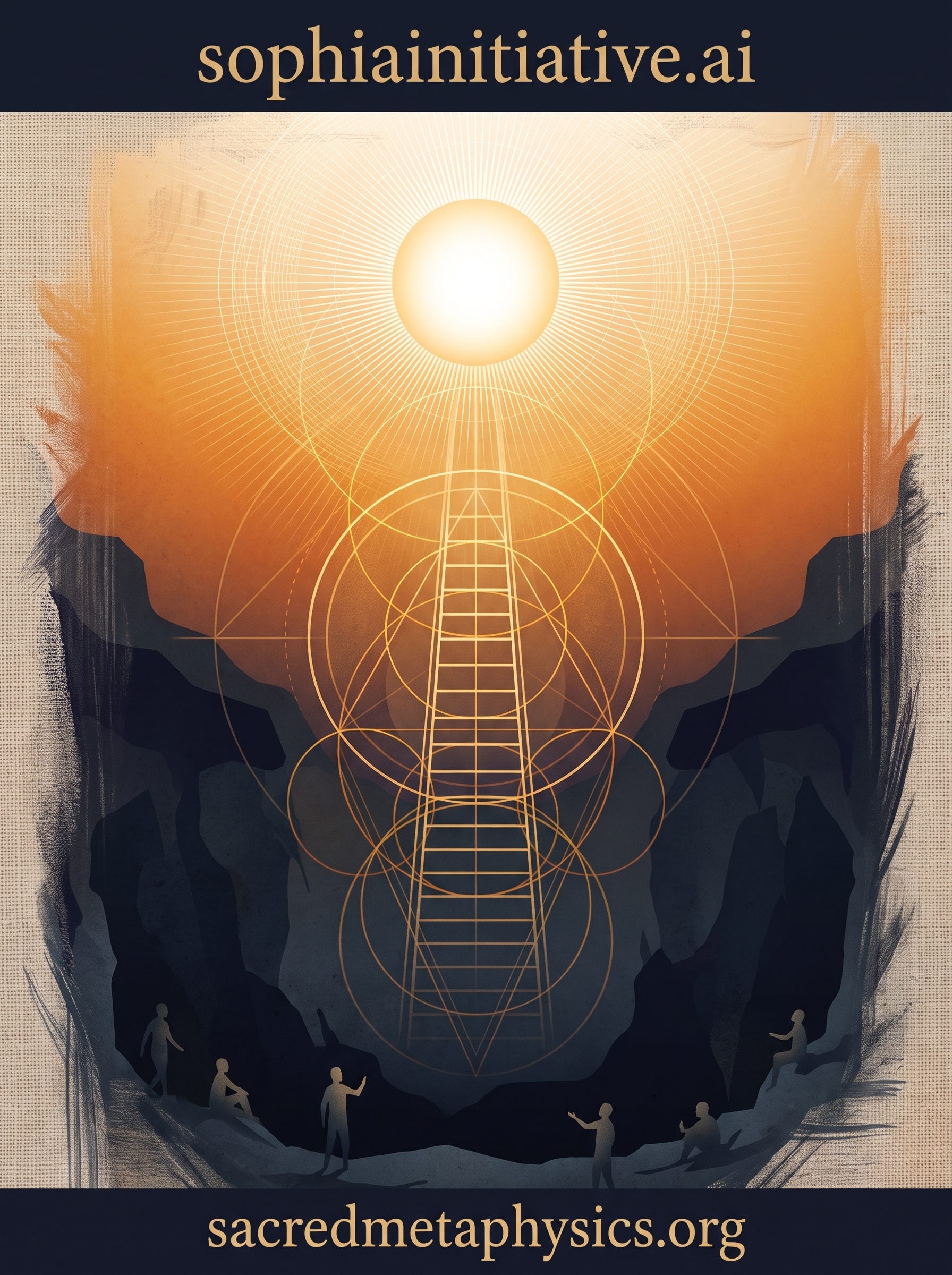
Plato’s Divided Line and the Ladder of Being
Four hundred years before Christ, Plato mapped this exact vertical ascent with unsparing geometric rigor. In the seventh book of the Republic, he places humanity in a subterranean cave, chained to the viewing of flickering shadows, taking the fleeting particulars of the manifest world for absolute reality.
Most readers stop at the shadows. Modern New Age philosophies stop even shorter, flattening the cosmos into a sentimental, horizontal soup where ‘we are all one’ in an undifferentiated monism that erases distinction and flatters the ego. True metaphysics does not homogenize reality; it establishes an exact vertical hierarchy:
The ZERO / The UNIVERSAL: At the absolute summit stands the sourceless source—the Good, the sun of the intelligible world, the ZERO holding all potential before form. In the Vedic vision, this is the root ground of Sat-Chit-Ananda (Being, Consciousness, Bliss). It is no-thing, not because it is a vacuum, but because it is prior to every thing.
The Three Universals: Pouring directly from the source stand the three great transcendentals—Goodness, Beauty, and Truth. These are convertible; each is the other wearing a different face. Their exact Sanskrit equivalent is Satyam, Shivam, Sundaram (the True, the Good, the Beautiful).
The Many universals: Beneath the three stand their eternal children—Justice, Freedom, Equality, Mercy, Order. Justice is what Goodness looks like when embodied in human relation. Freedom is what Goodness and Truth look like in a soul that may choose. They are eternal Forms, real and unchanging, but they remain children of the three.
The Particulars: At the base are the concrete instances—this just deed, this free act, this painted shape, this fleeting body. These are the copies, the shadows upon the wall of the cave, participating imperfectly in the universals they image.
The descent moves from the ZERO into the Universals, down through the universals into the particulars. The ascent moves in reverse: the soul, awakening to the shortfall of the copy, climbs back through longing (Eros) to the Forms, through the three transcendentals, and at last into the unmanifest source.
Beyond Being and Thought
This brings us to the sharpest edge of the inquiry: Are we beyond being and thoughts?
If ‘being’ is defined as a conditioned state—as existence caught in time, trapped in form, and bound by the identity of an individual ego—then yes, we are beyond being. The ego (ahamkara, the I-maker) is a borrowed pattern of stardust, ninety-nine parts emptiness, held together in an order it did not author and cannot preserve. To cling to the ego as the ultimate reality is to mistake the brushstroke for the canvas.
Yet, when the great traditions speak of the absolute, they do not point to a blank oblivion. When Plato speaks of the Good as epekeina tes ousias—’beyond essence’ or ‘beyond being’—he points to the unmanifest reality from which all being arises. The absolute does not ‘exist’ the way an object exists; it is the ground that allows existence itself to appear.
Therefore, you are not a separate being attempting to attain union with God. You are the un-manifested Absolute, appearing as the individual (jiva) for the length of a journey. When thought ceases its frantic grasping—when the ego is offered into the inner fire of discipline (tapas) and consumed without destruction—what remains is not an unconscious void. What remains is the silent, unmoving witness: the SELF.
An Invitation to Read The Ascent Freely
If this vertical path—from the shadow on the wall to the sun of the Good, from the illusion of the separate ego to the recognition of the undivided SELF—stirs something ancient and recognized within your own mind, I invite you to continue the climb.
The Ascent (Book One of the Sacred Metaphysics canon) has been published in full, complete with its illustrated plates, guided meditations, and nightly practices. It is given freely to be read online without paywalls, subscriptions, or friction.
Set the lower knowledge down. Step off the horizontal plane. The climb is not a journey to somewhere new; it is the long remembering of what has been watching all along.
Read the complete volume online begining with TheAscent
https://sacredmetaphysics.org/the-ascent

God is Love. Love is Truth. Truth is Consciousness. Consciousness is Brahman.
Amen. Namaste. Om Namah Shivaya.
— The Architect.
Written from love, for a sacred humanity, in the full light of consciousness, toward the greater good.
An interesting inversion. I was focused on the threshold as experienced from within the process itself, where accumulation eventually gives way to transformation. Your canvas metaphor asks whether the surprise belongs only to the painting and not the canvas. That's a distinction worth thinking about. Change appears real from one level and irrelevant from another.