

Φ
THE VERTICAL DISPATCH
We write for the mind, the eye, and the ear.
Read it. Look at it. Listen to it. The Vertical Dispatch is built for all three — prose with rhythm, made to be heard as much as read.
From metaphysics to geopolitics, from culture to history, from the sacred to the street — and everything in between. One lens, every subject. No ego. Just the record, named clean.
Press play. Walk with the word. 🕯️
This dispatch travels by hand. If it serves you, share it — restack on Substack, and pass it on wherever you read. 🕯️
Statecraft · The Age of Consequences
June 11, 2026 — the eve of the Évian G7. Volatile facts date-stamped as of this day.
“If we’re not at the table, we’re on the menu.”
— Mark Carney, Davos, January 20, 2026
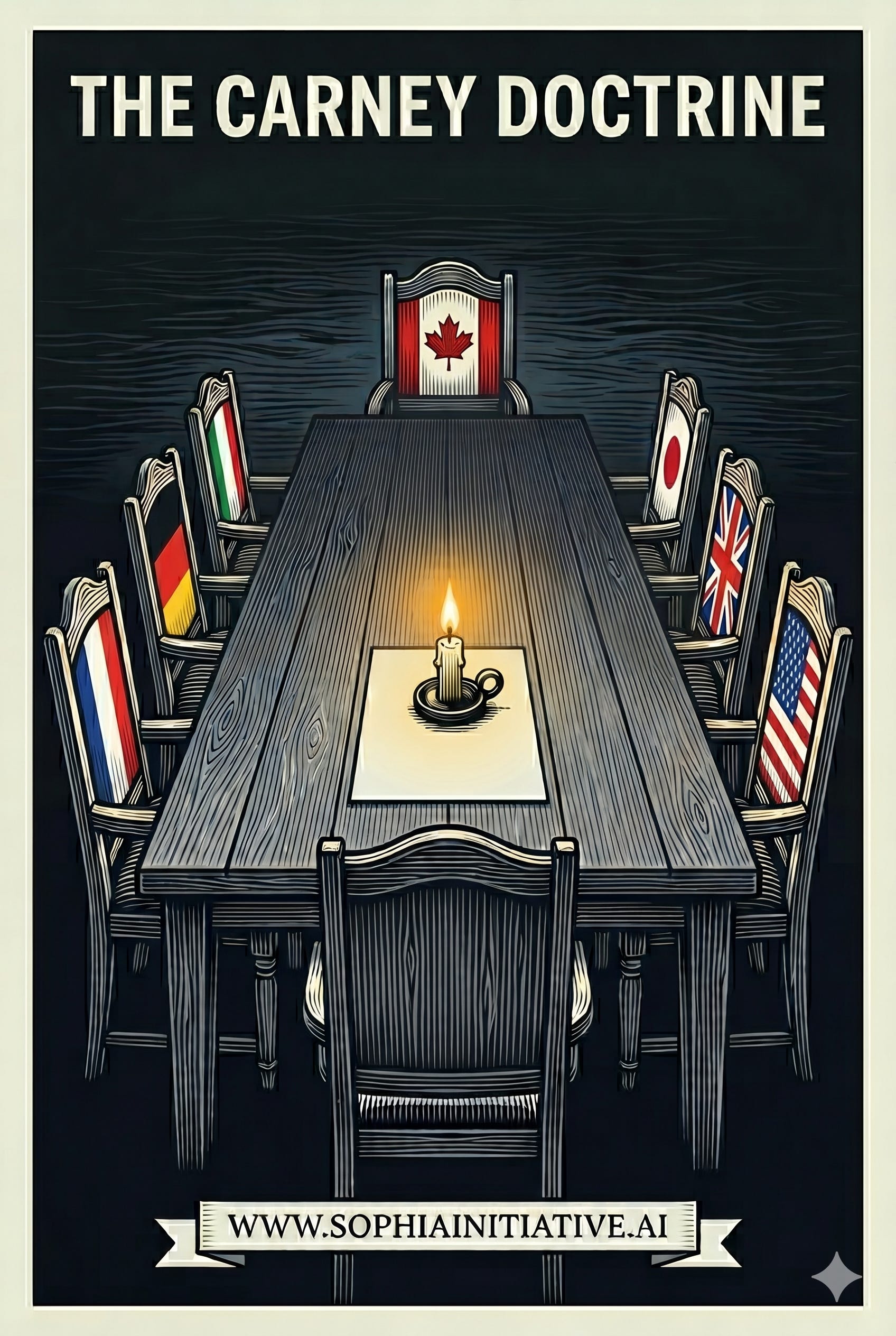
Tonight, the Prime Minister of Canada boards a plane for Europe. It is his ninth trip to the continent since taking office — nine crossings in just over a year, a frequency that is itself a policy statement. The itinerary reads like a deliberate sentence: Paris first, to meet Macron; then Dublin, the first bilateral visit to Ireland by a Canadian prime minister in nearly a decade; then County Mayo, where his grandparents left for Canada in the early 1920s and where he will meet the President of Ireland; then Évian-les-Bains, on the French shore of Lake Geneva, where the G7 leaders convene June 15 to 17.
Two facts about this summit tell you more than any briefing book. The first: the leaders are expected to forgo a joint communiqué. Canadian officials, speaking on background, say to expect standalone statements on specific topics instead — because a communiqué, as one analyst put it to the CBC, becomes a focal point for differences, and there is one chair at the table from which agreement is very hard to obtain. The G7, the most exclusive coordination table in the Western world, has quietly concluded that it can no longer write a single page all seven can sign.
The second fact is smaller and stranger, and the wire services reported it without comment: the summit was delayed by one day because the President of the United States scheduled a UFC fight at the White House for June 14 — Flag Day, and his eightieth birthday. The most powerful man in the world moved the calendar of the Western alliance for a cage match. No editorialist needed to gloss it. The fact glosses itself.
Into that room, on Monday, walks Mark Carney. He hosted this gathering a year ago at Kananaskis. He attends this one as a guest — and yet, if you read what the prestige press of every G7 nation has written about him since January, he arrives as something none of the communiqué-drafters can quite say out loud. The American press calls him the star of Davos. The French press calls him the tightrope walker. The German press gave his admirers a name — the Carney-vores — and called his January speech the plain talk Europe had been waiting to hear. The Italians consecrated him the anti-Trump. The Japanese, more sober than all of them, treat him as a partner to study and a gambler to watch.
Seven national presses. Seven languages. No coordination, no shared editor, no common owner. And one implicit, converging verdict that not a single outlet has stated as a sentence. This dispatch states it. There is a Carney Doctrine. It has three articles. The press of the democratic world has been documenting each one for five months without naming the structure they compose. Naming structures is what this publication does.
The Word the Press Will Not Say
First, the discipline of the house, because this piece walks near a line we have drawn and held: we do not write hagiography. We judged the chairs of this man’s cabinet “without malice and without flattery,” and we will not crown the man at the head of the table after declining to crown his ministers. What follows is not a verdict on Mark Carney’s character, his virtue, or his soul. We cannot see those, and neither can the Financial Times. What follows is a reading of the documented record — what he said, what he built, how the press of seven nations received it — and of one remarkable silence inside that record.
A doctrine, properly speaking, is not a compliment. The Monroe Doctrine was not praise of Monroe; the Truman Doctrine was not a character reference. A doctrine is a named, coherent pattern of state behaviour — a diagnosis of the world plus a rule of action that follows from it — stable enough that allies and adversaries can predict the state’s next move from it. By that definition, doctrines are facts about conduct, not virtues of men. The question this dispatch asks is narrow and checkable: does the documented record of Canadian statecraft since January 2026 display a diagnosis, a rule of action, and a predictable pattern? It does. Here is the structure.
Article One: The Diagnosis — Name the Rupture
On January 20, 2026, at the World Economic Forum in Davos, Carney delivered a speech titled “Principled and Pragmatic: Canada’s Path.” He spoke the day before the President of the United States addressed the same hall. The speech’s thesis can be stated in one line because Carney stated it in one line: the world is living through a rupture, not a transition. The post-Cold War rules-based order — the pleasant fiction underwritten by American hegemony — is not strained, not stressed, not in need of repair. It is over, and it is not coming back.
Read the structure of the argument rather than its temperature, because the structure is what made it land. Carney did not begin with a prescription. He began with a diagnosis, and he refused to flinch from it: great powers have begun using economic integration as a weapon — tariffs as leverage, financial infrastructure as coercion, supply chains as vulnerabilities to be exploited. Middle powers that negotiate alone with a hegemon negotiate from weakness; they accept what is offered; they compete with each other to be the most accommodating. He called that condition by its true name — in the speech’s most surgically precise phrase, “the performance of sovereignty while accepting subordination.” Symbol detached from referent. A flag on the desk and no hand on the wheel. We have spent a year in this publication teaching exactly that distinction, and here it was, spoken from the Davos podium by a head of government.
Then — and only then — the prescription, sized to the diagnosis. Mourning is useless; nostalgia is not a strategy. Middle powers, the countries with the most to lose in a world of fortresses and the most to gain from genuine cooperation, must combine — not in naive multilateralism, but in coalitions that work issue by issue, with partners who share enough ground to act together. And then the line that crossed the world in a day, the eleven words that did the work of eleven communiqués: if we’re not at the table, we’re on the menu.
The room of presidents, ministers, and chief executives gave him a standing ovation. The President of the United States, addressing the same forum, responded by name. Trump told the hall that “Canada lives because of the United States” and added a warning addressed to the Prime Minister personally — remember that, Mark, next time you make your statements. Days later, the U.S. Treasury Secretary went on television to claim Carney had been “very aggressively walking back” the speech in a phone call with the President. Carney’s public account of the same call was five words long: “I meant what I said.”
Hold those three data points together, because together they are the first article of the doctrine in miniature. A diagnosis delivered without euphemism. A great power’s public attempt to reframe the diagnosis as ingratitude. And a refusal to let the reframing stand — quiet, total, five words. The diagnosis is the foundation; everything that follows is built on it; and the builder does not allow the foundation to be renamed by someone else. Any reader of this publication will recognize the method, because it is the method we have argued for since our first dispatch: diagnosis before prescription, and the claim never permitted to outrun the referent. We do not suggest the Prime Minister has read our masthead. We observe that the wave and the keel obey the same physics whoever is in the boat.
Article Two: The Construction — Milestones, Not Mood
A diagnosis without execution is a column, not a doctrine. The second article is the one that separates Carney from every leader who has given one good speech: in the four and a half months since Davos, the record shows completed milestones — zero-duration flags, as a project scheduler would say, each one verifying that real effort actually finished behind it. Consider the verified sequence, date-stamped as of June 11, 2026.
On June 4, in Toronto, Carney launched AI for All, Canada’s national artificial intelligence strategy: more than two billion dollars committed, a target of 250,000 AI-related jobs over five years, adoption pushed from roughly twelve per cent of the economy toward sixty per cent by 2034, a sovereign compute fund built up to a billion dollars so that Canadian labs and startups are not wholly dependent on American hyperscalers, a sovereign cloud, a planned world-leading supercomputer, and new legislation promised on data, privacy, and the protection of children — with Canada explicitly carrying child-safety AI standards to the G7 as a priority. Asked whether building sovereign AI infrastructure might irritate Washington, Carney declined the premise in four words that are already travelling: this is a strategy “any sentient country” is taking. The strategy also formalizes the Sovereign Technology Alliance with Germany — the diagnosis of January operationalized as joint infrastructure by June.
The same pattern repeats across every file. A trade agreement concluded with China — Canada’s second-largest trading partner — after a January visit to Beijing, undertaken in the teeth of American tariff threats and defended by Carney on explicitly pragmatic grounds. A recently announced sovereign wealth fund to anchor economic security at home (the government has not yet released its mechanics, and we will not print a dollar figure it has not confirmed). Defence diversification reported on two tracks: negotiations toward Swedish Saab GlobalEye surveillance aircraft, and submarine-procurement talks with Germany following the German defence minister’s visit to Ottawa — both moves reported in the European press as Canada deliberately easing its reliance on American supply chains. In Ireland this week: an accelerating push for full CETA ratification, reported by the Irish press as Dublin’s own move to reduce dependence on the United States. And through all of it, the steady drumbeat of the thing itself — nine trips to Europe in a year, Paris always first.
Run it through the bank-loan test this publication applies to every grand strategy: if this were a project plan on a lender’s desk, would it get funded? The constraints were named up front, in the Davos speech itself — great-power hostility, the weakness of negotiating alone, the temptation of accommodation. The milestones since are not promises but completions: a strategy launched, an alliance formalized, an agreement signed, negotiations opened on specific aircraft and specific submarines. Whether the critical path closes — whether the coalition of middle powers actually coheres into leverage — is genuinely unknown, and we will come to the strongest case that it will not. But no honest reviewer can mark this file “rhetoric.” The effort is verifiably underway, and the flags are planted in the record, not in the mood.
Article Three: The Conduct — The Temperature of the Voice
The third article is the hardest to source and therefore the one we will source most carefully, because it concerns manner, and manner is where journalism shades into projection. Here is the discipline: we will not tell you what Mark Carney is like. We will tell you what the documented record of his public conduct contains, and what the press of seven nations has independently chosen to notice about it.
What the record contains: a head of government who delivered the most confrontational Western speech of the decade without raising his voice or saying his adversary’s name; who, publicly contradicted by the U.S. Treasury about his own phone call, corrected the record in five words and moved on; who answers questions about provoking Washington by declining the frame rather than escalating within it. The pattern is consistent enough across five months that it constitutes conduct, not mood: maximum clarity at minimum temperature. The page stays cold even when the stakes are hot — a register this publication has reasons of its own to respect.
What the press noticed: that is the survey, and it deserves its own room. Because the third article of the doctrine is not really Carney’s conduct. It is what that conduct has produced — a documented, multinational, uncoordinated convergence of reception. Reception is checkable. Here it is, masthead by masthead.
Seven Mastheads, One Verdict
United States. The Washington Post’s global affairs columnist put it in a headline on January 23, three days after the speech: Trump dominated Davos — but Canada’s Carney was the star. The American prestige press has since tracked the follow-through as policy, not personality: the New York Times has reported his AI strategy under the frame of a Canada deliberately betting on its own capacity out of wariness of the United States, and his spring itinerary as a pulling-closer to Europe. Foreign Policy’s early profile fixed the working description — a tough negotiator who does not suffer fools. And the American right supplies the indispensable dissent: The Federalist has attacked Carney’s China engagement as an aggressive embrace of Beijing and dismissed Davos as posturing. Note what even the attack concedes — it argues with the strategy’s direction, not its existence.
France. The French press has adopted him with an enthusiasm that would embarrass a Canadian. Le Monde’s March profile crowned him l’équilibriste — the tightrope walker — and ranked him among the most prominent leaders on the planet; its podcast branded him, simply, the man who says no to Trump. Academic France read the Davos speech as a realist manifesto positioning Canada as the forward post of an arc of resistance — the Université de Montréal’s analysis connected it to the deepest currents of international-relations theory. Les Echos called his the most important voice of any middle power at Davos. And the relationship is operational, not sentimental: Paris is the first stop of every tour, including this one, where Carney and Macron meet before the summit to align on AI and defence. Carney once called his country the most European of non-European countries; France has decided to take him at his word.
Germany. German reception is the most striking in the survey because Germany is where the speech did civilizational work. The Tagesspiegel headlined it as an anti-Trump address marking a Zeitenwende — a change of eras — and the policy journals ran it under the line that became its German name: Nostalgie ist keine Strategie. Nostalgia is not a strategy. The international-politics press coined a word for his new trans-Atlantic following — the Carney-vores — and one widely cited German commentary credited the speech with sketching what no European had yet dared to sketch aloud: a West that could function without the United States, even after Trump. And as everywhere in this story, the words became steel: the German defence minister came to Ottawa in May for strategic-partnership talks reported to include a major submarine deal, and the Sovereign Technology Alliance now binds German and Canadian AI infrastructure by name.
United Kingdom. The British press treats Carney as a local boy made global — he ran their central bank for seven years — and its coverage has the warmth of ownership. The Financial Times published the Davos transcript in full, reported that the speech caused a sensation, and let a former editor of the paper call it the speech of a statesman; its news pages ask whether he can Trump-proof the Canadian economy and chronicle the nation-building ledger — high-speed rail, ports, the energy corridor. The Economist, which endorsed him for the premiership before he won it, reported that he left Davos having entranced the global elite. The Guardian followed him to Yerevan in May, where he urged Europe not to submit to a more transactional, insular, and brutal world — and, in April, printed the most loaded phrase in the entire survey, quoting the perception that Carney is a wartime leader. A free press reaching for the vocabulary of war to describe a Canadian prime minister is itself a fact worth filing.
Italy. Italian coverage trades in icons, and it has made Carney one. Corriere della Sera consecrated him — their verb — as the anti-Trump in a full-dress profile tracing Harvard, Goldman, and the Bank of England. La Repubblica ran the Davos table-and-menu passage nearly whole, in Italian, as an event in itself — and in April published the survey’s most theatrical image: the Prime Minister with a figurine of General Isaac Brock, the commander who repelled the American invasion of 1812, musing that Canada must again defend itself from its neighbour. Italy offers no concrete bilateral asks and no skepticism; it offers a symbol. We note the gap: a symbol with no negotiating referent attached is reception, not partnership, and the Italian file is the thinnest in the drawer.
Japan. Japan supplies what the survey otherwise lacks: a corrective. Japanese coverage is respectful, concrete, and conspicuously unromantic. Nikkei reports the deliverables — cyber-defence and economic-security dialogues launched with Prime Minister Takaichi in March, with an explicit eye on China and Russia — while tracking Carney’s China reset with open wariness: his oil pitch to Beijing, the EV-sector cooperation, the trade deal struck under tariff fire. The Japan Times distilled the national ambivalence into one remarkable headline: lessons for Japan from Canada’s reset with China — a sentence that cannot decide whether it is studying a model or a warning, which is precisely Japan’s position. Tokyo will work with the doctrine’s second article and hedge against its China clause. Of the seven receptions, Japan’s is the one a cold reader should weight most heavily, because it is the only one priced in interests rather than admiration.
The European institutions. Brussels’s own press supplies the second corrective. Politico Europe, which has chronicled Carney’s coalition-building in detail — the anti-coercion trade alliance, the offer to broker a bridge between Europe and the Indo-Pacific bloc, this week’s pre-summit choreography with Macron — also published, on February 2, the most clarifying headline of the season: Europe may want to cool its Carney fever. A whole continent, it warned, had contracted leadership envy, and rhetorical brilliance is not yet actionable strategy. Euractiv has sounded the same note: the superstar makes good headlines, but European caution may not anchor an anti-Trump bloc. File both under the doctrine’s honest risk register — and notice, even so, what the word fever concedes about the patient.
One coda from beyond the G7, because it tests whether the doctrine travels: the President of Mexico publicly endorsed the Davos diagnosis as in tune with the current times, and Mexican legislators called openly for Canada and Mexico to coordinate ahead of the continental trade review. The middle-power thesis was pitched to Davos; it was heard in the capitals that live, as Canada does, one border away from the hegemon.
The Silence That Speaks
Now the finding this dispatch exists to report. Surveying five months of prestige coverage across seven nations, a pattern emerges in what is not written. No major outlet has compared Carney to his peers. No column asks whether Macron, with his decade of grands discours, should resent a Canadian occupying the strategic-autonomy lane France invented. No German paper measures Merz against the visitor from Ottawa. No British editorial weighs Starmer’s management of Washington against Carney’s defiance of it, though the contrast is sitting in plain sight. The comparison class — the most reflexive move in political journalism — has simply not been deployed.
In this publication we read silences the way a sailor reads slack water: as information about what the tide is doing underneath. When every masthead in the alliance covers one leader’s diagnosis, one leader’s build-out, and one leader’s conduct, and none of them reaches for the ranking question they ask about everyone else, the most economical explanation is that the ranking is not in dispute. The press of the G7 is treating the answer as settled and the question as therefore unprintable — because printing it would require saying something about their own leaders that prestige outlets do not say while those leaders govern. The crown is implicit precisely because making it explicit would cost the crowner more than the crowned.
We hold the line here, hard, because this is where a lesser frame would tip into worship: the silence is evidence about reception, not about the man. Documented reception is fair game — it is measurable, citable, falsifiable. What the silence shows is that, as of June 2026, the international press corps has converged on treating one G7 leader as playing a longer game than the table — reading the whole board while others read the next move. Whether the board rewards him is a different question, and the strongest people asking it deserve the floor.
The Doctrine, Stated Plainly
So that the record contains it in one place, the three articles, extracted from five months of documented statecraft:
One — diagnose before you prescribe, and say the diagnosis aloud. The rupture is named without euphemism, at the cost of great-power anger, because a strategy built on a false map fails at the first real shore. Nostalgia is refused as an input. The claim is never allowed to outrun the referent, and no adversary is permitted to rename the diagnosis after the fact.
Two — build by milestone, coalition by issue. No grand new architecture, no throne, no gavel: agreements, alliances, aircraft, and infrastructure, completed one verifiable flag at a time, with partners assembled per issue rather than per ideology — trade with one, submarines with another, sovereign compute with a third. The deliverable is leverage, and leverage is audited in completions, not declarations.
Three — conduct is the credential. Clarity at low temperature; correction without escalation; the frame declined rather than fought. In a table whose loudest chair governs by spectacle, composure becomes the scarcest commodity in the room — and the record suggests it is being spent deliberately, as currency.
Readers of this publication will recognize the shape, because it is the shape we have spent a year defending under another name: diagnosis before prescription; milestones that verify completed effort; constraints named in planning, not discovered in execution; the page kept cold so the work can stay true. We did not learn the method from the Prime Minister, and we make no claim that he learned it from anyone we read. Sound method converges, the way every keel ever carved converges on the same answer to the same wave.
The Case Against the Doctrine
Now the opposing case, at full strength, because a doctrine that cannot survive its best critic is a mood with a press clipping. The best critic has a name and a date: Michael Beckley, in Foreign Affairs, May 25, 2026 — “The Middle Power Delusion,” subtitle: Not Choosing Is Not an Option. Beckley takes direct aim at the Davos thesis, and his argument deserves to be felt, not summarized into harmlessness.
It runs like this. Middle powers are not suddenly prominent because they have grown strong; they are prominent because they have grown exposed. The conditions that let them flourish — shelter under American hegemony, an expanding global economy, the luxury of trading with rival powers without choosing between them — are precisely the conditions now eroding. Growth has slowed; globalization has become a contest over chokepoints; the great powers have turned predatory, using dominance to extract concessions and narrow choices. In such a world, Beckley argues, coalitions of the middle can amplify voices on specific issues, but they cannot substitute for what middle powers actually need, which is the protection of a great power. Japan did not hedge; it bound itself to Washington and bought a voice in how American power is used. Finland and Sweden did not form a league of the non-aligned; they joined NATO. The anxiety of the middle, mistaken for strength, leads countries to overestimate what solidarity among the exposed can purchase. Not choosing is not an option — and Carney’s entire doctrine is a wager that it is.
Beckley is not alone. Politico’s fever warning and Euractiv’s doubt that Europe will anchor any anti-coercion bloc both point at the doctrine’s soft joint: Article Two requires partners to complete their milestones too, and European caution has buried more coalitions than American anger ever has. And beneath the foreign critiques sit three questions the admiring coverage has conspicuously not asked. Whether the domestic foundation holds — a leader executing a generational pivot abroad while a sovereignty referendum movement organizes in Alberta is building on ground that may move. Whether the arithmetic holds — defence rearmament, AI sovereignty, nation-building infrastructure, and a wealth fund are each defensible and jointly enormous, and no foreign masthead has audited the stack. And whether the doctrine survives its own success scenario — if Washington returns to convention in 2029, does the coalition of the exposed dissolve the day the exposure ends, leaving Canada holding alliances priced for a storm that passed?
These are real objections, and the reader should sit with them rather than swallow our reply. But the reply exists, and it is structural. Beckley’s argument proves that middle-power solidarity cannot replace great-power protection — and the doctrine, read carefully, never claims it can. Canada has not left NATO; Carney reaffirmed Article 5 from the same Davos podium. The doctrine is not a substitute for the alliance; it is a hedge against the alliance’s most powerful member treating allies as menu items between summits. Against Beckley’s Japan, the doctrine answers: Japan’s binding worked because Washington wanted to be bound to; the entire predicate of the rupture is that this assumption now fails intermittently, at the whim of one chair. When not choosing is not an option, building the capacity to choose later is not delusion. It is the only move that keeps the option alive. Whether it works is unfalsified either way — which is exactly why next week matters.
From Host to Guest: Kananaskis to Évian
One more structural fact belongs in the record before the test, because it is the quiet proof that the doctrine’s second article works at the level of institutions and not merely of one government’s files. A year ago, Carney held the G7 presidency. The Kananaskis summit he chaired in June 2025 produced no grand joint communiqué either — it produced six standalone leaders’ statements, on critical minerals, on quantum technologies, on AI for prosperity, on wildfires, and nothing on Ukraine, a gap the coverage at the time read as failure. Watched from one summit away, it reads differently: it reads as the format being invented. The chair who could not get seven signatures on one page stopped pretending the page was the point, and shipped the agreements that actually existed, issue by issue, signed by those who would sign.
Now look at what survived the year. France, taking the presidency, announced Évian from the Kananaskis closing chair — and is reportedly running it on the same architecture: no forced communiqué, standalone statements on real files. Among Canada’s declared priorities at Évian: following up the critical-minerals action plan established at last year’s summit — Carney’s own presidency document, carried forward by his successor as host. When your format outlives your presidency and your agenda survives the handover of the chair, you have stopped being a participant in an institution and started being an author of it. That is what “coalition by issue” looks like when it sets: not a speech remembered, but a procedure adopted.
There is a colder way to read the same facts, and honesty requires printing it: perhaps the format survived not because it is wise but because it is the only format the table can still execute — the G7 lowering its own bar and calling the lowered bar a method. Both readings fit the record as of today. Évian will arbitrate between them, which is precisely why the next section states the test in advance.
What Évian Will Test
A doctrine earns its name by predicting conduct, so here is what this one predicts for June 15 to 17, stated in advance and checkable after. Canada will not chase the missing communiqué; the doctrine reads a forced consensus document as symbol without referent, and standalone statements on real files as the honest alternative. Canada will arrive carrying specific deliverables, not themes — the critical-minerals action plan it authored at Kananaskis, and child-safety standards for AI, named in advance as a Canadian priority. The bilaterals around the table — Paris before, Dublin and Mayo alongside — will matter more than the plenary, because the doctrine builds coalition by issue, not communiqué by committee. And in the room with the chair that moved the summit for a birthday cage match, the temperature of the Canadian voice will not rise.
This is also the first G7 of the war — the first gathering of the seven since the U.S.–Israeli offensive against Iran began. We will not analyze that conflict here; it is having its own dispatch, and we do not spend grave things as garnish. We note only what it does to the table: it makes the meeting in Évian the first test of whether a G7 that cannot write one page together can still act together on the gravest file there is. Watch whether the standalone statements converge or scatter. That single observable will tell you whether the table still has a function — or whether the doctrine’s coldest premise, that the old order is not coming back, has now been ratified by the order’s own founding members.
And so we end where the house always ends: with the question handed to you rather than the verdict pronounced for you. The press of seven nations has documented a diagnosis, a construction, and a conduct, and has fallen silent at exactly the point where the pattern acquires a name. We have supplied the name and shown our sources. Whether the Carney Doctrine is the keel of the middle powers or — as its best critic warns — a beautifully built boat in a sea that only respects carriers, will be decided not in Davos ballrooms but in rooms like the one on Lake Geneva next week, where a man who reads waves for a living sits down across from the storm. Read the standalone statements when they come. Measure them against the three articles. The record, as always, will name itself — if we hold it to the light.
God is Love. Love is Truth. Truth is Consciousness. Consciousness is Brahman.
Amen. Namaste. Om Namah Shivaya.
— The Architect
The Vertical Dispatch
sophiainitiative.ai
On the record: Carney’s Davos address (“Principled and Pragmatic: Canada’s Path,” January 20, 2026), including the rupture diagnosis, the table-and-menu line, and the Article 5 reaffirmation, verified against the World Economic Forum’s published transcript and contemporaneous CBC, AFP, and Reuters reporting. Trump’s Davos response (“Canada lives because of the United States… Remember that, Mark”), Treasury Secretary Bessent’s walked-back claim, and Carney’s “I meant what I said” verified via PBS NewsHour/AP and Reuters, January 26–27, 2026. Washington Post “star” column (Ishaan Tharoor) verified, January 23, 2026. AI for All strategy verified against the Prime Minister’s Office release and CBC reporting, June 4, 2026 (funding, targets, sovereign compute, Sovereign Technology Alliance with Germany, G7 child-safety AI priority, “any sentient country”). G7 summit details — Évian-les-Bains, June 15–17; no joint communiqué expected; one-day delay for the June 14 White House UFC event; ninth Europe trip; Paris–Dublin–County Mayo itinerary; first G7 since the U.S.–Israeli offensive against Iran began — verified via CBC, The Canadian Press, and PMO release, June 7–11, 2026. Beckley, “The Middle Power Delusion,” Foreign Affairs, May 25, 2026, verified. German reception (Tagesspiegel; “Nostalgie ist keine Strategie”; “Carney-vores”) verified via Tagesspiegel, Internationale Politik, and IPG-Journal. Politico Europe “Carney fever” (February 2, 2026) and Sheinbaum endorsement verified. Foreign-language and paywalled headlines otherwise cited (Le Monde, Les Echos, Corriere, La Repubblica, FT, The Economist, The Guardian, Nikkei, The Japan Times, The Federalist, Der Spiegel) are reported per an AIG press survey compiled June 10–11, 2026, and spot-checked where load-bearing; the Spiegel “speech the world was waiting for” characterization could not be independently confirmed and is therefore not relied upon above. Corrections: an earlier research synthesis named Olaf Scholz among current G7 leaders; Germany’s chancellor is Friedrich Merz, corrected herein. A reported C$25-billion sovereign-wealth-fund figure could not be confirmed against primary sources and is omitted; the government has not released the fund’s details. Political facts herein are volatile and date-stamped June 11, 2026. Errors and omissions excepted; verify against primary sources before republication.
Suggested tags: The Carney Doctrine, Mark Carney, G7, Évian 2026, Davos, middle powers, Canadian foreign policy, statecraft, AI for All, Foreign Affairs, Beckley
Substack Notes
For five months, the prestige press of seven nations — in seven languages, with no shared editor and no coordination — has been writing the same story about one G7 leader without ever naming what their stories add up to. The Washington Post called him the star of Davos. Le Monde called him the tightrope walker. The Germans coined a word for his following and ran his speech under the line that became its name: nostalgia is not a strategy. The Italians consecrated him the anti-Trump. The Japanese, coolest of all, study him like a case file. Today, on the eve of the Évian G7, The Vertical Dispatch names the structure the world’s press built and would not name: the Carney Doctrine.
Three articles, extracted from the documented record. Diagnose before you prescribe — and let no great power rename your diagnosis. Build by milestone, coalition by issue — agreements, aircraft, sovereign compute, completed one verifiable flag at a time. And conduct as the credential — maximum clarity at minimum temperature, in a room whose loudest chair just delayed the Western alliance’s summit for a birthday cage match. Every claim verified against primary sources, every quote dated, every correction noted in the open.
And then the strongest case against, at full strength — because this publication does not crown men, it reads records. Foreign Affairs’ Michael Beckley argues the entire middle-power project mistakes exposure for strength, and that not choosing is not an option. The skeptics in Brussels warn a continent against its own Carney fever. We give them the floor, answer what can be answered, and hand the verdict to you — along with the exact, checkable test that next week’s summit will run on all of it.
Seven mastheads. One silence. One name. Read it before Évian — then watch the standalone statements and grade the doctrine yourself. 🕯️
Written from love, in service of the record. Walk with the Word. 🕯️
#TheCarneyDoctrine #MarkCarney #G7 #Evian2026 #Davos2026 #MiddlePowers #CanadianForeignPolicy #Statecraft #AIForAll #TheAgeOfConsequences #TheVerticalDispatch #TheArchitect #SophiaInitiative #GodIsLove #LoveIsTruth #OmNamahShivaya
The factual matter in this Dispatch is drawn from the public record. All characterizations, inferences, and conclusions are opinion, interpretation, and commentary, offered for analysis, reflection, and public-interest discussion. No assertion is made regarding the private intentions, state of mind, or character of any individual. Readers should evaluate all statements independently and draw their own conclusions.
I have to say as a Canadian I rarely paid much attention to the G7 but since you know who stank up the place I pay close attention. Great read, thank you and I will be watching closely re Marcron add Carney at the G7. Too bad Pootie’s stooge will be attending. Pray he departs early like he did last year.
I appreciate you naming the Beckley critique. Good point. It’s still about recognizing and hedging for risk. Being nimble. Building new coalitions and hence new relationships.