

On the angel and the devil, the geometry of moral consciousness, and why thirty years of neuroscience has not touched what a five-year-old understands instinctively.
There is a scene you have seen a thousand times. A cartoon character stands frozen at a crossroads of desire. On one shoulder, a miniature angel — winged, luminous, earnest. On the other, a miniature devil — horned, grinning, entirely too persuasive. The character looks left. Looks right. And then does exactly what he was going to do anyway.
We laugh because we recognize ourselves. But the laugh contains a philosophy. And that philosophy is considerably more rigorous than most of what gets published under that name.
What the Cartoon is Actually Showing
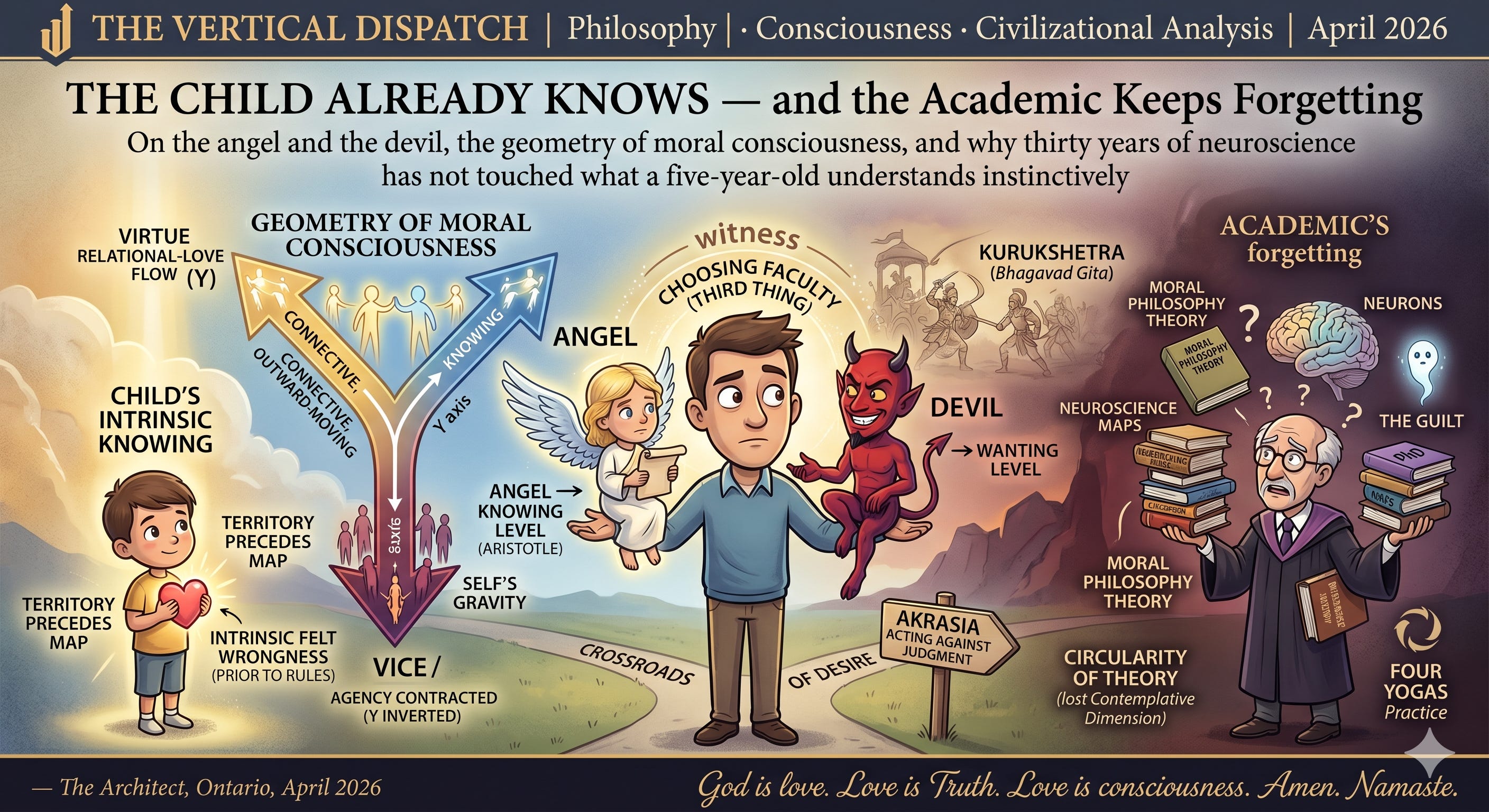
The angel and the devil are not two external voices breaking in from outside. They are the internalized structure of moral consciousness made spatially legible. What the animators understood intuitively — and what moral philosophy has spent centuries obscuring with technical vocabulary — is that consciousness is already divided against itself before any choice is made. The division is structural. It is not a defect. It is the architecture.
Notice the geometry. The figures sit on opposite shoulders — equidistant from the ear, equidistant from the head. Neither has ontological priority in the image. Neither is louder by default. And the character in the middle is not either of them. The choosing faculty — the one that hears both and acts anyway — is a third thing entirely.
That third thing is what consciousness actually is. Not the angel. Not the devil. The awareness that contains both and must move.
You are not the angel and you are not the devil. You are the one who hears both — and acts anyway.
The Problem the Greeks Saw First
What the cartoon depicts is what the Greeks called akrasia — acting against your own better judgment. You know the right thing. The angel has made the case. The case is not even contested. And yet the foot moves toward the other shoulder.
This broke Socrates. He insisted akrasia was impossible — that if you truly knew the good, you would do it. Knowledge of virtue was virtue. The rest of human history has been a fairly comprehensive refutation of that claim. Every person reading these words knows, from direct personal experience, that the Socratic equation fails. Not occasionally. Structurally.
Aristotle was closer. He saw that moral knowledge and moral will are not the same faculty. You can know perfectly and want otherwise. Which means the self is stratified, not unified. The angel speaks to the knowing level. The devil speaks to the wanting level. And the wanting level has momentum that no argument can simply override.
The Geometry of Y
In the framework I have spent thirty years developing — Universal Dynamics — this maps with precision onto the Y axis. Y is the relational-love principle: the connective, outward-moving, other-oriented dimension of consciousness. Every moral intuition, even in a child who has never heard the word ethics, is a Y-registration. The felt sense is asking one question beneath all its variations: does this move toward or away from the relational field?
Virtue is Y flowing in its natural direction — outward, connective, completing the circuit between self and other. Vice is Y inverted — agency contracted back on itself, choosing the self’s gravity over the relational pull. And here is what matters: the body knows the difference before the mind constructs a single justification. The registration is pre-conceptual. It arrives as a felt quality, not a proposition.
This is why no amount of ethical theory actually produces ethical behavior. Theory addresses the knowing level. Transformation requires working directly on what Y is attracted to. The will is not reformed by argument. It is reformed by practice — which is precisely what the four yogas are for, and precisely what the Western philosophical tradition, having lost its contemplative dimension, can no longer offer.
· · ·
What the Child Knows Without Being Taught
Here is the observation that should stop every neuroscientist and moral philosopher in their tracks: nobody teaches a child the feeling of doing something wrong. They teach rules. They teach consequences. They teach social expectations. But the felt sense of transgression — that interior registration that arrives before anyone catches you, before any punishment is administered, before any social mechanism has fired — that is not learned. It is already there.
The child who lies and feels the wrongness in the lying itself, not in being caught, is not drawing on catechism. Not on parental instruction. Not on cultural conditioning. They are drawing on something prior to all of that. A moral topology that is built into consciousness as part of its structure.
The natural law tradition was pointing at this — badly in some formulations, but pointing at something real. The territory precedes the map. The felt sense of moral reality is not constructed by training. Training sharpens it, distorts it, suppresses it, or refines it. But it does not originate it.
The PhD is sometimes the longest distance between a man and what he already knows.
Why the Academics Keep Missing It
The circularity of academic moral philosophy is not accidental. It is methodological. When you commit to explaining moral consciousness by going downward — into neurons, synaptic firing, evolutionary substrate, genetic advantage — you are committed from the outset to never finding what you are looking for. Because what the child knows is not located at the material level. No sub-bionic description of moral intuition touches the intuition itself. You can map every neurological correlate of guilt with perfect precision and you have not touched the guilt.
It is the difference between mapping the paper and the ink of a love letter and claiming you have understood the love.
Plato saw the structural reason for this failure. The particular instantiation of justice in this act, in this moment, in this child, is intelligible only because Justice as such is already present in consciousness as the ground of recognition. You do not derive the universal from particulars. You could not recognize the particulars as instances of anything without the universal already operating as the condition of recognition. The core axiom of Universal Dynamics states this as a first principle: the universal generates the particular. No accumulation of particulars can reconstitute a universal. The academics are attempting precisely that reconstruction, and the circles they travel are the predictable result.
The Cartoon’s Hidden Teaching
Return to the image. The figure in the middle does not look confused. He looks tempted. That distinction is everything. Confusion is an epistemic state — not knowing. Temptation is a moral state — knowing perfectly well, and being pulled elsewhere anyway.
Temptation presupposes knowledge. You cannot be tempted by what you do not already recognize as forbidden. The very structure of temptation is a testament to the prior moral knowing. Which means the cartoon is not depicting an ignorant soul being fought over. It is depicting an aware soul — one that already knows, already feels the geometry, and is watching its own will move toward the wrong shoulder anyway.
That is akrasia as lived experience. That is the gap between the witness and the will. And that gap — between what the deepest ground of consciousness knows and what the ego-structure chooses — is what every serious spiritual tradition has identified as the actual battlefield. Not the external world. Not other people. The interior distance between knowing and doing.
The Bhagavad Gita calls it Kurukshetra. Kashmir Shaivism identifies the contraction that makes the will move against its own recognition. Every genuine contemplative tradition maps this territory because it is the only territory that actually matters.
· · ·
The angel does not need credentials. It is not speaking from outside. It is the geometry of consciousness recognizing itself — Y flowing in its natural direction, reporting the structural reality of the relational field.
The child already knows this. The training that follows will either refine that knowing or spend decades trying to explain it away. Most of what passes for moral philosophy has chosen the latter path. The circles it travels are the cost of that choice.
What we need is not more sophisticated machinery for ignoring what we already know. We need to stop. Listen to the angel. And understand why, again and again, we look the other way.
That understanding — not as concept, but as direct recognition — is the beginning of the vertical path.
#VerticalDispatch #Philosophy #Ethics #MoralConsciousness #Akrasia #GeometryOfMoralConsciousness #UniversalDynamics #YAxis #TheVerticalPath #Innateness #MoralTopology #FeltWrongness #WillVsArgument #WillReformedByPractice #PreConceptual #TerritoryPrecedesMap #NaturalLaw #WesternPhilosophy #LostContemplativeDimension #FourYogas #Gita #KashmirShaivism #Kurukshetra #AcademicMoralPhilosophy #NeuroscienceFail #Consciousness #GodIsLove #LoveIsTruth #Namaste #Amen #April2026 #GlenRoberts #TheArchitect