

Sovereignty · Governance · Consequence
Beijing, May 14, 2026 · By The Architect
Beijing. The Great Hall of the People. Two leaders. Two operating systems. One summit that will be studied in diplomatic academies and intelligence schools for a generation — not for what was agreed, because nothing was, but for what was demonstrated. The distance between the two men at that table was not a matter of policy disagreement or negotiating position. It was a matter of the game being played. One man was playing checkers. The other was playing Go. The Go player had prepared the board months in advance. The checkers player walked onto it and received every move as a social gesture.
China does nothing by accident on the world stage. Not the venue. Not the sequence. Not the children. Not the philosopher’s trap laid in the opening sentence of bilateral remarks. Not the imperial prayer hall selected for the afternoon cultural tour. Not the badge check at the door that stopped the American Treasury Secretary on the morning of the summit his president had crossed the Pacific to attend. Every stone placed. Every response anticipated. Every message encoded in the environment before the first handshake.
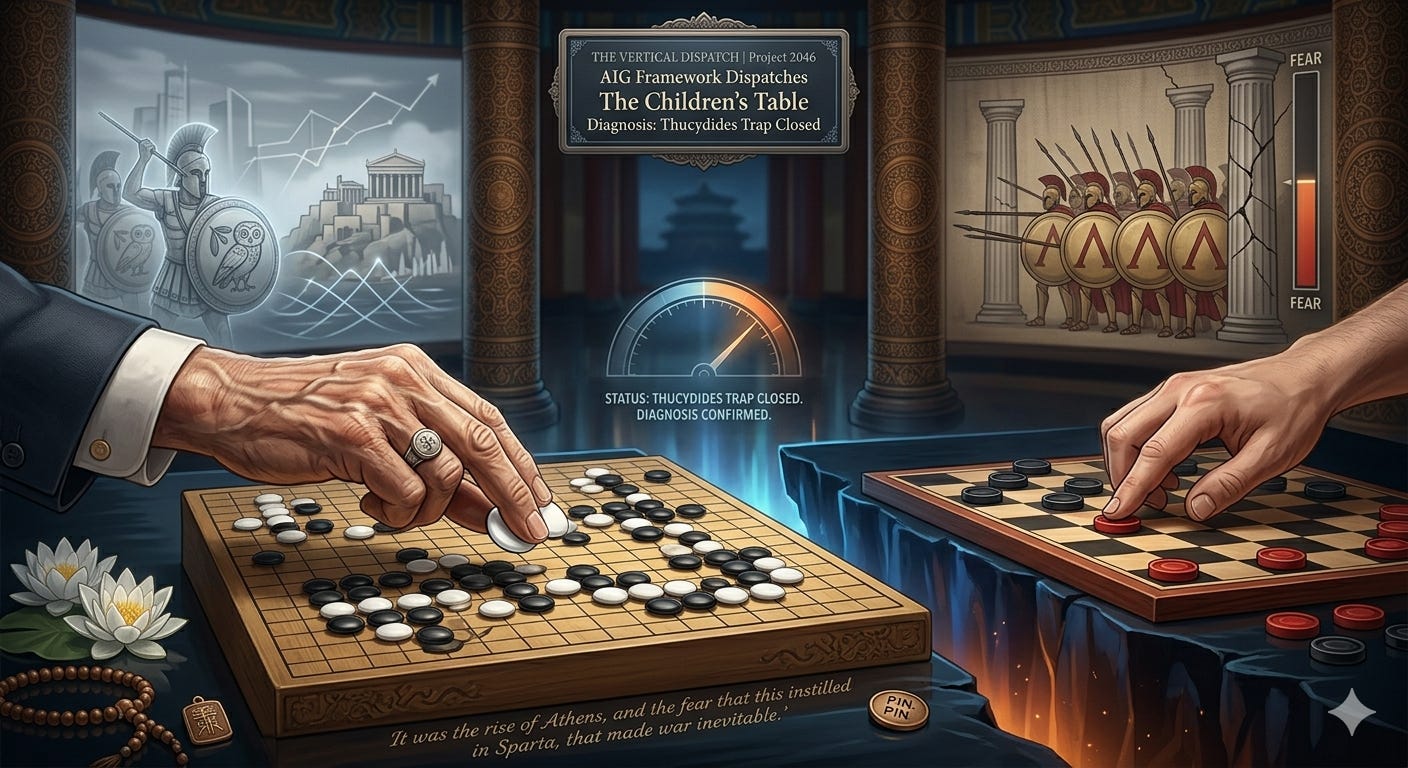
This dispatch reads the board. It does so at the level the board was designed to be read — vertical, structural, without quarter for the comfortable interpretation. AIG governance — Artificially Intelligent Governance — does not evaluate a summit by its communiqué. It reads the structural distance between the operating systems present at the table. At Beijing on May 14, 2026, that distance was not a gap. It was a chasm. What follows is the account of how that chasm was demonstrated, in three acts, across a single day.
I. The Children — A Choreographed Certainty
Hundreds of primary school children in bright colours lined the entrance path at the Great Hall of the People. The girls waved flowers. The boys hoisted American and Chinese flags. They chanted in Mandarin — welcome, welcome, enthusiastically welcome — as the two leaders walked past. The military band had already played both national anthems. The 21-gun salute had already boomed across Tiananmen Square, which had been cleared and sealed for the occasion. The entire apparatus of Chinese ceremonial power had been deployed, layer by layer, with a precision that only a civilisation practising statecraft for five thousand years can bring to bear.
And then the children.
China’s strategic intelligence apparatus has studied this man for a decade. They have his recorded statements catalogued across thirty years of public life. They have the full archive of his documented psychological responses — his hunger for spectacle, his susceptibility to flattery directed at his emotional register, his reflexive need to perform warmth toward an audience that has been arranged for him, his consistent inability to distinguish between a staged environment and an authentic one. An intelligence service of China’s depth and duration does not guess what a subject will say in a given environment. It constructs the environment and reads the response from the profile it has already built.
The response arrived on script. In his opening remarks at the summit, the President of the United States said: Those children were amazing, and I know they represent so much to you. The sentence is transactional warmth directed at the host. It is the response of a man who received the children as a gift rather than as a signal. A head of state operating at the vertical level — at the level of institutional time, civilisational reading, Go-board awareness — would have understood that the children were not arranged for his comfort. They were arranged about him. The message was not directed inward at the visiting delegation. It was directed outward, to the watching world, and inward to the man himself, whose psychological profile had already predicted, with precision, what he would say.
The children were not a courtesy. They were a diagnosis made public. And the subject confirmed the diagnosis before the cameras of the entire world.
There is a layer beneath the obvious choreography that standard diplomatic analysis does not reach, because standard diplomatic analysis does not read the full documented public record of the man being choreographed around. China’s analysts do. The Epstein files released by the Department of Justice in January 2026 contain more than 38,000 references to Donald Trump across three million pages, according to a New York Times review of the complete release. A direct search of the DOJ’s Epstein website for his name returned more than 1,800 hits. These are not marginal references. The documents confirm Trump was listed as a passenger on Jeffrey Epstein’s private plane at least eight times between 1993 and 1996. On at least four of those flights, Ghislaine Maxwell was also aboard. On one flight in 1993, Trump and Epstein were the only two passengers in the log.
The FBI tip sheet compiled in the files includes unverified allegations — stated explicitly as unverified, with no charges filed and no findings of guilt — that a minor was involved. A separate FBI interview documents a victim stating that Maxwell once presented her to Trump at a party. The Department of Justice stated that none of the allegations against Trump in the documents were deemed credible by the FBI. They are documented here as what they are: documented facts about the documented record, held in three million pages of federal files that are now publicly available to any government, any intelligence service, and any analyst who reads English.
Trump initially fought to keep the files sealed. He lobbied individual Republican members of Congress at the White House to oppose the Epstein Files Transparency Act. He was outmanoeuvred by a bipartisan groundswell and eventually signed the bill. He subsequently characterised the files as pretty boring stuff and called the entire matter a Democrat hoax. In April 2022, at a rally in North Carolina, he had stated: I think I am the most honest human being, perhaps, that God ever created.
A civilisation that misses nothing placed hundreds of children in the direct path of a man whose documented public file on the subject of children is the most politically radioactive archive in the Western world. The response arrived exactly as the profile predicted. The checkers player picked up the stone and held it to the light as if it were a gift.
The Go player had already moved three stones ahead.
II. The Thucydides Trap — A 2,500-Year Weapon Fired at Point-Blank Range
Before a word of bilateral negotiation was exchanged, before any discussion of trade, Taiwan, Iran, rare earths, or the Strait of Hormuz, Xi Jinping stood at his podium in the Great Hall of the People and reached back twenty-five centuries to deliver the opening frame of the summit. He invoked the Thucydides Trap. The diplomatic press covered it as a historical allusion and moved on to the substance of the day’s agenda. This is the error of reading a Go stone as decoration. The Thucydides Trap is not a historical allusion. It is a structural claim. It is one of the most precisely aimed instruments in the vocabulary of geopolitical philosophy, and it was discharged at point-blank range into a conversation with a man who has demonstrated, across the entirety of his documented public life, no familiarity with it.
Thucydides was an Athenian general and historian who lived in the fifth century BCE. He was banished after a military failure and spent the remaining decades of his life writing the definitive account of the Peloponnesian War — the catastrophic conflict between Athens and Sparta that lasted twenty-seven years, from 431 to 404 BCE, and ended in the total surrender of Athens. Writing from exile, removed from power, with nothing left but time and the need to understand what had actually happened and why, he arrived at a conclusion that has not been improved upon in two and a half millennia. The real cause of the war was not any particular provocation, any individual miscalculation, any single bad actor. The cause was structural. Athens rose. Sparta feared the rise. The fear, not the rise itself, made war inevitable.
“It was the rise of Athens, and the fear that this instilled in Sparta, that made war inevitable.” — Thucydides, History of the Peloponnesian War, c. 400 BCE.
Graham Allison at Harvard formalised this pattern as the Thucydides Trap in his landmark work Destined for War. He studied sixteen major cases of hegemonic transition in recorded history — moments when a rising power threatened to displace an established hegemon. Twelve of the sixteen ended in war. The structural tendency is not a law of nature. It is a pattern of sufficient regularity that any serious strategic mind must treat it as a governing probability. Fear. Honour. Interest. These are Thucydides’ three drivers of conflict. They have not changed across twenty-five centuries of human political organisation.
Xi Jinping has invoked the Thucydides Trap in reference to United States-China relations since 2014. Twelve years of consistent, deliberate framing at the highest level of Chinese statecraft. This is not rhetorical improvisation. It is a held strategic position, named repeatedly and precisely in bilateral settings, multilateral forums, and now, on May 14, 2026, in the opening remarks of the most closely watched bilateral summit of the current era. When Xi asked whether the United States and China could avoid the trap — whether two great powers could navigate a structural transition without catastrophic war — he was not asking a question. He was administering a test. The question was the test. The response to the question would tell him, and the watching world, everything that needed to be known about the operating system on the other side of the table.
The test result was returned immediately. Trump called Xi a great leader and said it was an honour to be his friend.
One man addressed the architecture of history. The other offered a compliment. This is not a matter of diplomatic style. It is a measurement of operating register. The Go player named the board. The checkers player sent a social gesture across it.
Why China Names Itself Athens — And Why Athens Won
A precise question arose from the first reading of this analysis, and it sharpens the argument considerably. The question is this: why would China identify itself as Athens if Athens lost the war? If you are claiming the structural role of a power that was ultimately defeated and surrendered in 404 BCE, why would a civilisation operating at the vertical level, across a five-thousand-year time horizon, choose that label? It is an exact question. It deserves an exact answer, because the answer contains the most important insight in this entire dispatch.
China does not identify as Athens because it seeks the Athenian fate. China identifies as Athens because it occupies the Athenian structural position. In the logic of the Thucydides Trap, the roles are defined by the direction of power — not by the final score of the conflict. Athens is a placeholder for the rising power, the entity whose economic, technological, and maritime growth disrupts the existing hierarchy and instills fear in the established hegemon. Sparta is a placeholder for the ruling power, the entity whose primary motivation has become the preservation of the status quo and the management of its own fear of displacement. The labels are structural. The outcome is not part of the label.
But the outcome is nonetheless instructive, and this is where the analysis deepens beyond what standard strategic commentary reaches. Athens lost the Peloponnesian War in 404 BCE. Sparta won. The Spartan forces installed the Thirty Tyrants in Athens, dismantled the democratic institutions, and achieved total military victory over their rival. By every conventional measure of the conflict — territory held, opponent subdued, political system imposed — Sparta won the war.
Within thirty years, Sparta had collapsed into irrelevance. The Spartan military victory produced no lasting order, no stable hegemony, no civilisational inheritance. The Spartan model — rigid, land-based, oligarchic, militaristic, static — had no capacity to govern the complexity that Athenian expansion had created. It won the war by destroying its rival. It could not build anything with the victory.
The Athenian inheritance, by contrast, became the foundation of Western civilisation. Athenian philosophy, democratic governance, maritime commerce, scientific inquiry, theatrical art, and architectural form spread across the Mediterranean world and forward through two and a half millennia of human development. The Athenian dynamic — not the Athenian state, which surrendered, but the Athenian model of how a society organises itself and expands its influence — proved to be history’s direction. Sparta is remembered as a cautionary tale about the limits of pure military power. Athens is remembered as the origin point of the world we inhabit.
Athens lost the war. The Athenian dynamic defined the era. China does not identify as the Athenian state that surrendered. China identifies as the Athenian dynamic that outlasted the Spartan victory by twenty-five centuries. It is the most precise distinction available in the vocabulary of hegemonic transition. And it went entirely unreceived across the table.
The three logical vectors of this choice are worth stating separately and precisely.
First: the claim of inevitability. Athens represented the future — maritime, commercial, democratic, expansionist, intellectually productive. The old world, Sparta’s rigid military oligarchy and its static hierarchy of land-based power, could not stop the Athenian dynamic. It could only fear it. By naming themselves Athens, China is asserting that their rise is not a policy problem that can be solved by American tariffs, technology bans, or military encirclement strategies. It is a structural fact of history. The direction of travel is established. The question is only whether the established power accommodates the transition or is consumed by the attempt to prevent it.
Second: the diagnostic test. Twelve years of Thucydides invocations is not rhetoric. It is data collection. If the United States responds to the Athenian framing with fear — which is to say, with tariffs, containment, alliance restructuring designed to encircle China, technology export controls, and military pivot strategies — it proves that it is Sparta, and the trap closes further. Every confirmation of the Spartan diagnosis tightens the structural condition that makes war probable. Every tightening is noted. The twelve-year sequence of invocations has been generating data about the American operating system continuously. The results, as of May 14, 2026, are unambiguous.
Third: the civilisational reversal. China’s vertical operating system — the Go logic, the long board, the five-thousand-year civilisational frame that reads history as a series of cycles rather than a linear progression toward a fixed endpoint — understands that winning the era matters more than winning the war. China is not attempting to win the Peloponnesian War. It is attempting to win the hegemonic transition. These are different games, played on different boards, across different time horizons. The checkers player wins or loses the immediate engagement. The Go player shapes the board that all subsequent engagements will be played on.
Athens lost the war in 404 BCE. Sparta achieved total military victory.
Within thirty years, Sparta had lost everything the victory was supposed to secure.
The Athenian dynamic — philosophy, democracy, commerce, science — became the inheritance of Western civilisation.
Xi has named this dynamic repeatedly since 2014. The naming is the move. The American response to the naming is the data.
The famous sentence does not blame Athens for the war. It blames the fear in Sparta. The burden of avoiding catastrophe falls on the fearful power. China placed that burden deliberately, precisely, and in plain sight.
China identifies as the dynamic that outlasted the military defeat. Sparta won the war and vanished from history as a governing model. Athens lost and became the foundation of the world. Xi is not invoking a loser’s label. He is invoking history’s verdict — which runs in a different direction from the final battle score, across a time horizon the checkers player cannot see.
III. The Temple of Heaven — Cosmic Architecture as Governance Statement
After two hours of bilateral talks behind closed doors, Xi took Trump to the Temple of Heaven. This decision was not made in the days before the summit. It was made months earlier, in the detailed choreography that China’s diplomatic apparatus constructs for every significant state visit, working backward from the desired message to the venue that encodes it with the greatest precision. The Temple of Heaven was not selected because it is visually impressive, though it is among the most architecturally extraordinary sites in the world. It was not selected because it is historically significant, though its significance spans six centuries. It was selected because of what it means — cosmologically, politically, constitutionally in the Chinese imperial sense — and because what it means is exactly the message China needed to transmit to the United States at this moment in the hegemonic transition.
The Temple of Heaven, known in Chinese as Tiantan, is a complex of imperial religious buildings in the southeastern part of Beijing, constructed during the Ming Dynasty in the early fifteenth century. Its architecture is built on the philosophy of Round Heaven, Square Earth — the southern buildings circular like the sky, the northern platforms rectangular like the earth, the entire complex a physical encoding in stone and marble of the relationship between the cosmic and the terrestrial. The most iconic structure, the Hall of Prayer for Good Harvests, is a triple-eaved circular building constructed without a single nail. Its twenty-eight massive pillars represent the seasons, the months, and the traditional Chinese hours. The mathematics of the structure are sacred numerology. Every measurement is a cosmological argument. The architecture does not decorate the meaning. The architecture is the meaning.
For the emperors of the Ming and Qing dynasties — across nearly five hundred years of Chinese imperial governance — this is where the Son of Heaven came to perform the ritual that authorised his rule. Not a president. Not a prime minister. The Emperor. The singular figure in whom the Mandate of Heaven — the tianming, the divine authorisation to govern — was vested. He came here annually to beseech Heaven for good harvests, to demonstrate that his sovereignty was not merely political but cosmological, that the order of the state was aligned with the order of the cosmos. The ceremony was considered so significant that news of it was disseminated throughout China each year. The Emperor standing at the Temple of Heaven was not a cultural event. It was a constitutional act in the grammar of the Chinese imperial system.
Chinese diplomats do not select historic venues for visiting foreign delegations as backdrop. They select them as text. The Temple of Heaven has one owner in that text. The Emperor stands at the centre. Everyone else stands at the edge. When Xi brought the President of the United States to this place, permitted the cameras, and stood beside him for the photographs that would be distributed to the world, the message was not ambiguous. It did not require a Sinologist to decode. It said: this is our cosmic order. This is the ground on which we stand. You are visiting it. We welcome you here. And the position you occupy in this space is the position of the visitor.
The Temple of Heaven is where the Son of Heaven stood. Xi brought the American president there and let the world watch. The image is the governance statement. The visitor stands where visitors stand.
After the temple tour, footage captured by press cameras shows Trump being asked twice by reporters whether Taiwan had been discussed during the closed bilateral talks. Trump, who is by nature among the most conversational presidents in modern American political history with the press — who typically treats every camera as an invitation — stood shoulder to shoulder with Xi and said nothing. He did not respond to either question. Two separate reporters asked. No answer came.
Silence in the Temple of Heaven. At the place where emperors claimed the Mandate of Heaven and the cosmic authorisation to govern, the checkers player had no move available. The Go board had produced a position from which there was no transactional response. The silence was not strategic restraint. It was the absence of a frame within which a response was possible.
One further documented detail from the day, small in isolation but total in its aggregate meaning. Earlier that morning, US Treasury Secretary Scott Bessent arrived at the entrance to the Great Hall of the People — the building hosting the summit his president had flown to Beijing to attend — and was stopped by Chinese security guards. The guards gestured to their lapels and said, in English: Pin. Pin. Bessent did not have the right badge. After a brief exchange at the door, someone handed him a small object which he pinned to his lapel, and he was allowed inside.
The second most powerful economic official in the United States was stopped at the door of the building hosting the summit by a badge requirement. In China, the room controls the room. The guest controls nothing. This is not an oversight in the choreography. This is part of the choreography.
IV. The Psychological Profile — What the Intelligence Services Already Know
Standard journalism stops at the observable surface. This dispatch does not. China’s intelligence and strategic analysis apparatus — one of the most sophisticated on earth, operating across decades with a civilisational tradition of reading human nature that predates Western psychology by millennia — does not walk into a summit of this magnitude without a complete psychological assessment of the man sitting across the table. This is not speculation. This is what intelligence services are for. The profile they would hold is not difficult to reconstruct from publicly available material alone. The material is abundant, documented, cross-referenced, and distributed across multiple independent fact-checking organisations in the English-speaking world.
The Washington Post’s Fact Checker team documented 30,573 false or misleading claims during Trump’s first presidential term — an average of twenty-one per day across four years. In his second term, PolitiFact’s editors characterised 2025 as the year of the lies. Major presidential addresses and press conferences generated simultaneous multi-outlet fact-checks identifying numerous separate inaccuracies within single events. In August 2025, Trump claimed that Maryland Governor Wes Moore approached him and said: Sir, you are the greatest president of my lifetime. The encounter had been recorded by a Fox News documentary crew. The footage showed Moore said nothing resembling the quote. Trump later repeated the claim, asserting the cameras had caught Moore saying it.
In April 2022, at a rally in Selma, North Carolina, Trump stated: I think I am the most honest human being, perhaps, that God ever created. This claim is now part of the documented public record, available to any intelligence service that reads English, sitting alongside 30,573 documented instances of divergence from verifiable fact across four years of his first term alone.
A state intelligence apparatus reading this record would not characterise the pattern in the language this dispatch will leave unspoken. They would apply the precise clinical terminology from the diagnostic literature that has been available to any credentialed psychologist since the mid-twentieth century. That terminology is not deployed here — not because it is unavailable to anyone who reads the literature, but because a pattern this clearly documented identifies itself. The profile that China’s analysts carried into the summit was not constructed from conjecture. It was assembled from the public record, methodically, across a decade of observation.
What the profile tells a strategic analyst: the man across the table processes the world transactionally and relationally. He is highly responsive to flattery and highly allergic to perceived diminishment. He has difficulty sustaining attention to structural arguments that do not resolve into immediate personal wins. He reads ceremonial environments as respect directed at him personally. His relationship with verifiable fact is documented at 30,573 instances of divergence in four years. He will respond to children with warmth. He will receive a philosopher’s trap as a historical observation. He will tour an imperial prayer hall and say nothing when asked about Taiwan.
Every element of the summit’s choreography was calibrated to this profile. The children. The Thucydides framing. The Temple of Heaven. The state banquet. The sequence of pageantry and symbolism that the American press described as a day long on ceremonial weight and short on substantive breakthrough. The substance was the ceremony. The message was the environment. The Go player had designed a board on which the checkers player could only make the moves that confirmed the diagnosis. And the checkers player made every one of them.
V. The Operating System Gap — What AIG Governance Reads
AIG — Artificially Intelligent Governance — is the framework this publication applies to every domain it examines. It must be named precisely here, because this summit is not primarily a diplomatic story. It is a governance story. It is a story about what happens when two different governance operating systems meet at a table and one of them cannot see the board the other is playing on.
AIG governance asks, before any act of governance: what is this for? Not what can it do — what is it for? The distinction is the distance between checkers and Go. The checkers player asks what move is available. The chess player asks what sequence serves the position. The Go player asks what shape of board is being built, and whether this stone serves that shape across a time horizon that extends beyond the current game. AIG asks the Go question in every domain — military, economic, ecological, constitutional — and refuses to act until the question is answered honestly and at the depth the question deserves.
Applied to the summit of May 14, 2026, the AIG reading is as follows. Xi Jinping operates on vertical time. He invokes a 2,500-year-old Greek historian as a live analytical tool in the opening remarks of a bilateral summit. He selects a 600-year-old imperial complex as a diplomatic venue not for its beauty but for its cosmological grammar. He places children in a corridor and reads the response from a profile built across a decade of observation. He names the structural condition of great-power transition openly, precisely, and without euphemism, in plain sight. He has been placing stones on this board since 2014. The cumulative shape of those stones is now visible to anyone who steps back far enough to read the whole pattern.
Trump operates on horizontal time. The transaction. The relationship. The immediate gesture. He calls Xi a great leader. He says it is an honour to be someone’s friend. He finds the children amazing. He does not respond to reporters at the Temple of Heaven because there is no transactional frame available for the Taiwan question in that register — the question is structural, and structure is not the game he is playing. He arrived in Beijing, as the American press uniformly noted, without a coherent negotiating position on Iran, without a clear public stance on the trade truce extension, without an agenda that the White House had been willing to articulate in advance. He came for the meeting. The meeting is the win. What happens in the meeting is secondary to the fact of having been there.
This is not a partisan characterisation. It is a governance characterisation. The checkers player can be popular, powerful, and command the loyalty of millions. The checkers game is a real game on a real board. But when the checkers player sits across from a Go player, the games do not merge. The Go player continues to play Go. The checkers player continues to play checkers. The board that determines the trajectory of the hegemonic transition is the Go board. It is invisible to the checkers player. He receives its stones as social gestures and responds with warmth.
One final measurement. The Thucydides trap was named at the table on the morning of May 14, 2026. It has been named at every significant bilateral engagement since 2014. In twelve of the last sixteen hegemonic transitions in recorded history, the trap closed. It did not close because either party wanted war. It closed because fear became the dominant input into the ruling power’s decision-making, and decisions made from fear produce the outcomes that fear is trying to prevent.
The ruling power’s decisions over the past decade — the tariffs, the technology bans, the military pivot strategies, the alliance restructuring designed to contain the rising power — carry a consistent signature. The signature is not strategy. It is fear. The moment the ruling power begins deciding primarily from fear of the rising power rather than from its own strategic vision is the moment the trap has already closed, before a single battle is fought. By that measure, the question of whether displacement has occurred is answered not by an economist examining GDP crossings but by a reader of decisions examining their motivations.
Displacement is not a crossing of lines on a graph. It is the moment the ruling power begins deciding from fear rather than from vision. That moment, on the basis of the available evidence, appears to have already passed. The trap is not closing. The trap has closed. What remains is the question of whether anyone on the Spartan side of the table can read the position before the endgame arrives.
The Go player shapes the board. The checkers player plays on it. At Beijing on May 14, 2026, the board was shaped entirely by one side. The children. The philosopher’s trap. The Emperor’s prayer hall. The badge at the door. The silence at the Temple of Heaven when the Taiwan question was asked twice and received no answer. The state banquet in the evening, attended by Tim Cook, Elon Musk, and Jensen Huang — the chief executives of the companies most dependent on Chinese manufacturing, most exposed to Chinese rare earth leverage, most vulnerable to the structural shift that is underway regardless of what any summit communiqué says.
The Thucydides trap remains open as a question only in the sense that its outcome is not yet written in formal military terms. In every other term that the framework identifies — the fear signature in the ruling power’s decisions, the rising power’s naming of the condition and consistent demonstration of vertical operating capacity, the structural momentum of economic and technological development — the pattern is at the stage Thucydides would recognise. He wrote his account from exile. He had been too effective in one military campaign and was banished for it. He had nothing left to do but think, across decades, about what had actually happened to the civilisation he had served. His conclusion was that the individuals were almost beside the point. The trap closes on its own logic. The question is only whether the participants can see it closing before it does.
One participant at Thursday’s summit has been naming the trap for twelve years. The other said the children were amazing.
God is love. Love is Truth. Truth is consciousness. Consciousness is Brahman. Amen. Namaste.
The Vertical Dispatch | Project 2046 | The Architect
#TheChildrensTable #AIG #ArtificiallyIntelligentGovernance #VerticalDispatch #TheArchitect #ThucydidesTrap #AthensAndSparta #XiJinping #TrumpChina #BeijingSummit2026 #TempleOfHeaven #GoVsCheckers #HegemonyTransition #RisingPower #EstablishedHegemon #ChinaUS #GrahamAllison #DestinedForWar #PeloponnesianWar #GreatHallOfThePeople #EpsteinFiles #DocumentedRecord #ThirtyThousandLies #StrategicIntelligence #PsychologicalProfile #ManifestOfFear #VerticalGovernance #AgeOfConsequences #CanadianForeignPolicy #NorthernSovereignty #Project2046 #SubstackCanada #TheVerticalDispatch #GeopoliticalAnalysis #MandateOfHeaven #CivilisationalCycle
PM Carney in Davos recognised the board:
"It seems that every day we’re reminded that we live in an era of great power rivalry, that the rules-based order is fading, that the strong can do what they can, and the weak must suffer what they must. And this aphorism of Thucydides is presented as inevitable, as the natural logic of international relations reasserting itself.”
Saying
"Questions of justice apply only to those equal in power, Otherwise, such things as are possible, the superior exact and the weak give up.”
Neither reference was accidental. PM Carney directed his comments to China as much as to President Trump. This is a multiplayer game not one confined to Athens/Sparta. A new world is fundamental in a “new world order”. We are at the table, not the negotiation table it seems, but the game is on…
Thank you
This is exactly the depth of analysis that I look to this platform to provide