

THE VERTICAL DISPATCH
AGE OF CONSEQUENCES
May 2026 · No Quarter Edition
While billions watch the pitch, the other kind of fever rages unchecked — war, famine, and the death of innocents at historic scale. This is not sport. This is bread and circuses with a Coca-Cola logo.
BY GLEN ROBERTS · THE ARCHITECT
There are two kinds of fever in the world right now. One fills stadiums. The other fills graves. The question no commentator dares put on screen — between the Coca-Cola anthem and the Pepsi activation and the Lay’s chip campaign and the Aramco logo burnished into the corner of your feed — is this: how did we become a species that can hold both realities at once, and feel nothing about the second?
Neil Postman warned us in 1985. He called it Amusing Ourselves to Death, and his argument was precise. The age of television had displaced the age of typography, and with it the capacity for sustained moral seriousness. We would not be destroyed by what we feared. We would be destroyed by what we loved. Forty years on, the apparatus has only grown more total. The screen now lives in your pocket, on your wrist, embedded in the seat in front of you — and the fever it delivers runs at 1080p with Dolby surround.
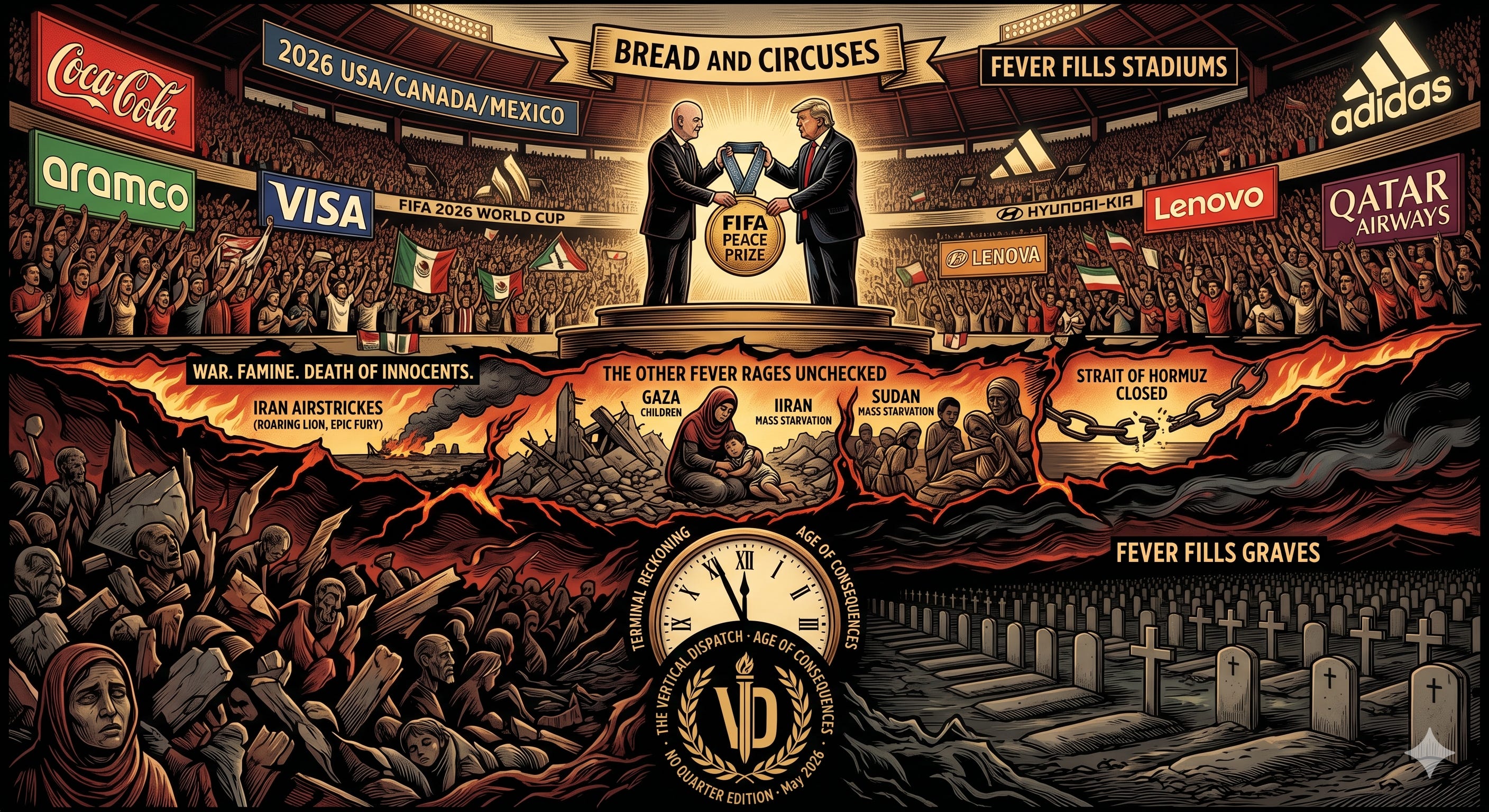
The pitch is packed. Gaza buries its children. Sudan starves. Iran smolders under a ceasefire that no one trusts. The world watches the ball, and calls it unity.
The 2026 FIFA World Cup — the largest in the tournament’s history, spanning three nations, 48 teams, 104 matches — arrives at a moment of civilizational emergency. Wars of consequence burn across three continents. Famine conditions grip Sudan, where experts document mass starvation of historic proportion. The civilian death toll in Gaza has shattered contemporary precedents for concentrated slaughter in an urban environment. Yemen has not stopped bleeding. Ukraine remains a charnel house. And now Iran — struck, decapitated, and only provisionally quieted — has joined the ledger. Into this world we have unleashed the grandest sporting spectacle ever assembled, and called it a gift.
This is not cynicism. This is the age of consequences speaking plainly.
— THE WAR THAT VANISHED FROM THE SCREEN —
Consider what the spectacle has had to compete with this spring, and lost.
On 28 February 2026, the United States and Israel launched coordinated airstrikes against Iran — nearly 900 strikes in twelve hours, under the code names Operation Roaring Lion and Operation Epic Fury — targeting nuclear facilities, air defenses, military infrastructure, and the regime’s leadership. The opening salvo killed Iran’s Supreme Leader, Ali Khamenei, along with dozens of other officials. It also killed roughly 170 people when a single missile struck a girls’ school. Iran answered with hundreds of missiles and thousands of drones against Israel, against U.S. bases, against U.S.-allied states across the region — and then reached for the one lever that mattered most, closing the Strait of Hormuz and seizing the world’s energy traffic by the throat.
By the time a Pakistan-brokered ceasefire took hold on 8 April, the conflict had displaced civilians en masse, blacked out Iran’s internet, disrupted global trade, and, by the assessment of The Guardian, conveniently overshadowed the regime’s own executions of political prisoners swept up in the January protests. The U.S. operation was formally declared concluded on 5 May. Many legal scholars argued the war was illegal under American law; the administration waved this away by pointing to the unauthorized wars of its predecessors — which is its own kind of confession.
Hold that timeline against the other calendar. The World Cup draw, with its invented peace prize, took place on 5 December 2025. The bombs fell on 28 February. The ceasefire arrived on 8 April. The tournament kicks off on 11 June. The war and the spectacle did not merely coincide; they interleaved. And as the missiles flew, the marketing machine kept building its emotional platform, undisturbed. A Supreme Leader was assassinated, a strait was closed, a school full of girls was buried — and the dominant cultural product of the season remained a soft drink’s three-film series about how the tournament makes you feel.
That is the function. Not a side effect. The function.
— THE MEN WHO OWN THE CIRCUS —
Understand first who is running this event. FIFA President Gianni Infantino is not a steward of sport. He is a political operator of the first order, and his record speaks without ambiguity. He was pulled into the Panama Papers reporting in 2016. He faced a FIFA Ethics Committee investigation for alleged malpractice in 2017 — by the very committee he had promised to empower. Swiss prosecutors opened a criminal inquiry into his conduct in 2020. And yet he sits today at the apex of the world’s most-watched institution, having converted it into a personal vehicle for proximity to power.
THE RECORD — INFANTINO & FIFA 2026
• Panama Papers (2016): Infantino drawn into FIFA corruption reporting shortly after taking office.
• Ethics Investigation (2017): Faced a FIFA Ethics Committee probe for alleged malpractice — the same committee he had pledged to strengthen.
• Criminal Investigation (2020): Swiss prosecutors opened a criminal inquiry into his conduct.
• The Peace Prize (December 2025): Infantino created a brand-new “FIFA Peace Prize” — nonexistent a month earlier — and awarded it to Donald Trump at the World Cup draw on 5 December, presenting him a medal and certificate. Trump, who had publicly chased the Nobel and been passed over, called it one of the great honors of his life. The advocacy group FairSquare filed an ethics complaint citing violations of FIFA’s foundational principle of political neutrality. Norway’s football federation publicly urged FIFA to scrap the prize entirely.
One analyst, writing for the LSE Business Review, framed Infantino and Trump as “two peas” — figures who flout the rules and gouge ordinary people, whose respective domains have come to mirror one another: chaotic, divisive, scandal-ridden. That is not invective. That is governance analysis.
The Swiss corruption expert Mark Pieth, who once chaired FIFA’s own reform committee, offered the bleakest warning to would-be attendees: displease the officials, he suggested, and you’ll be on the next flight home — if you’re lucky. When the man who oversaw FIFA’s internal governance speaks in those terms, you have left the territory of sport and entered something older and darker.
— THE CIRCUS HAS ALWAYS HAD THIS PROBLEM —
Here the historically literate reader will pause and say: this is not new. Correct. It is not new. The 1936 Berlin Olympics is the canonical case, and it rewards full attention.
The Nazi Party took power in 1933. Berlin had won the Olympic bid in 1931 — two years before Hitler. By 1933 the International Olympic Committee faced a moral question that could not be deferred: do you hand a propaganda platform to a regime that had already begun stripping Jewish athletes of their rights? The American Athletic Union voted that year not to send a team if Jews were discriminated against. Its president, Judge Jeremiah Mahoney, argued that participation would constitute an endorsement of Hitler’s Reich. The Catholic journal The Commonweal called it an endorsement of anti-Christian Nazi doctrine. Ernst Lee Jahncke, a former assistant secretary of the U.S. Navy, was expelled from the IOC for taking a public stand against attendance.
And then forty-nine nations went to Berlin anyway.
For two weeks in August 1936, the regime soft-pedaled its antisemitic program, removed its anti-Jewish signage, temporarily cleared Roma from the streets, and presented the world a portrait of a “tolerant Germany.” The Olympics delivered the legitimation coup Hitler needed. The Games concluded. Within years, the Holocaust was underway, and the world was at war.
This is not ancient colour deployed for effect. It is the structural template. Mega-events held by or for authoritarian power — or under the shadow of authoritarian entanglement — have never been politically neutral. The 1980 Moscow boycott, the 1984 Los Angeles counter-boycott, the 2008 Beijing Games staged as China accelerated its surveillance state, the 2022 Qatar World Cup built on migrant labour in conditions that killed workers by the thousands — each edition of this argument arrives in different colours and different languages, but the structure does not change.
The IOC and FIFA have always insisted on neutrality in matters of politics and religion. The 2026 World Cup draw occurred at the Kennedy Center, with the sitting President of the United States on the stage, receiving a gold trophy invented for the occasion — six weeks before that same president ordered nearly 900 strikes on Iran. The neutrality doctrine expired some time ago. We are merely watching the body count down.
— THE ECONOMICS OF DISTRACTION —
Now attend to the money. Not the FIFA revenue. The advertising machine — which is what this is, at its operating core.
Brands are projected to pour an additional $10.5 billion in global advertising spend into Q2 2026 on the strength of this tournament alone. Coca-Cola has held stadium advertising at every World Cup since 1950 — not because Coca-Cola loves football, but because Coca-Cola loves the concentrated global attention football delivers. This year it has produced a World Cup anthem, a multipart film series, a Trophy Tour franchise, and a three-film emotional platform called “All the Feels.” FIFA’s tournament sponsorship revenue is projected at roughly $1.8 billion. The top-tier partner roster includes Adidas, Coca-Cola, Visa, Hyundai-Kia, Lenovo, Qatar Airways, and Aramco — the Saudi state oil company, whose presence in the pool is less a commercial arrangement than an instrument of foreign-policy influence.
You believe you are watching a football match. What you are consuming is a geopolitical and commercial architecture of extraordinary sophistication, engineered to make you feel — in the campaign’s own words — “All the Feels,” and nothing else. The feel of Gaza does not fit the platform. The feel of Sudan does not convert. The feel of a closed strait or a bombed school does not play in a thirty-second spot between halves.
WHAT $10.5 BILLION COULD PURCHASE
• The advertising surge on this tournament alone equals roughly five times the UN World Food Programme’s 2023 emergency funding gap for Sudan.
• The $1.8 billion in World Cup sponsorship revenue exceeds total humanitarian funding for multiple active conflict zones combined.
• Front-row seats run $3,285 each. Resale listings have hit $80,000. Toronto seats sit unsold — because the citizens whose tax money underwrites the security perimeter cannot afford to attend the event held in their own city, in their own stadium.
• Coca-Cola’s stadium presence has run unbroken since 1950. The product is high-fructose corn syrup and carbonated water. The consumer is told, between images of joy and unity, to drink sugar.
This is the Circus of Circuses. Not because sport is without value — sport is not without value. The beautiful game, played at its truest, is genuinely beautiful. But the World Cup in its current form is not the beautiful game. It is the beautiful game’s corpse, dressed in gold and sold back to you at $3,285 a seat, brought to you by Aramco and by the man who handed a peace prize to Donald Trump six weeks before Trump ordered the bombing of Iran.
— IS IT TIME TO END THE CHARADE? —
The honest question must be asked without retreat: has the World Cup — has the Olympic movement — lost all claim to the idealism that once justified it? And if so, what follows?
The founding idealism was not naive. Pierre de Coubertin’s Olympic revival in 1896 carried a genuine proposition: that athletic competition across national lines could be a form of peace-making, that the encounter of bodies in fair contest could dissolve, however briefly, the enmities of history. The early World Cups carried something similar — a democratic energy, a moment when the Argentine street and the English pub and the Brazilian favela held the same breath at the same instant.
That idealism has been progressively colonised. Not suddenly. Progressively. By television rights. By sponsorship architecture. By the sovereign wealth funds of unaccountable states. By governing bodies that operate with less transparency than most municipal councils and far greater immunity. By the logic of the deal — which is Trump’s logic, which is Infantino’s logic, which is the logic of every official who ever took a briefcase in a Zurich hotel room.
The security cost alone strains comprehension. Host cities must militarise themselves — checkpoints, surveillance, restricted movement, the temporary conversion of civilian space into a securitised zone. The cost falls to taxpayers. The profit flows to FIFA, a private organisation paying no taxes in Switzerland, accountable to no electorate, reformed by no external authority.
The three outcomes for host nations, documented across South Africa, Brazil, Russia, and Qatar, have been consistent: debt, displacement, and the militarisation of public space. The economic “boost” projections — FIFA floated a $50 billion figure for the United States from this tournament — have historically failed to materialise at the promised scale, while the infrastructure debts materialise with absolute precision.
So: is it time?
The Vertical Dispatch does not call for the abolition of football. It calls for clarity. The World Cup and the Olympics, in their current institutional form, are not sporting events in any philosophically coherent sense. They are instruments of power legitimation, commercial extraction, and strategic distraction — occasionally interrupted by genuine athletic beauty. The beauty is real. The structure that contains it is corrupt to the root.
And the cost — not merely in dollars, but in the moral attention economy — is too high. Every hour of World Cup coverage is an hour in which Gaza does not trend, in which the girls’ school in Iran goes unnamed, in which Sudan’s famine does not convert to a headline. Every anthem is a frequency that crowds out the sound of what is actually being done to human beings on this earth in this hour. This is not coincidental. This is the function.
Bread and circuses. Panem et circenses. The Roman who watched the games while the republic collapsed did not know, in the moment, that he was watching collapse. He was watching the games. They were very good games. The lions were magnificent.
— THE TERMINAL RECKONING —
The world is not going mad. Madness would be a kind of innocence. What the world is doing is more deliberate: it is choosing, with full cognitive capacity, to look elsewhere. The apparatus makes that choice easy, comfortable, even virtuous-feeling — you are celebrating unity, you are cheering for your country, you are participating in the shared human experience of sport.
You are also, in that same moment, consuming a product manufactured in a political economy with no interest in your moral clarity. Infantino needs your eyeballs. Coca-Cola needs your thirst. Trump needs the legitimation of the stage — the same stage, six weeks before he ordered the strikes. Aramco needs its logo normalised against a background of joy. The dead of Gaza, of Sudan, of a school in Iran, need a witness. They will not receive one from this platform.
The Vertical Dispatch does not ask you to stop watching football. It asks you to see the frame around the picture. It asks you to name what is absent from the screen as clearly as you name what is present. It asks you to hold both fevers at once — the one in the stadium and the one in the field hospital — and to refuse the mercy of choosing only one.
Because that is what consciousness demands. Not comfort. Not the anesthesia of the spectacle. Consciousness.
The pitch is full. The world is on fire. Both things are true. Only one of them is on your screen.
God is love. Love is Truth. Love is consciousness.
Amen. Namaste.
GLEN ROBERTS · THE ARCHITECT · THE VERTICAL DISPATCH
✦ NO QUARTER ✦
#WorldCup2026 #FIFA #FIFAWorldCup #Infantino #GianniInfantino #FIFAPeacePrize #Trump #BreadAndCircuses #PanemEtCircenses #NeilPostman #AmusingOurselvesToDeath #SportsWashing #Geopolitics #Gaza #Sudan #IranWar #StraitOfHormuz #Aramco #CocaCola #Qatar2022 #Berlin1936 #Olympics #MoralAttention #MediaCriticism #SpectacleSociety #AgeOfConsequences #TheVerticalDispatch #NoQuarter #SophiaInitiative #PoliticalEconomy #Distraction #CivilizationalCrisis #Consciousness #SoccerPolitics #BeijingOlympics #MarkPieth #FairSquare
I haven't watched the Olympics, the World Cup, most high level international sports for years. Because I'm watching Ukraine, Gaza, Iran, Sudan. I haven't watched the halftime shows or the big money commercials that run between innings. Because I've been watching them being held in and broadcast by the powers that are bombing Ukraine and Gaza and Iran, starving the people in multiple countries, denying life saving medicines to other countries. I've been watching those powers being allowed to stand in other countries, tall, proud and legitimized by their presence.
I haven't watched the Olympics, the World Cup, most high level international sports for years. And I'm still not.