

Φ
THE VERTICAL DISPATCH
We write for the mind, the eye, and the ear.
Read it. Look at it. Listen to it. The Vertical Dispatch is built for all three — prose with rhythm, made to be heard as much as read.
From metaphysics to geopolitics, from culture to history, from the sacred to the street — and everything in between. One lens, every subject. No ego. Just the record, named clean.
Press play. Walk with the word. 🕯️
This dispatch travels by hand. If it serves you, share it — restack on Substack, and pass it on wherever you read. 🕯️
Canada and Climate · The Age of Consequences · Part One of Three
June 29, 2026
“When I see that something’s not working I will change it.”
— Mark Carney, 9 March 2025
The Architect of the Machine
Begin with the size of the thing he built, because the retreat means nothing without it. In April 2021, in the run-up to the Glasgow climate summit, Mark Carney — then United Nations Special Envoy on Climate Action and Finance — launched the Glasgow Financial Alliance for Net Zero. It was not a committee. It was the largest coalition of financial institutions ever assembled for a single purpose: by the time he reported on it, banks, asset managers and insurers responsible for some one hundred and thirty trillion dollars in assets had signed on to align their lending and investing with net-zero emissions by 2050. He chaired it. He was, by any honest measure, the most powerful figure in the history of climate finance — the man who built the plumbing through which the world’s capital was meant to flow toward the transition.
That is the chair he sat in before he sat in the one he holds now. Keep it in view. The argument of this dispatch is not that Mark Carney does not understand climate change. No one alive understands its financial architecture better; he built it. The argument is stranger and harder, and it is the thing the country now has to look at squarely.
The Retreat, Named Clean
Since becoming Prime Minister on the ninth of March 2025, Carney has presided over the most sweeping reversal of Canadian climate policy in recent memory. The record is not in dispute; only its meaning is. In roughly his first fourteen months in office, his government abolished the consumer carbon price; repealed the electric-vehicle mandate in favour of a looser emissions-based standard projected to yield only about thirty-eight per cent vehicle electrification by 2035; scrapped the oil-and-gas emissions cap; amended the Trudeau-era Clean Electricity Regulations to give natural-gas generation more room to operate and expand; and agreed to a discounted industrial carbon price for Alberta.
Taken one at a time, each can be argued as an adjustment. Taken together, they are not a trim. The sectors touched by these reversals — buildings, transportation, oil and gas, heavy industry, and electricity — accounted for roughly seventy-five per cent of Canada’s total greenhouse-gas emissions. That is not the edge of the climate plan. That is the plan. And on the question that matters most — whether Canada will still meet its 2030 target under the Paris Agreement — the government will not say. Asked directly, Carney replied that his government would update its climate plans and emission-reduction targets in due course. His environment minister’s office, pressed the same way, reaffirmed the 2050 net-zero goal but would not commit to 2030.
The independent readers of the board were blunter. The Canadian Climate Institute’s president said the Alberta agreement put any hope of net-zero by 2050 firmly out of reach. The Institute had earlier found that Canada was no longer on track to meet any of its targets, attributing the slide to the removal or weakening of climate policies over the preceding year. By the middle of June 2026 the retreat had drawn the government’s first climate lawsuit: the environmental-law charity Ecojustice, acting for three young Canadians and two advocacy groups, asked the Federal Court to rule that Ottawa no longer holds a credible plan to meet its legally binding 2030 target, and to order it to make one. The verdict from outside the building, in other words, was arriving in courtrooms as well as in think-tank reports.
The Man Who Stepped Off the Boat
And the retreat was splitting his own house — the progressive flank that helped build the architecture he is now loosening. The split has a face, and it belongs to the most committed climate voice his cabinet ever held. Steven Guilbeault — the activist who became Trudeau’s environment minister, the man who carried the federal climate file at its most ambitious — left Carney’s cabinet in late 2025, on his own account unable to defend what he called the government’s backsliding on climate. He did not soften it into a scheduling difference. The following spring he resigned his seat in Parliament altogether. By his own stated reasoning, he would not put his name to the turn, and rather than work it from the inside, he left.
It is worth marking what that choice is, without pretending to judge the conscience that made it. There are two ways to meet a storm you do not like. You can stay in the boat and set its angle to the wave — work the room, hold the power, manage the keel according to the weather you actually have, not the weather you wish for. Or you can decide the course itself is wrong, and step off onto principle, and let the boat go where it goes without you. Guilbeault stepped off. Carney stayed in. Whether the man who walked chose integrity or chose an error of judgment is not a verdict this dispatch will render on another person’s conscience — that call is his, and it was made in good faith on his own telling. What the record gives us is the shape: the same storm, and two men making opposite choices about the keel. Hold that, because the rest of the dispatch is the choice Carney made, read as carefully as it can be read.
The same storm, and two men making opposite choices about the keel. One stepped off onto principle. The other stayed in the boat and gave up a stone.
His Own Account
A disciplined reading does not stop at the rollback; it reports the reason the man himself gives, at full strength, before weighing it. Carney’s frame is not denial. It is reordering. Announcing the national electricity strategy in May 2026 — a strategy that names a strategic role for natural gas in Western Canada — he put it in one line:
“There’s no credible path to net-zero without a relentless focus on affordability.”
This is the whole of his defence compressed to a sentence, and it deserves to be taken seriously rather than dismissed. The claim is not that the destination has changed. It is that the road to it runs through household cost and industrial competitiveness, and that a transition which breaks the public’s budget — or drives investment and emissions to less-regulated jurisdictions — is not a transition at all, only a gesture. It is the argument of a man who spent a career inside the machinery of finance and does not believe in plans that cannot be paid for. Whether that is wisdom or retreat is precisely the question the record cannot settle for us. It can only frame it.
Checkers, Chess, or Go
This publication has read the Alberta file through the difference between three games, and the same lens reads the man at the centre of it. The checkers player takes the piece in front of him. The chess player thinks several moves ahead toward a single decisive capture. The Go player does something else entirely: he places stones to shape the whole board, and he will sacrifice a stone — give it up willingly, let it be taken — when surrendering it strengthens his position everywhere else. To the checkers player, a sacrifice looks like a loss. To the Go player, it is the move.
Most of us have never played Go, so let the one rule that matters be said plainly. Go is not about capturing the enemy’s king, as chess is; it is about controlling the most territory on the board. And in that game a player will sometimes let his own stone be surrounded and taken — on purpose — because losing it in one corner buys him three corners elsewhere. The sacrifice is not a mistake. It is the strategy. But to anyone watching who does not know the game, the moment a stone is given up looks exactly like defeat. Hold that image: a player letting a piece go, and the onlookers gasping at a blunder that is, in truth, the winning move. That is the whole of what follows.
Here are the two readings of Carney’s retreat, and the honest work is to put both at full strength rather than to crown one. The first reading is the plain one — and it is the one Guilbeault’s departure embodies: a man abandons the cause he was the world’s foremost champion of, because power costs more than principle, and the climate plan is the price he paid to hold a minority government together through Alberta’s anger and a hostile continent to the south. On this reading the architect dismantled his own building the moment it became inconvenient, and the soaring net-zero rhetoric was always, in the end, negotiable.
The second reading is the Go player’s. On this account the affordability frame is not a surrender of the board but a sacrifice of a stone: give ground on the consumer carbon price and the gas-fired flexibility now — the politically lethal pieces — to keep the larger game alive, to hold the federation together, to keep Alberta inside the tent rather than outside it threatening to leave, and to preserve the industrial base that any real transition will eventually need. On this reading the retreat is not the abandonment of the climate file but its relocation: from the symbolic policies that win applause to the structural ones that survive a change of government. The man who knows the plumbing has decided the visible taps matter less than the pipes.
The record does not tell us which reading is true, because the truth of it lies in an intention no document discloses, and this publication does not claim to read the private mind of any living person. What the record tells us is the shape of the play. A man gives up the very thing he was known for. Either he has lost his nerve, or he is making the hardest move on the board — the one that looks like defeat to everyone who is only watching the piece that was taken. Both are live. The reader who has watched a wave come in knows that the boat which turns side-on to meet it looks, for a moment, like a boat giving up.
The House With No Roof
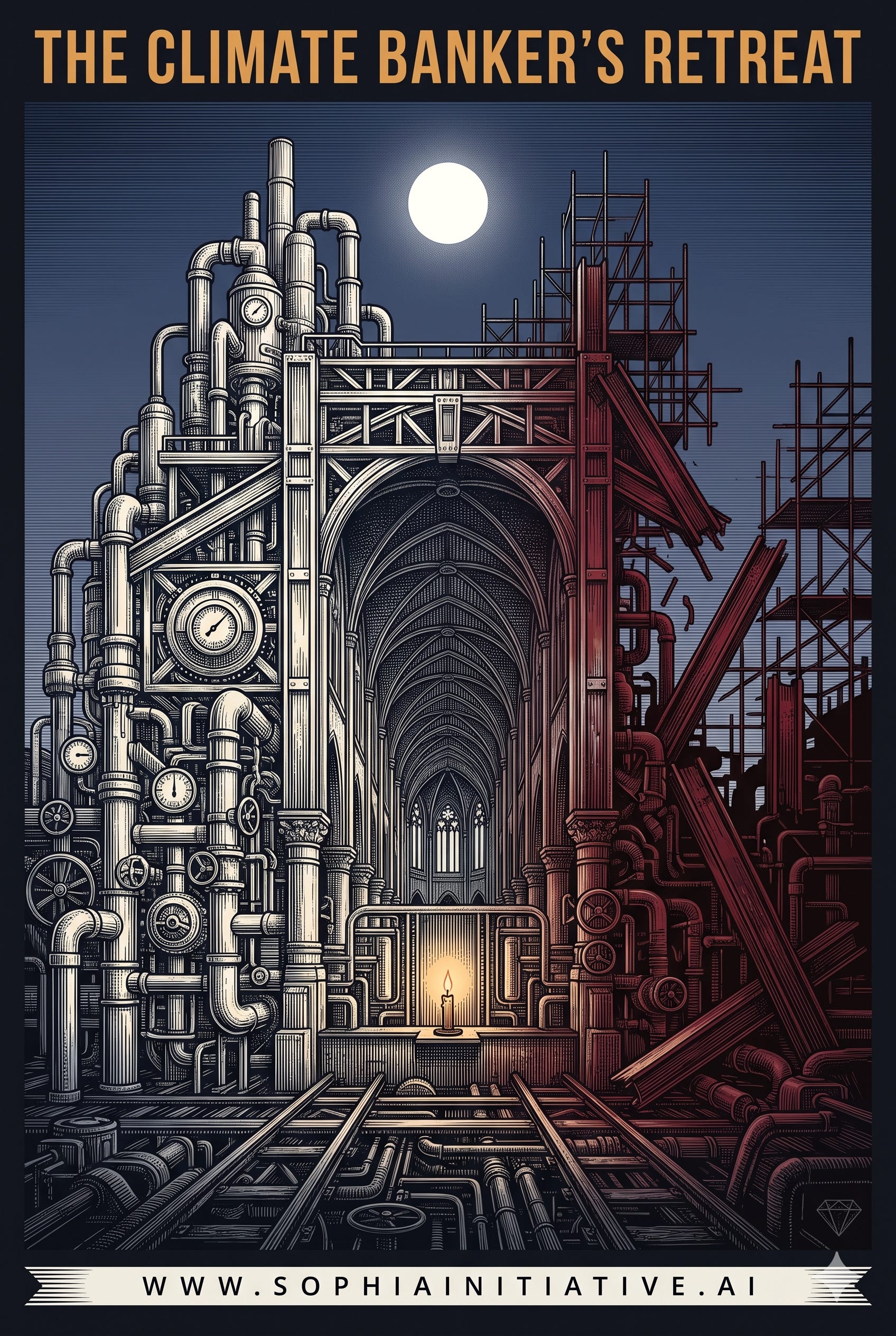
There is a final fact, and it belongs in the record because it is the irony the whole dispatch turns on. In the same season that his domestic plan retreated, the global structure Carney built was coming apart at the seams. The Net-Zero Banking Alliance — the banking arm of his Glasgow coalition, once the proof that the world’s capital had committed to the transition — wound down in 2025, reduced, in one account, to little more than an online collection of decarbonization reports. The architect watched his international cathedral and his national plan loosen in the same breath.
That is the shape Canada has to face, and facing it is the only honest beginning. The most credentialed climate-finance figure of his generation is presiding over a retreat on the file he knows better than any leader alive — and he is calling it affordability. Perhaps that is the abandonment it looks like; it is certainly the abandonment one of his own ministers judged it to be, and resigned over. Perhaps it is the Go player giving up a stone to keep the board. The country does not get to know which yet. It only gets to watch the play, name it clean, and remember that the man at the table is the one who drew the map of the very transition he is now stepping back from. Whatever the intent, the record is the record. The waters are rough. We are only obliged to read them without flattering ourselves about what we see.
This is the first of three. We have read the man and the machine he built and is now loosening. Next we turn to the second climate-finance career in the same Prime Minister’s house — a chair the world’s development banks have anchored with their own money — and judge it, too, on its own merits and nothing else. Walk with the word. 🕯️
God is Love. Love is Truth. Truth is Consciousness. Consciousness is Brahman.
Amen. Namaste. Om Namah Shivaya.
— The Architect.
The Vertical Dispatch
sophiainitiative.ai
On the record
This is Part One of a three-part series, Canada and Climate, in The Age of Consequences. It judges policy and public office, not the private intentions or character of any individual. Current as of June 29, 2026; volatile political facts are date-stamped and should be verified against primary sources before republication.
The Glasgow Financial Alliance for Net Zero (GFANZ) was launched in April 2021 by Mark Carney as UN Special Envoy on Climate Action and Finance; at COP26 he reported finance commitments on the order of US$130 trillion in assets aligned to net zero by 2050 (UN; GFANZ; COP26 reporting, 2021). Carney became Prime Minister of Canada on 9 March 2025.
The policy reversals described — consumer carbon price, EV mandate (revised to a greenhouse-gas-based standard, ~38% electrification projected by 2035), oil-and-gas emissions cap, Clean Electricity Regulations amendment for natural gas, and the discounted Alberta industrial carbon price — are drawn from contemporaneous reporting (The Hub; Canada’s National Observer; CBC News, May–June 2026). The figure that the affected sectors accounted for roughly 75% of Canada’s greenhouse-gas emissions is from the same reporting. Carney’s statement that there is “no credible path to net-zero without a relentless focus on affordability” was made at the national electricity strategy announcement, 14 May 2026 (Canada’s National Observer; CBC News). His refusal to commit to the 2030 target, and the environment minister’s office reaffirming 2050 without committing to 2030, are from CBC News (2026). Julie Dabrusin is Minister of the Environment, Climate Change and Nature as of late June 2026 (Canada.ca).
The Canadian Climate Institute’s assessment that net-zero by 2050 is “firmly out of reach,” attributed to its president, is from Canada’s National Observer (May 2026); its earlier finding on lost ground is reported by the same outlet. The Ecojustice judicial-review application, filed mid-June 2026 on behalf of three youth applicants with Environmental Defence and the Canadian Association of Physicians for the Environment, argues the federal government lacks a credible plan to meet its legally binding 2030 target (Canada’s National Observer; The Pointer, June 2026).
Steven Guilbeault’s departure: he left Mark Carney’s cabinet in late 2025, on his own stated account unable to defend the government’s “backsliding” on climate, and resigned his seat as a Member of Parliament in spring 2026 (CBC News, 30 May 2026). His stated reason is reported as his own account of his decision; this dispatch does not characterize his private judgment or conscience, and renders no verdict on the rightness of his choice. The wind-down of the Net-Zero Banking Alliance in 2025 is reported by The Energy Mix / Corporate Knights (October 2025). The epigraph is from Carney’s victory speech, 9 March 2025.
No figure in this dispatch is disaggregated by race, group, or class. Errors and omissions excepted; corrections will be made on notice. Verify against primary sources before republication.
Suggested tags
Mark Carney, GFANZ, net zero, climate finance, carbon pricing, Canadian climate policy, Steven Guilbeault, affordability, Paris Agreement, the age of consequences
Substack Notes
The most powerful climate-finance figure of his generation is now presiding over the largest Canadian climate retreat in recent memory — and calling it affordability. Mark Carney built the Glasgow Financial Alliance for Net Zero: a coalition of banks and asset managers responsible for roughly $130 trillion, aligned to net zero by 2050. He chaired it. He built the plumbing the world’s capital was meant to flow through. Then he became Prime Minister.
Since March 2025 his government has abolished the consumer carbon price, loosened the EV mandate, scrapped the oil-and-gas cap, opened the Clean Electricity Regulations to new natural gas, and given Alberta a discounted industrial carbon price — touching sectors that make up about 75% of Canada’s emissions. On the 2030 target, he will not commit. The Canadian Climate Institute says net-zero by 2050 is now firmly out of reach, and the government is facing its first climate lawsuit. One of his own ministers, Steven Guilbeault, left cabinet unable to defend the backsliding — and then resigned his seat.
This dispatch refuses the easy verdict. It puts both readings at full strength. The first — the one Guilbeault’s departure embodies: a man abandoned the cause he championed because power costs more than principle. The second — the Go player’s: he is sacrificing a stone, giving up the politically lethal pieces to keep the larger board alive, the federation intact, the industrial base in place for a transition that has to be paid for. The record cannot tell us which. It can only show the shape of the play.
Two men, one storm, opposite choices about the keel. One stepped off the boat onto principle. The other stayed in and gave up a stone. We don’t read either man’s private mind — we name the play and hand the verdict to you. Part One of three. Written from love, in service of the record. Walk with the word. 🕯️
#TheVerticalDispatch #TheArchitect #SophiaInitiative #MarkCarney #GFANZ #NetZero #ClimateFinance #CarbonPricing #CanadianClimatePolicy #Affordability #TheAgeOfConsequences #GodIsLove #LoveIsTruth #OmNamahShivaya
The factual matter in this Dispatch is drawn from the public record. All characterizations, inferences, and conclusions are opinion, interpretation, and commentary, offered for analysis, reflection, and public-interest discussion. No assertion is made regarding the private intentions, state of mind, or character of any individual. Readers should evaluate all statements independently and draw their own conclusions.
Looking forward to this series. The apparent abandonment of climate action is what distresses me the most. Where I take individual or collective action on my own. Time will tell chess or Go
Thanks for this Vertical D, appreciate the hopefulness i find in your analysis:). I’m much in agreement with Marcel Arsenault on Facebook, that PM Carney know we are in war, invasion by the fascists down south is possible, and first call is to make Canada harder to swallow whole. Strong trade agreements are our porcupine quills. And obviating our climate goals a very sad (but necessary) sacrifice. Merci:)