

The Vertical Dispatch · The Age of Consequences
By Glennford Ellison Roberts · The Architect · May 2026
If you love Canada, please share and restack.
An earlier version of this dispatch, published May 22, reversed the polarity of Premier Smith’s stated position on the October 19 referendum question. The dispatch wrote that Smith said she would personally vote No. Against the actual ballot wording — “Should Alberta remain a province of Canada or should the Government of Alberta commence the legal process required under the Canadian Constitution to hold a binding provincial referendum on whether or not Alberta should separate from Canada?” — the pro-Canada response is Yes to the first clause. The text below has been corrected. The substantive argument of the dispatch is unchanged. The Vertical thanks the reader who flagged the error in the comments — and has been inspired by the catch to commission a companion dispatch examining all ten questions on the October 19 ballot against the spirit of the Clarity Act, forthcoming. The publication’s standard is that corrections of this kind appear at the top of the affected dispatch, in the open, on the date they are made.
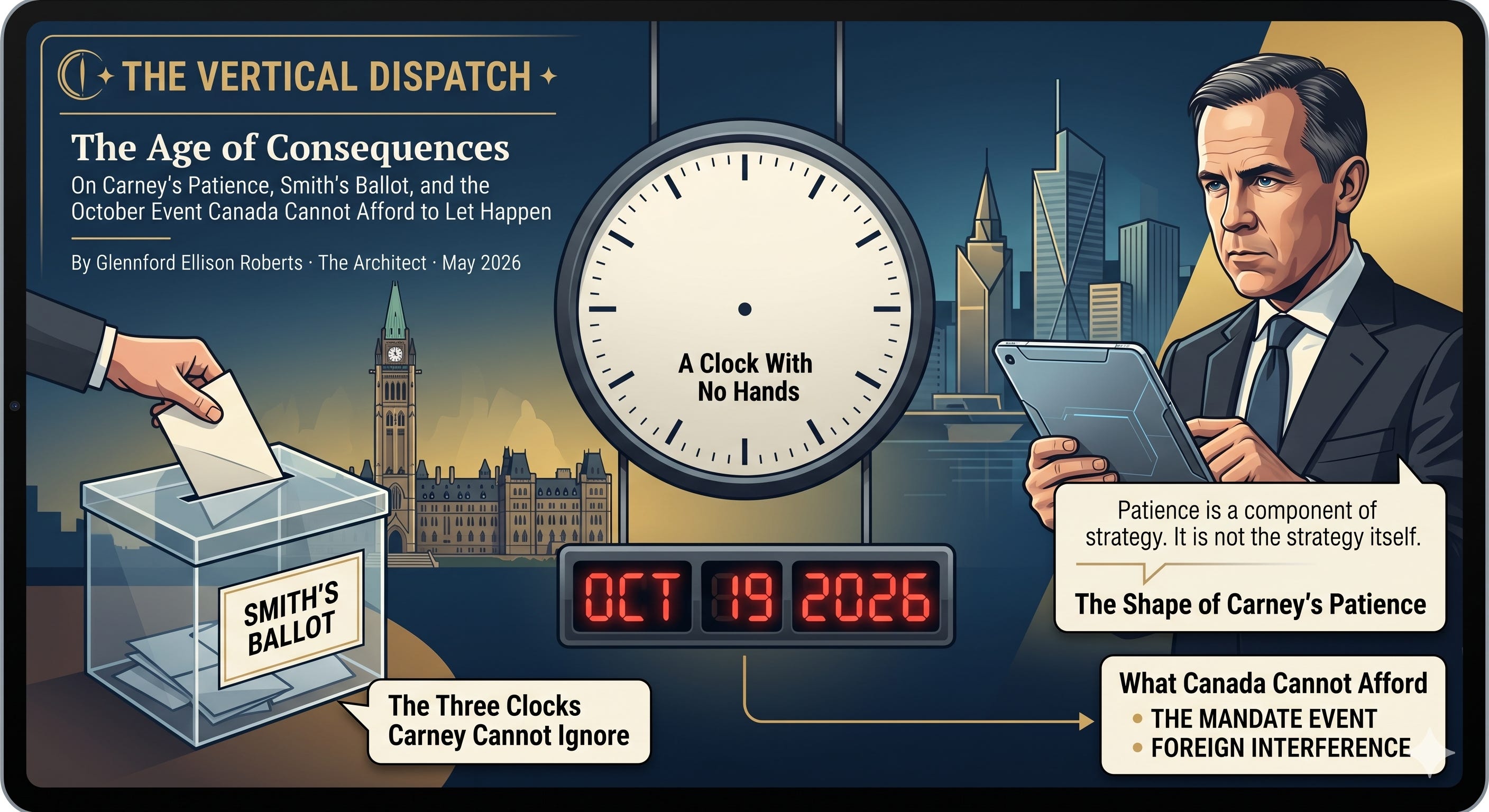
There is a clock running in this country that has no hands on its face. You cannot look at it and read the time. You can only watch what it is counting toward — and the name of what it is counting toward is October 19, 2026.
On that date, Albertans will be asked whether their province should remain inside Canada, or whether the Government of Alberta should commence the constitutional process required to hold a binding referendum on separation. That is the question Danielle Smith added to the ballot on May 21. She said she would personally vote No. She said the question was about process. She said it was about letting Albertans be heard.
What she did not say is that the legal architect of the petition infrastructure behind this movement met U.S. State Department officials three times in Washington — the final meeting inside a Sensitive Compartmented Information Facility, a classified American government room used for national security business — to discuss the logistics of Alberta breaking from Canada, switching to U.S. dollars, and accessing a five-hundred-billion-dollar U.S. Treasury credit line to fund the transition. She did not say that. She has never said that. She has not been asked to account for it on the record, under pressure, in terms that require a direct answer.
That is the clock. And Mark Carney is the man with the watch.
The Shape of Carney’s Patience
Understand first what Carney is doing and why it is not weakness. He is allowing the constitutional architecture to do the structural work. Justice Leonard’s ruling on May 13 did not merely kill one petition. It established — in binding precedent — that the entire separatist petition process violates the Crown’s duty to consult First Nations under Section 35 of the Constitution Act. That is not a political opinion. That is a constitutional finding. Every time Smith revives the mechanism, she walks directly back into the same wall. Carney knows this. He is watching a premier who plays checkers construct her own trap in real time while he stands in Calgary signing pipeline agreements and reading thirty-year boards.
The trade negotiation frame adds a second layer of rationality to his restraint. Picking a constitutional fight with Alberta’s government in the spring while simultaneously negotiating with Washington on tariffs would hand Donald Trump exactly the internal Canadian fracture he is trying to produce. Carney is not giving him that. He is separating the timelines. That is Go. That is not accident.
“A premier who places a separation question on the ballot, hoping it loses so she can claim she gave the base their day, has not thought about what happens if it wins.”
But patience is not the same as permission. And restraint exercised past its natural deadline becomes, in the public eye, something indistinguishable from complicity.
The Three Clocks Carney Cannot Ignore
There are not one but three countdowns now running simultaneously, and each one has a different failure mode if Carney allows it to expire without action.
The first is constitutional. Smith’s referendum question — framed as a question about process rather than separation itself — is her legal theory for escaping Justice Leonard’s ruling. Her argument is that asking Albertans whether to hold a referendum is categorically different from asking whether to separate, and therefore does not trigger the same duty-to-consult obligations. The First Nations who won that ruling will file again. The lawyers are likely already drafting. If Carney’s federal government does not intervene — does not file a reference question to the Supreme Court of Canada, does not join the First Nations intervenor motion, does not place Ottawa visibly and formally on the constitutional record — then he has allowed the prime minister’s office to be a spectator at a process his own constitution governs. That is not tenable. That is not Go. That is surrender dressed as patience.
The second clock is the foreign interference record. It is now fully assembled in the public domain. The three Washington meetings. The SCIF. Jeffrey Rath’s public statements about briefing officials with direct reporting lines to the Oval Office. Scott Bessent at Davos calling Alberta a natural partner for the United States. The sworn national security affidavit before Justice Leonard describing the situation as a foreign interference operation directed at a Canadian domestic political process. A Canadian national security expert, under oath, in a Canadian courtroom, calling this what it is. The Globe and Mail has it. CBC has it. The Financial Times has it. Bloomberg has it. NBC News has it.
What Canada does not yet have is a prime minister who has stood at a podium and named it. Not accused it. Named it. Presented the documented record to the Canadian public as a national security matter under the authority of his office. Carney has the receipts. The receipts are already on the table. The question is whether he picks them up.
The third clock is the one your instinct identified — Canadian public sentiment, which is the most volatile and the most consequential. English Canada has been in a sovereignty mood since February. The wave that returned Carney’s government was not merely anti-Trump. It was pro-Canada in a register this country has not produced since the 1995 referendum. That mood does not cool slowly. It pivots. If Canadians spend the summer watching their prime minister negotiate trade deals while a foreign-interference operation prepares an October mandate event — and Carney offers nothing except patience — the mood will not stay with him. It will move past him. And a prime minister left behind by the sovereign instinct of his own electorate is a prime minister who has lost the frame that elected him.
What Real Strength Looks Like
It is not a speech. Speeches are what politicians give when they have decided not to act. Real strength, in this configuration, on this board, has three specific instruments.
The first is a reference question to the Supreme Court of Canada. File it before July. Ask the Court whether Smith’s referendum question — given Justice Leonard’s constitutional finding and the unresolved duty-to-consult obligations under Section 35 — is itself constitutionally permissible. This is not aggression. It is the constitutional mechanism that exists precisely for this purpose. It pulls the question into federal jurisdiction. It signals that Ottawa is not a spectator. It makes Smith defend her legal theory before the highest court in the country rather than before an October electorate that has been told this is simply about being heard. File the reference question and the board changes overnight.
The second instrument is a formal public intelligence briefing on the foreign interference operation. Not a leak. Not a background briefing to friendly journalists. A prime ministerial address — nationally televised, with documented evidence presented in full — naming the SCIF meetings, the Rath statements, the Bessent endorsement, and the sworn affidavit. This is not partisan. The Clarity Act already establishes that a referendum on Canadian sovereignty is a matter of national interest. A foreign government actively funding and operationally supporting the separatist architecture surrounding that referendum is, by any definition, a national security matter. Carney does not need to call it treason. He needs to call it what the affidavit already called it, from a podium, in his own name.
The third instrument is the summer trade deal itself — used not merely as an economic deliverable but as a structural argument. If Carney closes a trade framework with Washington that protects Canadian sovereignty, Canadian supply chains, and Canadian resource revenues before October 19, he has answered the separatist premise on its own terms. The separatist argument is that Ottawa cannot protect Alberta’s economic interests. Close the deal. Then stand in Alberta and say: here is what membership in this country delivered, and here is what the alternative would have cost you.
“The patience has a hard deadline. And the deadline is not October 19. The deadline is the moment Canadians decide their prime minister is watching the clock rather than reading it.”
The Board Canada Is Actually Playing
Here is what Smith has not calculated. She is playing for tonight’s news cycle and October’s headline. She is not playing for what happens if the Yes side wins. A premier who places a separation question on the ballot, hoping it loses so she can claim she gave the base their day, has not thought about what happens if it wins. A Yes vote — even a narrow one — does not produce separation. It produces a mandate. A mandate that travels to Washington, where people who have been meeting in classified rooms for a year and a half are ready to receive it. A mandate that Rath will take to the U.S. Treasury officials he has already said he is looking forward to meeting. A mandate that transforms the foreign interference architecture from a fringe operation into a legitimized negotiating position backed by a provincial democratic outcome.
That is what Carney cannot allow. Not the referendum. The mandate event. The legitimacy transfer. The moment the foreign interference operation acquires a democratic certificate of origin that it can carry into every room it has already been preparing to enter.
Canada has been here before. In 1995, the No side won by 50,000 votes. The country did not lose itself that night. But it came close enough that every institution that governs this country has lived in the shadow of that margin ever since. The Clarity Act exists because of 50,000 votes. The Referendum Act exists because of 50,000 votes. The duty-to-consult framework that Justice Leonard applied to kill Smith’s first petition exists, in its developed constitutional form, because this country learned — painfully, over thirty years — that you cannot govern a sovereign nation by allowing its fracture points to be managed by whoever shows up with a ballot question and a foreign credit line.
Mark Carney knows this. He is not naive about the board. He is not unaware of the clocks. The question — the only question — is whether he picks up the instruments available to him before the window closes, or whether he allows the summer to pass in the belief that patience is the same as strategy.
It is not. Patience is a component of strategy. It is not the strategy itself. The strategy requires a move. The move is the reference question, the named record, and the closed deal. Together, those three instruments do what no speech can do — they change the constitutional, informational, and economic terrain on which October 19 will be fought, before October 19 arrives.
The clock has no hands. But it is running. And Canada is watching to see whether its prime minister is reading it.
God is Love. Love is Truth. Truth is Consciousness. Consciousness is Brahman.
Amen. Namaste.
#TheClockWithNoHands #NoQuarter #MarkCarney #DanielleSmith #Alberta #October19 #SeparationReferendum #AlbertaProsperityProject #JeffreyRath #SCIF #ForeignInterference #ScottBessent #WashingtonMeetings #Section35 #DutyToConsult #JusticeLeonard #ReferenceQuestion #SupremeCourt #ClarityAct #CanadianSovereignty #CooperativeFederalism #CheckersAndGo #1995Redux #TheMandateEvent #Patience IsNotStrategy #TheThreeClocks #ConstitutionalArchitecture #FirstNationsWon #TreatyRights #NationalSecurity #ForeignInterferenceAct #TrumpIdeology #TheSeparatistArchitecture #AlbertaReferendum #CanadaFirst #IAmCanadian #TheReceipts #TheRecordIsWhatItIs #AgeOfConsequences #TheVerticalDispatch #TheArchitect
Dear Universe, I'm ready. Pass the popcorn 🍿. Proud to be an Alberta-born Canadian, and glad to have read this piece because of the hope it gives me!
I would like to clarify that it is the first question that requires a “YES” vote - NOT no. Because it’s asking if voters support Canada STAYING IN CANADA.
It’s the second question that requires the “no” vote. Because it’s asking if voters support the govt moving forward to begin the process of Alberta seceding from Canada.
I would ask that you revisit this issue. Thank you.