

The Sovereign Core · The Age of Consequences
Synthesis Dispatch · May 2026
Not everything that is faced can be changed. But nothing can be changed until it is faced. — James Baldwin
Belshazzar did not know it was the last night. That is the first thing to understand about the fall of empires, and the hardest. The king of Babylon held a feast for a thousand of his lords, and he sent for the sacred vessels his father had carried out of the temple in Jerusalem, and he drank wine from them, and praised the gods of gold and silver and bronze and iron and wood and stone. He was not afraid. He had no reason to be. Babylon was the centre of the world, its walls were beyond the reach of any army, its wealth was beyond counting. And on the wall of the banquet hall, in the light of the lamps, a hand appeared and wrote four words that no one in the room could read. They had to send for a captive Hebrew to translate them. Mene, mene, tekel, upharsin. Numbered, numbered, weighed, divided. Your days are counted. You have been weighed in the balance and found wanting. Your kingdom will be divided and given to others. That same night the Persians came under the walls through the diverted river, and Belshazzar was killed, and the empire that had ruled the known world passed to other hands. The feast was still warm on the tables.
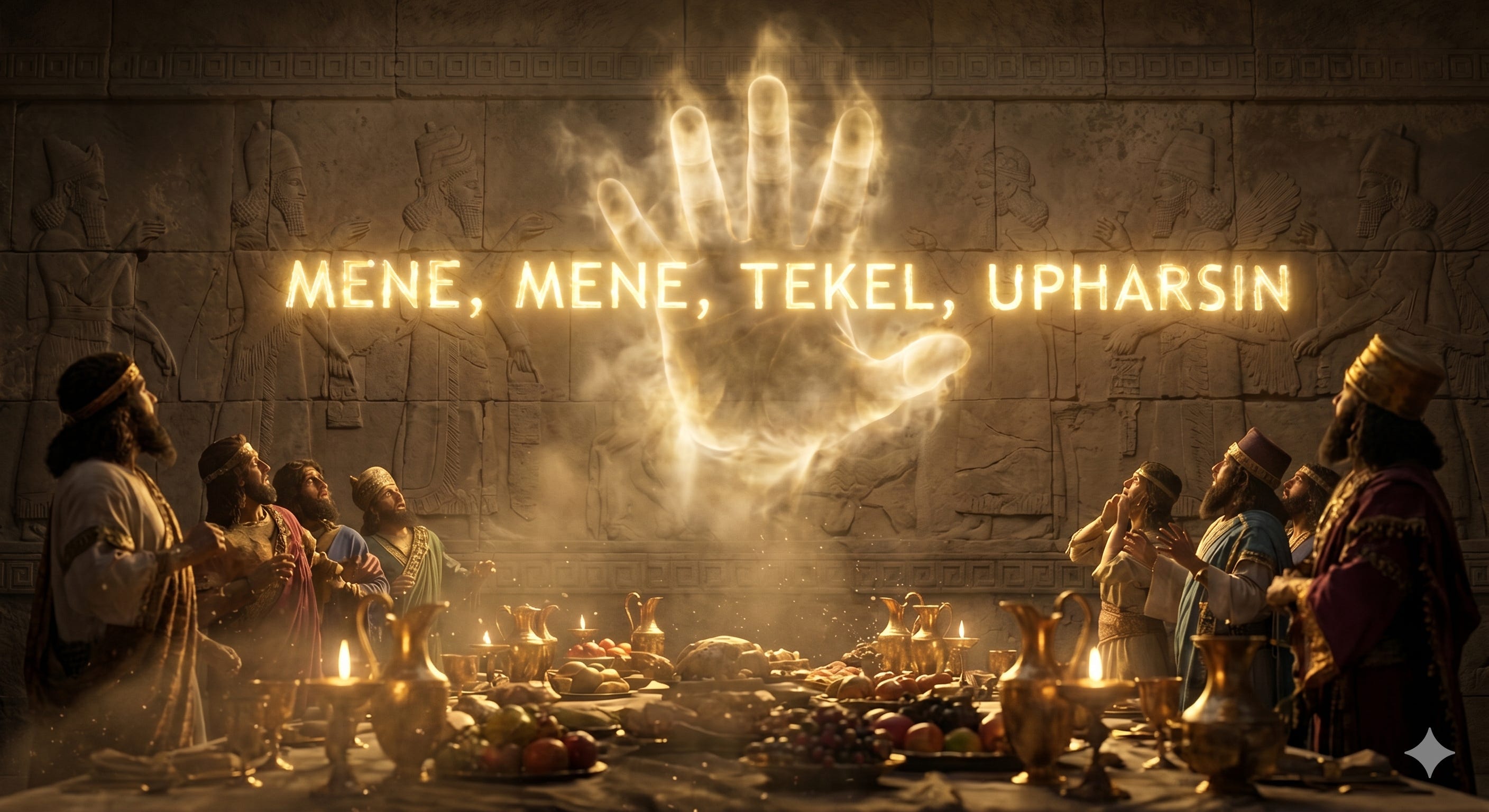
The story is three thousand years old and it has never stopped being current, because it is not really a story about Babylon. It is a story about a particular kind of blindness — the blindness that wealth and power produce in the souls that hold them, the precise inability to read the writing that is plainly visible on one’s own wall. Babylon could not read it. Rome could not read it. The Spanish empire that drowned in its own silver could not read it. The British empire on which the sun was not permitted to set could not read it. And the United States of America, in the year 2026, standing at the apex of a power no previous empire ever approached, cannot read it either. The writing is on the wall. It has been on the wall for some time. This dispatch is an attempt to read it.
I. The Disease That Kills Empires
Empires do not die the way the textbooks suggest — overrun by stronger neighbours, defeated in a single decisive war, undone by a barbarian at the gate. The barbarian at the gate is almost always the last cause, never the first. By the time the gate falls, the thing inside has already died. What kills empires is internal, and it is astonishingly consistent across three thousand years of recorded history. The names change. The mechanism does not.
Joseph Tainter, in The Collapse of Complex Societies, named the structural half of it. Societies solve their easiest problems first. Each new problem is solved by adding complexity — another layer of administration, another tier of military, another stratum of subsidy and management and law. And complexity, as a problem-solving strategy, faces diminishing marginal returns. Each new layer costs more and delivers less, until the society is paying enormous sums to maintain a complexity that no longer solves anything, and a shock arrives that it can no longer afford to absorb. Rome did not fall because the Germanic tribes were strong. Rome fell because by the fifth century the cost of being Rome exceeded what Rome could extract, and the periphery quietly concluded that the empire was no longer worth paying for. The barbarians did not breach the wall. The wall was no longer being maintained, because the men who would once have maintained it had done the arithmetic.
Peter Turchin named the human half of it. Every declining society produces, in its late phase, more elites than it has positions for — more lawyers than there are judgeships, more aspirants than there are seats at the table, more men and women trained and credentialed and convinced of their own entitlement to power than the structure can possibly absorb. Turchin calls it elite overproduction, and he has shown that it is the single most reliable leading indicator of political violence across the historical record. The surplus elites do not quietly accept their exclusion. They turn on the system that made and then failed them. They become the demagogues, the factional warlords, the men who would rather rule in a burning house than serve in a sound one. Elite overproduction is the engine of every civil war, every revolution, every descent of a republic into faction and then into blood.
But the structural account and the human account, true as they both are, do not reach the root. They describe the body of the dying empire. They do not name the soul. And every tradition that has ever watched an empire die — the Hebrew prophets, the Roman moralists, the Confucian historians, the Islamic philosopher Ibn Khaldun who built an entire science around it — has named the same thing at the root, and it is older and simpler than either Tainter or Turchin. Empires die when they lose their virtue. They die when the thing that made them worth defending hollows out from the inside, and the citizens can feel the hollowness even when they cannot name it, and they stop believing — not in the power of the empire, which may be greater than ever, but in its goodness, which is gone.
II. Virtue and the Loss of the Sacred
This is where the analysis has to go vertical, because virtue is a vertical word, and the modern study of power has amputated the vertical entirely. The geopoliticians count armies and economies and territory. They do not count virtue, because virtue cannot be counted, and what cannot be counted has been defined out of the real. But every civilization that ever lasted understood that its survival rested on something the ledgers could not capture — a shared sense of the sacred, an axis around which the common life was ordered, a belief that the society was answerable to something higher than its own appetite.
A society that has lost the capacity to recognize the sacred reduces all of life to the profane. Such a society Eliade calls desacralized.
Mircea Eliade gave the language for it in 1957. The sacred is the manifestation of the wholly other within human experience — the dimension that orders ordinary life by reference to something beyond it. The profane is the merely material, the unsanctified, the transactional. Every traditional society maintains what Eliade called an axis mundi, a centre of the world that connects the human to the transcendent, through which the sacred orders the profane. And a society that loses the capacity to recognize the sacred does not become neutral. It becomes desacralized. It reduces everything — every office, every vow, every symbol, every human life — to the profane. Price replaces worth. Transaction replaces covenant. The brand replaces the temple. The celebrity replaces the saint. And nobody inside the desacralized society can quite see what has happened, because the loss of the sacred takes with it the very faculty by which the loss could be perceived.
Virtue, in the old and exact sense, is what a people does with the sacred. It is the sacred made into conduct — the honesty that holds because truth is held to be holy, the courage that holds because some things are held to be worth dying for, the restraint that holds because power is understood to be answerable. When the sacred goes, virtue has nothing left to stand on. It becomes, at best, a brand of itself — performed, marketed, invoked in slogans, and absent from the actual conduct of the powerful. This is the disease. This is what kills empires at the root. Not the loss of power. The loss of the sacred, and therefore of virtue, and therefore of the one thing that ever made the power legitimate in the eyes of the people who lived under it and the allies who stood beside it.
III. The Profane Is Strong in America
Read against this frame, the American present becomes legible in a way the daily coverage cannot make it. The United States in 2026 is not an empire short of power. It is an empire that has lost its virtue and retained its power, which is the most dangerous configuration an empire can occupy, because power without virtue does not restrain itself and cannot persuade. It can only coerce. And an empire reduced to coercion has already announced, to everyone watching, that the thing which made it worth following is gone.
Consider what the documented record has placed before the world in the last twelve months, and read it not as a sequence of news events but as a single spiritual diagnosis. The president of Venezuela, Nicolás Maduro, seized in a US military strike on Caracas on the third of January and flown to New York to face American justice. A small Arctic territory of fifty-seven thousand people, Greenland, threatened through 2025 and into early 2026 with annexation, with tariffs on the European allies that defend it, and with a refusal to rule out the use of military force. Cuba, blockaded into a humanitarian crisis so severe the island declared itself out of fuel, with the United Nations and humanitarian agencies recording the collapse of medicine and food, and other countries threatened with tariffs if they attempted to send oil. The ninety-four-year-old former president of Cuba, Raúl Castro, indicted in May 2026 on charges three decades old, in what the documented reporting names as the legal pretext for possible regime change. The closest neighbour and oldest friend, Canada, told repeatedly through 2024 and 2025 that it should become the fifty-first state — most recently at a gathering of senior US military officers at Quantico in September. And the European democracies, the very alliance the post-war American order was built to lead, threatened with escalating tariffs for refusing to deliver Greenland to Washington. Each act, taken alone, can be argued. Taken together, they are the portrait of a power that no longer recognizes any sacred limit on what it may do to others — which is the precise definition of the profane operating at the scale of a state.
The profanation reaches inward as well, and this is the deeper tell. The office of the presidency, once a sacralized thing, reduced to a brand and a grievance. The constitutional symbols reduced to merchandise. The category of truth itself — the most sacred thing any republic possesses, because self-government is impossible without a shared factual ground — reduced to a matter of factional preference, so that the country can no longer agree on what happened in its own elections, its own streets, its own recent past. A people that cannot agree on what is true has lost its axis mundi. It has been desacralized. And the figure currently at its head is not the cause of this condition but its perfect expression — a desacralized man occupying a desacralized office in a desacralized republic, profaning, as a matter of temperament, every sacred symbol he encounters. The man is mortal and temporary. The condition that produced him is neither.
IV. A Stratum-Three Power in a Stratum-Seven Moment
There is a cognitive dimension to this, and it is the most quietly devastating part of the diagnosis, because it speaks to whether the condition can be reversed at all. Elliott Jaques, the Canadian-born theorist, showed that minds and the institutions they build sort themselves by time horizon — by the longest arc of future a person, or a polity, can actually hold in view and plan against. A power operating at the highest strata thinks in twenty- and fifty-year civilizational arcs. A power operating at the lowest thinks only in the immediate move, the immediate capture, the transaction directly in front of it.
The American state in 2026 is conducting itself at the lowest strata its modern history has recorded. Every move is immediate. Every move is legible. Every move is transactional and zero-sum — seize, threaten, blockade, indict, tariff, annex. There is no surrounding, no positioning, no building of a structure that will stand in thirty years. It is the conduct of a player who sees only the piece in front of him on a board where every other serious power has begun to play the long territorial game. This is what the loss of virtue does to cognition: it collapses the time horizon. A soul, or a state, that has lost its sense of the sacred has lost its reason to plan for a future it will not personally consume. The desacralized cannot think in fifty-year arcs, because the fifty-year arc requires a reverence for what comes after oneself, and reverence is precisely the faculty that the profane destroys first.
And here the diagnosis turns genuinely grave, because the question is whether the capacity to change remains. The honest measure of a society’s capacity to reverse its decline is the cognitive condition of its population — its ability to read complexity, to hold a long argument, to distinguish truth from its counterfeit. The international assessments give that question a sobering answer. The OECD’s Survey of Adult Skills — the Programme for the International Assessment of Adult Competencies, the PIAAC — found in its 2023 cycle that twenty-eight percent of American adults aged sixteen to sixty-five, on the order of fifty-nine million people, scored at Level 1 or below in literacy: a level at which a reader can locate a single piece of information on a page but cannot reliably compare, contrast, or draw an inference across a text. The numeracy figure is worse — thirty-four percent, on the order of seventy-two million adults, at Level 1 or below. And the direction is the tell. Both figures rose sharply from the previous cycle, the literacy share of low performers climbing from nineteen percent in 2017 and the numeracy share from twenty-nine, while mean scores fell on both scales. The country is not holding steady. It is sliding, and the bottom is widening.
These are not minor statistics. They name a fraction of the adult population — comfortably over a quarter on literacy, over a third on numeracy — that reads and reasons at a level that makes the deliberate, patient, decades-long work of civilizational reversal extraordinarily difficult. Cognition of that kind does not change in an electoral cycle. It does not change in a generation. And reversal of a civilizational decline is precisely a multi-generational, high-complexity, high-patience undertaking — the one kind of work a desacralized and cognitively foreshortened polity is least equipped to perform. The most powerful checkers player in the world, operating as if checkers is the only game on the table.
V. The Two Roads Down
If the disease is real and the capacity to reverse it is doubtful, then the honest question is not whether the American century closes but how. The historical record offers two roads, and they are worth naming plainly, because the difference between them is the difference between a manageable transition and a catastrophe that reaches everyone.
The first road is the steady descent — the long, managed, undignified slide that Britain made across the twentieth century, shedding empire and primacy and the assumption of centrality, contracting into a wealthy and diminished nation that no longer set the terms of the world. It is not a happy road. It is full of resentment and nostalgia and the periodic eruption of grievance politics. But it does not, in the end, take the world down with it. The descending power finds, eventually, a smaller and survivable place, and the international order reorganizes around the powers that are rising and the coalitions that are building. This is the better of the two roads, and it remains available, and the Dispatch holds that it remains the more probable.
The second road is the one the sacred traditions always feared most, because a profaned power that retains the instruments of total destruction is not like a profaned power that does not. Babylon fell in a night and the harm was contained to Babylon. Rome fell across centuries and the harm, vast as it was, was bounded by the technology of the age. A nuclear-armed empire in the terminal phase of desacralization is a new thing under the sun — a power that has lost the sacred restraint on what it may do, while retaining the physical capacity to end the human story. This is the scenario that cannot be waved away and must not be dwelt upon in panic: that an empire which can no longer read the writing on its own wall, and can no longer think past the move in front of it, holds in its hands the one weapon whose use admits no recovery and no second draft. The Dispatch names this road soberly, as the lower-probability and higher-consequence tail, precisely because naming it is the beginning of facing it, and nothing can be changed until it is faced.
Between these two roads, the work of every other serious power in the world is the same: to build the architecture that survives either one. This is what the new alliance of democratic middle powers is — a distributed coalition constructing, in plain sight, the structure that can outlast the closing of the American century whether that closing is gentle or violent. They are not picking a war with the descending power. No one is. They are reading the wall the descending power cannot read, and they are quietly building the house that will still be standing when the feast in the banquet hall is over.
VI. The Writing, and the Reading
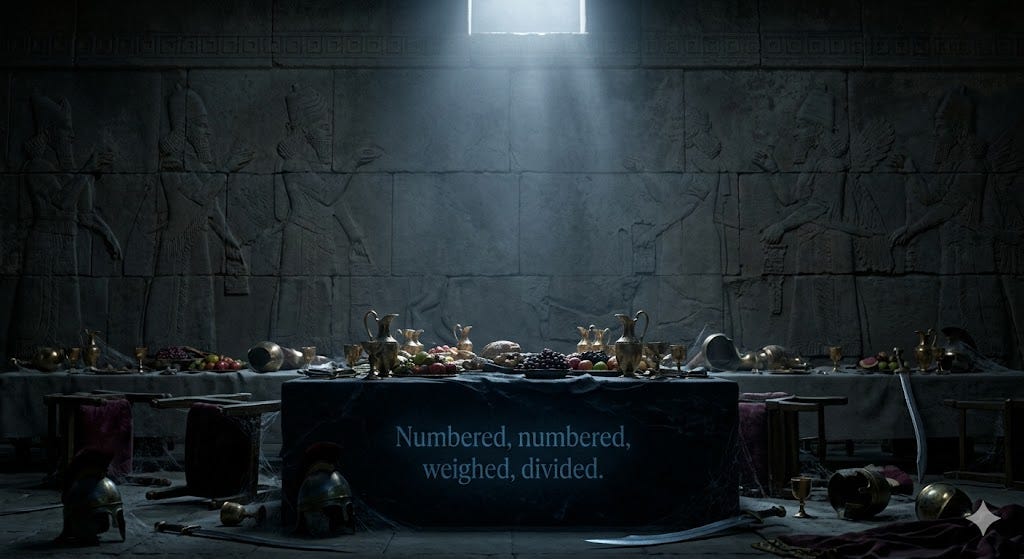
Every empire that ever fell had its writing on the wall, and not one of them could read it from the inside. This is not a coincidence and it is not a failure of intelligence. It is the disease itself. The loss of the sacred takes with it the faculty by which the loss could be perceived, which is why the desacralized power is always the last to know. Belshazzar had to send for a captive to read the wall, and by then it was the final night. Rome had its prophets and its moralists and ignored them all. The pattern is not that the writing is hidden. The pattern is that the power which most needs to read it has destroyed in itself the organ of reading.
The reading, then, falls to everyone else — to the powers and the peoples and the coalitions that still possess the faculty, that have not yet traded the sacred for the brand and the long arc for the immediate capture. And this is the place to name what is plainly visible to the high-altitude reader: the leaders quietly building the new architecture — Canada under Carney, the European democracies, the Pacific middle powers — are not opposing America in the political sense the daily coverage assumes. They are reading the wall America cannot read, and acting on what the reading requires. Their poise is not weakness. Their patience is not appeasement. Their measured smile in the face of provocation is the conduct of statesmen who understand that a descending power is best handled with dignity and distance, while what comes next is built. The logical choice — the only choice that meets the moment at the level the moment demands — is exactly what they are doing: speak softly, hold the principles, rebuild the alliance, and let the descent run its course without giving it the war it needs to make itself something other than a descent.
The Canadian reader is among the inheritors of that work, and the responsibility that comes with it is not to gloat at a falling giant, which would be its own small profanation, but to read the wall clearly, to build the architecture that survives, and to refuse the disease in oneself. Because the disease is not American. The disease is human, and it is available to every nation that builds its identity on a lie it cannot face and ends by worshipping its own power as though power were the sacred thing. America caught it because America stopped doing the work. Every nation that stops doing the work will catch it too.
The writing on the wall is not a prophecy of doom. It is a diagnosis, and a diagnosis is the first act of healing. Numbered, numbered, weighed, divided — the words are terrible only to the power that cannot read them. To everyone else they are an instruction: face what is being faced, build what must be built, and hold the sacred in a time of profanation, so that something true survives the closing of the sky. That is the work that remains. It was always the work that remains.
VII. The Measure of a Man
There was once an emperor who ruled the greatest power on earth and wrote, at night and for no eyes but his own, a private book about how to remain a good man while holding it. Marcus Aurelius governed Rome at its zenith, commanded its legions, held more worldly power than almost any human being who has ever lived — and spent his evenings reminding himself that none of it was the point. The point was virtue: to be just, temperate, courageous, and free, and to understand that nothing which made a man unjust could ever truly be good for him. He set down a single sentence that contains the whole of what this dispatch has been circling.
What is not good for the hive is not good for the bee. — Marcus Aurelius, Meditations, 6.54
It is the oldest definition of virtue there is, and the most exact: the good of the part cannot be separated from the good of the whole, and the man who mortgages the hive for his own comfort has not enriched himself, he has impoverished the only thing that made his own life possible. This is precisely the faculty that the desacralized leader has lost. He can no longer perceive the hive at all — only the self, only the move in front of him, only the transaction he can extract before the lamps go out. He profanes the sacred office because he cannot feel that it is sacred. He breaks his word because he cannot feel that the word is holy. He cannot read the writing on the wall because the writing is addressed to a part of him that has gone dark. Marcus held the greatest power of his age and remained answerable to the hive. The figure this dispatch has been describing holds the greatest power of ours and is answerable to nothing but himself. Between those two men lies the entire distance an empire falls.
That distance — the man and the missing virtue — is the subject the next dispatch will take up directly, and at close range. This essay has named the disease at the level of the civilization. The next will name it at the level of the single human being who has become its clearest expression: the profanation of the sacred office, told from the documented record and from the man’s own words, without malice and without flattery. The Dispatch will call it The Man Who Had No Virtue. What this dispatch has argued of the empire, that one will argue of the man — that the loss is not of power but of the sacred, and that the writing on his wall, as on Babylon’s, is plain to everyone but the one who most needs to read it.
God is Love. Love is Truth. Truth is Consciousness. Consciousness is Brahman.
Amen. Namaste. Om Namah Shivaya.
— The Architect
Read the work. Walk with us.
sophiainitiative.ai
#TheClosingOfTheSky #AmericanEmpire #TrumpPresidency #Geopolitics #Belshazzar #MeneMeneTekelUpharsin #AmericanDecline #EmpireCollapse #Carney #Canada #CdnPoli #CanadianPolitics #DemocraticAlliance #MiddlePowers #WorldOrder #AfterAmerica #Greenland #Cuba #Venezuela #Maduro #RaulCastro #Tariffs #Trump #Trump2026 #USPolitics #ProperStudy #Consciousness #SacredMetaphysics #TheVertical #TheVerticalDispatch #TheArchitect #SophiaInitiative #Project2046 #Tainter #Turchin #Eliade #MarcusAurelius #IbnKhaldun #PIAAC #Stratum #Krishnamurti #Jung #ValuesBasedGeopolitics #GlennfordEllisonRoberts
Darcy McNeil’s Substack points out that at its founding , the American colonists had one of the highest literacy rates in the world. A factor behind their rise and independence. What a sad change.