


There is a version of Canada that ends at the Manitoba border.
It is not a hypothetical. It almost happened. In the 1870s, British Columbia had just joined Confederation on a specific promise: a railway connecting it to the east within ten years. When that deadline began slipping, BC threatened to leave. The United States was watching with considerable interest. The western half of the continent was not yet settled in any permanent political sense, and Washington understood that perfectly well.
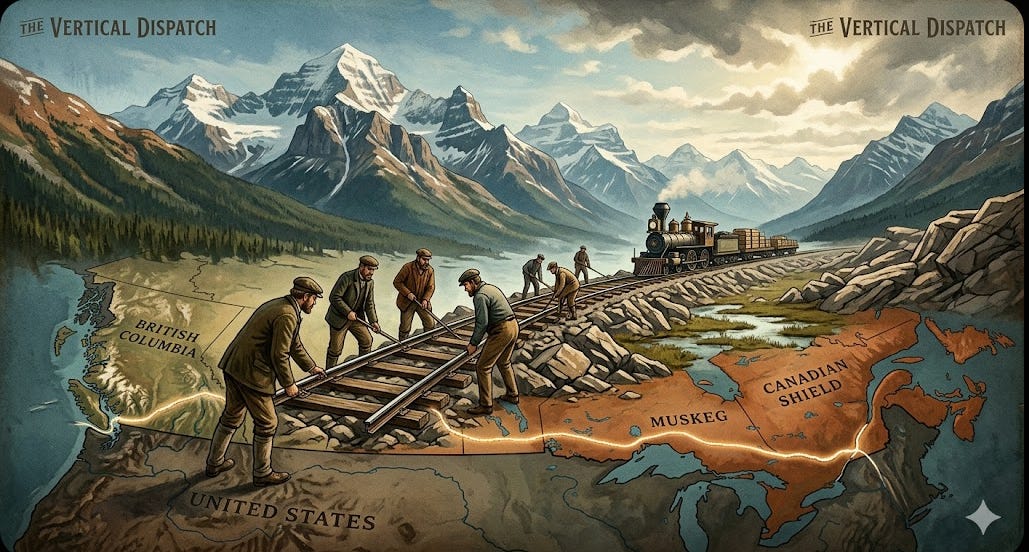
The Canadian Pacific Railway was not a nation-building romance. It was a bet — an enormous, arguably reckless bet — that a country could be willed into physical existence across four thousand kilometres of rock, muskeg, and mountain before the geography made the question moot.
It very nearly didn’t work.
What It Actually Cost
The numbers, translated into modern terms, are staggering. The federal government provided the CPR syndicate with $25 million in direct cash subsidies, 25 million acres of land, and 1,000 kilometres of already-completed track — all before a single spike was driven on the main contract. When the syndicate ran out of money mid-construction in 1884, the Macdonald government went back to Parliament for a $22.5 million emergency loan, surviving a no-confidence vote by a margin thin enough that historians still argue about whether it should have held.
The political opposition at the time called it reckless. They called it a giveaway to private interests. They called it fiscally irresponsible. Some of that criticism was legitimate — the land grant terms were extraordinarily generous, and the financial arrangements that preceded the railway’s construction had already brought down one government in the Pacific Scandal of 1873.
The criticism was not wrong on the merits. The investment was genuinely risky. The books did not obviously balance. And the government made it anyway, because the alternative was not fiscal prudence. The alternative was a smaller country, or no country.
The Permanent Tension
Every significant piece of Canadian infrastructure carries this same history if you look closely enough.
The St. Lawrence Seaway. Trans-Canada Highway. The national electricity grid. CBC. The Trans-Canada Pipeline, which nearly brought down the St. Laurent government in 1956 in a parliamentary crisis that ended careers and changed the country’s political direction for a generation. Every one of these projects had serious, intelligent opponents who made fiscally coherent arguments against proceeding.
They were not wrong that the projects carried risk. They were wrong that risk was the relevant question.
The relevant question, in each case, was whether the country that would exist without the investment was the same country as the one that would exist with it. And the honest answer, repeatedly, was no.
This is not an argument that governments should invest carelessly, or that every project wrapped in national interest language deserves public money. The history of Canadian infrastructure includes genuine boondoggles, genuine corruption, and genuine failures of judgment. The Pacific Scandal was real. The costs of the CPR land grants echoed for generations in western alienation. Nation-building has a balance sheet with entries on both sides.
What the Railway Actually Teaches
The lesson is not “government investment always works.” The lesson is narrower and more useful than that:
There is a category of investment where the return cannot be fully captured by any private actor, where the time horizon exceeds what private capital will accept, and where the consequence of not proceeding is not a missed opportunity but a permanent foreclosure of possibility. In those cases, government is not stepping in because the market failed. Government is stepping in because the market was never going to show up. The math didn’t work for private capital in 1881 either. That was precisely the point.
Canada exists in its current geographic form because a government accepted that logic and acted on it under enormous political pressure, with imperfect information, on a timeline it could not fully control.
That is not a template for every spending decision. It is, however, the template for understanding what governments are for — and what they forfeit when they treat risk avoidance as the highest virtue.
A country that will only build what the market will already fund is not governing. It is administering.
The Question That Doesn’t Age
In 1881, the question was whether Canada would physically exist from sea to sea.
The specific questions change. The underlying logic does not. Every generation inherits infrastructure it did not pay for and takes for granted, and every generation faces its own version of the same decision: what do we build now that the market won’t build, that our grandchildren will take for granted, that makes the country something more than the sum of its private transactions?
The railway was Canada’s answer in 1881. The answer required risk, required political courage, required accepting that the books would not balance in the short term and might not balance at all.
It worked. Not perfectly. Not without cost. But it worked well enough that you are reading this in a country that stretches to the Pacific.
That is not nothing.
Glen Roberts publishes The Vertical Dispatch on Substack. He is the author of Sacred Metaphysics and Consciousness: History of the Absolute and Eternal, and the developer of the Universal Dynamics framework and AIG — Artificially Intelligent Governance.
#CanadianHistory #CPR #CanadianPacificRailway #NationBuilding #Confederation #TheVerticalDispatch #TheArchitect #GlenRoberts #Infrastructure #CanadianEconomy #CdnPol #CdnHistory #BritishColumbia #CanadianShield #Muskeg #TransCanada #HistoryDeepDive #PoliticalEconomy #Substack #Geopolitics #CivilizationalDepth #RailwayHistory #NationalInterest #NationalIdentity #Heritage #CanadaStretchesToThePacific #StrategicInvestment #TheGradientOfTheReal #UniversalDynamics #LogicIntegrated