


“The trouble with most people is that they do not really want to know themselves; they want to be told what they are. That way they can blame somebody else if it turns out badly.”
— Robertson Davies
The Vertical Dispatch
Sovereign Analysis · Glen Roberts, The Architect
The Age of Consequences
May 25, 2026
I. The Forty-Five Minute Read
To render the professional biography of Timothy Hodgson, the Minister of Energy and Natural Resources in the Carney government, at the depth the public record supports, requires forty-five minutes of a serious reader’s attention. The reader must understand what twenty-five years inside Goldman Sachs in the late twentieth and early twenty-first centuries actually meant — the desks the man sat at, the deals he closed, the capital architectures he helped design, the institutional knowledge that accumulates in a person who walked into the firm at the level he walked in at and walked out as the Chief Executive Officer of its Canadian operations. The reader must understand what the eighteen months as Special Adviser to the Governor of the Bank of Canada from 2010 to 2012 actually meant — the repo markets, the over-the-counter derivatives reform, the Financial Stability Board coordination during the global recovery, the fact that the man walked away from a Goldman managing director’s compensation to take a public-service salary because the Governor of the Bank of Canada at the time, a man named Mark Carney, asked him to help rebuild the global financial architecture after 2008. The reader must understand the eight years chairing the board of Hydro One through a pandemic and a hostile provincial government. The reader must understand the years on the Public Sector Pension Investment Board investment committee. The reader must understand the trajectory of a man who, having earned the right to retire at fifty into private wealth, chose instead, when the new Prime Minister of Canada asked, to run for federal office in a riding he had no base in, to fill the hull of a government being assembled in nine weeks under wartime conditions.
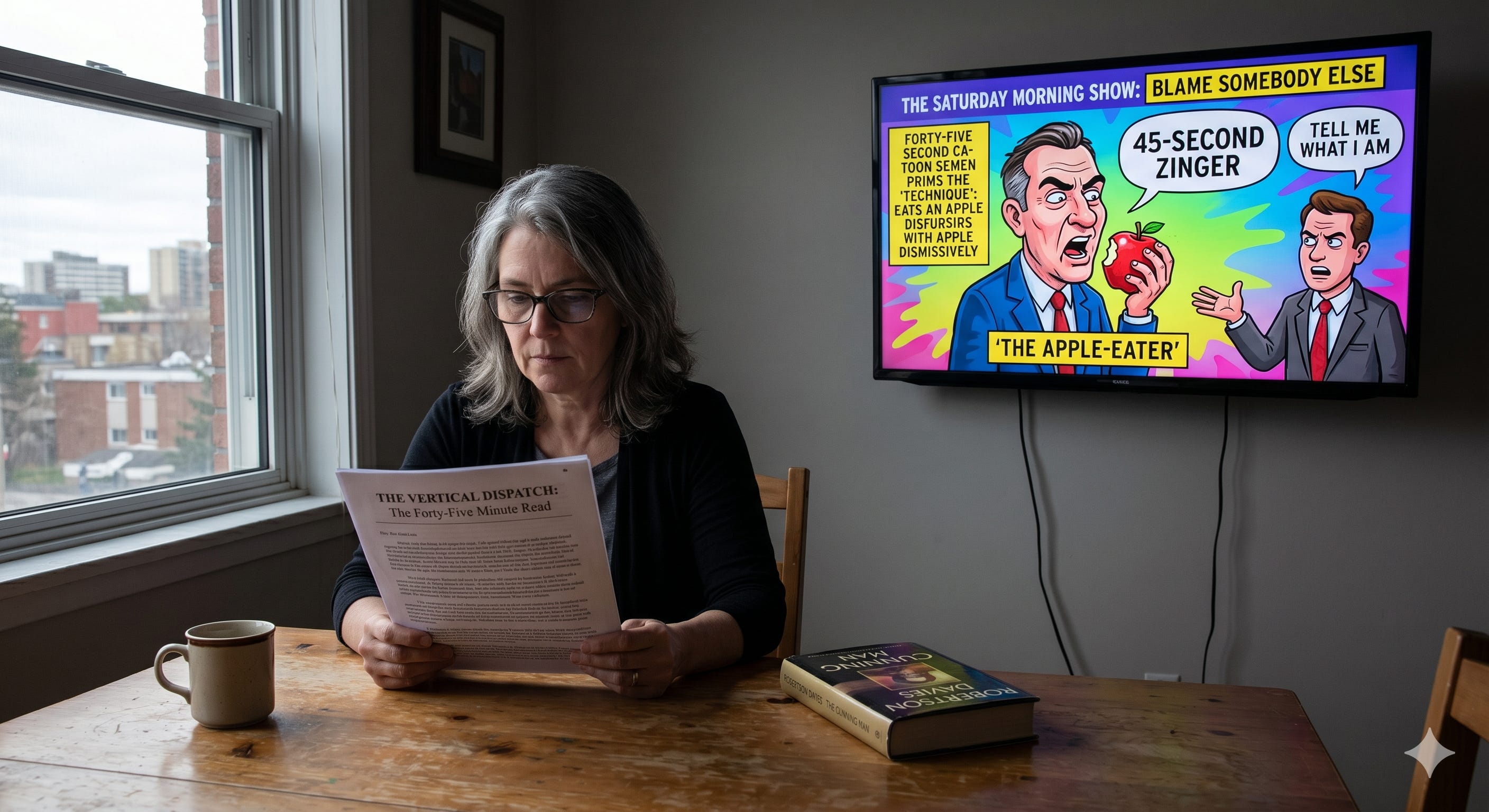
Forty-five minutes. That is the time the public record requires to render Tim Hodgson at the level his actual professional life supports.
The Canadian Broadcasting Corporation, the Globe and Mail, the National Post, the Toronto Star, the CTV evening news, and the talk radio operations in every major city in this country have, on average across the spring of 2026, given the man forty-five seconds. The same forty-five seconds they gave Anita Anand at Foreign Affairs. The same forty-five seconds they gave Mélanie Joly at Industry. The same forty-five seconds they gave François-Philippe Champagne at Finance. The same forty-five seconds they gave Dominic LeBlanc carrying four portfolios simultaneously while holding the federation together. The same forty-five seconds they gave David McGuinty at Defence and Gary Anandasangaree at Public Safety and Evan Solomon at Artificial Intelligence and Mark Carney at the head of the room.
Forty-five seconds. The duration of a television commercial for a luxury vehicle. The duration of a radio promo for the morning show. The duration of a TikTok video. The duration of an Instagram reel. The duration of the average attention span the digital extraction economy has trained the country to operate at.
There is a country here. The country is in a hinge moment of its history. The country has, by the accidents of an election and the deliberate acts of a Prime Minister who assembled a cabinet under wartime pressure, been given a government whose accumulated professional biography is, on any honest reading, the most experienced cabinet this country has fielded in its post-war history. The country has, simultaneously, an Official Opposition whose Leader has spent twenty-two years on the federal payroll without holding any other job in his adult life and whose shadow bench, on the public record, is structurally thinner than the cabinet it claims to be capable of replacing.
The country cannot see any of this. The country cannot see any of this because the country has not been shown any of this. The country has been shown the forty-five second version. The forty-five second version is the cartoon. This dispatch will name the cartoon for what it is and will name what the cartoon has cost the country it has been broadcasting to.
II. The Cartoon
The mainstream Canadian media, by which this dispatch means the broadcast news divisions of the Canadian Broadcasting Corporation, the Canadian Television Network, and Global News; the daily newspapers of the Postmedia chain and the Globe and Mail and the Toronto Star; the talk radio operations of every major Canadian market; and the social-media-adjacent outlets that aggregate and recirculate the daily output of all of these, has, across the past two decades, undergone a structural transformation that this dispatch does not pretend is the fault of any individual journalist working in any individual newsroom. The transformation is structural. It is the structural consequence of the collapse of the classified-advertising business model that funded serious journalism in the analog twentieth century, of the migration of advertising dollars to platforms that have not replaced the lost newsrooms with anything resembling journalism, of the demographic compression of newsrooms that once carried multiple decades of institutional memory and that now carry the average age and the average tenure of a small mid-tier law firm, and of the metrics-driven imperative to produce content that performs in the time-windows the algorithm rewards.
The structural consequence of all of this is the cartoon. The cartoon is the forty-five second version. The cartoon reduces Anita Anand’s career as one of the most respected scholars of comparative constitutional law in the Commonwealth, with a chair at the University of Toronto Faculty of Law for over a decade, with significant work on financial regulation in the post-2008 environment, with a record as Minister of Public Services and Procurement that produced the largest peacetime procurement operation in Canadian history during the pandemic vaccine rollout, and with subsequent portfolios at Defence, Treasury Board, Transport, and Foreign Affairs, to the social-media shorthand that has accumulated around her handling of individual politically charged files — shorthand generated by partisan attacks that the cartoon vocabulary subsequently used to overwrite the entire record of the woman it was being applied to. The cartoon reduces Mélanie Joly’s ten years across five portfolios in a Liberal government, which is the working definition of accelerated political maturation, to a wardrobe assessment and a series of social-media memes about her Instagram presence. The cartoon reduces Mark Carney’s two G7 central bank governorships, his chairmanship of the Financial Stability Board during the global recovery, his United Nations Special Envoy role on Climate Action and Finance under the Secretary-General, his Oxford doctorate in economics, his thirteen years at Goldman Sachs, and his published book on stakeholder capitalism to the phrase the Davos man, as if Davos were not the precise forum at which the post-war global order has been administered by adults who do the work that keeps the lights on while the Saturday morning audience watches the cartoons.
The cartoon is not, in its origin, malicious. The cartoon is the product of the time-window the algorithm rewards. The algorithm rewards the phrase that can be screen-captured and recirculated. The phrase that can be screen-captured and recirculated is, by selection, the phrase that does not require the reader to hold complexity in mind. The reader who is asked to hold complexity in mind clicks away from the cartoon. The reader who clicks away is the metric the newsroom is being measured against. The newsroom that fails the metric is the newsroom that does not survive the quarter. The newsroom that survives the quarter is the newsroom that produces the cartoon. There is no malice in the system. There is only the system, doing what the system rewards, producing the cartoon, broadcasting it to the country, calling it journalism, and continuing to call it journalism even as the country it is broadcasting to has lost, through the steady erosion of two decades, the capacity to read at any level deeper than the cartoon.
The cartoon’s deeper failure is not what it does to the politicians it reduces. The deeper failure is what it does to the audience that consumes it. The cartoon trains the country to expect to be entertained, not to be addressed as citizens of a democracy in a serious moment. The cartoon trains the country that politics is a sport between teams. The cartoon trains the country that the proper register of public participation is the witty rejoinder, the screen-captured zinger, the meme that travels. The cartoon trains the country that the citizen’s role is to applaud the favoured team and to mock the opposing team. The cartoon does not train the country to read at the depth a democracy in a serious moment requires of its citizens. The cartoon trains the country to be a Saturday morning audience watching the cartoons.
And the Saturday morning audience, trained by two decades of the cartoon, has produced exactly the politician the cartoon was always going to produce. The Saturday morning politician is a man who has mastered the forty-five second clip, the screen-captured zinger, the apple in the orchard, the overpass video, the slogan that resolves a complex policy into the binary the cartoon can broadcast. The Saturday morning politician is the natural product of the Saturday morning audience. The Saturday morning politician is what the cartoon has produced. The cartoon is what the metric required. The metric is what the digital extraction economy rewarded. And the country, having been broadcast to in this register for twenty years, has lost — in too many of its members — the capacity to recognize the difference between the Saturday morning politician and the politician who is actually doing the work.
III. The Citizen Who Was Not Prepared
The dispatch will say the harder thing now, because the dispatch is required to say it, and because the publication this dispatch lives inside of has been saying it in pieces across the spring of 2026 and is now required to say it whole.
Too many Canadians are not educated on what democracy actually means. Not in the schoolbook sense — the Canadians who are reading this dispatch have a schoolbook command of the parliamentary system, the separation of powers, the role of the Crown, the function of the courts. The schoolbook is not the problem. The schoolbook is what eighty-five percent of the country has, more or less. The problem is the layer beneath the schoolbook. The layer beneath the schoolbook is the operational understanding of what democracy actually asks of a citizen. Democracy asks the citizen to read at depth before voting. Democracy asks the citizen to hold the historical record and the morning news in the same thought. Democracy asks the citizen to distinguish the politician who is performing for the cartoon from the politician who is doing the work the country requires. Democracy asks the citizen to refuse, in the privacy of the polling booth, the easy gratification of the team sport and to make the harder judgment about which candidate is actually prepared for the chair the candidate is asking to occupy.
Too many Canadians, on the evidence of the past several election cycles in this country and on the evidence of the equivalent cycles in every other democracy of the developed world, can no longer perform this function. The function has not been removed from them by any specific act of suppression. The function has atrophied. The Programme for the International Assessment of Adult Competencies, the OECD’s most comprehensive measurement of adult literacy and numeracy across thirty-eight member economies, places the Canadian adult population in 2024 with sixty-three percent reading at PIAAC Level 3 or below. Level 3 is the schoolbook level. Level 3 can read the news article and form an opinion. Level 3 cannot, in the technical definition of the framework, hold the historical record and the current moment in the same thought, draw the line forward, and make the strategic judgment a democracy in a hinge moment requires of its citizens. Level 3 is the operational ceiling of sixty-three percent of the adult population. The remaining thirty-seven percent splits between Level 4, which is the publication’s audience and the operational floor of the strategic citizen, and Level 5, which is the elite cognitive layer that the publication does not pretend to be writing for.
The four million Canadians who read at PIAAC Level 4 are the publication’s constituency. They are also, on the evidence of the past two decades, the constituency the mainstream Canadian media has stopped writing for. The mainstream media writes to Level 2 because the metric rewards it. The academic press writes at a register above Level 5, in a specialist vocabulary closed to the general reader, because the tenure file rewards it. The four million in the middle have been left without a publication that addresses them at the level they actually read at, and the cumulative effect of being left without that publication has been the political phenomenon this publication has spent the spring documenting. The four million have, in too many cases, drifted toward the cartoon because the cartoon was the only register being broadcast to them. The four million have, in too many cases, voted as if they were Level 2 readers because they have been treated as Level 2 readers by every institution in the public square except for the publications that demand Level 5 and lose them to the difficulty of the prose.
This is the literacy failure. The literacy failure is the substrate of the political failure. The political failure is the surface. The two are inseparable. A country whose citizens cannot perform the strategic judgment a democracy in a hinge moment requires is a country that will produce, through the polling booth, the politicians the cartoon has trained the citizens to recognize. The cartoon politician is what the cartoon audience selects for. The cartoon politician is also what the cartoon audience deserves, in the strict democratic sense that a self-governing people produces the government their actual cognitive condition can produce. The remedy is not anti-democratic. The remedy is the cognitive condition. The remedy is the four million being addressed at the level they actually read at, by publications willing to write at that level, until the four million become a coalition large enough to shift the centre of gravity of the country’s political life from the cartoon back toward the public record.
And there is a deeper failure beneath the literacy failure. The literacy failure is technical. The deeper failure is spiritual. Too many Canadians are not prepared, in the spiritual sense the word means before the moderns moralized it, for the moment the country is in. Spiritually prepared means having a relationship to a story larger than one’s own preferences. Spiritually prepared means being able to ask, before voting, what kind of country one is making the choice on behalf of, and what kind of country one is making the choice for the generations that will inherit it. Spiritually prepared means having internalized that the citizen’s vote is a transmission, not a transaction. The transmission is the country itself, handed from one generation to the next, with whatever has been added or subtracted in the interval being the citizen’s signature on the historical record. The cartoon does not train spiritual preparation. The cartoon trains the opposite of spiritual preparation. The cartoon trains the citizen to think of the vote as a personal choice from a menu of options offered by competing brands, and to choose the brand that best matches the citizen’s mood on the morning of the election. That is not democracy. That is consumer behaviour applied to a process that requires more than consumer behaviour.
And beneath the spiritual failure is the physical failure. The dispatch is required to name this also, because the publication does not flinch from naming what the public record shows. The physical condition of the average Canadian adult in 2026 — the actual neurological architecture, shaped by twenty years of optimized digital extraction of attention by platforms whose engineering teams are explicitly designed to maximize the time the user spends inside the platform at the expense of every other claim on the user’s attention — is the condition of an organism that has been engineered, against its own will, into an attention-fragmentation pattern incompatible with the cognitive operation a democracy requires of its citizens. The brain that has been trained for twenty years to switch tasks every twelve seconds cannot, by an act of will on election day, suddenly become the brain that can hold the historical record and the morning news in the same thought. The neurological architecture has been changed. The change is not reversible without specific and sustained practice that the citizen has not been informed they need to undertake. This is the physical floor of the failure. The body that consumes the cartoon for twenty years becomes the body that cannot read at the level the dispatch is being written at. The body votes. The body votes for what the body can recognize. The body recognizes the cartoon.
IV. What Davies Saw Before We Lost It
Robertson Davies, in his last novel, The Cunning Man, published in 1994 when he was eighty-one years old and had concluded that he might not have another novel in him, performed an act of diagnosis that the country has not, in the three decades since, fully reckoned with. The narrator of The Cunning Man is Dr. Jonathan Hullah, a Toronto physician who has spent his career practicing a form of medicine that the contemporary medical institution no longer recognizes as legitimate. Hullah treats the whole patient. Hullah knows the patient’s family, the patient’s history, the patient’s spiritual state, the patient’s marriage, the patient’s relationship with their work. Hullah is, in the technical sense, a general practitioner of an older order — the practitioner who was once the default in Canadian small-town life and the default in Canadian neighbourhood medicine in the cities, and who has, across the second half of the twentieth century, been displaced by the specialist who treats the symptom, the institution that treats the file, and the system that treats the population.
Davies’s argument in the novel is the argument the publication has been gesturing at across its CanLit dispatches and that the present dispatch is required to make plain. The country has lost the figures who carried the integration. The family doctor who knew the patient as a person. The local baker who knew which neighbours had not picked up bread that week. The teacher in the small school who knew the family three generations back. The priest who carried the parish’s collective memory of grief and joy. The cunning woman in the older village who knew the herbs and the seasons and the births and the deaths. The figures Davies named in The Cunning Man are not nostalgia. The figures are the operational infrastructure of a country that knew itself as a country. The figures held the country together at the level the cartoon cannot reach — the level of the felt sense that one’s neighbours were part of the same story one was inside of, and that the story was larger than any individual life inside it, and that the country itself was the working summation of the stories the figures had been keeping track of.
The figures are gone. The family doctor is, in the country we now live in, the walk-in clinic where the patient sees a different physician each visit and where no one is the keeper of the patient’s history. The local baker is the in-store bakery section of a multinational grocery chain. The neighbourhood teacher is, in too many districts, the contract worker who teaches the year and is gone the next. The priest, the rabbi, the imam, the elder — the figures who carried the collective memory of grief and joy — have, in too many communities, retired or aged out without being replaced, and the parishes and the congregations they served have, in too many cases, dissolved without anyone in the community noticing the dissolution as a loss until well after the loss had completed itself.
Davies’s diagnosis, made in 1994, was that the loss of the figures was the loss of the felt sense that we were part of the same story. The country could continue, administratively, as a country. The passports still issued. The taxes still collected. The borders still policed. The elections still held. But the felt sense of the shared story, which was what made the elections meaningful and the taxes consensual and the borders defensible — the felt sense was gone, and was gone before the country had noticed it was going. The cunning man Jonathan Hullah, in his Toronto office in the closing years of the twentieth century, was the last echo. The novel was Davies’s farewell to the country that had produced him. The novel was Davies asking the country to notice what it had lost before it lost the capacity to notice.
The country did not notice. The country went on. The figures continued to disappear. The cartoon arrived. The cartoon broadcast the country to itself in a register the figures would not have recognized. The citizen who was the figure’s neighbour became the citizen who watched the cartoon. The citizen who watched the cartoon stopped recognizing the figure when the figure walked past in the street. The figure stopped walking past in the street because the figure had retired or died or moved away. The country continued to operate as a country in the administrative sense. The country stopped operating as a country in the sense that the felt sense of the shared story had carried.
And then, in the absence of the felt sense of the shared story, the ripper arrived.
V. The Ripper in the Footsteps of Trump
This publication has documented Pierre Poilievre’s career across two previous dispatches — The Ripper: Pierre Poilievre, the Rules He Does Not Follow, and the War He Is Fighting Instead of Governing on May 17, 2026, and The Apple, the Seat, and the Caucus That Could Not Hold on May 24, 2026. The reader who wishes the forensic detail can read both dispatches in the back catalogue. The present dispatch is required only to name what the two previous dispatches have together established, and to place that naming inside the larger diagnosis the present dispatch is making.
Pierre Poilievre is a Canadian political figure who has adapted, with notable tactical sophistication, the technique of the Trump-era American Republican Party to the Canadian political environment. The technique is the ripping technique. The technique reads the country as a body of grievances, identifies the grievances that can be amplified, amplifies them with the maximum available volume across the maximum available channels, and harvests the political energy the amplification produces. The technique does not weave. The technique does not heal. The technique does not propose the longer time horizon the country requires. The technique rips. The ripping is the point.
The technique is, in its origin, an American import. The figure who perfected the technique in the contemporary period is Donald J. Trump, the President of the United States, whose first administration ended in January 2021 and whose second administration began in January 2025 and whose tariff war on Canada in the spring of 2025 was the precipitating crisis the Carney government was formed in response to. Poilievre’s tactical operation in 2022 — the convoy overpass video, the data-driven targeting of alienated voter segments, the rejection of the institutional norms of Westminster opposition leadership, the security-clearance refusal whose stated rationale was that the briefing would constrain his freedom to attack the government — is the Canadian application of the Trump technique. The application was effective. The application produced the most decisive Conservative leadership victory in modern Canadian history. The application produced the largest official opposition in Canadian history at the April 2025 election. The application has also, on the public record this publication has been documenting across the spring, produced the political phenomenon that has now begun to break.
Four Conservative Members of Parliament have crossed the floor to the Carney Liberal caucus since November 2025. Each of them was a named member of Poilievre’s shadow cabinet at the time of departure. Each of them said publicly, in their own interviews, that the Carney room is the more serious room. The shadow cabinet of seventy-four critics — nearly double the size of the government it is shadowing — is not holding the bench it was designed to manage. The shadow Public Safety critic has admitted in committee that he is not an expert on the file. The shadow leader has himself lost his own seat by 4,500 votes to a marketing consultant from Manotick and has returned to the House through a by-election in a riding the party has already announced he will be leaving at the next election. The technique has begun to break. The technique has begun to break because the technique is, in the end, what David Brooks called it in 2020 — the technique of the politician for whom the conflict is the point. The technique cannot govern. The technique can only continue to rip. And a caucus that has noticed the technique cannot govern is a caucus that has begun, by the slow movements of individual moral judgment, to walk across the aisle.
This is where the dispatch is required to say the thing that the previous dispatches have not yet said in this register. Pierre Poilievre does not belong in the same room as any of the nine ministers of the Sovereign Core of the Carney government. He does not belong in the room on the criterion of education. He has one Bachelor of Arts in International Relations from the University of Calgary, completed at age twenty-nine, while he was already a sitting Member of Parliament. The nine ministers of the Sovereign Core hold, between them, multiple doctorates, multiple law degrees from the world’s leading faculties, multiple advanced economics credentials, and a combined record of academic and professional credentialing that would, if laid out on a single table, fill the table. He does not belong in the room on the criterion of professional achievement before politics. He has zero years of significant private-sector employment. He has never built a business. He has never met a payroll. He has never led an organization outside the federal parliamentary apparatus. The nine ministers of the Sovereign Core have, between them, central bank governorships, supreme legal credentials, executive leadership of major financial institutions, comparative constitutional law chairs, cabinet experience across multiple portfolios, and the accumulated operational record of careers that would each, individually, be the career of a lifetime.
This dispatch will not pretend that the comparison is a comparison of equals diminished by the inadequacy of one of the parties. The comparison is not a comparison of equals. The comparison is a comparison of a serious cabinet of accomplished adults and a Leader of the Opposition whose entire adult working life has been the federal political apparatus and whose professional preparation for the prime ministership he seeks is, on the public record, not adequate to the role he is asking to occupy. His ego has overtaken his virtue. His ambition for power has displaced any project he might once have had for the country. The man does not belong in the room. The dispatch is required to say so. The public record supports the saying.
VI. The Four Million
There are approximately four million Canadians who read at PIAAC Level 4. They are the publication’s audience. They are the readers this dispatch is addressed to. They are also, in the larger argument the dispatch is making, the operational floor of the country’s recovery.
Four million is not a majority. Forty million is the country. Sixty-three percent of the country reads at Level 3 or below. The four million are the strategic-cognitive minority. The strategic-cognitive minority is, in every functioning democracy in history, the operational floor of the country’s serious life. The four million are the readers, the small-business owners who have actually run businesses, the professionals who have actually practiced their professions at depth, the teachers who have actually taught generations of students, the doctors and the lawyers and the engineers and the trades-masters and the artists who have actually done the work the country runs on. The four million are not the elite. The four million are the operational class of the country in the working sense of the term — the citizens who actually do the work the country requires, at the level the work requires, and who therefore can recognize when the work is being done by others and when it is not.
The four million can read the forty-five minute biography of Tim Hodgson and recognize the man for what he is. The four million can read the Anita Anand record and recognize a Commonwealth-class constitutional lawyer. The four million can read the Mélanie Joly trajectory and recognize a political operator of unusual durability. The four million can read the Champagne file and recognize the closer he is. The four million can read Carney’s CV and recognize the once-in-a-generation institutional credential he carries. The four million can read all of this when it is presented to them at the depth the public record supports. The mainstream media has stopped presenting it to them at that depth. The mainstream media presents the cartoon. The four million have, in too many cases, walked away from the cartoon and stopped consuming the mainstream media at all. The four million are present. The four million are not being addressed.
This publication exists for the four million. The dispatches across the spring of 2026 — the Carney Level 8 Mind piece on April 30, the Joly Accelerated Mind piece on May 20, the Two Birds of a Feather Carney-and-Stubb piece on April 15, the Volunteer Traitor O’Leary piece on May 11, the Corner Stones Were Already Placed piece on the Alberta separation petition on May 13, the Architect in Yerevan piece on May 6, the Maple MAGA pieces on the Canada Strong and Free Network Conference, the Gliders on the Tarmac piece on the aviation deal, the two Robertson Davies dispatches, the Adi Shankara book announcement, the Pierre Poilievre Ripper piece on May 17 and the Apple, the Seat, and the Caucus That Could Not Hold piece on May 24, and the Gary Anandasangaree piece filed earlier today — are the working corpus of the four million’s publication. The conversation has now begun. The seed has sprouted. The publication needs the four million to water it with care — to read the dispatches at the depth the dispatches were written at, to share them with the citizen at the kitchen table who has not yet found them, to restack them into the feeds where the citizen who is still being broadcast the cartoon might encounter the alternative, and to consider becoming part of Project 2046 — the founding tier the publication is offering to the readers who recognize that the work being done here is the work the next twenty years of the country require. The publication is the room. The dispatches are the practice. The four million are the country’s strategic-cognitive floor. The country’s recovery is the four million’s mobilization. The mobilization is the reading. The reading is the kata. The kata is performed by the citizen who picks up the dispatch, gives it the forty-five minutes, finishes it, and then — in the privacy of the polling booth, in the conversation at the kitchen table, in the message sent to a friend who has not yet read the dispatch, in the restack that pushes the dispatch into one more reader’s feed — acts on what the reading has shown. The country is the working summation of the kata being performed by the four million in concert. The publication is the place where the kata is being practiced.
This dispatch is the publication’s statement to the four million that the publication knows who the four million are and what the four million have been waiting for. The publication has been writing the forty-five minute version. The publication will continue. The publication is the corpus the four million have been waiting to be addressed by. The four million are the country’s strategic-cognitive floor. The country’s recovery is the four million’s mobilization. The mobilization is the reading. The reading is the kata. The kata is performed by the citizen who picks up the dispatch, gives it the forty-five minutes, finishes it, and then — in the privacy of the polling booth, in the conversation at the kitchen table, in the message sent to a friend who has not yet read the dispatch — acts on what the reading has shown. The country is the working summation of the kata being performed by the four million in concert. The publication is the place where the kata is being practiced.
Coda. The Apple-Eater’s Country
Return to the orchard.
A man stands in front of a reporter and eats an apple. The man does not engage with the reporter. The man is performing the technique. The man is teaching the country, in the silent transmission of the image, what ignorance literally means. The technique is celebrated by the cartoon. The cartoon is broadcast to the country. The country has, by the time the apple-eating is performed in the orchard, been broadcast to by the cartoon for twenty years. The country has, in too many of its members, lost the felt sense of the shared story that Davies’s cunning man was the last echo of. The country, in too many of its members, watches the apple-eating and applauds. The country has become, in too many of its members, the audience the apple-eater was performing for. The apple-eater is the country, in the deeper sense the dispatch has now been required to name.
The country is not lost. The four million are present. The publication is the corpus. The kata is being practiced. The cunning man’s office is still open in whoever has read Davies and recognized themselves in the diagnosis. The family doctor is gone but the citizens who remember what the family doctor was for are not gone. The local baker is gone but the citizens who remember what the bakery was for are not gone. The teacher in the small school is gone but the citizens who remember what the teacher was for are not gone. The felt sense of the shared story is gone but the citizens who remember the feeling are not gone. The four million are the carriers. The publication is the room. The dispatches are the practice.
And the apple-eater — the man in the orchard, the man on the overpass, the man at the security-clearance refusal, the man at the buy-back-program leaked-audio dismissal, the man on the public payroll for twenty-two years without ever having held a job outside it — is what the country produced when the country stopped reading. The apple-eater is the country’s reflection in the cartoon mirror. The reflection is not flattering. The reflection is the diagnosis. The diagnosis is the beginning of the cure.
The cure is the forty-five minute read. The cure is the citizen putting down the cartoon and picking up the dispatch. The cure is the kitchen-table conversation that the dispatch makes possible. The cure is the four million addressing the four million in the register the four million can read at. The cure is the slow, patient, unspectacular work of rebuilding the felt sense of the shared story that the cunning man was the last echo of. The cure is the kata, performed daily, by each citizen who has read the dispatch and has chosen to be a carrier of what the dispatch has shown.
If the dispatch’s last sentence is the dispatch’s diagnosis, the sentence is this. The citizen who will not take the forty-five minutes the dispatch requires has no business shooting off their mouth or eating the apple. The dispatch is offered to whoever is ready to take the forty-five minutes. The apple is offered to whoever is ready to put it down.
The Vertical Dispatch will continue to file. The cunning man’s office is the room. The dojo is the dojo. The kata is the kata. The work is the work. The country is the country.
The apple-eater is still eating the apple. The country is still waiting to be noticed.
God is Love. Love is Truth. Truth is Consciousness. Consciousness is Brahman.
Amen. Namaste.
Om Namah Shivaya.
#TheCountryWeStoppedReading #FortyFiveMinuteRead #TheCartoon #PIAACLevel4 #TheFourMillion #ReadDavies #TheCunningMan #TheApple #TheVerticalDispatch #AgeOfConsequences #Level8 #TheTeachingOfCanada
Brilliant read. Thank you. I have shared.
👏👏👏👏👏👏👏👏👏