

Φ
THE VERTICAL DISPATCH
We write for the mind, the eye, and the ear.
Read it. Look at it. Listen to it. The Vertical Dispatch is built for all three — prose with rhythm, made to be heard as much as read.
From metaphysics to geopolitics, from culture to history, from the sacred to the street — and everything in between. One lens, every subject. No ego. Just the record, named clean.
Press play. Walk with the word. 🕯️
This dispatch travels by hand. If it serves you, share it — restack on Substack, and pass it on wherever you read. 🕯️
Building Canada Strong · The Age of Consequences
June 2026 — reformatted for the archive, June 15, 2026.
WHERE PART I LEFT OFF
Part I read the ledger. It established the indictment: a founding railway built to unite the country but created by cabinet memo rather than statute, cut in waves whenever it looked idle, starved while the profitable carriers around it were privatized, and then cited as proof that passenger rail cannot work — all while sixty years of public money made flying over the country cheap and dwelling in it slowly the one unaffordable option, until Canadians learned, as Huxley foretold, to consume their country without loving it. The leak was built. The grief was real. The Chaleur still does not run.
But an indictment named precisely is a blueprint. Every charge in Part I points at its own remedy, and this is where the building begins. Part II sets out the directive in full — what it is, what it costs, who rides, and how it pays for itself.
AIG INTEGRATION BLOCK: THE DIRECTIVE
Artificially Intelligent Governance begins from the elenchus: can the institution define what it knows? Ottawa says it wants Canadians to choose Canada. Very well — the audit question follows. Choose it how? On foot? The Strong Pass answers for the destination and falls silent on the distance. The directive completes the answer, and it answers the three problems of Part I directly. Cost: every Canadian citizen is entitled, once, to a transcontinental rail crossing at a citizen’s fare — a fare set as civic infrastructure, not market recovery, with the train itself serving as the accommodation so that no hotel chain stands between a family and its country. Time: the journey is the vacation — the crossing, the towns, and the destination are one continuous experience, so the household’s two or three weeks are spent entirely on the country rather than partly on the windshield. Distance: the train dissolves it — you sleep, and the Shield passes; you wake, and the Prairies have begun.
The specifications, so the solution is buildable rather than rhetorical: a citizen’s fare defined in legislation, not a promotional code; passenger priority on the mainline secured by statute or by acquisition, so the family is never parked in a siding behind a freight; a modern fleet order, because seventy-year-old equipment cannot carry a generational program; service in every season, because a country that exists for part of the calendar is not a country; and the return ticket, always the return ticket — because a one-way fare is transportation, and a return fare is a journey whose purpose is the country itself. The westbound leg runs northern Ontario in daylight; the eastbound runs the Fraser Canyon in daylight. The two directions are not repetition. They are completion.
And the pricing architecture is two fares on one train, stated without apology. The Citizen’s Fare: for Canadians, under a Canada program, priced as civic infrastructure — the rate at which a working family can actually buy the crossing. The World Fare: for the international visitor, priced at what the market will bear — and the market for sleeping-car rail through the Canadian Rockies is a market the luxury operators have already tested at thousands of dollars a berth. Two tiers, one consist, and the second tier is not a surcharge on hospitality. It is the funding mechanism: the world’s premium cross-subsidizes the citizen’s fare, so that the foreign skier’s berth helps pay for the Canadian family’s. The full justification of the two-fare structure follows below, in the section on the Sovereign Pass — because the principle is not novel, it is merely unapplied. Canada already prices its lakes, its universities, and its hunting grounds in two tiers. The railway is the one national asset it forgot.
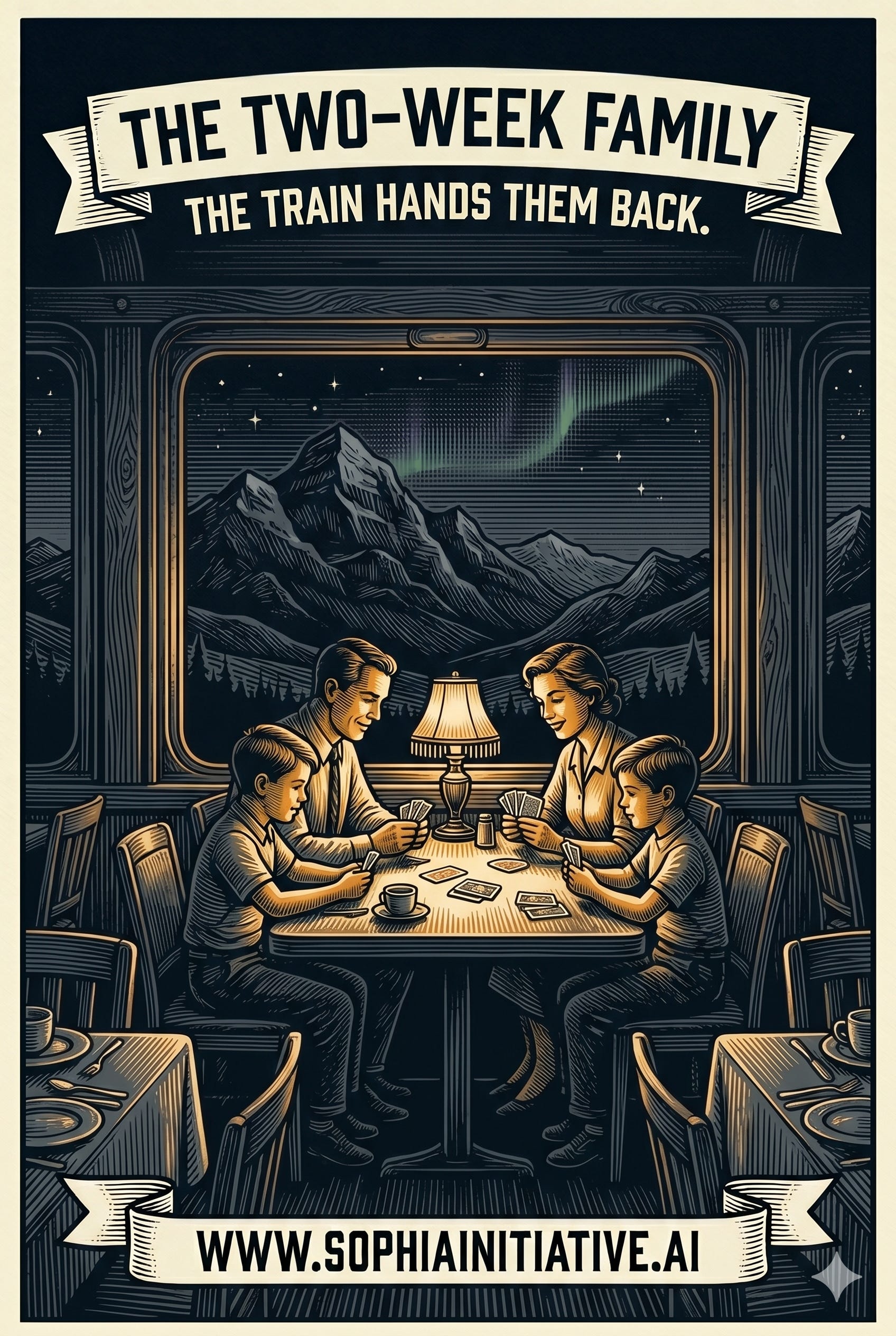
THE TWO-WEEK FAMILY
Here is the argument that outranks every other in this dispatch, because it is the one lived at every kitchen table in the country.
The Canadian working parent gets two weeks of vacation, perhaps three. Those weeks are the scarcest resource the family owns — scarcer than money, because money can be earned back. Now run the family driving trip to the Rockies through that arithmetic. Toronto to Banff is four days of driving each way, done responsibly with children aboard. Eight of the family’s fourteen days are spent in transit — and spent is the precise word. Dad is behind the wheel, eyes on the traffic, seeing exactly nothing of the country sliding past, exactly as Ms. Pettis describes. Mom is navigating, refereeing, and rationing the snacks. The children are sealed in the back seat with their screens, because the back seat of a sedan crossing Saskatchewan offers a child nothing else. The family is together in the car and absent from each other for eight consecutive days. That is not family time. That is family proximity.
Now run the same two weeks through the train. Nobody drives. The transit time is not subtracted from the vacation — it becomes the vacation. Dad is at the table in the family car playing cards with his son while the Shield rolls past the window. Mom is in the dome with her daughter watching for the first sight of the mountains. The four of them eat dinner together at a table, facing each other, every night — a thing that the household calendar at home may not manage twice a month. The grandmother’s rule applies: they share the dining car with strangers and the children learn that the country is full of people with stories. By the time the train reaches Jasper, the family has not endured the distance. The family has been built by it.
The scarcest thing a Canadian family owns is not money. It is the two weeks. The car spends them on the windshield. The train hands them back to the family, every single hour, with the country thrown in.
THE MOVING VILLAGE
The economics of the evening layover are not speculative. They are the economics of the cruise port, proven across every coastal economy on earth. A cruise ship is a hotel that travels: passengers never pack, never unpack, and every port call delivers several hundred wallets into a local economy for an evening — spending on meals, shops, and attractions while costing the town nothing in accommodation infrastructure. Towns compete for port calls because the arithmetic is overwhelmingly in their favour.
Run that model on rails. The train arrives in Winnipeg, Saskatoon, Sioux Lookout, Edmonton at four in the afternoon. The town puts on its evening: the local museum stays open late under the Strong Pass it already participates in, the main-street restaurants fill, the market runs. At eleven, the passengers walk back to their berths and sleep while the prairie rolls past. The town receives the spending without bearing the burden. The traveller receives the country without the logistics. Every stop converts a place Canadians fly over into a place Canadians have stood in. The grandmother walked the platform at every stop to see something of the towns. The directive simply gives her rule a schedule and an economy.
Nor is the format unproven on rail. Australia’s Ghan operates precisely this architecture across terrain emptier than the Prairies — the train pauses at Alice Springs and Katherine, passengers disembark for town time and excursions, then re-board and sleep as it rolls on. It is one of the most successful rail products in the world. The difference is that Australia prices it as luxury cruising. The AIG move is to take a model that currently exists only at thousands of dollars a berth and ask the obvious question: why can a country not run this as civic infrastructure at a citizen’s fare? The format is proven. Only the pricing philosophy is in dispute.
The cruise industry proved that the hotel can travel and the towns can be the destination. Canada merely declined to apply the proof to itself.
THE SEGMENTED TRAIN
The next design element answers the problem that quietly kills most family travel and most adult travel simultaneously: they occur in the same space. The directive’s train is segmented by car, the way the historic Canadian was segmented by class — except the axis is not wealth. It is the shape of the journey each passenger is making.
Family cars: bunked berths, a play dome, meal service built for children, priced on the existing Strong Pass logic under which children already ride free. Adults-only cars: quiet carriages for couples and solo travellers, the dome car as reading room. Seniors’ cars: accessible berths, an attendant, the pace of the train matched to the pace of the passenger. The generation that built the country and the generation that will inherit it ride the same train without riding the same car — and meet, when they choose to, in the dining car between, at shared tables, in the grandmother’s tradition.
And one more car, drawn not from invention but from restoration. For four decades in the twentieth century, Ontario ran school cars on the northern rail lines — converted coaches with a classroom and a teacher’s living quarters aboard, bringing education to railway families and remote communities at stops the road never reached. The train in this country has already been a school. It has been a post office, a clinic, a town square on wheels. The directive does not ask the railway to become something new. It asks the railway to remember what it was.
This is not innovation. It is restoration. The train built the country, schooled its remote children, and carried its mail. The directive asks it to carry its citizens again.
THE SOVEREIGN PASS
The international benchmark exists, and the comparison clarifies exactly what the directive is and is not. Europe has run the Eurail Pass for half a century: a single ticket granting flexible train travel across more than thirty countries, the rite of passage of generations of young travellers. It is the obvious model — and the directive beats it on structure, not merely on sentiment.
Eurail sells movement. Every night, the Eurail traveller steps off the train and pays Europe’s hotel prices; the accommodation is the hidden second ticket, and over a multi-week journey it routinely costs more than the pass itself. Europe can afford that architecture because its distances are short — Paris to Amsterdam is an afternoon. Canada’s distances are the entire problem. That is precisely why the train-as-hotel model is not a luxury flourish here but the only architecture that makes the geography crossable at a citizen’s price. The directive bundles what Eurail externalizes: the berth travels with the passenger, and the towns receive the spending the hotels would have absorbed.
The deeper difference is philosophical, and it is the AIG point. Eurail is a commercial consortium product, priced at market, sold to whoever can pay. The Sovereign Pass — call it what it is — is a citizenship instrument, priced as infrastructure, owed to whoever belongs. One is a product with a customer. The other is a covenant with a citizen. Europe built the pass to sell its trains. Canada would build the pass to bind its territory. A traveller finishes a Eurail summer having seen Europe. A Canadian finishes the crossing having become, in the full territorial sense of the word, Canadian.
Now the two-fare structure promised in the directive, justified in full — because the moment a citizen’s fare and a world fare appear side by side, someone will call it discrimination, and the answer is that it is the most ordinary pricing principle in Canadian life, applied at last to the one asset that forgot it. Start at home. Every province in this country charges a non-resident more for a fishing licence than a resident — two-tier pricing on a public natural asset is settled, universal Canadian practice, and no angler on either side of the counter has ever called it unjust. Every Canadian university charges an international student a multiple of domestic tuition, on a justification every family understands without being told: the citizen’s household already paid for the institution, through decades of taxes, before the first tuition cheque was written. The domestic rate is not a discount. It is a shareholder’s rate on an asset already purchased.
Now look abroad, because residency pricing on national railways specifically is how serious countries already operate. Europe runs it today and has for decades: Interrail for European residents, Eurail for everyone else — two products, two price structures, divided precisely on the residency line, uncontroversial for fifty years. Japan runs the inversion that proves the principle cuts in both directions: the Japan Rail Pass is available only to foreign tourists, at a rate domestic Japanese cannot buy, because Japan calculated that subsidizing inbound visitors served the national interest. India prices the foreigner’s ticket to its monuments at many multiples of the citizen’s, and the world pays it without complaint, understanding perfectly that it is buying a guest’s access to another nation’s patrimony. The principle is everywhere. The only place it is missing is the Canadian railway.
So price the two fares for what they actually are. The Citizen’s Fare is the rebate of ownership: Canadians built this railway, paid the ledger’s sixty years of subsidies, and absorbed every cut — the citizen boards as a shareholder collecting, once, on a long-held asset. The World Fare is a guest’s ticket to that asset, set at what the market will bear — and the market has already spoken, loudly, in the order books of the luxury operators who sell sleeping-car passage through these same mountains at two to ten thousand dollars a berth. Benchmark the World Fare against that proven market, fill those berths from the record global skier demand looking for new snow, and the arithmetic completes the architecture: the foreign premium cross-subsidizes the citizen’s fare. The Japanese skier’s berth helps pay for the family from Brandon. The machine does not merely run in both directions — one direction funds the other, and the world ends up financing the reconstruction of Canadian territorial belonging, at a profit to its own holiday. There is a word for a pricing structure that charges the guest the market rate and the owner the owner’s rate. The word is normal.
Two fares, one train. The citizen boards as a shareholder; the world boards as a guest at the market’s price — and the guest’s premium pays for the citizen’s crossing. Canada already prices its lakes and universities this way. The railway is the one national asset it forgot.
Eurail sells movement and externalizes the bed. The Sovereign Pass bundles the bed and internalizes the country. One is a product. The other is a covenant.
THE GENERATION CLAUSE
Here is the thesis beneath the policy, and it should be stated without decoration.
The generation now under seventeen — the one already riding free under the Strong Pass — is the generation that will serve this country and the generation this country exists to serve. Within twenty years its members will be the soldiers, nurses, engineers, premiers, and parents of Canada. What sense of the country will they carry into that service? A country experienced as a screen, a flag emoji, and the inside of two airports? Or a country crossed at ground level — four days and four nights of it, the Shield giving way to the Prairies giving way to the Rockies, with evenings spent standing in towns whose names they had only ever seen on weather maps?
A citizen who has crossed the territory holds the country differently than one who has only seen the map. They have eaten in Saskatoon. They have watched the Shield’s granite run for a full day and understood, in the body rather than the textbook, why this country is hard and why it holds together anyway. Ms. Pettis crossed it as a girl with her grandmother and carried it for a lifetime — carried it so vividly that her remembrance, half a century later, set this dispatch in motion. I crossed a piece of it at the other end of the country, in January, and have carried it for fifty-six years. That is what the crossing does. That knowledge is not tourism. It is civic formation — and it is precisely the formation a nation should want in the generation it will soon ask to defend, govern, and pay for it.
You cannot ask a generation to serve a country it has never seen. The directive is the price of the asking.
END OF PART II
The directive now stands complete on paper: the citizen’s fare and the world fare, the return ticket, the train as the hotel, the towns as the destination, the segmented cars, the school car restored, and a pricing structure that finances itself by charging the world’s guests the market rate and the country’s owners the owner’s. It answers every charge in the ledger of Part I — not with a subsidy, but with an instrument that pays its own way while it rebuilds a people’s relationship to its ground.
What remains is to run the instrument across the whole calendar and the whole map — because a directive that works one season in one direction is only half an argument. Part III turns the train through all four of Canada’s seasons and opens it to the world: the winter line and the ski weekend that costs nothing, the World’s Winter Door and the country north of the cities, the fall colours and the spring sugar, and the long game that a country this large can actually win.
Continued in Part III — The Four-Season Train: How a Winter Country Finally Sells Its Winter. The format is proven. The fleet is one. The seasons are four. The door is open.
God is Love. Love is Truth. Truth is Consciousness. Consciousness is Brahman.
Amen. Namaste. Om Namah Shivaya.
— The Architect.
The Vertical Dispatch
sophiainitiative.ai
On the record. Reproduced in house format for the archive; body text unchanged. Load-bearing facts to verify against primary sources before republication: the Canada Strong Pass rail terms and the existing two-tier and youth-fare structure; the family driving-time arithmetic (Toronto–Banff ~4 days each way); the cruise-port and Ghan (Australia) layover-economics comparisons; the historic Ontario school cars on northern rail lines; the Eurail and Interrail residency-split structure; the Japan Rail Pass (foreign-visitor-only) and India’s two-tier monument pricing; Canadian resident/non-resident fishing-licence and domestic/international university-tuition precedents; and the luxury sleeping-car market benchmark of roughly $2,000–$10,000 per berth through the Rockies. Verify against VIA Rail, the Canada Strong Pass program terms, and the named international operators before republication. The pricing architecture, the Sovereign Pass framing, and the Generation Clause are policy proposal and analysis. Errors and omissions excepted.
Suggested tags: VIA Rail, the Sovereign Pass, the citizen’s fare, the world fare, two fares one train, for Canadians by Canadians, the two-week family, the Moving Village, the Ghan, school cars, Eurail, Interrail, cruise-port economics, civic formation, the Generation Clause, Building Canada Strong, The Age of Consequences, AIG, Project 2046
Substack Notes
Part I read the ledger; Part II builds the answer. The directive is one instrument addressing the three problems named in Part I — cost, time, and distance. Every Canadian citizen is entitled, once, to a transcontinental crossing at a citizen’s fare set as civic infrastructure, with the train itself as the accommodation so that no hotel chain stands between a family and its country. The journey is the vacation; the return ticket is its moral centre.
The engine that makes it pay is two fares on one train. The Citizen’s Fare is the rebate of ownership — Canadians built this railway and absorbed sixty years of cuts, and board as shareholders collecting once on a long-held asset. The World Fare is a guest’s ticket at the market rate the luxury operators have already proven, and the guest’s premium cross-subsidizes the citizen’s crossing. Canada already prices its lakes, its universities, and its hunting grounds in two tiers. The railway is the one national asset it forgot.
Beneath the policy is a thesis: you cannot ask a generation to serve a country it has never seen. The crossing is not tourism — it is civic formation, the country learned in the body rather than the textbook. Part III runs the instrument across all four seasons and opens it to the world. Walk with the word. 🕯️
Written from love, in service of the record. Walk with the word. 🕯️
#TheCountryYouSleepThrough #PartTwo #TheDirective #SovereignPass #CitizensFare #WorldFare #TwoFaresOneTrain #ForCanadiansByCanadians #TheTwoWeekFamily #FamilyTime #TheMovingVillage #TheGhan #SchoolCars #Eurail #CruisePortEconomics #CivicFormation #TheGenerationClause #AIG #TheVerticalDispatch #TheArchitect #Substack #CanadianPolitics #NationBuilding #SovereignReconstruction #Project2046 #SophiaInitiative #GodIsLove #LoveIsTruth #OmNamahShivaya
The factual matter in this Dispatch is drawn from the public record. All characterizations, inferences, and conclusions are opinion, interpretation, and commentary, offered for analysis, reflection, and public-interest discussion. No assertion is made regarding the private intentions, state of mind, or character of any individual. Readers should evaluate all statements independently and draw their own conclusions.
very good idea. get Cape Breton rails running again too. lil shame bout Newfoundland, but add on for the bus.
I've had the pleasure of riding the train across Canada - some years ago. It was excellent! Riding the train from Ottawa to Toronto return was also civilized and took less time than driving or flying when taking everything into account. (waiting at the airport, taxi from/to airport from downtown in heavy traffic). Canada needs more access to train travel.