

Φ
THE VERTICAL DISPATCH
We write for the mind, the eye, and the ear.
Read it. Look at it. Listen to it. The Vertical Dispatch is built for all three — prose with rhythm, made to be heard as much as read.
From metaphysics to geopolitics, from culture to history, from the sacred to the street — and everything in between. One lens, every subject. No ego. Just the record, named clean.
Press play. Walk with the word. 🕯️
This dispatch travels by hand. If it serves you, share it — restack on Substack, and pass it on wherever you read. 🕯️
Yesterday, in America on Trial, we examined the ancient Greek disease of hubris: the intoxicated delusion that wealth, political office, or strategic indispensability lifts a human being above the moral and legal gravity that governs everyone else. We argued that republics do not collapse merely because bad actors break the law; they collapse when high councils, political dynasties, and cheering crowds decide that enforcing the standard is too inconvenient for the ledger.
We did not have to wait twenty-four hours for a live, textbook demonstration on the global stage.
Over the past two weeks, financial markets and intelligence circles witnessed one of the most revealing governance reversals in modern corporate history. In late October 2026, reporting by major American newspapers brought to light that U.S., Singaporean, and Taiwanese intelligence officials had been tracking an extramarital relationship between Nvidia Chief Executive Jensen Huang and Alice Huang, a former executive at Singapore-based cloud firm Megaspeed—a company scrutinized by federal authorities over the suspected diversion of restricted American artificial intelligence chips into China. Within days, Huang acknowledged the affair to employees, reports of a second internal relationship surfaced, and on November 12, facing mounting governance pressure and active federal inquiries, he resigned as chief executive.
For eleven days, it appeared that institutional gravity still functioned—even at the summit of a multi-trillion-dollar artificial intelligence empire. Nvidia’s stock tumbled nearly forty-seven percent from its October peak, wiping out roughly $2.75 trillion in paper valuation as algorithmic risk models and institutional funds repriced key-person exposure and export-control jeopardy.
Then the high council intervened. Following a November 19 trilateral summit in Shenzhen where Chinese President Xi Jinping reportedly praised Huang as a brilliant man, President Donald Trump—himself carrying a New York felony conviction while wielding sweeping executive authority—took to social media over the weekend to urge Nvidia’s board to put Huang back in charge, declaring him a good man who had made some bad decisions and arguing that his leadership was essential to American artificial intelligence dominance. On November 23, Nvidia’s board unanimously complied. Huang was reinstated without a pause, and Wall Street greeted the reversal with a thirty-one-percent single-day surge that conjured roughly $950 billion in paper market capitalization out of thin air.
Step back from the ticker tape and look at the choreography. Strip away the silicon, the sovereign wealth funds, and the press releases. What unfolded between Shenzhen, Washington, and Santa Clara is one of the oldest scenes in human memory.
I. THE MODERN CALL FOR BARABBAS
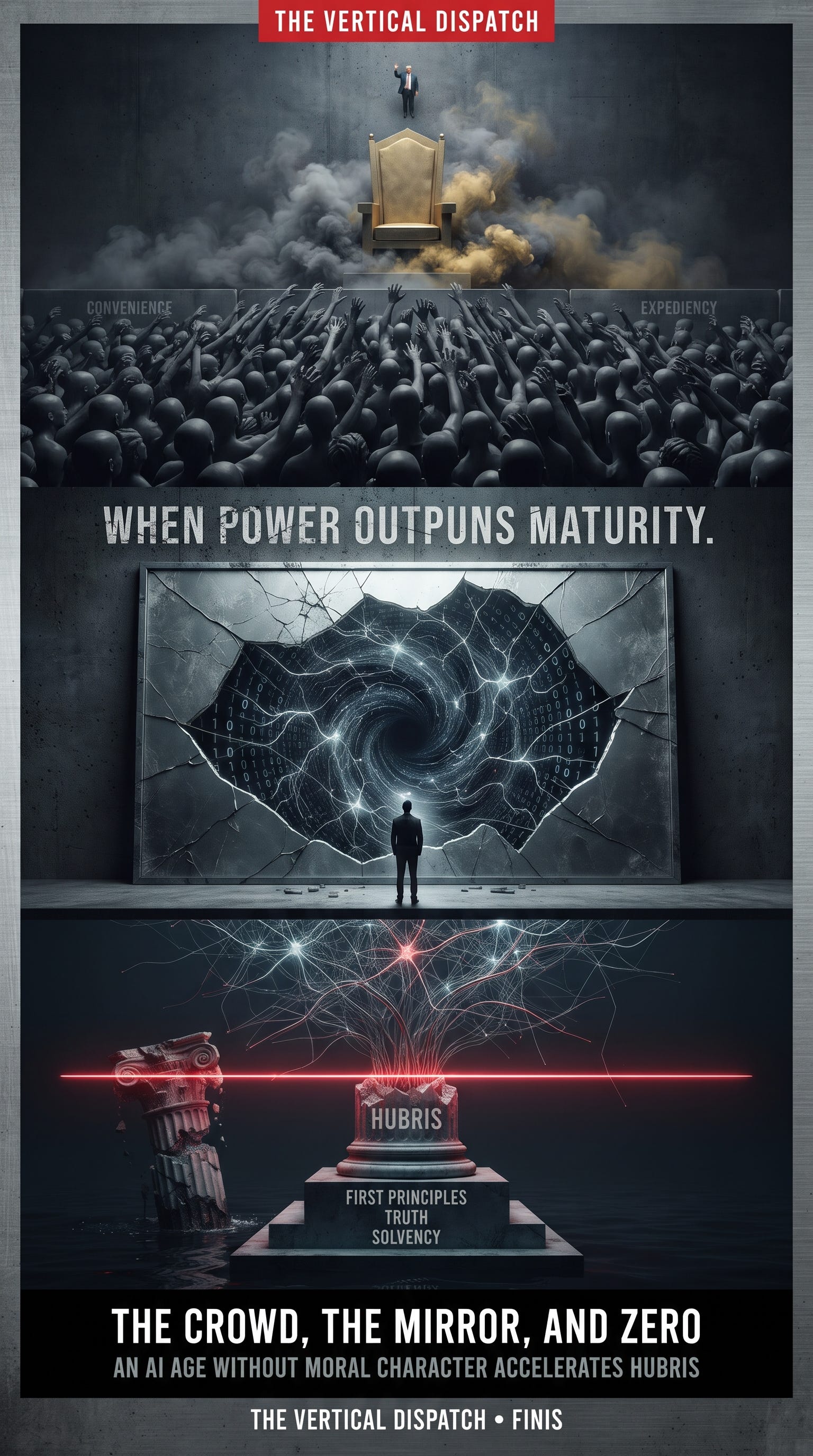
Two thousand years ago, when a high council and a crowd were handed a choice between moral truth and political expediency, they shouted for Barabbas. They did not choose Barabbas because they were confused about what he was. They chose him because he fit the mood of the hour, served the immediate calculations of power, and spared the ruling class the cost of reckoning with truth.
Today, the names change, the stage spans continents, and the roar of the crowd is measured in basis points and market capitalization, yet the reflex is identical. Whenever a figure accumulates enough financial weight, geopolitical leverage, or symbolic indispensability, the modern high council—corporate boards, political leaders, institutional allocators, and partisan media—stops asking whether the standard of virtue still holds. Instead, it rewrites the standard on the spot. National security alarms, fiduciary duties, criminal convictions, and basic governance rules are waved aside with a rehearsed chorus: We must protect our titans. The machine cannot be slowed down.
There was a time in American public life when serious ethical breaches, personal recklessness entangled with foreign intelligence risks, or blatant conflicts of interest ended public and corporate careers permanently. Think back to the standards that once toppled presidential contenders over a single weekend lapse on a boat named Monkey Business, or ended ambitions at Chappaquiddick, or forced cabinet officers and corporate chairmen to resign in disgrace when their private conduct compromised public trust. Nobody pretended those earlier eras were populated by saints. Rather, institutions still respected a foundational boundary: once a society signals that brilliance, net worth, or political utility purchases immunity from moral and legal consequence, every rule beneath that summit dissolves into theater.
When a convicted chief executive or a politically protected billionaire is elevated back onto the dais by acclamation while ordinary citizens face zero-tolerance enforcement at every border, courtroom, and workplace, the message radiates downward through the entire culture. Virtue becomes a tax paid only by the powerless. Integrity becomes an obstacle for people who lack leverage. And the crowd cheers the resurrection of Barabbas because, for one more trading session, the green numbers on the screen keep climbing.
THE GOVERNANCE PARADOX
When a society signals that brilliance, market capitalization, or geopolitical utility purchases immunity from accountability, every rule beneath the summit dissolves into theater.
II. JUNG’S WARNING: THE MIRROR OPERATING AT TREMENDOUS SPEED
What makes this moral collapse uniquely perilous in 2026 is not merely old-fashioned political corruption or boardroom cowardice. It is the instrument we are scaling at the exact same moment.
Public discourse treats artificial intelligence as though it were an alien intelligence descending upon humanity from outside our history—an objective, clinical oracle that will somehow rescue us from human fallibility. That assumption is a dangerous fairy tale. The truest, sharpest analogy for artificial intelligence is far simpler and far more sobering: AI is a mirror of who we are, operating at tremendous speed.
Every large language model, every algorithmic trading engine, every automated surveillance platform, and every autonomous defense system is trained on human archives, optimized around human incentives, and steered by human priorities. It inherits our blind spots, our hierarchies, our double standards, and our unspoken bargains—and then executes them millions of times per second without fatigue, conscience, or a pause button.
This is the exact danger Carl Jung warned against throughout the twentieth century whenever technological power outran moral and psychological maturity. Jung observed that when human beings refuse to confront their own shadow—their lust for domination, their hypocrisy, their willingness to trade principle for tribal advantage—that shadow does not vanish. It gets projected outward into the tools, ideologies, and institutions they command. In Jung’s framework, the ultimate threat to civilization is never the machine itself; it is the unconscious, morally unanchored human being holding the controls of a machine whose reach exceeds his wisdom.
Ask yourself a straightforward question: What can we realistically expect from artificial intelligence if the leaders funding it, regulating it, and deploying it are not people of moral character—if they do not operate by virtue? If the men sitting in the high councils of state and capital treat truth as a public-relations variable, treat national security as a bargaining chip at a summit table, and treat fiduciary governance as a rubber stamp for market rallies, artificial intelligence will not purify their motives. Speed does not redeem a corrupt premise. Speed multiplies it.
When a society chooses Barabbas at human speed, the rot unfolds across decades, leaving room for reform, conscience, and course correction. When a society encodes that same moral weightlessness into high-frequency markets, automated enforcement, and planetary-scale AI infrastructure, the distortion compounds in milliseconds.
III. THE SACRED, LOGIC, AND THE QUESTION OF ZERO
A mirror traveling at light speed without an anchor does not clarify reality; it turns every distortion into an inescapable hall of mirrors. To survive an age of exponential computation, human intelligence requires two anchors that no neural network can generate on its own: grounding in the sacred and grounding in strict logic.
Grounding in the sacred does not require sectarian dogma. It means recognizing that certain boundaries are inviolable—that human dignity, truth-telling, stewardship, and justice are ends in themselves, never raw material to be liquidated for a quarterly earnings beat or a diplomatic photo opportunity. Without a sense of the sacred, everything becomes transactional, and every human being becomes either an asset to be leveraged or an obstacle to be cleared.
Alongside the sacred stands logic—the discipline of non-contradiction, honest measurement, and cause and effect. And that brings us to a deeper structural question that sits at the heart of both modern technology and modern political economy: Does logic need to be grounded in zero?
In pure symbolic logic, an argument can be valid on paper if its conclusions follow from its premises. Yet the moment logic enters the real world—through mathematics, computer architecture, engineering, or financial accounting—it collapses into chaos unless it is anchored to a true, uncorrupted zero. Zero is not mere emptiness or nihilism. Zero is the origin point on the coordinate plane. It is the calibrated tare weight on a scale before anything is measured. It is the boundary between solvency and insolvency, between signal and noise, between truth-value and falsehood.
Look at what happens when powerful institutions tamper with zero. In computer science, a floating or corrupted zero reference corrupts every downstream calculation, no matter how fast the processor runs. In public finance, when a nation accumulates $40.55 trillion in federal debt while conjuring $195.9 trillion in paper household wealth through circular credit expansion and stock buybacks, it is pretending that the zero line on the national ledger no longer exists. And in moral and legal life, when high councils waive accountability for presidents, cabinet officials, and billionaire chief executives, they erase the zero point of hubris—the foundational rule that before the law and before truth, every human being starts on level ground.
Logic ungrounded in zero becomes nothing more than high-speed rationalization: a machine for inventing sophisticated excuses after the verdict has already been bought.
GROUNDING IN ZERO
Zero is not emptiness. It is the origin point on the scale—the calibrated baseline that separates solvency from debt, signal from noise, and equal justice from institutional hubris.
IV. ZERO BEGINS PUBLISHING SOON — AND THE ILLUSION OF WEALTH FOLLOWS
When you put all three pieces together—yesterday’s indictment of institutional impunity in America on Trial, today’s warning about moral character and high-speed artificial intelligence, and the economic reckoning waiting right behind them—a single unified picture emerges.
An era governed by men without virtue, amplified by machines without conscience, and measured on ledgers without a true zero can produce only one outcome reliably: magnificent illusions floating above cracking foundations. It produces $950 billion single-day stock surges built on governance reversals while public infrastructure rusts. It produces closed-loop capital deals among a handful of mega-cap tech giants while working families absorb rising costs and shrinking real purchasing power. It trades permanent moral standards for temporary market euphoria.
That is why we are preparing to launch Zero.
Zero is a new publishing initiative built from the ground floor up to strip away institutional noise, reject partisan theater, and test every claim of power, finance, and technology against first principles and an honest baseline. Before you can build anything durable—whether an AI architecture, a constitutional republic, or an honest economy—you have to return the scale to zero. You have to clear out the rigged premises, name the crowd’s bargain for what it is, and refuse to applaud the illusion.
Watch for Zero to begin publishing soon. Immediately following Zero’s opening dispatch, we will release our next major political-economy investigation, America and the Illusion of Wealth—a forensic breakdown of how a $40.55 trillion debtor nation manufactures paper fortunes on screen while its bridges rust, its dollar standard strains, and its working class carries the real physical weight of the republic.
The mirror is accelerating every single day. Before we ask what artificial intelligence will become tomorrow, we have to answer for the character we are feeding into it today.
God is Love. Love is Truth. Truth is Consciousness. Consciousness is Brahman.
Amen. Namaste. Om Namah Shivaya.
— The Architect.
Written from love, for a sacred humanity, in the full light of consciousness, toward the greater good.
I am reminded of the Egyptian Book of the Dead, where the heart is weighed against the feather of Ma’at. If the heart is weighed down by wrong doing, then it is devoured, resulting in second death. Hhhmmm…!