

Wednesday, May 20, 2026
Vol. I · Edition 001
Egos play the board games. Innocents pay the price.
Checkers for the quick win.
Chess for the strategic win.
Go for the world itself.
Time is the clock that defines the game.
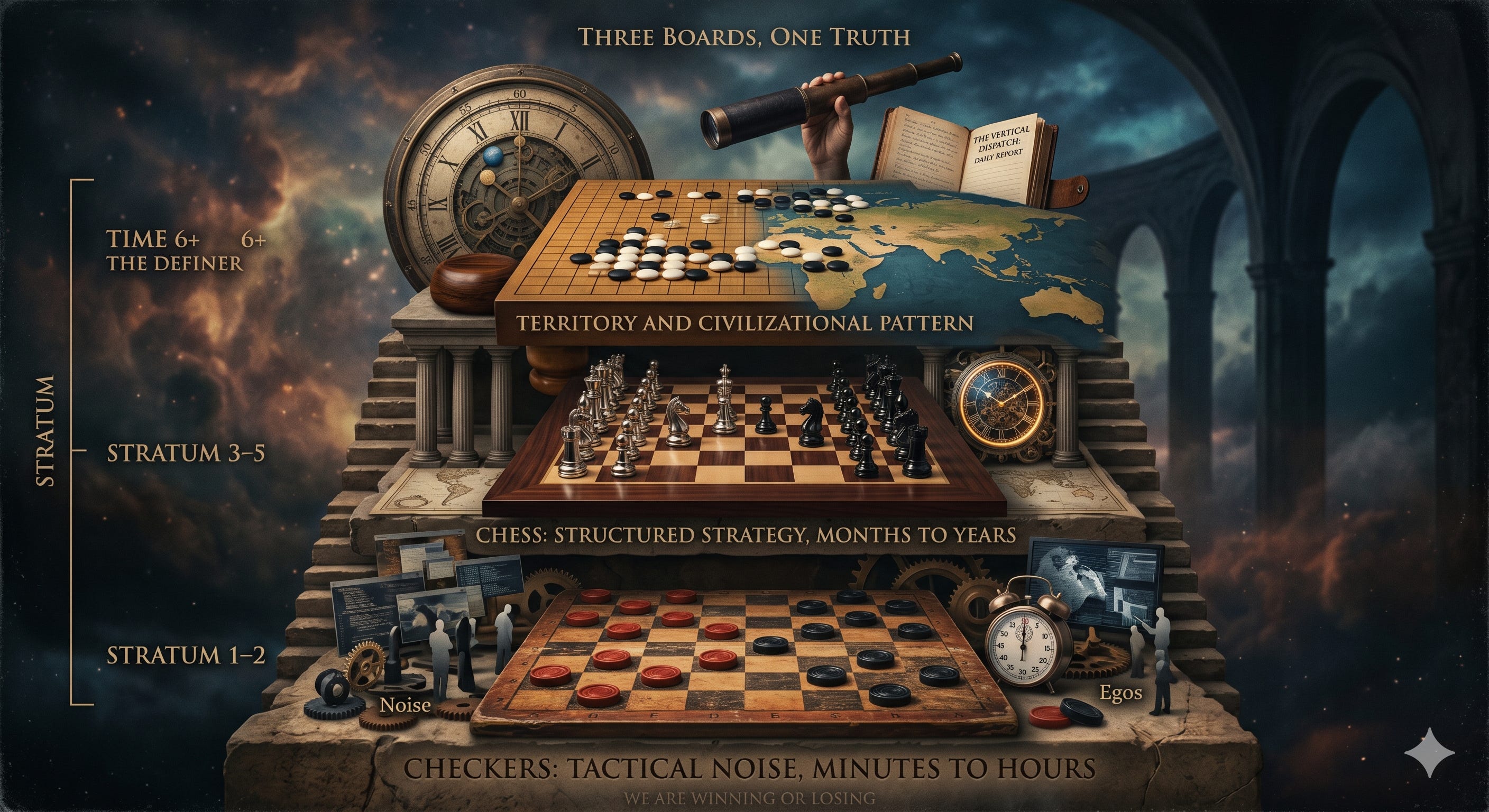
Stratum 1–2 — Checkers. Minutes to hours. Short horizons. Tactical noise. The board most of the world watches, because it is the loudest — and the board on which almost nothing of consequence is decided.
Stratum 3–5 — Chess. Months to years. Structured strategy. Coordinated moves. The board most professionals operate on — generals, ministers, CEOs — where pieces have distinct roles and sacrificing one can win a position.
Stratum 6+ — Go. Decades to lifetimes. Long horizons. Territory and civilizational pattern. The board most of the world cannot see, because the moves do not look like moves while they are being made — by the time they are visible, the territory is already gone.
The Vertical Dispatch reads and reports the board daily.
That way, we know if we are winning or losing.
WHO IS PLAYING CHECKERS TODAY
The Trump administration indicted Raúl Castro.
The former Cuban president, ninety-four years old, was charged today at Miami’s Freedom Tower with conspiracy to kill U.S. nationals, two counts of destruction of aircraft, and four counts of murder — all of it tied to the 1996 shootdown of two Brothers to the Rescue planes in the Florida Straits. Acting Attorney General Todd Blanche announced it. Secretary of State Marco Rubio framed it. Cuban president Miguel Díaz-Canel called it a political manoeuvre without legal basis. Díaz-Canel was correct.
This is a checkers move. The horizon is the next news cycle. The audience is Miami’s Cuban exile community ahead of November’s midterm elections in Florida. The piece being taken is a ninety-four-year-old man who has not been president since 2018, who almost certainly will never set foot in an American courtroom, and whose indictment changes nothing on the actual island. The board state is unchanged. The headline is what was wanted.
What makes it pure checkers, in the Jaques sense, is the absence of any horizon beyond the move itself. Ask the prior question — to what end? — and the answer collapses. To prosecute? No serious extradition path exists. To deter? The deterrence target has been dead in office for years. To change the Cuban government? Vice Foreign Minister Carlos Fernandez de Cossio said two months ago that Havana “categorically” rejects any U.S. talks contingent on removing Díaz-Canel. The indictment does not move that needle by a millimetre.
There is one move underneath the move, and it belongs on a higher board. Trump said in March that “Cuba is next” after the January military raid in Caracas that captured Nicolás Maduro and brought him to a New York courtroom. The Maduro indictment was the legal scaffolding for the Maduro raid. The Castro indictment may be the legal scaffolding for whatever comes next. If so, the indictment itself is the checkers move; the raid it may be pretexting is the chess move. The dispatch will watch for that.
For today, Castro is a stone taken from a piece that left the board years ago. The crowd at the Freedom Tower cheered. The board did not move.
WHO IS PLAYING CHESS TODAY
Putin announced the war is ending. Trump met Xi. Now Putin is going to Beijing.
The chess board is the most active it has been in three years. On May 9 — Russia’s Victory Day, with the customary ceremonies pointedly scaled down — Vladimir Putin announced from Moscow that the war in Ukraine is moving toward settlement and that he wants a new economic relationship with both the United States and Europe. Within days, Trump and Xi concluded their long-delayed Beijing summit, the meeting originally scheduled for March and pushed back by the U.S.–Iran war that triggered the worst global energy shock in modern history. Putin now flies to Beijing next week, days after Trump leaves.
Read those three moves as one position.
Putin is moving because he has to. The battle lines in Ukraine have frozen. The Russian economy is exhausted. Domestic pressure on his regime is growing. He needs the war off his ledger and he needs a Western economic re-engagement to refloat the rouble. He is offering the Europeans a security architecture in exchange for ending sanctions, which is the same offer he made in 2021, refused because he had not yet invaded — and which the Europeans may now accept because the invasion has happened and stalemate is more expensive than concession. That is a chess sacrifice. Putin will give up the maximalist war aims in exchange for a position from which the next campaign can be launched in five or ten years.
Trump is moving because the U.S.–China economic relationship is the only board he genuinely cares about. The November 2025 trade deal lifted most restrictions but left indium throttled — the one mineral input to data centres that Beijing has not released. The Xi summit was the next move in that negotiation. The communiqué was friendly. Xi will visit Washington later this year, his first trip in a decade. The U.S. congressional consensus on Taiwan still holds, but the gap between commitment and capability has widened to the point where the consensus matters less than it did.
Xi is moving because he can. He has the indium. He has the rare earths. He has the manufacturing base the United States needs to rebuild and cannot rebuild without him. Every time the Americans build a new export-control regime, Beijing finds a piece to hold back and a market to redirect. Xi does not need to escalate. He needs only to wait, and to keep collecting friendly visits from American presidents at his own court.
The chess board today is a tableau of three players who all need the others to lose a piece, and none of whom can afford the game ending. That is the most stable form of war.
WHO IS PLAYING GO TODAY
China just announced a rare earth discovery that could rewrite the global map.
Three days ago, in a paper published in the Chinese journal Acta Petrologica Sinica, a team from the Chinese Academy of Sciences’ Institute of Geology and Geophysics and the Heilongjiang Bureau of Geology and Mineral Resources announced a new rare earth deposit in the icy northeast of the country. The find, the team wrote, could “potentially rewrite the ‘heavy in the south, light in the north’ pattern of rare earth resources in China.”
That sentence is the Go move. Read it twice.
Rare earths are seventeen critical minerals — cerium, neodymium, dysprosium, and fourteen others — without which there are no electric vehicles, no precision-guided munitions, no MRI machines, no commercial wind turbines, no smartphones, no F-35s, and no AI compute infrastructure. China already produces roughly 90 percent of the world’s processing capacity. By 2035, on current trajectory, China will supply over 60 percent of refined lithium and cobalt, around 80 percent of battery-grade graphite and rare earth elements, and approximately 70 percent of battery-grade manganese. Those are not market shares. Those are choke points.
The United States knows this. The October 2025 U.S.–Australia Critical Minerals Framework, the February 2026 U.S.–Japan border-adjusted price floor action plan, the March 2026 deep-sea mining memorandum with Tokyo, the Trump administration’s equity stakes in domestic refiners — all of it is a frantic attempt to build, by the mid-2030s, the supply chain China built across the previous thirty years. The most optimistic forecasts say it takes ten years. The honest forecasts say it takes longer. And every additional Chinese discovery — like the one announced this week — pushes the finish line further out.
This is the Go board, and the stones are placed in places most readers will never look. A paper in a Chinese geological journal. A refinery in Malaysia. A deep-sea muds memorandum off the Japanese island of Minamitorishima. A Brazilian deposit being quietly courted by Washington while Trump and Lula publicly thaw. A BRICS summit in Rio next July where rare earths will be the actual agenda underneath the photographs.
Beijing is not making news. Beijing is making territory. By the time the territory is visible to the checkers players in Miami, it will already be gone.
And here is the question the dispatch cannot yet answer, but will keep asking. The Castro indictment is a checkers move. The Ukraine settlement is a chess move. The rare earth discovery is a Go move. The American political class is competent at the first, struggling at the second, and structurally absent from the third. The Chinese political class is uninterested in the first, competent at the second, and dominant at the third. Which of the three boards determines the next fifty years?
The answer is on the third board. The dispatch will keep watching it.
WHERE THE BOARDS INTERSECT TODAY
The Castro indictment, the Ukraine settlement, and the rare earth discovery look like three unrelated stories. They are one story. The American political class is playing the checkers board because the checkers board is the only one its electoral cycle can see. The Russian regime is playing the chess board because chess is what Putin learned at the KGB and what he has played for twenty-five years. The Chinese state is playing the Go board because Go is what the Chinese state has played for two thousand years.
A country that cannot read all three boards at once does not know which game it is losing. Canada, today, is one of the very few Western governments structurally positioned to read all three — and the Carney cabinet, audited in this publication’s parallel series, was built for exactly that purpose. Whether it will be used for that purpose is the open question of the next eighteen months.
God is Love. Love is Truth. Truth is Consciousness. Consciousness is Brahman.
Amen. Namaste.
DISPATCH HASHTAGS
#TheVerticalDispatch · #TheDailyBoard · #ThreeBoardsOneTruth · #TheArchitect · #Checkers · #Chess · #Go · #ElliottJaques · #RequisiteOrganization · #Geopolitics · #Cuba · #RaúlCastro · #UkraineSettlement · #TrumpXiSummit · #PutinBeijing · #RareEarths · #CriticalMinerals · #BRICS · #ChinaGoBoard · #CanadianSovereignty · #SovereignPlan · #Substack · #LongformAnalysis · #CivicLiteracy
The beauty of being able to read all three time horizons