


Thursday, May 21, 2026
Vol. I · Edition 002
The Vertical Dispatch reports the boards daily, so we know if we are winning or losing.
Egos play the board games. Innocents pay the price.
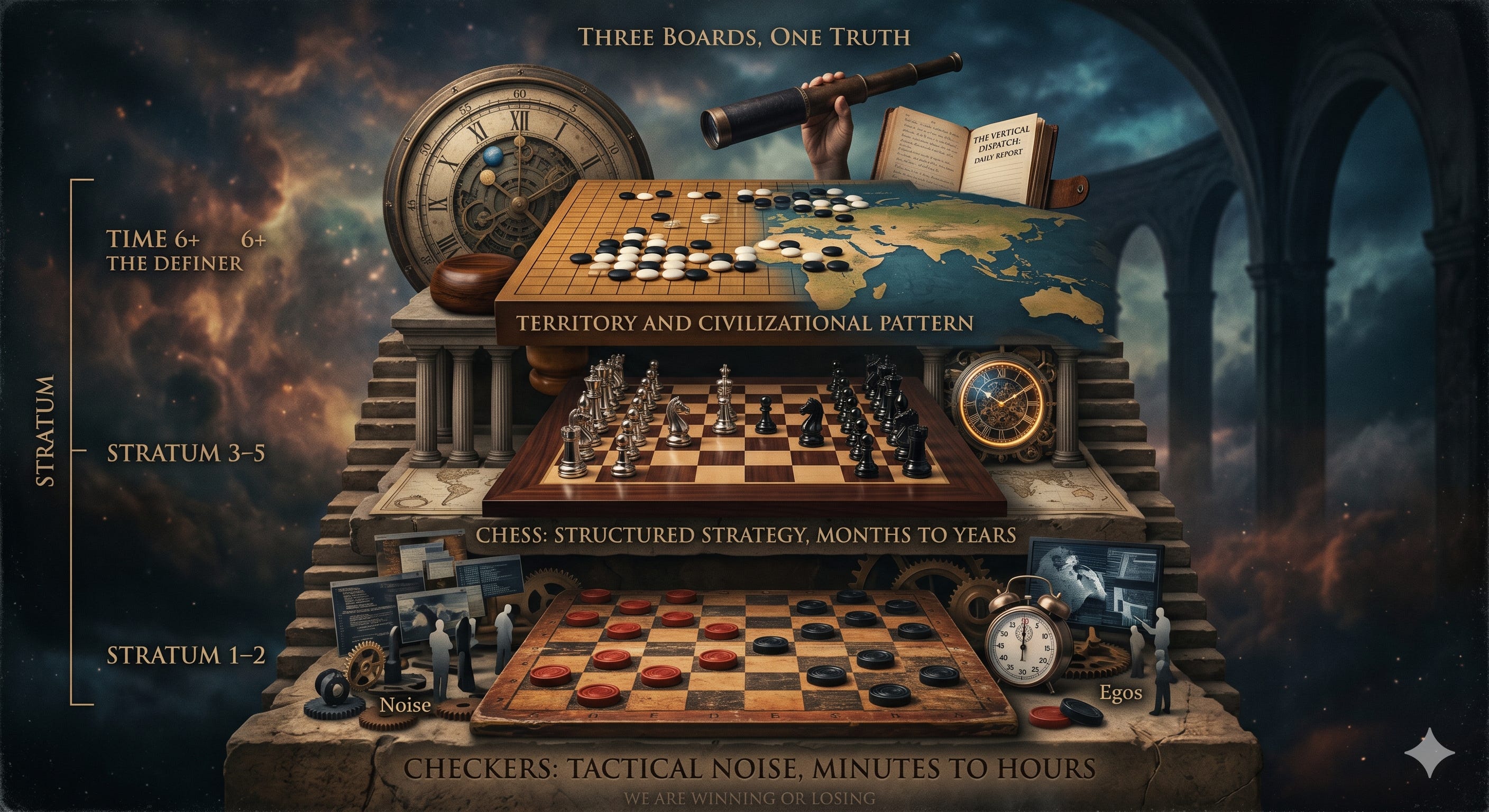
NOTE — WHAT THE PYRAMID SHOWS
The dispatch is read through a pyramid that the publication’s masthead image now makes explicit. At the base sits the checkers board — Stratum 1–2, minutes to hours, tactical noise, where the operators with stopwatches stare at screens and the egos count their wins. In the middle sits the chess board — Stratum 3–5, months to years, where ministers and generals move structured pieces and accept sacrifices for position. At the top, resting on the curvature of the Earth itself, sits the Go board — Stratum 6 and above, decades to lifetimes, where the stones are placed in patterns most observers cannot read until the territory is already taken. Time is the definer. The clock runs vertically up the side of the pyramid, from the stopwatches at the bottom to the orrery at the apex.
The boards are not a metaphor. They are an instrument. The dispatch uses them daily because almost every story carried by the world’s press is a checkers story, almost every story analysed in the world’s foreign affairs journals is a chess story, and almost every story that will actually shape the next fifty years is a Go story being played in places the press does not look. The pyramid tells the reader where to look. The dispatch tells the reader what is being placed there today.
It is not a comfortable instrument. Calling geopolitics a game is offensive on its face, because the stones being placed are countries and the pieces being sacrificed are people. The masthead names the offence and does not look away from it. The board players treat the world as a game. The dispatch reports on the game because that is how the players think, and reading them as they read themselves is the only way to predict where the next stone will fall. But the dispatch keeps the human ledger and closes every edition with it. That, too, is the instrument.
I — THE GO BOARD TODAY
At the Beijing summit, Washington tacitly accepted the rare earth export controls. The Busan position is gone.
The most consequential geopolitical event of this week did not happen at a podium. It happened in a White House communiqué issued two days ago and a follow-up statement from China’s Ministry of Commerce yesterday morning. Read in sequence, the two documents mark the end of a position the United States held publicly from October 2025 through May 2026 — that Beijing’s rare earth export controls were illegitimate, temporary, and would be dismantled — and the quiet acceptance of a new position, in which Washington concedes the controls as lawful and asks only that “reasonable concerns” be addressed case by case.
Six months ago at Busan, after the Trump-Xi meeting on the margins of APEC, the White House said the controls would come down. Last week at Beijing, after the long-postponed bilateral summit, the White House said China had “agreed to address concerns” around shortages of yttrium and scandium. Two different verbs. Two different positions. Yesterday Beijing’s commerce ministry responded that “the Chinese government imposes export controls on rare earths and other critical minerals in accordance with laws and regulations, and reviews applications for compliant, civilian licenses.” The framing is precise. The controls are lawful. The licences are reviewed on Chinese terms. Washington’s acceptance was not negotiated. It was registered.
This is shi. It is the Go-board word for the gathering weight of strategic position — the influence a stone exerts on the board through the territory it threatens to enclose, before any of the threatened territory has actually been taken. Beijing did not need to escalate. Beijing needed only to hold the controls in place across two summits and let the gap between American rhetoric and American leverage become visible to everyone in the room. By the time the Beijing communiqué was drafted, that gap was the only thing the room saw. Washington walked in asking for the controls to come down and walked out describing them as a matter of “reasonable concerns.” The headline most of the American press carried from the summit was that Xi will visit Washington later this year. The actual move on the board was the verb change.
The mechanism is worth naming, because it is the mechanism almost nothing in the Anglosphere press has named. Beijing does not refuse. Beijing reviews. A licence that takes four months instead of four weeks is not a denial — it is a process. A licence that comes through at sixty percent of the requested volume is not a cut — it is a compliance adjustment. The flow stays just above the threshold at which Washington would retaliate. The American defence industrial base does not collapse. It just cannot grow at the rate the strategy documents require. The gap between American ambition and American capability widens on a schedule Beijing controls. The Go-board name for this is aji — latent potential, the influence a stone exerts not by what it does but by what it could do, lawfully and on schedule, at any moment Beijing chooses. Washington has now accepted the lawful and on schedule. Beijing has reserved the at any moment. You get what we give you. If you retaliate, we cut you off. There is nothing to retaliate against, because nothing has technically been refused.
Read this against the broader picture. China handles approximately ninety percent of the world’s rare earth processing. The Pentagon’s critical minerals initiative — Project Vault, the equity stakes in domestic refiners, the USA Rare Earth acquisition of Brazil’s Serra Verde Group — is real, it is well-funded, and the most optimistic forecasts put the United States ten years out from independent supply. Ten years is two presidential terms. In Go terms, it is the period during which Beijing’s existing stones will continue to define the shape of the board regardless of what Washington places on it. The Busan-to-Beijing verb change is the formal recognition of that fact. The territory is not being contested. The territory is being conceded.
The dispatch will watch what Beijing does with the concession. The first test is the indium throttle — the one mineral input to data centres that Beijing has not released. The second is the rare earth supply to the European defence industrial base, which Brussels has begun routing through Australia and Canada in anticipation of exactly this kind of American capitulation. The third is what Xi brings to Washington in the autumn, and what he is permitted to leave with.
II — THE CHESS BOARD TODAY
Putin to Beijing next week. The Russia-China axis is hardening around the minerals architecture, not the war.
Putin flies to Beijing days from now, the visit confirmed in Moscow this week and choreographed to follow Trump’s departure by a margin that the Chinese protocol officers will have selected carefully. The Russian announcement from May 9 — that the Ukraine war is moving toward settlement and that Moscow wants a new economic relationship with Europe — has been read in the Western press as a chess sacrifice in which Putin gives up maximalist war aims for sanctions relief. That is a fair read, but it is incomplete. The Beijing leg of the move is the structurally important one.
Russia holds the world’s largest reserves of palladium and significant deposits of nickel, cobalt, and several rare earths. China holds the processing capacity. The war in Ukraine has stripped Russia of European refining partnerships and forced Moscow into long-term offtake agreements with Chinese refiners on terms that would have been unthinkable in 2021. Those agreements are the substance of the Beijing visit. The settlement framework for Ukraine is the diplomatic packaging. Putin is not flying to Beijing to discuss Ukraine. He is flying to Beijing to lock in the terms under which Russian minerals reach the global market through Chinese hands for the next twenty years.
This is the move European foreign ministries have not yet fully absorbed. If the Ukraine war ends in 2026 on something close to the current line of contact, and if Russian minerals enter the global market predominantly through Chinese processors, then the minerals architecture China has been assembling becomes not just dominant but redundant in its own dominance — the West will face a single integrated supply chain controlled at the processing layer by Beijing and at the raw material layer by Moscow, with no leverage point at which to insert pressure. The chess board produces the Go-board outcome.
Brussels has read this. Berlin has begun to read this. European foreign ministries have begun the pivot toward Canadian critical minerals offtake agreements, in fragmentary press releases and quiet ministerial visits over the past six weeks. It is small, it is late, and it is the right move. The dispatch will return to the European-Canadian axis as it develops.
III — THE CHECKERS BOARD TODAY
The Nimitz arrives in the Caribbean. The dispatch flagged the scaffolding yesterday. Here is the stone.
Yesterday’s edition noted that the Castro indictment might be the legal scaffolding for whatever the Trump administration intends next in the Caribbean. Within twenty-four hours, the USS Nimitz Carrier Strike Group arrived in the Caribbean as part of Southern Seas 2026, with the Pentagon’s framing language carefully ambiguous between routine exercise and pre-positioning. The dispatch will not perform surprise at this. It is a checkers move executed inside a chess frame — the headline value is immediate and domestic, the strategic value is the option it creates for whatever Caracas or Havana operation the administration may run in the coming months. The Nimitz is fifty-one years old and scheduled for decommissioning in March 2027. Sending her to the Caribbean is theatre. Sending an entire strike group around her is not.
The piece is placed. The board has not yet moved. The dispatch will report it when it does.
IV — THE BOARD THE WEST IS NOT WATCHING
Iran’s “Controlled Maritime Zone” in the Strait of Hormuz is a Go move read by the Western press as a chess threat.
Tehran announced this morning that it has formally declared a “Controlled Maritime Zone” across the Strait of Hormuz. The Anglosphere press has filed the story under continuing fallout from the U.S.–Iran war that began earlier this year, treating the declaration as a chess move — a threat, a piece of leverage, a marker thrown down to be negotiated against. That is how the Western press reads almost every non-Western actor. It is wrong.
A Controlled Maritime Zone is not a threat. It is a claim of jurisdiction. It asserts that Tehran has the standing to define lawful and unlawful transit through a body of water that carries roughly a fifth of the world’s seaborne oil. The assertion does not require enforcement to begin doing work. It requires only that flag states, insurers, and shipping registries begin treating the claim as a fact they must price into their decisions. Lloyd’s of London will price it. The Greek tanker operators will price it. The Chinese refiners taking Iranian crude through the zone will price it favourably for Tehran. Within months, the zone will exist in the documentary architecture of global shipping regardless of whether any Iranian patrol boat ever stops a vessel inside it.
That is a Go move. It places a stone whose influence radiates across territory the player does not yet control, and waits for the territory to accept the influence. The Western press cannot see it because the Western press has only one framework for Tehran, and that framework is the framework of confrontation. The dispatch will read non-Western players as players. Iran is one of them.
The companion stone is BRICS. Next month’s BRICS+ ministerial in Rio will carry the maritime zone forward as a discussion item, alongside rare earths and the de-dollarisation working group. None of those agenda items will produce a communiqué that the Anglosphere press treats as significant. All of them will produce the structural conditions for the next five years.
V — THE LEDGER
Egos play the board games. Innocents pay the price. This is what the boards cost today.
In Sudan, the United Nations confirmed this morning that twenty million people are now in acute hunger, the worst figure since the war between the Sudanese Armed Forces and the Rapid Support Forces began. The fighting continues. The grain corridors do not.
In Gaza, four Palestinians were killed in the last twenty-four hours — two in Rafah, one northeast of Khan Younis, one in Beit Lahia after an Israeli quadcopter drone dropped a bomb on a group. Several others were injured. In the occupied West Bank, near Umm al-Khair, settlers backed by Israeli soldiers erected mobile homes surrounded by fortifications in an outpost that violates international law, Israeli zoning law, and Israeli court orders simultaneously.
In Ukraine, the line of contact did not move today. The dead were not counted publicly.
The board players moved their pieces. These are the lives the pieces cost.
God is Love. Love is Truth. Truth is Consciousness. Consciousness is Brahman.
Amen. Namaste.
DISPATCH HASHTAGS
#TheVerticalDispatch · #TheDailyBoard · #ThreeBoardsOneTruth · #TheArchitect · #Checkers · #Chess · #Go · #ElliottJaques · #RequisiteOrganization · #Geopolitics · #RareEarths · #CriticalMinerals · #BeijingSummit · #BusanReversal · #Indium · #Yttrium · #Scandium · #PutinBeijing · #RussiaChinaAxis · #StraitOfHormuz · #IranMaritimeZone · #BRICS · #Sudan · #Gaza · #Ukraine · #TheLedger · #InnocentsPayThePrice · #ChinaGoBoard · #CanadianSovereignty · #SovereignPlan · #Substack · #LongformAnalysis · #CivicLiteracy