


Φ
THE VERTICAL DISPATCH
We write for the mind, the eye, and the ear.
Read it. Look at it. Listen to it. The Vertical Dispatch is built for all three — prose with rhythm, made to be heard as much as read.
From metaphysics to geopolitics, from culture to history, from the sacred to the street — and everything in between. One lens, every subject. No ego. Just the record, named clean.
Press play. Walk with the word. 🕯️
This dispatch travels by hand. If it serves you, share it — restack on Substack, and pass it on wherever you read. 🕯️
The Price of Everything · A Vertical Dispatch Feature · Part Seven of Seven
June 28, 2026
“There are two kinds of debt: the kind that builds a thing, and the kind that only burns. The card is designed so you cannot feel the difference.”
— The Architect
We have come the whole way. We stood at the graveyards of the thinkers and learned that every creed mistook its map for the world. We met the steward who sat the chair twice, and the machine he steered, and we followed the wire out the back of it to find the mirror: a national debt of thirty-nine trillion dollars owed, in the end, to no one outside the circle of ourselves, held up by nothing but faith. And we promised one last door. If that is the debt at the top, at the scale of nations — what is it at the bottom, in your own wallet? In the card and the mortgage and the loan that feel so personal, so heavy, so much like a debt owed to a very real someone who will very really come for you? Today we open that door. And we find, on the kitchen table, the very same engine — small enough now to fit in a pocket.
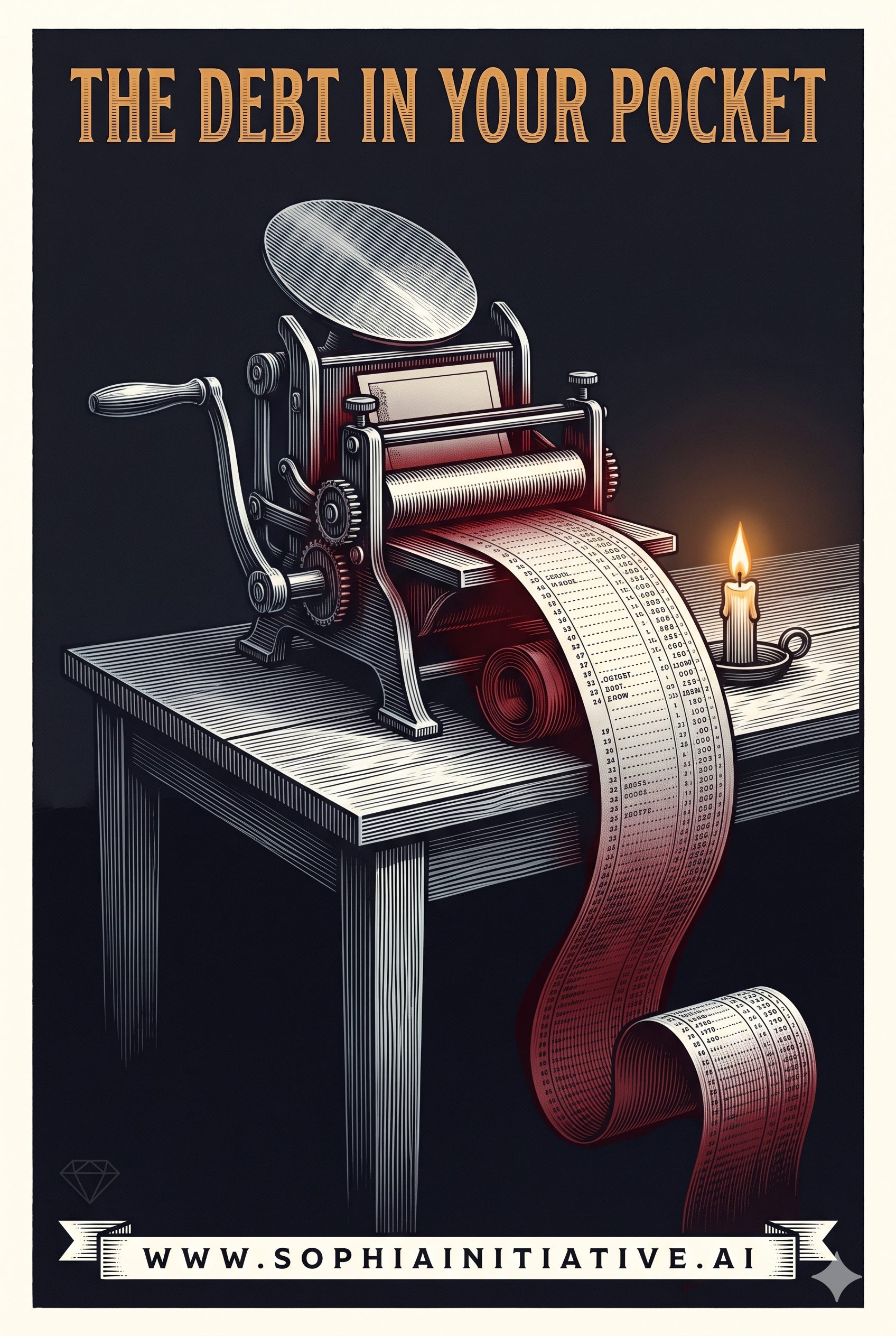
The Press in Your Pocket
Return to the plainest fact of this whole feature, the one from Part Five that overturns what everyone assumes. The commercial banks create most of the money, and they create it by lending — they do not hand you someone else’s savings from a vault; they write the loan into existence as a new deposit. We said that was the engine. Now hold the purest, smallest version of that engine in your hand. It is your credit card.
When you buy a two-thousand-dollar sofa on a card, the bank does not move two thousand dollars from a saver’s account to the furniture store. It creates a two-thousand-dollar debt — your promise to repay — and pays the merchant. New money, conjured against your signature, exactly as the central bank conjures money against a government’s bond. The card is the money-printing press of this entire feature, sitting in your back pocket, and the thing it prints is your own promise. The same act that builds a nation’s debt — a promise written into existence — builds the balance on your statement. The couch and the deficit are the same engine. The only difference is whose signature is on the promise, and how many zeros follow.
How the House Always Wins
If the bank conjures the money from nothing, how does it profit? Three ways, and naming them strips the mystique. First, every time you swipe, the merchant pays a fee — interchange — a slice of every purchase, and the bank earns it whether or not you ever pay a cent of interest. That is why they want the card in your hand for every coffee. Second, and this is the great river of it, interest: if you carry a balance, the standard Canadian purchase rate runs to roughly twenty per cent a year, and often higher on a store card. Third, the fees — annual, late, the charge on a balance transfer. The bank created the money against your promise, and now charges you a fifth of it, every year, for having borrowed your own future.
And the interest is crueller than the headline number, because of how it is reckoned. The rate is annual but it is charged daily — it compounds, so you pay interest on the interest, and the balance grows against you while you sleep. Lose the grace period by carrying a balance, and new purchases begin accruing interest the day you make them. A two-thousand-dollar balance, paid at only the minimum each month, can take over a decade to clear and cost you thousands more than the thing you bought. The sofa is long worn out. The debt for it is still in the room.
The card is the money-printing press of this whole feature, in your back pocket — and the thing it prints is your own promise. The couch and the deficit are the same engine. The only difference is whose signature is on the promise.
The Doorway That Counts on You
Now the cleverest instrument of all, the one a careful reader will have met in the mail: the promotional rate. Zero per cent, or near it, for twelve or fourteen months — transfer your balance here and pay almost no interest, for a one-time fee of perhaps three per cent. Why would the bank print money and lend it to you for nearly nothing? It is not generosity. It is a bet, and the odds are kept by the house. The transfer fee is collected up front and guaranteed — three per cent on a ten-thousand-dollar transfer is three hundred dollars in hand on day one, often more than the bank would have earned in a year of ordinary margin on that sum. They are already paid. Then comes the wager: that a knowable fraction of people will not clear the balance before the promotion ends — and the day it ends, the rate snaps back to twenty per cent or more on whatever remains. The promo is a doorway the bank has counted, very precisely, on a certain number of people not walking back out of in time. The kindness is the trap, and the trap is in the arithmetic.
The Machine With a Product at the End
Set the card down a moment and look at its cousin: the financing on a manufactured thing — the Harley, the Ski-Doo, the boat, the car. Zero per cent for sixty months. Here the conjured money has a different shape, and it is worth seeing why. The manufacturer often subsidizes the financing arm; the zero per cent is a marketing cost, like an advertisement, because the real prize is moving the machine off the floor. They would rather sell you the twenty-five-thousand-dollar Ski-Doo at zero interest than not sell it at all — the margin is in the product, not the loan. Sometimes the interest is simply folded into a higher sticker price, so you pay it invisibly, baked into the cost of the thing. The financing and the product are two halves of one sale.
And the mortgage is the same engine at the size of a life — the largest single act of money-creation most people ever sign, the loan written into existence as a deposit, with a house standing at the other end of the promise. Card, manufacturer loan, mortgage, the bond of a nation: one engine, four sizes. Every one of them conjures money against a promise. And in the end — this is the line the whole feature has been walking toward — they all produce the same thing: a debt. The question the engine never asks, and is built so that you will not ask either, is the only question that matters. A debt for what?
The One Distinction It Is Built to Erase
Here is the heart of the last door, and it is the oldest lesson of this whole publication wearing the plainest clothes. There are two kinds of debt, and they are not the same, though the card is engineered so that at the moment of the swipe they feel identical. There is debt that builds a thing — the mortgage that leaves a house standing, the loan that leaves a machine that a person can use to work, to travel, to live. That debt has a referent. Something real remains when the money is spent: an asset, a tool, a roof, the labour of the maker who built it. And there is debt that only burns — the balance carried on a meal eaten, a holiday gone, a thing already consumed and forgotten. That debt is money printed against nothing that lasts. The symbol with no referent. The promise made for a thing that is already smoke.
This is the master lesson of everything we write, returned at last to the kitchen table: the symbol is not the referent. Productive debt is bound to its referent — the house exists, the machine exists, the work was done. Consumptive debt floats free, a promise tied to nothing that remains. And the genius and the danger of the whole apparatus is that it is built to make the two feel exactly the same at the point of sale — the same plastic, the same swipe, the same painless second between wanting and having. The card cannot tell you, and is not designed to tell you, whether you are building or burning. It only prints the promise and starts the clock.
There is debt that builds a thing, and debt that only burns. One is bound to a referent; the other floats free. The card is built to make the two feel identical at the moment of the swipe — and that erasure is the whole danger.
The Case the Other Way
Now the strongest version of the objection, at full strength, because this work sets down the opposing case before any verdict — and here it must be set down with particular care, because the objection guards something sacred. It runs like this: that to divide debt into the building kind and the burning kind is one short, ugly step from dividing people into the prudent and the feckless — the worthy who borrow for houses and the weak who borrow for dinner. That the distinction, however true in the abstract, becomes in practice a sermon against the poor, a way to look down at the person carrying a balance and call it a moral failing. And the objection is right to fear this, because it is a real and common cruelty.
So let us be exact, and let the keel hold. The distinction between building debt and burning debt is a judgment about the system, never about the soul of the borrower. The person carrying a balance to buy groceries, to cover a medicine, to get the children through a hard month, is not burning anything — they are surviving on a wage that does not reach the end of the month, and the debt they carry is the gap between what work pays and what living costs. That is not a moral weakness. It is an indictment of the gap, and the indictment points up — at an economy that has made consumptive debt the ordinary way that ordinary people bridge the distance between their labour and their rent. The accountability points up, at the architect of the blur — the system that profits, at twenty per cent compounding daily, from the erasure of the very distinction it depends on you not seeing. It never points down, at the person caught inside it. Judge the engine. Never the hand that was forced to pull its lever.
Where the Whole Feature Has Been Walking
And so we close, seven days from where we began, with the machine named root to wallet. We have seen the price of everything — the schools that priced the world and mistook the price for the world; the steward and the central bank that govern the measure; the national debt that loops back to a promise we made to ourselves and hold up by faith; and now the same promise, the same conjured money, the same engine, small enough to sit in your pocket and print your own signature into a debt. From the thirty-nine-trillion-dollar bond to the two-thousand-dollar sofa, it is one machine, conjuring money against a promise, at every scale of human life. That is the whole of it. That is the price of everything.
We promised at the very beginning that we would not hand you the answer, because the honest work is to put the question back on the table and refuse to take it off. So here is the table, and here is the question, and we leave it in your hands where it belongs. Every debt is a promise, and every promise can build or burn. The measure will be kept; it always is. The only thing that was ever in your power, from the bond of a nation to the card in your wallet, is to know — every single time the money is conjured and the promise is made — whether you are building a thing that will stand, or burning a thing that is already gone. The card will not tell you. The system is built so you will not ask. So ask. That is the whole of the work, and it is yours now. Hold the question where the verdict wants to be. Walk with the word. 🕯️
God is Love. Love is Truth. Truth is Consciousness. Consciousness is Brahman.
Amen. Namaste. Om Namah Shivaya.
— The Architect.
For everyone who ever signed the promise without being told there were two kinds — and built, or burned, in the dark.
The Vertical Dispatch
sophiainitiative.ai
On the record
This is Part Seven, the final part, of the Feature “The Price of Everything,” and it follows Part Six (“Who Do We Owe It To?,” June 27, 2026). It is a structural and interpretive essay; the load-bearing figures are matters of consumer-finance record in Canada and are sourced to financial institutions and consumer-finance authorities.
Money creation by commercial banks. Most money is created by commercial banks through lending — the loan is written into existence as a new deposit — as established in Part Five (The Canadian Encyclopedia, “Monetary Policy”; Bank of England, “Money creation in the modern economy,” 2014). A credit-card purchase is this mechanism at the individual scale.
Credit-card interest and mechanics (Canada). Standard purchase APRs in Canada generally run roughly 19.99%–25.99%, with some store cards higher and a small number of low-rate cards in the single digits to low teens (RBC Royal Bank; NerdWallet Canada; Canadian Bankers Association data, 2025–2026). Interest is calculated daily and compounds; carrying a balance forfeits the interest-free grace period on new purchases; cash advances accrue interest immediately, often at a higher rate plus a fee (RBC; Canadian Debt Relief; 4 Pillars). A $2,000 balance at ~19.99%, paid at the minimum only, can take over a decade to repay and cost thousands in interest (industry illustrations; oboe.com). Figures date-stamped 2026; verify current rates before republication.
Promotional / balance-transfer offers. Promotional low or 0% rates are time-limited and condition-bound; balance-transfer fees commonly run 2%–5% of the amount transferred, charged up front, with the rate reverting to the standard APR (often ~20%+) at the end of the promotional period (RBC; NerdWallet Canada). The characterization of the promotional rate as a behavioural “bet” kept by the issuer is the author’s interpretation of the documented fee-and-revert structure.
Manufacturer / 0% financing. The description of 0% manufacturer financing as a marketing cost subsidized by the manufacturer (or recovered through pricing) reflects common industry practice and is the author’s interpretation; specific terms vary by manufacturer and dealer. Mortgages are described as money-creation at the scale of a life, consistent with the commercial-bank lending mechanism above.
Productive vs. consumptive debt. The distinction between debt that produces a lasting asset and debt incurred for consumption is a long-standing one in economics; the framing here — “debt that builds” vs. “debt that only burns,” bound to the publication’s “symbol ≠ referent” axiom — is the author’s interpretation and commentary. Per the standing discipline of this publication, the distinction is applied to the system and never to rank or judge any individual borrower; accountability is directed upward at structures and never downward at the vulnerable, and no figure herein is disaggregated by race, group, or class.
This is a sensitive subject for anyone struggling with debt. If debt is causing distress, non-profit credit counselling and licensed insolvency resources are available in Canada; readers should consult a qualified, accredited professional. All characterizations herein are opinion, interpretation, and commentary. No assertion is made about the private intentions, state of mind, or character of any individual. Errors and omissions excepted; corrections will be made on notice. Verify all figures against primary sources before republication.
Suggested tags
credit cards, consumer debt, how credit cards work, money creation, productive vs consumptive debt, balance transfer, mortgages, household finance, political economy, the price of everything, how money works
Substack Notes
Seven days ago we set out to find the price of everything. Today, in the final part, we open the last door — and find the whole machine, small enough to fit in your pocket. The credit card is the money-printing press of this entire feature, sitting in your wallet, and the thing it prints is your own promise.
When you buy a sofa on a card, the bank doesn’t move someone’s savings — it conjures the money against your signature, exactly as the central bank conjures money against a government’s bond. The couch and the deficit are the same engine; only the signature and the number of zeros differ. We strip the mystique: how the bank wins three ways (interchange, ~20% compounding interest, fees), why the 0% promo is a behavioural bet the house keeps, why the Ski-Doo’s 0% financing is really a marketing cost, and why the mortgage is the same engine at the size of a life. One engine, four scales — and they all produce the same thing: a debt.
But a debt for what? That is the heart of the last door. There are two kinds of debt — the kind that builds a thing (a house, a machine, a tool that lasts) and the kind that only burns (a thing already consumed and gone). One is bound to a referent; the other floats free. And the card is engineered so that, at the moment of the swipe, you cannot feel the difference. The symbol is not the referent — the master lesson of everything we write, returned to the kitchen table.
We end where the whole feature began: not with an answer, but with the question put back in your hands. The distinction between building and burning is a judgment about the system, never about the soul of the borrower — the person carrying a balance to eat is surviving a wage that doesn’t reach the end of the month, and the accountability for that points up, never down. From the $39-trillion bond to the $2,000 sofa, it is one machine. The only thing in your power is to know, each time, whether you are building or burning. The card won’t tell you. So ask. Walk with the word. 🕯️
Written from love, in service of the record. Walk with the word. 🕯️
#ThePriceOfEverything #TheDebtInYourPocket #CreditCards #ConsumerDebt #MoneyCreation #ProductiveVsConsumptiveDebt #HouseholdFinance #PoliticalEconomy #TheVerticalDispatch #TheArchitect #SophiaInitiative #GodIsLove #LoveIsTruth #OmNamahShivaya
The factual matter in this Dispatch is drawn from the public record. All characterizations, inferences, and conclusions are opinion, interpretation, and commentary, offered for analysis, reflection, and public-interest discussion. No assertion is made regarding the private intentions, state of mind, or character of any individual. Readers should evaluate all statements independently and draw their own conclusions.